
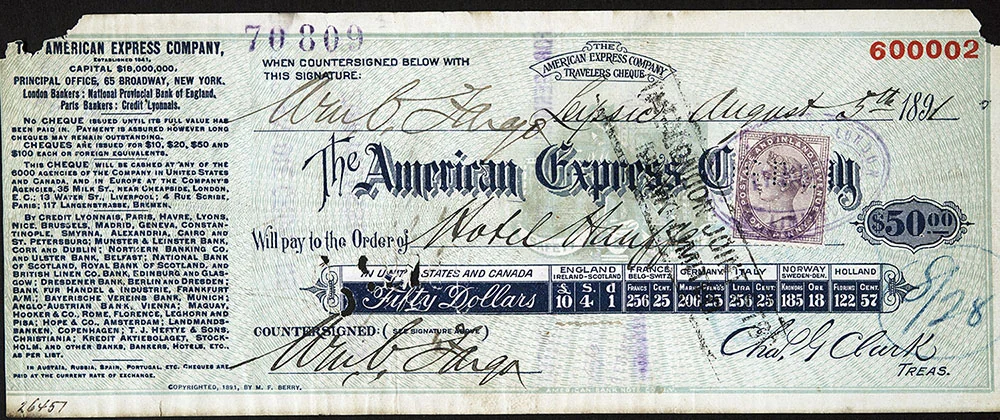
On a fifty-dollar cheque cashed in Leipzig on 5 August 1891, two instances of the same handwriting face a small table of foreign currencies.
Wm. C. Fargo appears once near the top and again across the lower edge. The first signature was made when the cheque was bought. The second was made when it was spent, under the eyes of the person asked to accept it. If the two matched, the paper belonged not merely to whoever held it but to the person who had signed it before departure.
The table beside the signatures converted fifty dollars into pounds, francs, marks, lire and other leading currencies. Before a cashier in Leipzig named a rate, the cheque had named its own.
Across the centre, larger than either signature or any sum, ran the name AMERICAN EXPRESS COMPANY. The hotelier did not need to know William Fargo. He needed to recognise the name between Fargo’s signatures and believe that the company would pay.
The cheque was therefore more than portable money. It was a portable introduction. It answered three questions at once: Who owns this paper? What is it worth here? Whose promise turns it into value?
Could a stranger arrive with something safer than cash, more immediately useful than a letter of credit and already recognised before the traveller was?
Marcellus F. Berry made such a thing possible. American Express then had to make an unfamiliar world behave as though the paper were money.
The important man nobody knew
The company legend begins with an affront. James C. Fargo, president of American Express, travelled in Europe with a letter of credit and found it slow or useless away from the right banks. The precise date and the famous speech he supposedly delivered to Berry were never reliably recorded. The inconvenience is consistently reported; the polished dialogue came later.
Fargo was not a stranded innocent. He was wealthy, prominent and head of one of America’s great transport companies. He could have carried dollars, exchanged them and gone on. Peter Z. Grossman, writing from the company archives in American Express, finds a more revealing injury in the episode: European bankers did not recognise Fargo’s importance and did not treat him as he thought his position deserved. A man accustomed to institutional power became an ordinary stranger at a foreign counter.
A letter of credit was itself a kind of introduction. One bank vouched for one customer to a selected chain of other banks. The traveller presented the document, proved identity and waited while a correspondent examined the claim. A surviving lettre d’indication issued by Messrs Drummond in the 1860s named correspondents in more than 280 towns and cities. The network could be broad, but it observed banking hours and banking places.
Cash removed the waiting and created another problem. American dollars had exchange value in Europe; they were not universal shopping money. An American passenger guide from 1889 advised travellers to obtain small change for landing and use banking houses for exchange. A Hamburg America guide from 1890 sold passengers several European currencies for their first expenses, while warning them to lodge valuables with the ship’s purser because the line accepted no responsibility for theft from a stateroom.
The traveller could have immediate money, protected money or predictable exchange, but not easily all three. Cash would serve whoever possessed it. A letter of credit protected the owner but sent her looking for the correct bank. A personal cheque preserved a claim against a distant account, but gave an unknown hotelier no compelling reason to honour it. At the next unfamiliar counter, a cashier could still decide how much of the traveller’s money survived the conversion.
Back in New York, Fargo wanted the safety of a letter of credit with the convenience of cash. He handed the contradiction to Berry.
The traffic manager
A Portsmouth family record gives his name as Marcellus Fleming Berry and his birth as 17 April 1848. Later financial histories often spell the middle name Flemming and place the birth a year later. The initial is safer than either certainty.
The surviving record offers little of Berry’s private temperament. It offers forms, systems and a career inside an organisation of motion. He joined American Express as a messenger in 1866 and rose into management when the company was still an express carrier, moving parcels, gold, currency and financial documents by wagon and rail.
Every consignment posed variations of the same questions. Who had custody? What amount had been handed over? Could the document be altered? What proof would satisfy the person at the other end?
Berry became a traffic manager. The title suits him. His surviving work is concerned less with money as an abstraction than with what can happen to value while it travels.
When American Express entered the money-order business in 1882, Berry devised a form with numerical tables printed along its margins. The seller trimmed the paper to indicate the sum, making it harder to raise a small order into a larger one. Berry obtained a United States patent for the arrangement, then sued a printer for infringement. In 1897, a federal court held the patent invalid because earlier designs had already used marginal figures and tearing to prevent alteration.
The judgment corrects the lone-inventor mythology without diminishing Berry’s gift. He could take familiar elements, find the point at which fraud, delay or doubt entered, and arrange a procedure that thousands of clerks and customers could repeat.
A payment system does not require every ingredient to be new. It requires every participant to know what happens next.
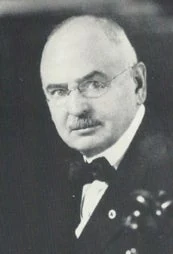
Money that knew its owner
Fargo returned from Europe with the failure. Berry reduced it to a ritual.
The traveller bought cheques in fixed denominations and signed each one in the presence of the selling agent. The serial numbers were recorded separately. When money was needed, the traveller wrote the same signature again while the hotelier, merchant or banker watched. The acceptor compared the two and, if they reasonably matched, treated the cheque as value.
Identity ceased to be a social fact described in a banker’s letter. It became an action an unfamiliar person could witness at the moment of payment. The traveller did not have to be personally known in Leipzig. The cashier did not have to infer solvency from clothes, accent or apparent rank. It was enough to watch a hand, compare two lines and recognise the promise printed between them.
Cash obeyed possession. Berry made travel money obey identity.
The paper added a watermark, fixed denominations and recorded serial numbers. A stolen cheque not yet countersigned was awkward to activate; a lost book could be identified and, under the company’s rules, replaced. Berry had made something close to cash with an off switch.
The switch was not foolproof. A competent forger might imitate both signatures. A careless owner might countersign too soon. An honest merchant could accept a convincing counterfeit. The visible test mattered because the issuer accepted responsibility behind it.
The rate on the paper
The second signature became the traveller’s-cheque ritual. The currency table on the same sheet is easier to overlook, although it answered a different uncertainty.
Berry printed what each denomination would yield in Europe’s leading currencies. As the economic historian Edwin J. Perkins has shown, the arrangement told the traveller before reaching the foreign counter precisely what the cheque should produce.
The promise was possible because the major currencies were then joined through the international gold standard. A pound, franc, mark and dollar each represented a defined relation to gold; their relationship could remain stable enough to print. American Express guaranteed conversion at the stated sums and assumed the risk that rates would move.
This was not free exchange or a universal guarantee of the best imaginable bargain. The purchaser paid for the service, only leading currencies appeared on the table and the system depended on the company’s agents honouring its terms. But the rate was no longer first revealed during a conversation with an unfamiliar cashier. It had been declared before the journey began.
Cash made the tourist ask what her money was worth. Berry made the paper answer before the clerk could.
Two sides of the counter
The cheque could now do everything necessary except circulate. Berry had made a piece of paper capable of behaving like money. American Express still had to make travellers and merchants behave as though it were money.
Berry and Fargo had planned distribution through thousands of American Express offices and correspondents. Fargo personally led the campaign to win acceptance. The European banks already connected to the company through its money-order business were the easier side. Hotels were not. American Express had no established relationship with them, and hotels did not ordinarily cash financial instruments. Beginning in April 1891, Fargo and his staff solicited hundreds of them by post.
They did not ask for faith alone. American Express paid commissions to establishments that sold or cashed the cheques. It promised to reimburse currency-exchange losses and, provided the cashier exercised reasonable care, to absorb losses on fraudulent or forged paper. It placed additional funds with major European banks so that the promise looked covered because it was covered.
The letter sent to hotel owners enclosed a sample cheque and predicted that “a very large proportion of Americans traveling in Europe hereafter” would carry them. It guaranteed payment without discount or inconvenience, then invited each respondent to let American Express print its name among the prominent hotels accepting the new instrument.
The proposition to the hotel was beautifully circular: American travellers will arrive carrying our money; accept it, and we will protect you, pay you and tell those travellers that your hotel belongs to the network.
On the other side of the Atlantic, the company sold the same circle to the customer. An advertisement from 1892, one year after launch, said that principal hotels received the cheques in payment of accounts and that the traveller’s signature both secured and identified him. A later advertisement called them “the most modern form of carrying funds.”
Each new hotel made the consumer promise more nearly true. Each new traveller made the hotel’s decision more valuable. In 1891 American Express sold only 248 cheques, worth $9,120. In 1892 it sold more than 21,000, worth $483,490, while a fourteen-page brochure named accepting banks, hotels and tourist offices from Europe to India and Australia.
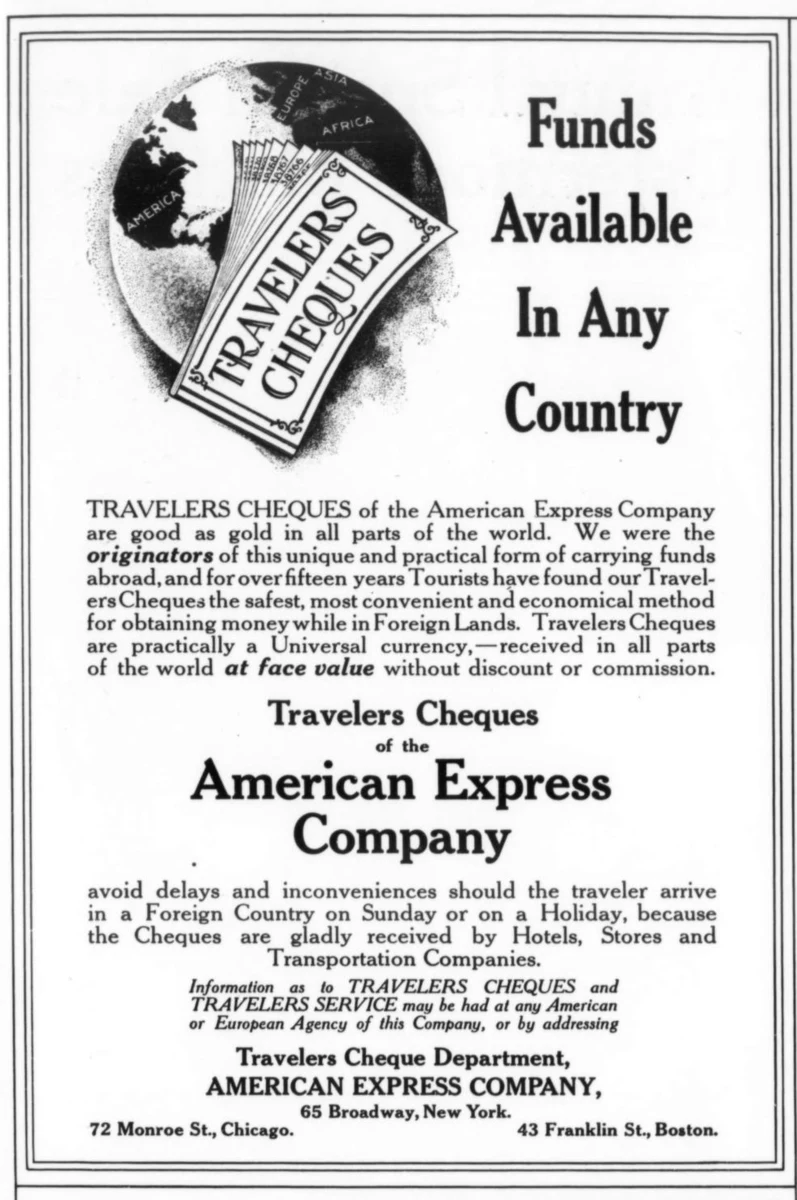
By 1907, a Ladies’ Home Journal advertisement could lead with Funds Available In Any Country. It described the cheques as practically universal currency, payable at face value and useful at hotels, shops and transport companies even on Sundays and holidays.
That last detail was the triumph. When the bank was shut, the hotel desk could become a small branch of the American Express monetary world. The cheque was not legal tender. Yet inside the network, at the moment a traveller needed it, it behaved remarkably like money.
American Express kept pushing after utility had been established. By 1921, six years after Berry’s death, an advertisement called the blue cheque a passport. Its bearer, the copy promised, was “recognized instantly as one who knows how to travel; and he is treated accordingly.” Another carried him “From the Sahara to the Ritz,” borrowing the great hotel’s name as shorthand for acceptance at the highest social register.
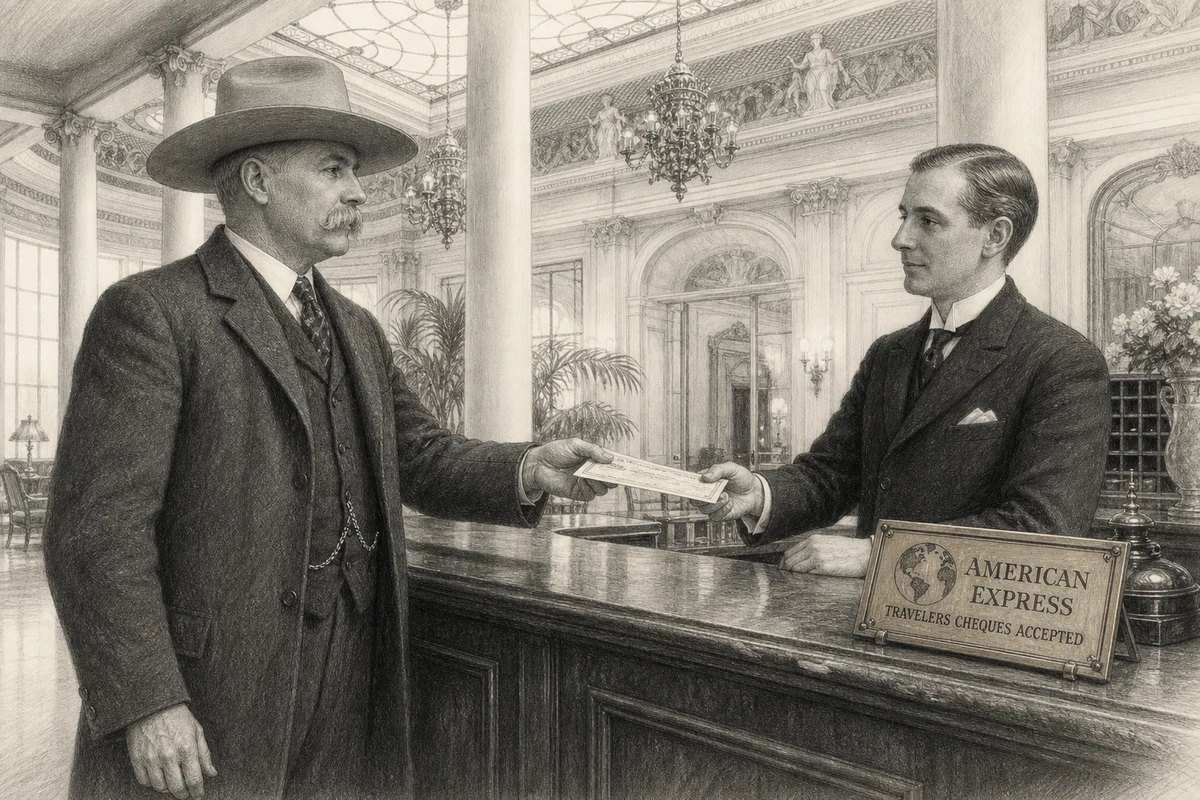
This was not admiration. It was recognition with practical consequences. The cheque made its bearer institutionally legible. He had bought the right instrument, followed the ritual and arrived inside a system that had promised to recognise him. The role model here was not a famous traveller. It was the unknown but competent American who knew how to travel.
American Express had introduced the two strangers to each other. The traveller saw a hotel prepared to honour the cheque. The hotel saw a customer carrying American Express’s prepaid promise. Neither had to know the other; both had been taught what the name between the signatures meant.
Berry made the signature recognisable. American Express made recognition consequential.
The World War I rescue
War broke the monetary order on which the little currency table depended. Exchange rates lurched. European banks closed or refused credit. Trains and liners disappeared from many schedules. About 150,000 American tourists and residents were caught across Europe. Some possessed letters of credit they could not cash. Some had no usable money. Cash itself could not create a train or an Atlantic berth where none was available.
On 2 August, the Paris correspondent Charles Inman Barnard found fifty Americans at the United States embassy asking how to leave and how to turn their letters of credit into money. The diary he published that year included a photograph of another crowd under the caption: “Americans in Paris besieging the American Express Company’s office for funds for their daily bread.”
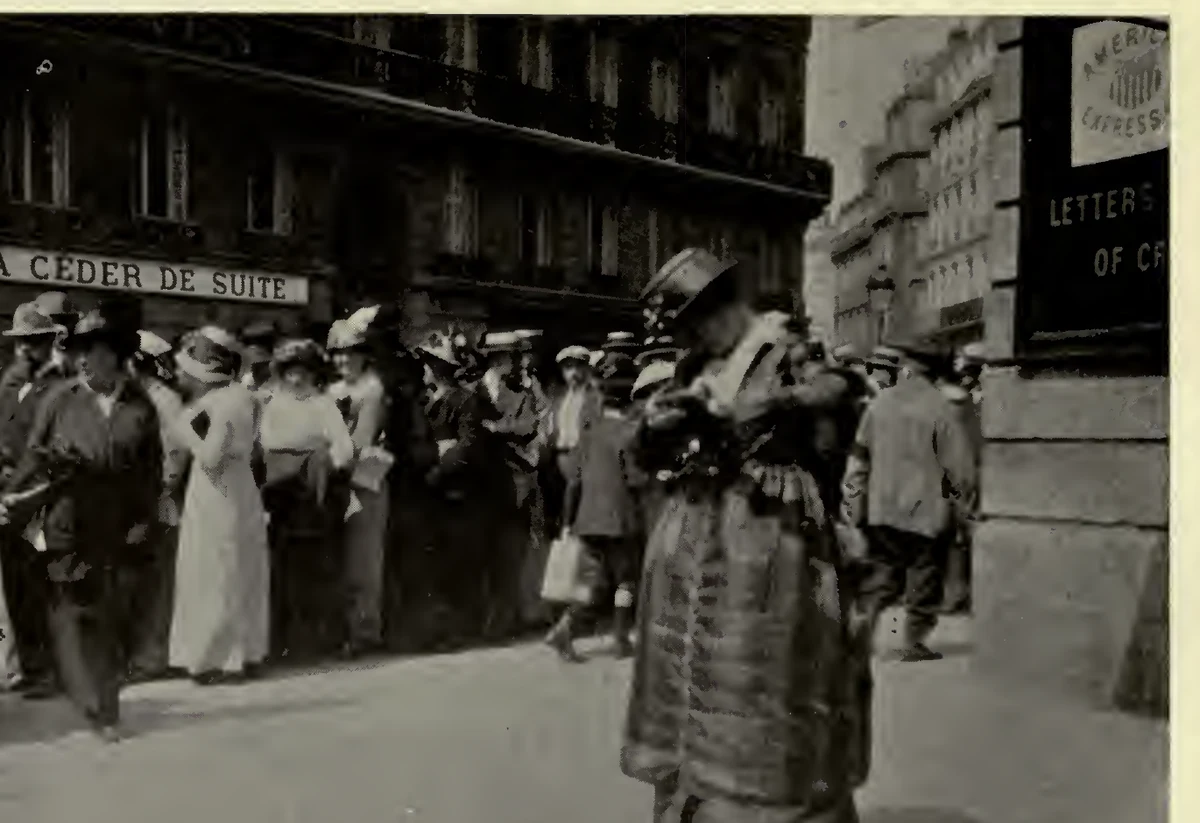
William S. Dalliba, the company’s director general for Europe, had watched the crisis build during July. According to Peter Z. Grossman’s history from the American Express archives, Dalliba brought three million francs in gold into France and ordered other European offices to accumulate cash. When the Paris bank department opened at 11 Rue Scribe, its queue ran from the counter, through the office, around the corner and along the Rue Auber, sometimes six people abreast. London, Berlin and Rotterdam saw their own crowds.
American Express offices paid the company’s traveller’s cheques in full and, where possible, honoured other institutions’ paper too. Staff tried to arrange passage home and distributed telegrams and letters so that stranded travellers could reach their families. The Paris operation became useful enough that the American embassy directed people towards Rue Scribe.
This was one part of a much larger repatriation. Congress appropriated relief money; New York banks contributed more; the armoured cruisers USS Tennessee and USS North Carolina sailed with $4.5 million in gold; American residents in London organised shelter, loans and passages. American Express did not bring 150,000 people home. It did something narrower at the point of panic: while governments assembled the rescue, its offices kept financial promises usable.
The effect reached the other side of the counter. Because the cheques were being paid in full, Dalliba reported, hotelkeepers and others began hoarding them in preference to French paper money. A 1924 American Express advertisement looked back on the moratoria as the moment its claim to “universal currency” had been tested. The copy was self-congratulation, but the behaviour behind it was the stronger advertisement.
The table on Berry’s cheque had broken. The institution between the signatures had not.
Twenty-three years earlier, American Express had asked hotels to receive its paper as money. In August 1914, some preferred it to money. Berry’s own name remained in the smallest line on the cheque: Copyrighted, 1891, by M. F. Berry. At 11 Rue Scribe, the larger name between the signatures still meant the company would pay.
What the card inherited
The war had done more than test the cheque. It exposed the distinction on which later payment systems would rely. The cheque was an object, but its value did not live in the paper alone. It lived in a recorded claim and in an institution prepared to answer it.
For much of the twentieth century, buying traveller’s cheques belonged to the preparations for going abroad. One signed a stack before departure, kept the serial-number receipt apart from the cheques and countersigned each piece only when spending it. The inconvenience was visible because the protection was visible too.
Then the paper lost its advantage. Cash machines supplied local currency from a home account. Cards spread through merchant networks. Chips, PINs, devices, cryptograms and online authorisation moved the test from two lines of handwriting into systems faster than the eye.
One part of the old system remained deliberately visible: the acceptance mark on a door, window or payment terminal. A surviving American Express porcelain sign reduces the proposition to four words: Travelers Cheques Accepted Here. Visa now supplies merchant signage; Mastercard authorises decals that indicate acceptance. The names changed, but the mark kept its job. It tells a traveller, before she enters, that the establishment belongs to a network which knows what her payment promise means.
The quieter inheritance appears when the token itself has vanished. After an issuer approves the request, Visa’s emergency service can arrange cash for collection at more than 270,000 locations worldwide. Mastercard likewise lists emergency cash advances and replacement cards among its round-the-clock services. The traveller does not go to a Visa office as she once went to American Express. The network directs her to an available disbursement point and makes the value present again.
Berry had made a lost cheque different from a lost banknote. The card networks extended the principle: losing the token need not mean losing access to the money.
Foreign exchange moved into the network as well. When a Visa purchase is processed in local currency, VisaNet supplies the daily rate used to authorise and settle it; the issuer may add its own charge. If a traveller accepts dynamic currency conversion, the merchant’s provider supplies the rate and fees instead. The card has not abolished the possibility of a poor exchange rate. It has moved the calculation—and the choice of who performs it—behind the screen.
A card also promises a hotel something Berry’s cheque did not. The cheque could settle an account when traveller and hotel met. It could be sent ahead as completed payment, but then the owner surrendered the protection of countersigning before the payee. A card can secure a room before the guest arrives and, under the reservation’s terms, leave the hotel with a claim if she never does.
Berry solved payment between strangers who had met. The card later allowed the promise to arrive first.
American Express no longer issues new Travelers Cheques, although surviving ones remain backed by the company and may still be redeemed. A Visa or Mastercard transaction is not Berry’s cheque made electronic: its legal instrument, technology and commercial relationships are different. What survived was the architecture. A traveller presents a token; a system authenticates the claim, converts the value and sends an unfamiliar merchant a promise it will accept.
At an unfamiliar hotel, a traveller can now tap, wait a second and take the room key without being personally known, without carrying local banknotes and without asking the cashier what her money is worth.
The screen says APPROVED.
It does not mean the hotel knows her. It means the hotel recognises the promise. The mark at the entrance said where that promise would be accepted. Emergency cash says the promise can survive even when the card does not.
Berry’s two signatures have disappeared. The introduction remains.