
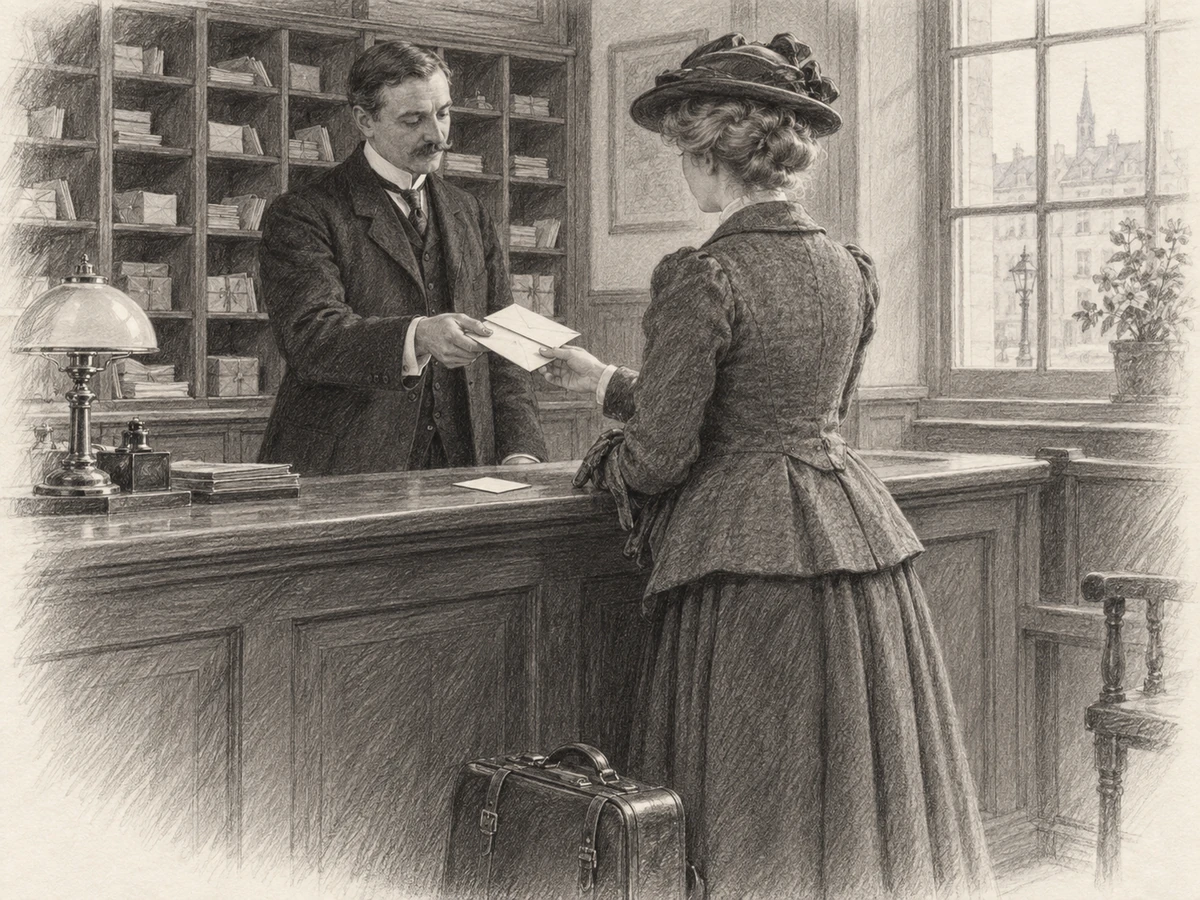
Collecting letters while travelling, around 1907. An illustration of the guidebook ritual. Illustration: blonde.travel.
Open M. D. Frazar’s practical travel guide from 1907 and, among the expected advice on steamships, luggage, railway tickets and letters of credit, there is a small heading: Mail.
Its instructions belong to a world that now feels almost magical. If a traveller does not yet know which hotel he will use, the guide explains, his banker can receive and forward his letters and telegrams. American Express will do the same. So will Thomas Cook & Son. Or, if he knows only the city where he expects to arrive, he can have a letter sent to the post office itself, marked Poste Restante, and collect it there.
The procedure is described with almost comic confidence. Present a visiting card at the proper window, the guide says, and “there will be no difficulty in obtaining the mail.”
That casual sentence contains an entire lost architecture of travel.
A person could leave London, Paris or New York for weeks or months and remain connected without remaining fixed. He might cross the Mediterranean, take a steamer up the Nile, stay in Cairo longer than planned, move on to Bombay, wait for the monsoon, spend a month in a hotel in Nairobi, and still receive family news, business instructions, bank correspondence, invitations, manuscripts, bills, telegrams and gossip from home.
The traveller did not need to carry an address.
The address could wait ahead of him.
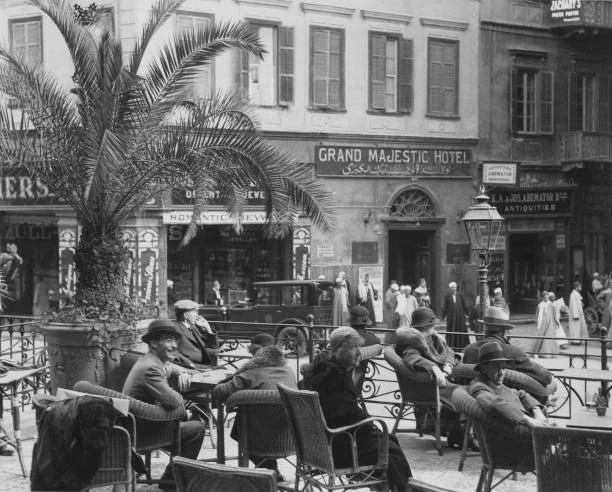
By the time the writers of Hemingway’s generation began filling novels and memoirs with people who disappeared into Spain, East Africa or the Riviera and nevertheless found a packet of letters waiting at a hotel desk or a general post office, there was little need to explain the mechanism. Readers understood it. You told correspondents where you expected to be. Mail was sent there. If plans changed, a hotel, bank, travel agency or post office might forward it. If there was no hotel yet, poste restante gave you an address in a city simply because you intended eventually to arrive there.
This was one of the quiet luxuries of the golden age of travel: not speed, but continuity.
The railway and the steamship moved the traveller. The hotel gave him temporary domesticity. Thomas Cook could arrange tickets and money. The post allowed news of his social and professional life to follow him abroad.
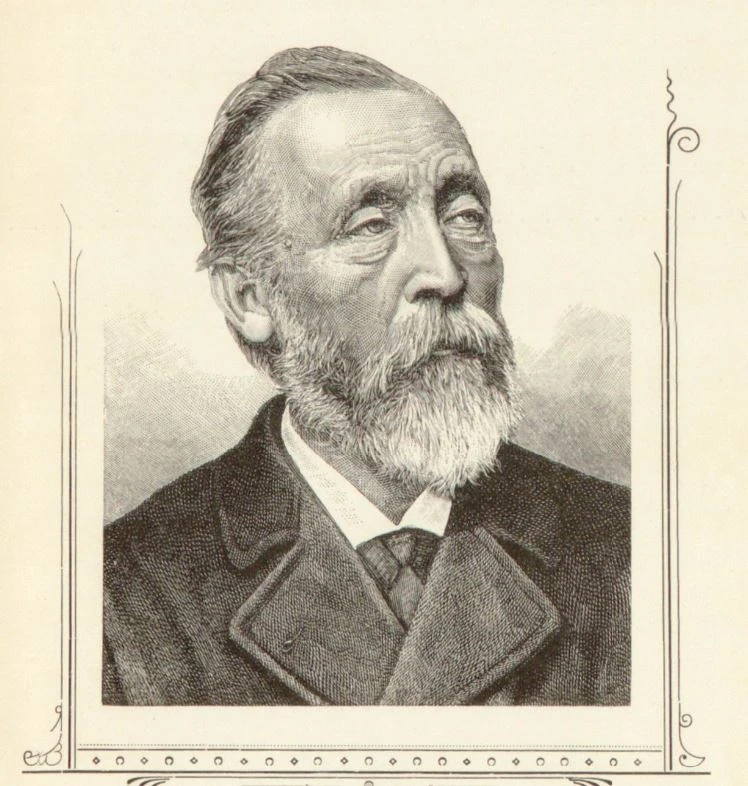
One of the men who gave that system its international architecture was a Prussian civil servant named Heinrich Stephan.
The “von” came in 1885.
Before the world became one postal territory
International mail existed long before Stephan. So did forwarding, general-delivery counters and forms of poste restante. The task was to make national postal systems cooperate under common international rules.
For centuries, international letters crossed borders through a dense web of bilateral treaties. One postal administration negotiated with another over rates, transit rights, accounting, weights and routes. Add a third country and another set of agreements appeared. Add dozens of countries and the system became an administrative maze.
By the nineteenth century, expanding trade, migration, railways and steamship services were making that maze increasingly absurd. According to the Universal Postal Union’s own history, the accumulation of bilateral arrangements had become so complicated that it was beginning to obstruct the commerce they were supposed to serve.
Britain’s Rowland Hill had already shown one way forward. His postal reforms of 1840 simplified domestic mail by introducing prepayment and uniform rates based chiefly on weight rather than distance. The postage stamp became the visible symbol of a deeper idea: communication should be easy enough that the customer need not understand the postal system’s internal economics.
In 1863, U.S. Postmaster General Montgomery Blair gathered representatives of fifteen European and American countries in Paris. They agreed on useful principles but failed to produce a binding international postal settlement.
The problem remained.
And Heinrich Stephan understood it unusually well because he had spent his career living inside it.
Born in 1831 in Stolp in Pomerania—today Słupsk in Poland—Stephan was the son of a master tailor. He entered the Prussian postal service in 1848, still in his teens. He rose quickly, studied languages, wrote on postal history and administration, and in 1858 moved into the foreign department of the Prussian General Post Office. By the early 1860s he was negotiating postal treaties with other European states.
This was not abstract diplomacy for him. He knew what happened when incompatible systems met at a frontier.
Prussia’s absorption of the Thurn und Taxis postal network in 1867 gave Stephan a larger task. Germany itself had been a patchwork of jurisdictions, tariffs and inherited privileges. He had to make the enlarged service work.
The inconvenience had a pattern. Each new connection demanded another negotiation. Stephan wanted a common agreement that countries could join, with rules their post offices could apply.
Bern, 1874
In 1868 Stephan produced a memorandum proposing an international postal union.
He gathered earlier proposals into a practical scheme. Nations would keep their post offices while agreeing on enough common rules to simplify the sending of an ordinary letter abroad.
At Stephan’s suggestion, the Swiss government convened an international conference in Bern on 15 September 1874. Representatives of twenty-two countries attended.
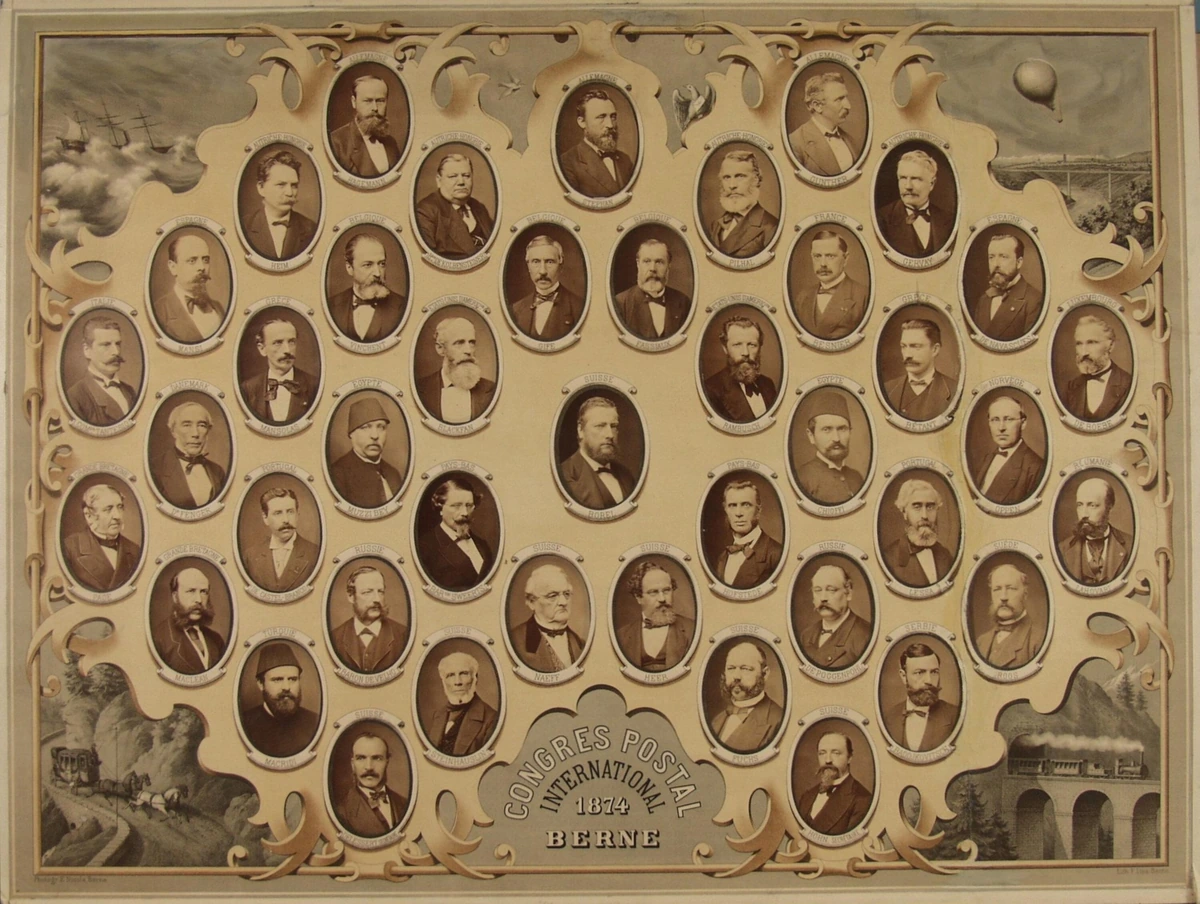
Less than a month later, on 9 October, they signed the Treaty of Bern and created the General Postal Union.
Its first article made the participating countries “a single postal territory” for the reciprocal exchange of correspondence.
The phrase described a service, not a new country. Governments retained their administrations; the sender gained a simpler transaction.
A general Union rate for a prepaid letter was set at 25 centimes, with limited national variation for currency conversion and local conditions. The basic weight unit was 15 grams. Postcards, printed matter and commercial documents received common treatment. The right of transit through member territories was guaranteed. Postal administrations were instructed to use the most rapid available routes.
A sender no longer had to reckon with so many different international arrangements. The post offices had agreed the rules in advance.
The General Postal Union began operating on 1 July 1875. Its membership expanded so quickly that in 1878 it was renamed the Universal Postal Union.
Stephan had helped transform the international post from a collection of national systems that happened to exchange letters into something recognisably closer to global infrastructure.
The technology of staying away
To understand why that matters to travel, forget for a moment about postcards from holidays.
The traveller of the late nineteenth and early twentieth centuries had a deeper problem: how do you remain a functioning person while absent from home?
Travel could last months. Ships did not cross oceans overnight. A journey to Africa or Asia was not necessarily an interruption between two periods of ordinary life; for diplomats, writers, engineers, businessmen, archaeologists, hunters, colonial officials, artists and wealthy wanderers, it could become a temporary way of living.
Money had to reach you. Instructions had to reach you. Family news had to reach you.
Your publisher might need a decision. Your bank might send documents. Someone in Paris might answer a letter you wrote from Cairo three weeks earlier. A friend could announce that she would be in Naples next month. A lawyer might need a signature. A newspaper could commission another article.
The longer the absence, the more valuable it became to have reliable ways of receiving news and instructions.
Poste restante itself was older than Stephan. His achievement was to help make the international arrangements behind it simpler and more widely shared.
Once national posts increasingly operated inside a common international framework, the destination of a letter could be not merely a house but a point on an itinerary.
Mr Smith
Poste Restante
Cairo, Egypt
or perhaps:
Mr Smith
c/o Shepheard’s Hotel
Cairo, Egypt
or:
Mr Smith
c/o Thomas Cook & Son
Cairo, Egypt
If Smith had moved on, the next instruction could send future correspondence elsewhere. A hotel could forward what remained. A bank or travel agency could act as a stable intermediary. Frazar’s guide treated receiving and forwarding correspondence as an ordinary service for clients. Telegrams belonged to a separate communications system; the Union’s work concerned the post.
That is a remarkable service to place beside a railway timetable.
The traveller’s identity was portable before his communications were instantaneous.
There is something wonderfully civilised in the image: a stranger in a foreign city enters the post office, presents a calling card, and asks whether the world has written to him. A name could be enough because the difficult arrangements had been made elsewhere.
Reachable, without being continuously available
It is tempting to think of old travel as difficult because it was slow.
The journey certainly demanded patience. Steamers waited for weather. Trains missed connections. Roads could be appalling. Luggage travelled separately. A letter from home might take days or weeks.
But slowness and difficulty are not the same thing.
For travellers with the money and leisure to linger, the delays of correspondence could fit the journey’s own pace. This was a particular freedom, enjoyed within a world of unequal incomes and imperial privilege; cheap postage did not buy everyone a month abroad.
A traveller expected to remain in a place long enough for correspondence to catch up.
He could stay in Florence for three weeks, Cairo for a month, Nairobi for a hunting season. A letter that took eight days was not useless if its recipient was still there on day nine.
The itinerary did not need to be optimised to the hour. It could have generous spaces in it.
This produced a rhythm of travel that is hard to recreate today.
You arrived, checked into a hotel, asked for letters. You read what had happened elsewhere and answered. Then, sometime later, you left.
Delay was built into the arrangement. You could be reachable without being continuously available.
A person travelling through Africa in the 1930s could still be found. Family and business associates were not necessarily cut off from him. But they could not demand a reply in five minutes because a green dot showed that he was online.
The world could catch up with you at the next post office.
It could not follow you into every lunch, train compartment, safari camp or bedroom.
The golden age of slow travel was built partly on this separation.
You were absent, but not lost.
The address behind the ticket
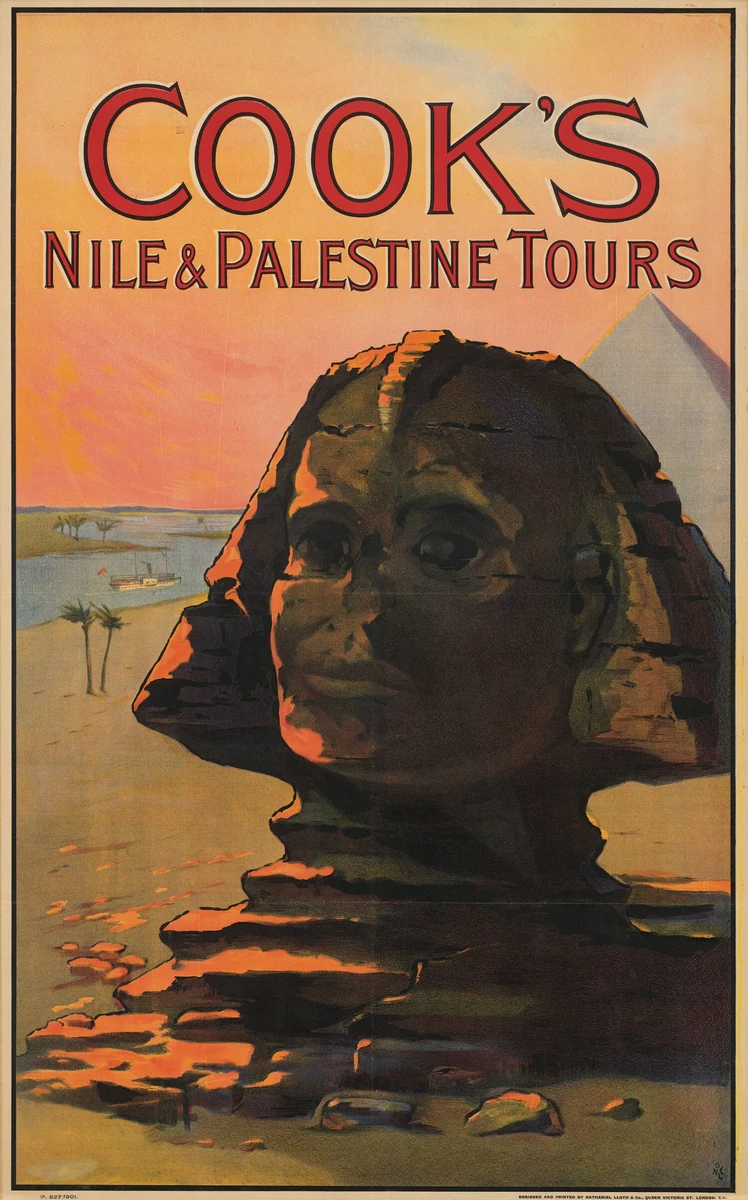
Thomas Cook and his successors could arrange tickets, coupons, hotels and couriers. Banks and firms such as American Express made money and credit accessible abroad. Grand hotels stored luggage, held messages and forwarded letters after a guest had gone.
These services were different, but the post connected them. A travel agency could serve as an address because correspondence could reach its office. A hotel could send a departing guest’s letters onward. The same paper world held the invitation, the bill and the instructions for the next journey.
The appeal of going far away depended partly on being able to keep these practical ties. Stephan’s international settlement helped reduce the administrative price of absence.
A bureaucrat with a taste for the future
The man behind this accommodation of slow travel was himself impatient for newer means of communication.
He oversaw the growth and reorganisation of the imperial post, integrated postal and telegraph administration, encouraged new postal buildings and founded what became the Reichspostmuseum. He supported the correspondence card. In 1877 he personally participated in Germany’s early adoption of Bell’s telephone; the Museum for Communication in Berlin records that he made one of the country’s first telephone calls and soon incorporated the new technology into the postal administration.
Paper, telegraphy, telephone: the medium could change. He wanted the system to grow. Yet his readiness to adopt new machinery did not extend to everyone who might work it. In a letter to the writer Fanny Lewald-Stahr, he opposed women’s employment in the postal service, invoking their supposed physical limitations and domestic destiny. The Berlin museum preserves this uncomfortable side of its founder alongside his innovations.
The Union outlived him. Its rules could accommodate faster transport without surrendering the useful principle that national administrations should cooperate. The original settlement concerned correspondence; the modern Union’s work reaches into the movement of parcels as well. The paper letter’s decline did not remove the need to agree how things cross a border.
The address at the end of the road
By the 1920s and 1930s, when the mythology of modern cosmopolitan travel took recognisable form, Stephan had been dead for decades.
His influence is easy to miss because the arrangements had become ordinary.
A novelist does not stop the story to explain why a hotel in Paris can receive a letter from New York. A memoirist does not need a chapter on postal treaties before describing mail waiting in Nairobi. A traveller does not praise the Universal Postal Union each time a forwarding address works.
And so in the literature of the period we meet people who live with a freedom that can seem implausible to modern readers. They leave one country, settle temporarily in another, alter plans, stay longer, go farther—and correspondence continues to reach them.
It seems romantic because the technology has vanished from our daily imagination.
But the romance rested on bureaucracy.
Behind the cream envelope on the hotel desk stood postal clerks, sorting offices, rail mail, steamship mail, standardised weights, transit rights, accounting rules, multilingual forms, international congresses and the diplomatic insight that twenty-two national systems could become more useful by agreeing not to behave like twenty-two entirely separate worlds.
He helped make absence administratively survivable.
The smartphone eliminated the need to predict where we would be next Thursday in order to receive a message. Maps, money, reservations and communication now travel in the pocket. Yet it is surprisingly difficult to become unavailable for an afternoon.
The old poste restante counter offered a different bargain between mobility and connection. You told the world roughly where you were going. Then you went. Somewhere ahead—perhaps in Rome, Cairo, Buenos Aires, Nairobi or Tokyo—a letter waited under your name.
The railway made distance crossable. The steamship made continents reachable. The grand hotel made foreign cities inhabitable.
Von Stephan helped make the traveller himself addressable.
And for several generations of globetrotters, that was one of the technologies that made the world feel large enough to escape into—yet organised enough to stay away.