
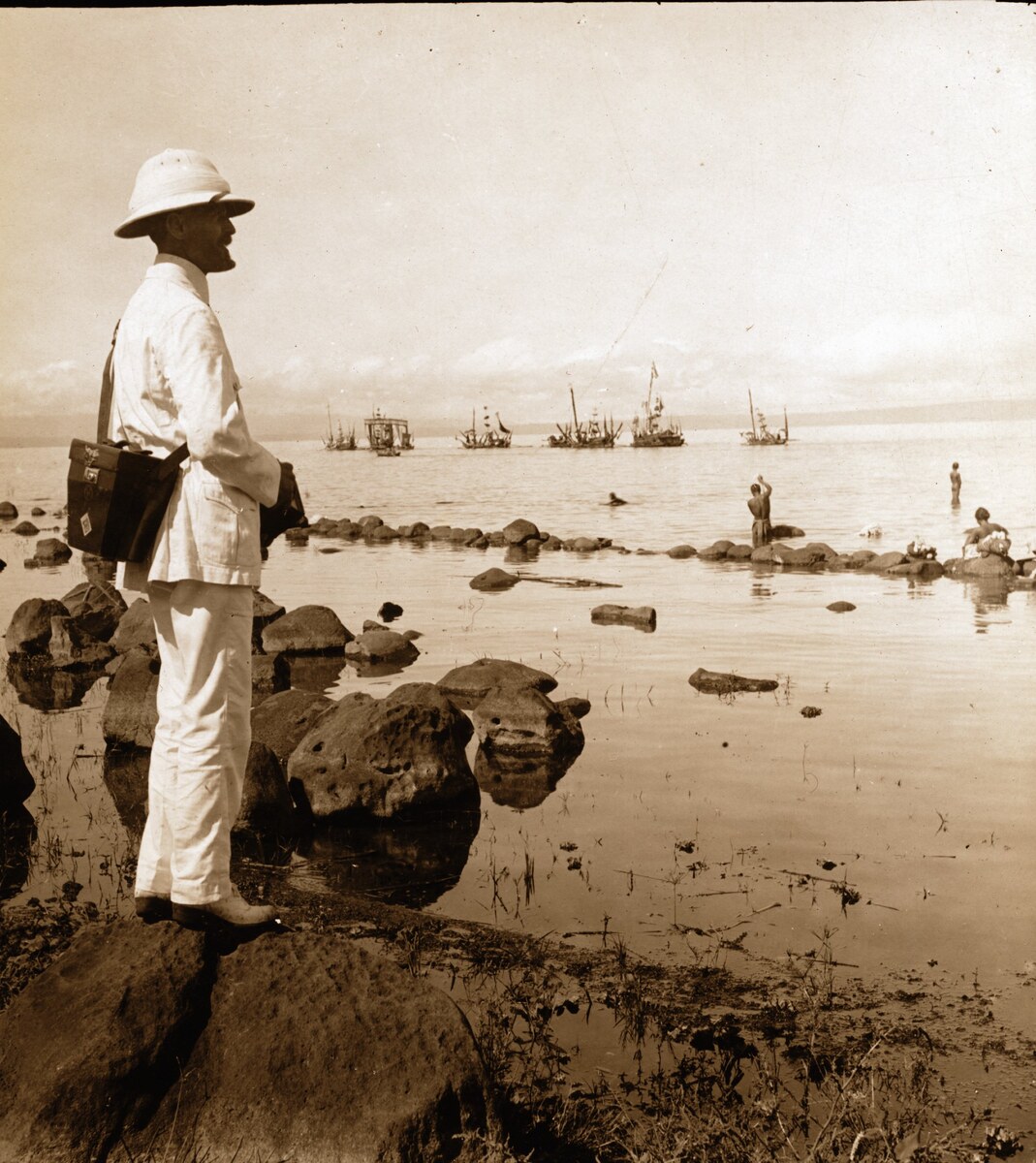
In 1901, introducing the printed edition of his lectures, Burton Holmes told a small story he plainly enjoyed. On the screen of a darkened hall glowed a village at sunset: a river flowing at the spectators’ feet, misty mountains in the distance, the calm of approaching night in the golden twilight. A woman in the audience looked and listened, then murmured to her companion, “Oh, if some one could only paint that!”
Holmes offered the remark as proof that his illusion worked. The whole effect, he explained, was produced by “the projection of a colored photograph and the utterance of a few suggestive words.” The colour, however, had been painted. Holmes’s slides were black-and-white photographs printed on glass and tinted by hand, first in Yokohama and then by American artists such as Katharine Gordon Breed and Helen E. Stevenson. Breed once described landing in Morocco, after painting scores of North African scenes, and meeting a street beggar whose face and rags she had already worked out with her brushes. “He was an old friend to me,” she said, “instead of a stranger.”
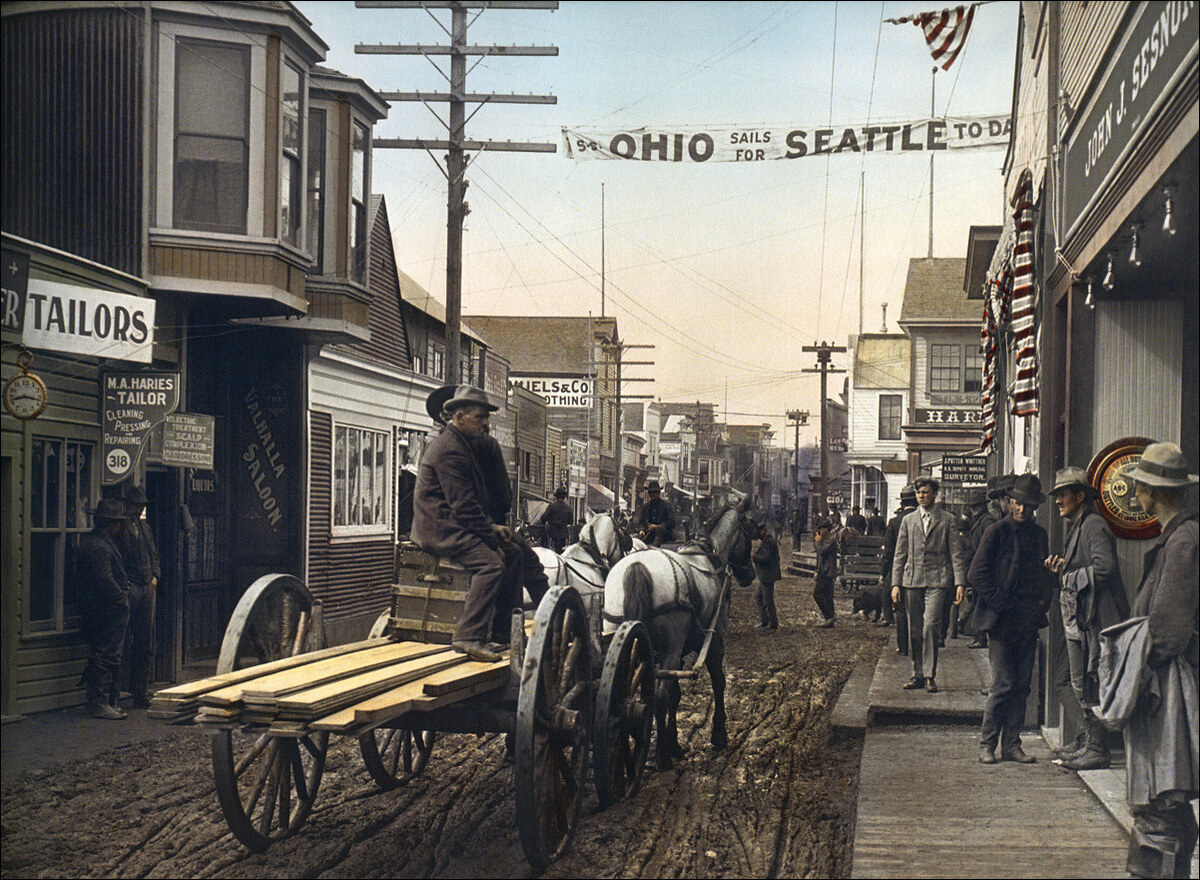
A Burton Holmes evening worked on the same principle. A place could become familiar before anyone arrived, through a picture that had been chosen, coloured and explained. For sixty years Holmes sold that familiarity, in more than eight thousand performances, in weekly films for Paramount and in handsome sets of books for the parlour. His name became so closely attached to the word travelogue that he is still credited with inventing it. Yet audiences did not buy Japan, the Grand Canyon or the Trans-Siberian Railway. They bought an evening in the company of a particular man who had been there, and who always spoke as though they had come with him.
A camera and a grandmother
Elias Burton Holmes was born in Chicago in January 1870, the son of a banker and the grandson of a prosperous builder and importer of French wines. As a boy he was taken to hear John L. Stoddard, the most celebrated travel lecturer in America, describe the Passion Play at Oberammergau. At thirteen he bought a camera and fitted up a darkroom. At sixteen he went to Europe with his grandmother and brought back photographs.
That was the ordinary privilege of his class. What he did next was not. On a Tuesday evening in December 1891, at the Recital Hall of Chicago’s Auditorium building, he gave the Chicago Camera Club an illustrated account of a later European tour, “Through Europe with a Kodak.” The poster promised 150 stereopticon views, with tickets at fifty cents from Brentano’s bookshop, and borrowed a joke from Kodak’s famous slogan: “You buy a ticket—we do the rest.” The evening raised money for the club, and a reviewer noticed how its humour relieved “the sombre stories of history.”
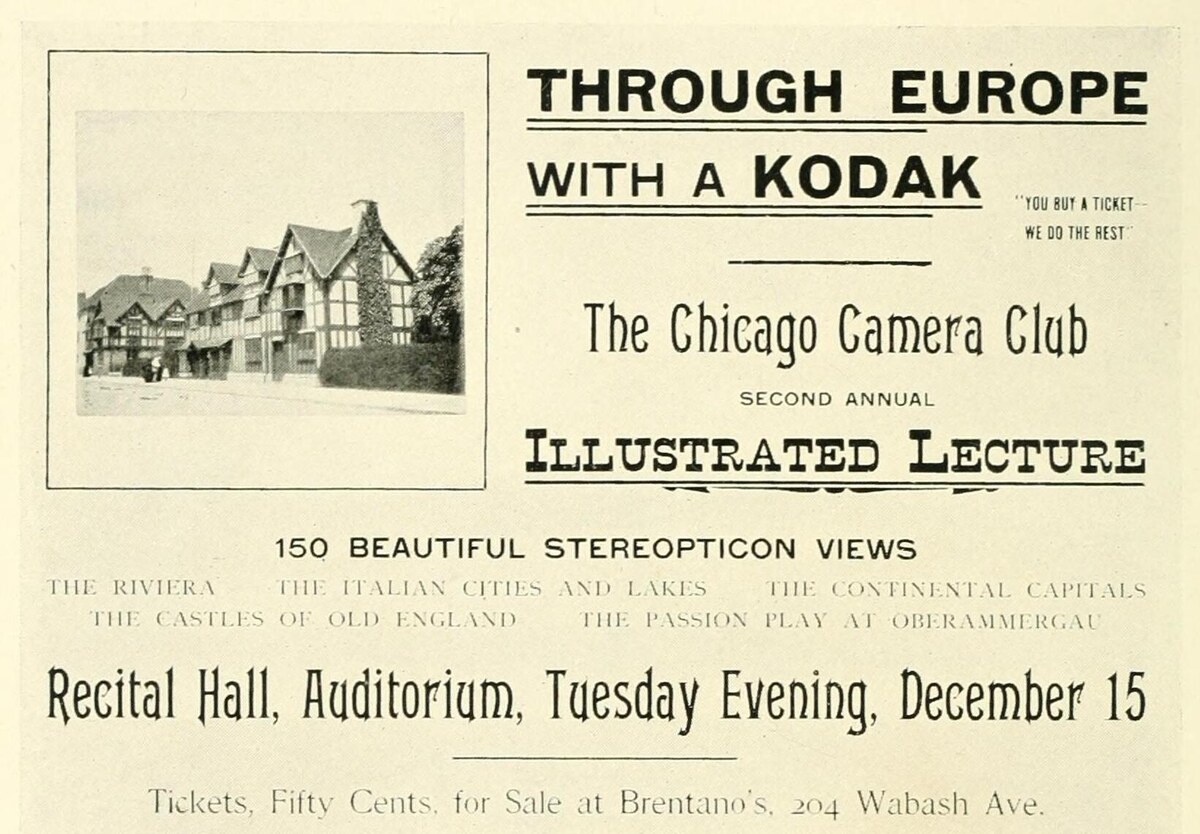
The talk survives in the form Holmes later printed, and its first words already contain the method: “To-night we are to travel in the Paradise of the Amateur Photographer.”
We. Not “I travelled,” nor “Europe contains,” but a journey undertaken together, by a speaker in the dark and people in their seats. Holmes called his text “the merest thread, carelessly spun to bind together the pictures.” The thread was the invention. A travel photograph shows a place. A voice saying we turns it into something a room can share.
The profession
He did not plan to make a living from it. In 1892 his family sent him to Japan for four months; on the train to Vancouver he met Stoddard again, bound for the same country. The next year the Panic of 1893 ruined his father. Holmes, who had failed at selling real estate and worked as a clerk in a camera shop, needed money. He had a box of Japanese negatives.
He had them made into slides and coloured in Yokohama, rented a stereopticon and its operator from the McIntosh Battery and Optical Company, and in November 1893 presented “Japan—The Country” and “Japan—The Cities” in the Auditorium’s Recital Hall. The operator was Oscar Bennett Depue, who would work the machines behind Holmes for most of the next half-century. The Inter Ocean found “not a dull instant” in the talk and closed with a sentence that now reads like a job description: “surely no one has done more to make Japan seductive to the prospective traveler than Mr. Holmes is doing in these lectures.”
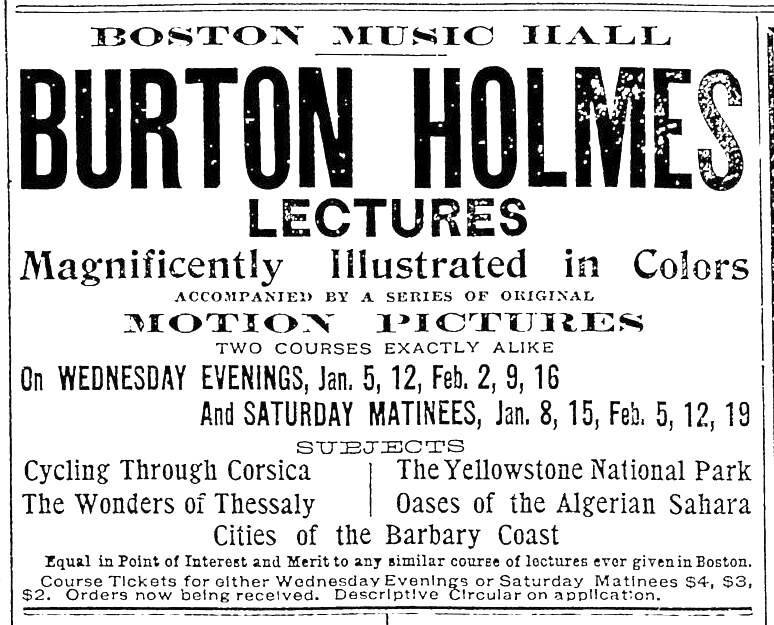
The Chicago performances cleared about $700. Four nights in Milwaukee lost most of it. For four seasons Holmes did well at home and less well elsewhere. Then, in 1897, Stoddard retired after nearly two decades on the platform, and Holmes stepped into the vacancy. He opened his fifth season to a crowded house at Central Music Hall, where the Inter Ocean greeted him with “The King is dead, long live the King.” A new manager, Louis Francis Brown, secured him courses in New York, Boston, Brooklyn and Philadelphia. In Boston, a series of five lectures cost four, three or two dollars, and the advertisements promised pictures “magnificently illustrated in colors,” together with something newer still.
Pictures that moved
That summer Depue had gone to Paris and bought a camera from Léon Gaumont. It used film sixty millimetres wide and unperforated; the camera punched its own holes as the operator turned the crank. Holmes’s prospectus for 1897–98 gave a whole page to the “Chronomatographe” and explained, for people who had never needed to know, that one minute of motion required more than a thousand pictures, taken at eighteen to twenty a second on a ribbon of film over a hundred feet long.
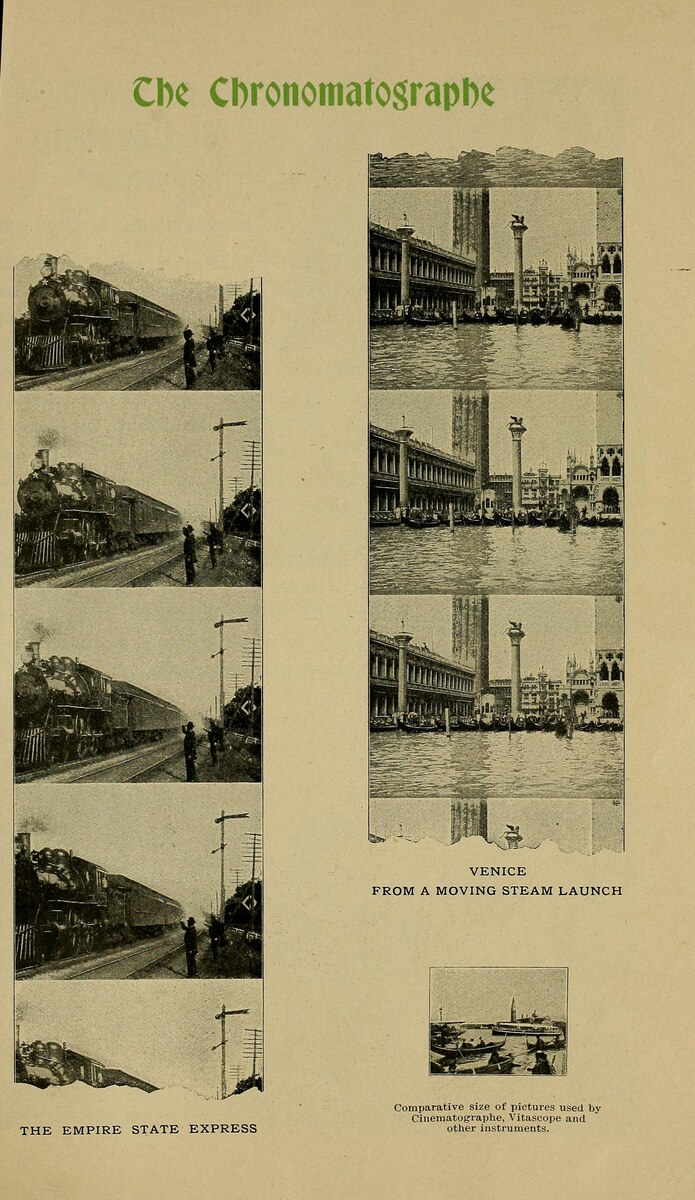
At first the films followed the lecture as a separate novelty, “not necessarily related to the subject of the evening.” On the opening night in Chicago the reel ran from a North German Lloyd liner leaving its Hoboken pier to a street in Naples, the Piazza San Marco, Venice seen from a moving steam launch, the Place de la Concorde, the upper falls of the Yellowstone and polo at Lake Forest. Thayer Soule, who later became Holmes’s right-hand man, remembered other early subjects: Chicago police on parade, the Omaha fire department answering an alarm, Neapolitans eating spaghetti.
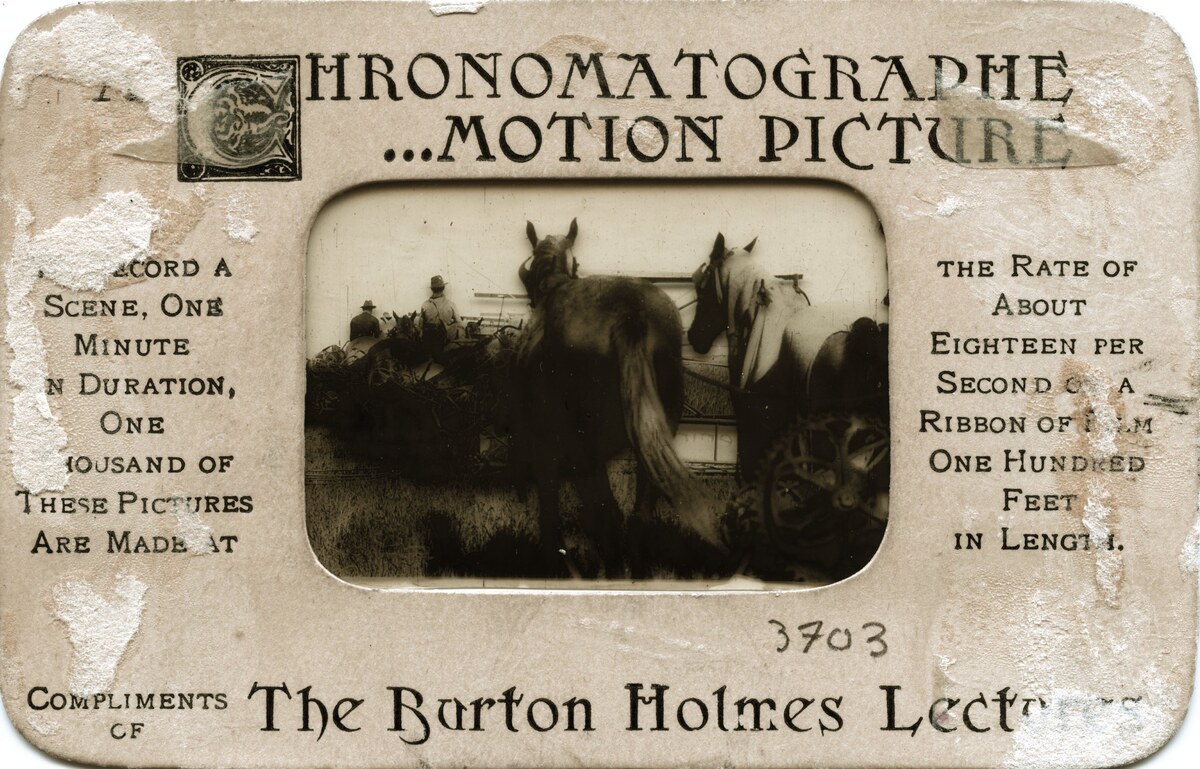
By the season of 1899–1900 the films had moved into the body of the lecture, where they illustrated the journey instead of trailing after it. The change was larger than a new running order. A coloured slide invited admiration. A moving picture of a Hopi ceremony, a Hawaiian shore or a Manila street, appearing at the moment the speaker described it, made the audience feel like witnesses, and Holmes stood beside it to tell them what they were seeing.
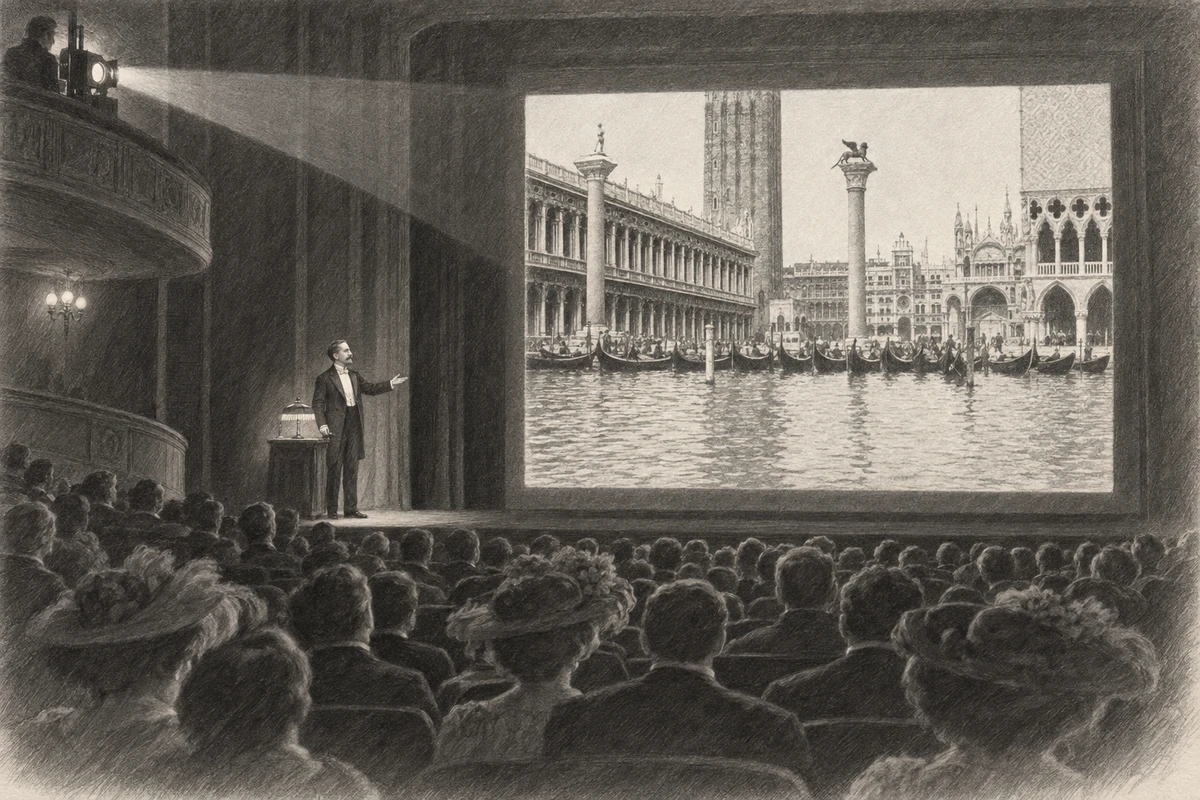
The man in evening clothes
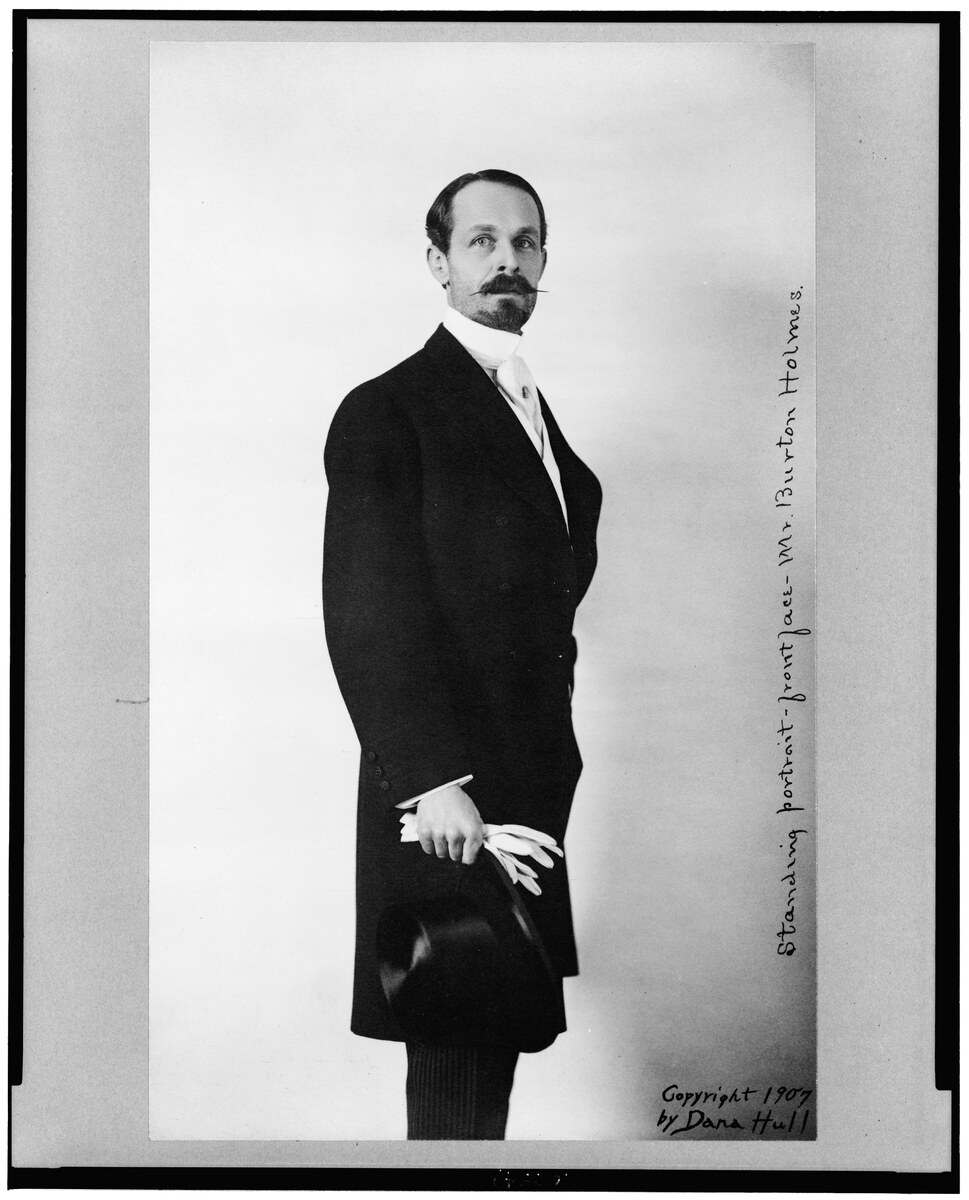
He always appeared in formal dress. Photographs of Holmes in his thirties show a slim, alert man with a pointed beard, a high collar and the composure of someone who expects to be looked at. He did not present himself as a scholar. His programmes insisted that he was “not a lecturer in the ordinary sense of the word” but “pre-eminently a traveler—one who travels for the love of travel,” whose eloquence was “born of actual experience.”
His life was arranged to produce that experience on schedule. He travelled in spring and summer, usually with Depue at the camera, and toured American auditoriums in autumn and winter, bringing audiences what a 1904 programme called “the essence of his Spring and Summer travel.” In a single year, 1901, he crossed Russia on the new Trans-Siberian Railway, filmed Tolstoy and went on to Peking and Seoul. The next season the audience travelled there too.
That year, asked for material for a biographical sketch, Holmes replied that his biography would be found in his lectures, “each lecture being a chapter from his life of travel.” The answer is modest in tone and startling in implication. His life was the material. His travels were the season’s programme. His audience was the reason the travelling could continue, and he said so in the same volume, thanking his auditors, “who, by their support and sympathy, have made possible the years of travel which these volumes represent.” He addressed his readers as “an audience, not of strangers, but of friends.”
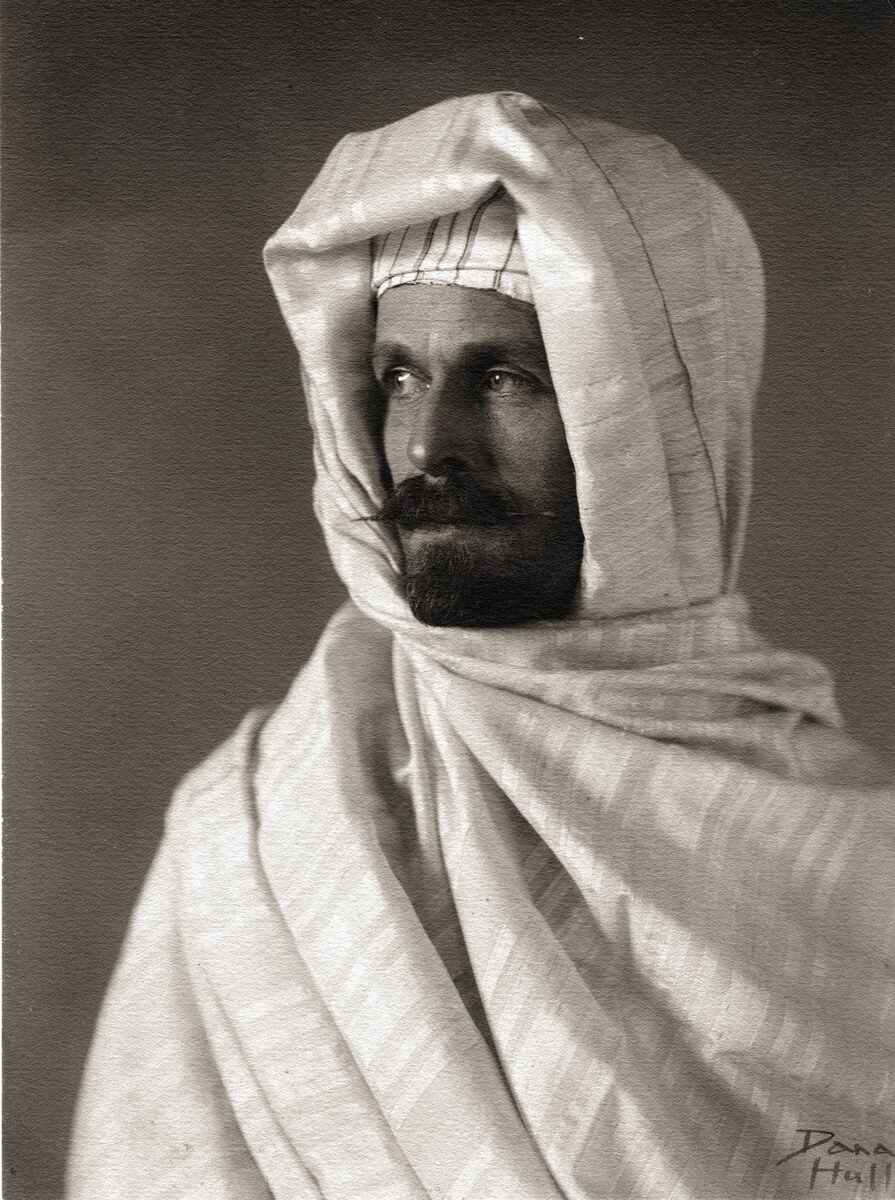
He dressed for the part in another sense too. Holmes posed in the clothes of the places he visited: Moroccan robes in 1894, the gown and horsehair hat of a Korean gentleman, a Japanese kimono and a Javanese batik in advertisements for his films. The costumes told audiences that their companion had not merely looked through a window. They also made his face, rather than any landscape, the picture that stood for the show.
A word and a way to get there
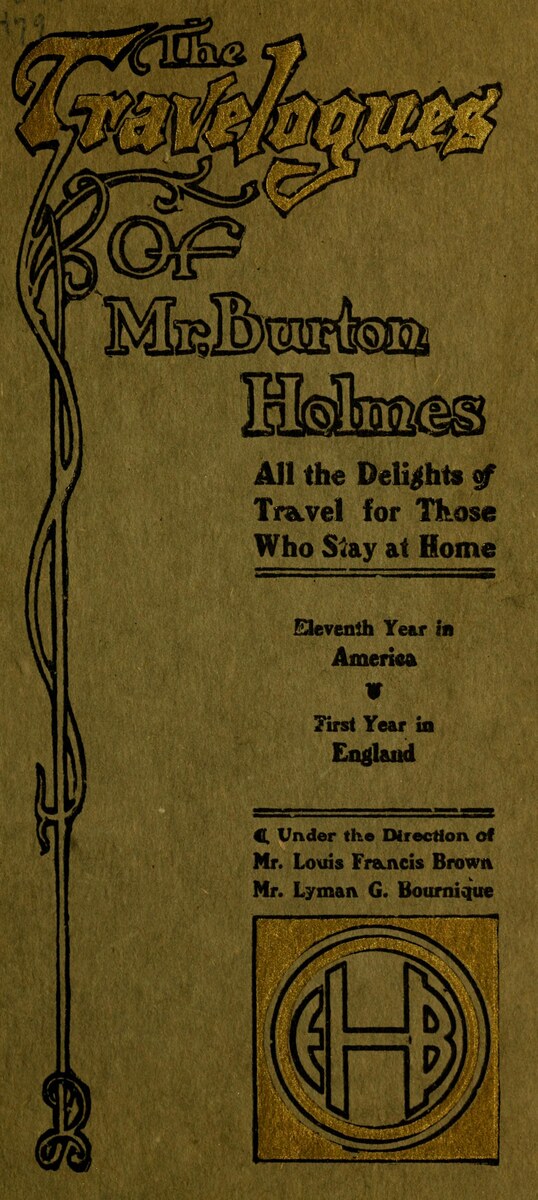
In 1904 Holmes took his lectures to Queen’s Hall in London. The cover of the programme, stamped with his monogram, announced his “Eleventh Year in America, First Year in England” and promised “All the Delights of Travel for Those Who Stay at Home.” Inside it defined the product:
“The Gist of a journey, Ground Fine by discrimination, Leavened with information, Seasoned with humor, Fashioned in literary form, and Embellished by pictures that delight the eye, while the spoken story charms the ear.”
Then, more sharply: “A Travelogue is not a lecture—one listens to a lecture; one experiences a Travelogue.”
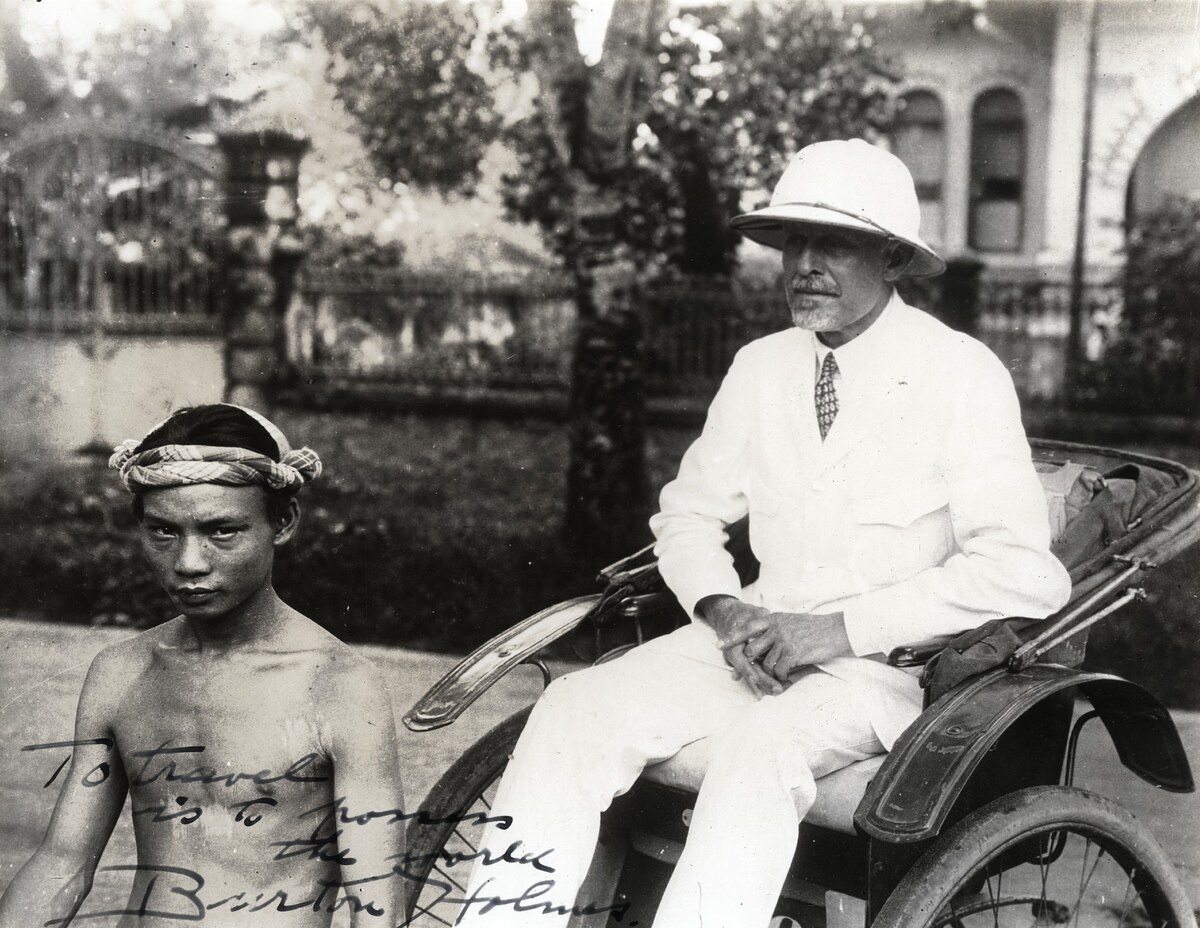
The word was not new; it had appeared in American print before, and the archive that keeps Holmes’s papers credits Brown with putting it on the London advertising. Holmes made it stick and made it his own. For the rest of his life his shows, books and company carried the name Burton Holmes Travelogues. On the same page of the London programme appeared the motto he would write on photographs and autographs for decades: “To travel is to possess the world.”
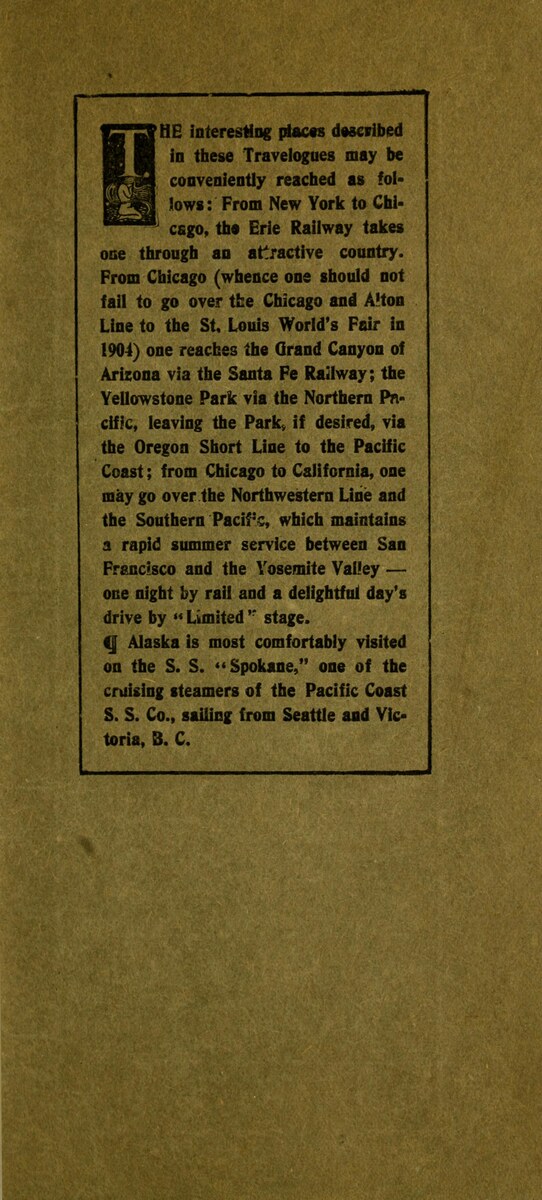
One more page rewards slow reading. After five descriptions of the American West, the programme told its readers how to go there: from New York to Chicago by the Erie Railway; to the Grand Canyon by the Santa Fe; to Yellowstone by the Northern Pacific; to Yosemite by the Southern Pacific, “one night by rail and a delightful day’s drive by ‘Limited’ stage”; to Alaska, most comfortably, on the steamer Spokane from Seattle. The back cover advertised the Hamburg-American Line’s cruises to Norway, the Orient and around the world. Holmes’s 1897 prospectus had shared its pages in the same way with a Hamburg-American “Grand Tour to the Orient,” a Chicago tour company and a Wabash Avenue shop that rented Kodaks.
The evening delighted those who stayed at home. The printed matter they carried out of the hall told them how to leave it.
What it meant to possess
The motto is lighter than it sounds, and heavier. As a traveller’s paradox it is charming: the person who has seen a place holds something its landlord may not. Holmes’s audiences possessed the world in exactly that way, in the dark, for a few dollars a season.
But the world he showed was also being possessed in the ordinary sense, and his camera was often present when it happened. He filmed Hawaii in 1898 for a lecture subtitled “On the Eve of Annexation.” In 1899 he reached Manila during the war between the United States and the Philippine Republic, when American forces held little more than the city and a thin wedge of country along the railway. From the deck of his steamer he watched American warships shell the shore of Bacoor Bay: “a terrific spectacle, made unreal and vague by the long miles of space between us and the warships.” When he landed, he wrote, “we step across the threshold of our new possessions.”
The language of capture was not confined to politics. On the voyage out, Holmes noted that the Chinese passengers objected to being photographed and tried to dodge the camera, “not knowing that the motion-picture camera is a photographic Gatling, certain to hit its victim, no matter how fast he may be able to run.” In Canton the American consul arranged for him to film his official departure in a sedan chair. After “three tremendously amusing rehearsals,” the reluctant extras were finally induced “by exhortation and handsome bribes to pass before the camera.”
Holmes was curious, observant and often generous, and his pictures kept street life, ceremonies and faces that no American newspaper was sending anyone to record. He could see the arrangement clearly when he chose to. Outside Manila, he wrote, men were killing one another after months spent pursuing “an enemy whom we, contemptuous white men, have pretended to despise.” But he did not linger there. He was not on stage to argue. He was there to take the audience along, and the places he took them were very often places Americans were learning to regard as theirs.
Easy chairs
In late 1915 Holmes signed with Paramount, which began releasing a new Burton Holmes travel picture every week. The company’s president, W. W. Hodkinson, gave the series its most honest description: the aim was to bring out the human interest of foreign countries “on what we might call ‘Our Easy Chair Journeys.’”
Paramount’s advertisements to cinema owners were franker still. One, with Holmes in a Japanese kimono, conceded that it wasn’t any trick to fill a theatre “now and then with a big star,” but urged the shrewd manager to demand “a star short reel,” one “with advertising possibilities, a nationally known name that draws.” Another, with Holmes in Javanese dress, put the matter plainly: “Why fool along with just a scenic when you can have a personally conducted travelogue by the world-famous traveler Burton Holmes? You can advertise the name and attract business.”
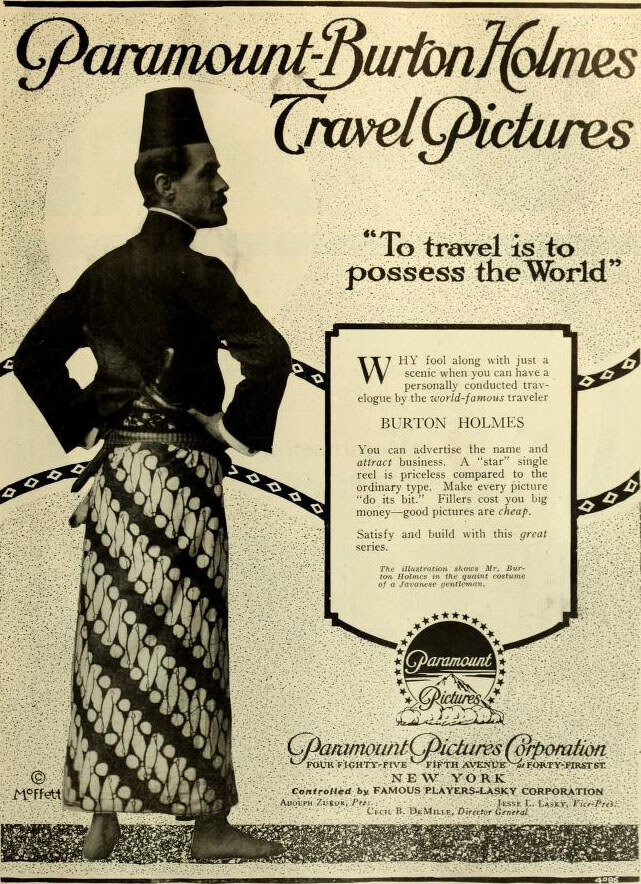
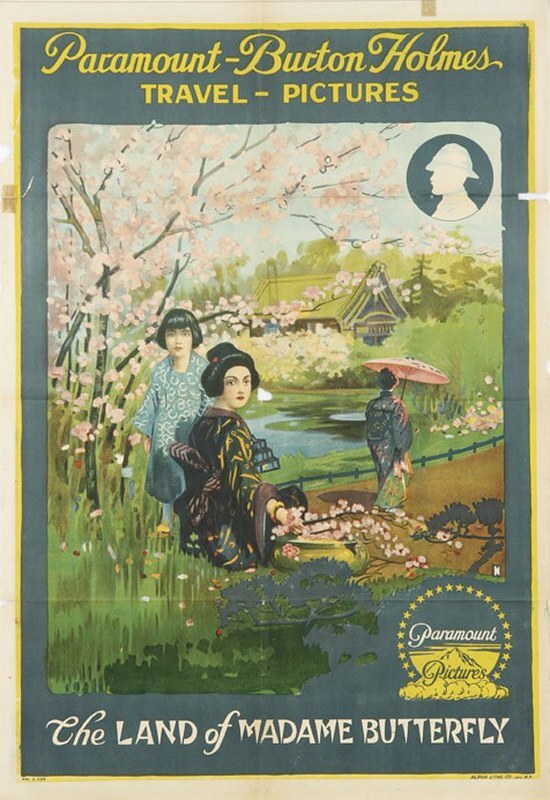
The scenery was interchangeable. The name was not. By then it supported a small industry: a film laboratory on Chicago’s North Ashland Avenue, a footage library that supplied scenes to Hollywood features, educational reels for schools and stereographs of Holmes himself, sold by the Keystone View Company as “America’s Favorite Traveler.” In the season of 1945–46, at seventy-five, he still gave 157 two-hour lectures.
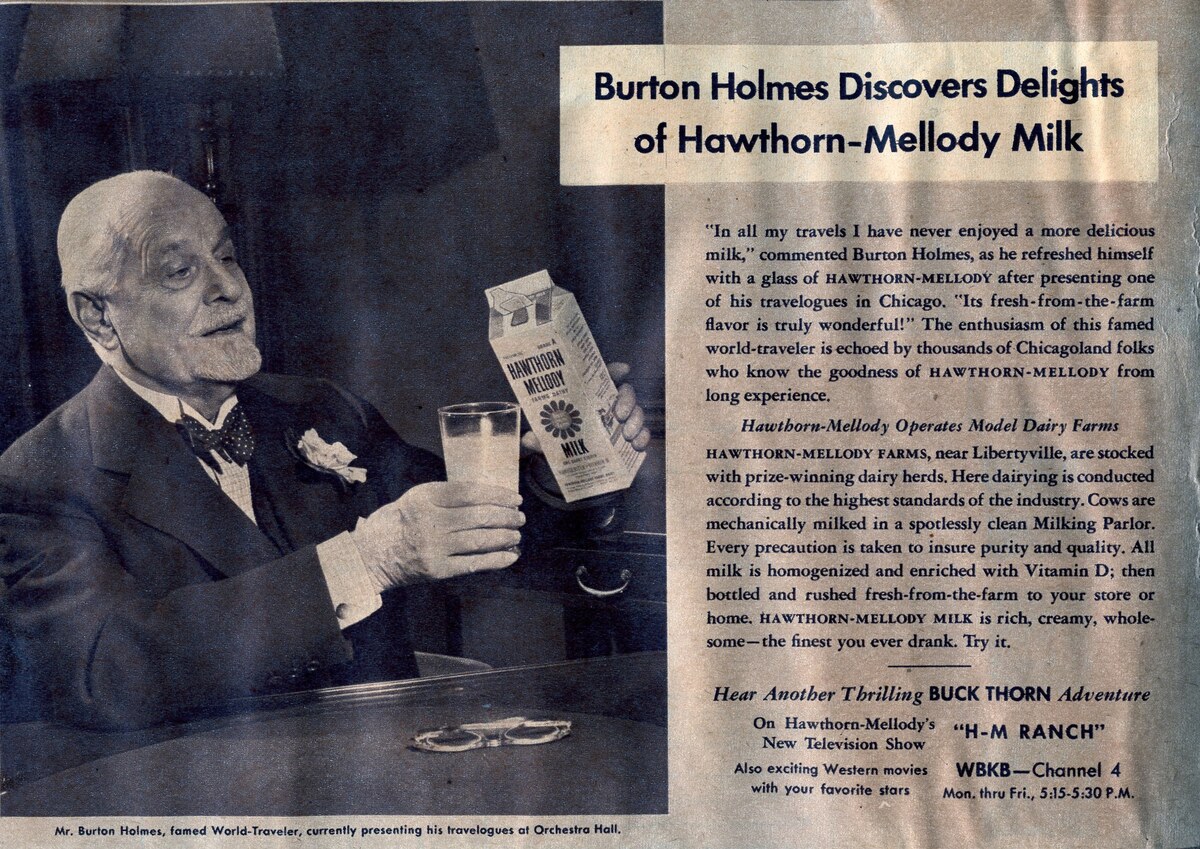
The name kept working. In 1949 a Chicago dairy printed his photograph, a glass of milk in hand, under the headline “Burton Holmes Discovers Delights of Hawthorn-Mellody Milk,” and quoted him after a travelogue in the city: “In all my travels I have never enjoyed a more delicious milk.”
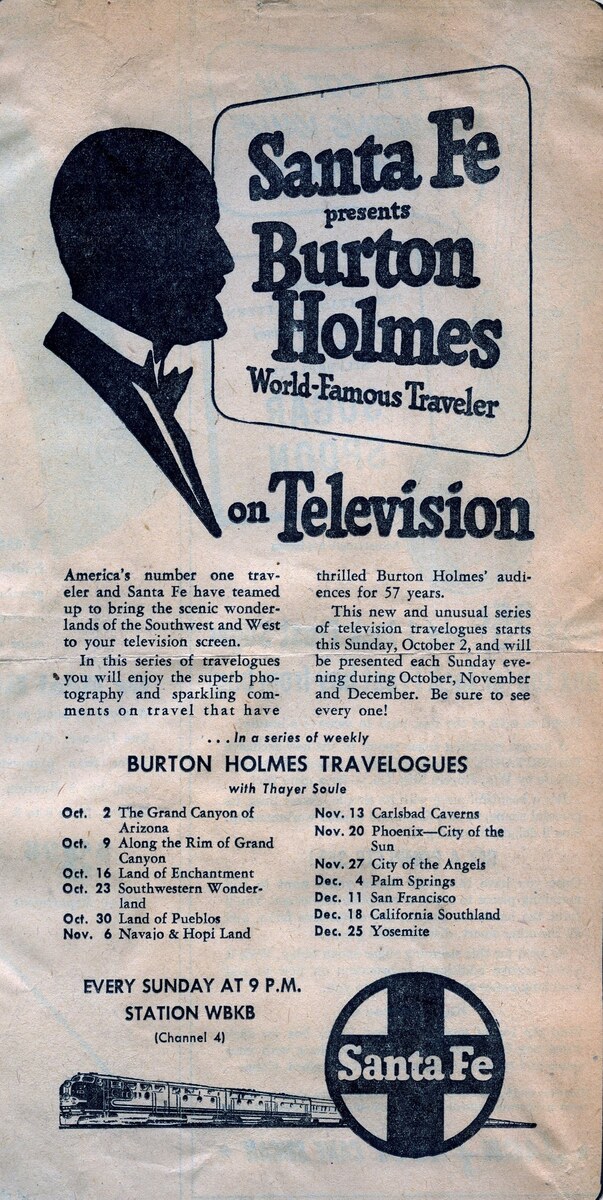
That autumn a railway sponsored thirteen Sunday-evening travelogues on Chicago television. The advertisement was dominated by a silhouette of Holmes in evening dress: “Santa Fe presents Burton Holmes, World-Famous Traveler, on Television.” The first programme was the Grand Canyon of Arizona. Forty-five years earlier, his London programme had told its readers to get there by the Santa Fe.
The boutonnière
The company was already preparing for his absence. In January 1947, on stage, Holmes transferred his boutonnière to Thayer Soule, the Harvard graduate who had filmed and presented many of the later shows—a small ritual that named a successor. In 1949 the firm hired another lecturer, Robert Mallett, who, by the company’s own history, knew nothing about photography and was engaged for his talent as an entertainer. After Holmes suffered a stroke in 1951, Soule and Mallett gave more than 250 scheduled shows. The billing still read Burton Holmes Travelogues.
In February 1953, writing from his house in the Hollywood Hills to his former cameraman André de la Varre, Holmes reported that receipts were well down that year. “People can now sit in slippered ease at home,” he wrote, “and see rotten travel pictures on their TV screens.”
It is a very good complaint, and a strange one for him to make. For sixty years he had sold precisely that: all the delights of travel for those who stay at home, the easy chair journey, the world possessed without the trouble of leaving it. Television kept the promise and did away with the hall, the evening clothes and the man at the side of the screen.
He died in Hollywood on 22 July 1958. Shows under his name went on for more than a decade, narrated by other men. What audiences had come for, from that first night at the Camera Club, was never quite the view. It was a person who went, came back and said we.