
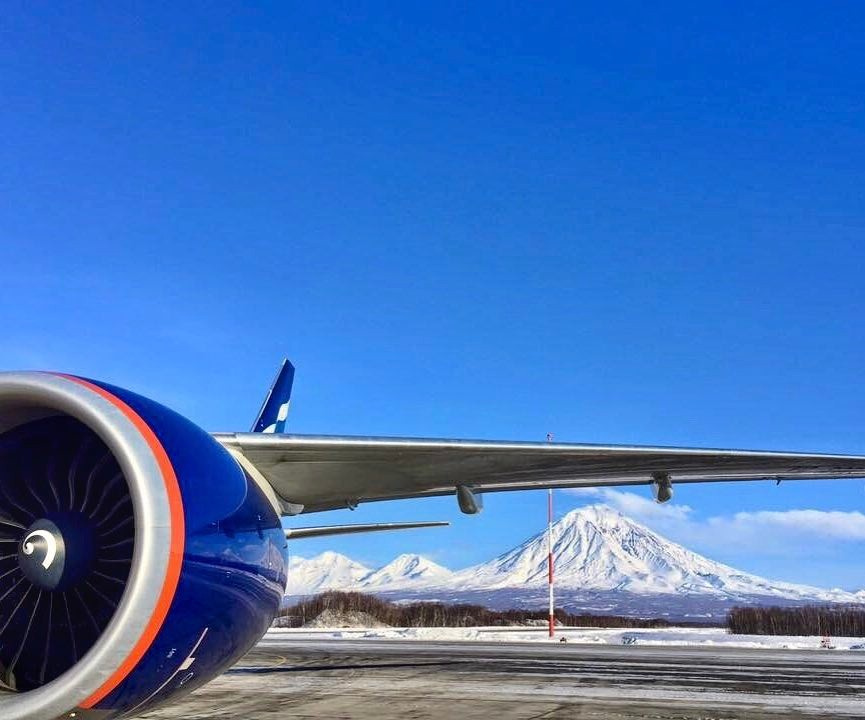
The first thing Kamchatka gave me was a volcano at the airport. Koryaksky rose beyond the apron at Yelizovo, its white cone filling the view past a terminal that already felt too small for the landscape. I had crossed Russia in search of a fireplace. The mountain made the ambition look rather domestic.
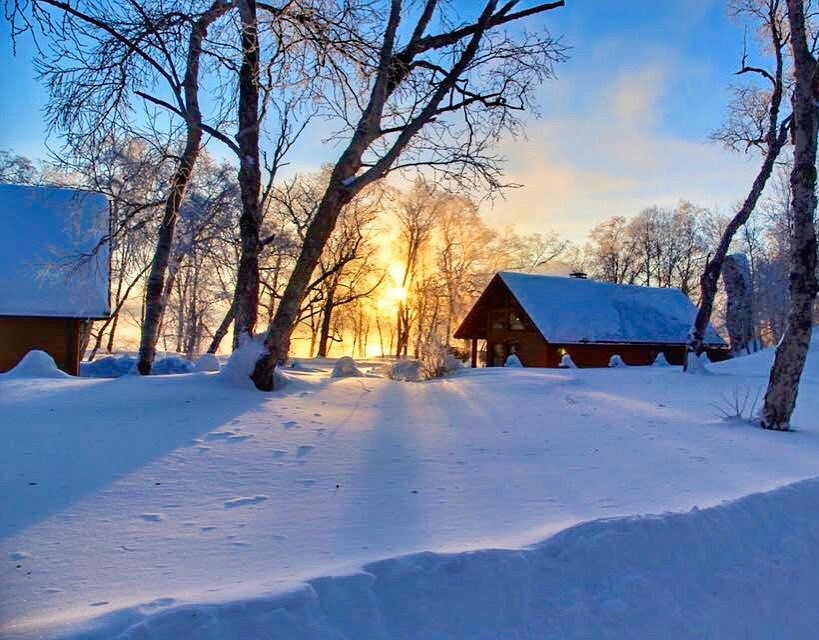
Kostya and I stayed at Russo‑Balt North Adventures for the first week of January 2016, in a wooden cottage outside Paratunka. It was the only accommodation I had found in Kamchatka that approached luxury, and it had a very Russian provincial way of doing so.
The little terminal in my photographs is no longer where regular passengers arrive; flights moved into Yelizovo’s new terminal in March 2025. Kamchatka’s essential distance remains. No road or railway connects the peninsula to mainland Russia. You fly in, then continue by road into a place where the snow, the darkness, and the scale of the mountains quickly make the journey feel justified.
Where Kamchatka is—and how it became Russian
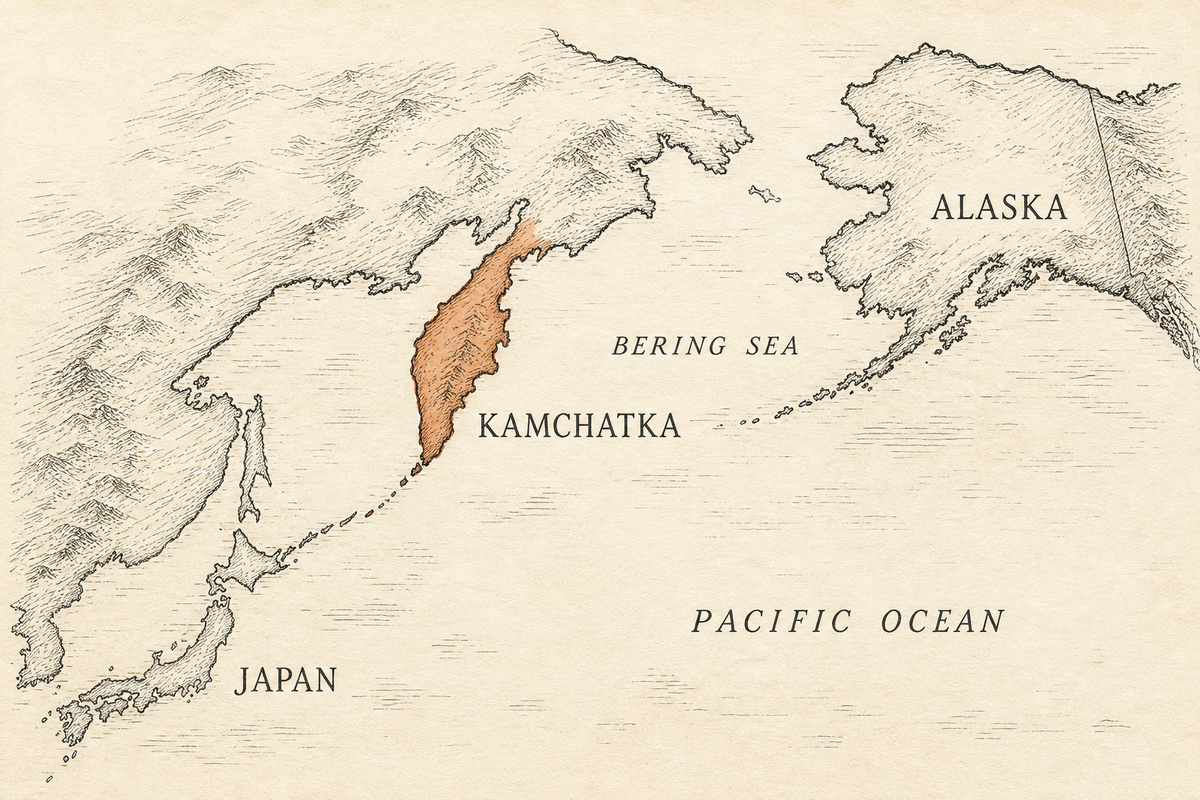
Kamchatka is the long volcanic peninsula hanging from Russia’s far eastern edge into the North Pacific. The Sea of Okhotsk lies to its west; the Bering Sea and Pacific open to the east. Alaska faces it across the water, while Japan lies to the southwest beyond the Kuril chain. On a map, Moscow belongs to another world.
The volcanoes are not scenic decoration laid over an ordinary landscape. Kamchatka sits on the Pacific Ring of Fire, and its protected volcanic territories contain active cones, glaciers, wild rivers, salmon runs, and major populations of brown bears and Steller’s sea eagles. UNESCO inscribed the Volcanoes of Kamchatka in 1996, recognizing six protected areas spread along the peninsula.
Long before it became Russian, Kamchatka was home to Indigenous peoples including the Itelmen and Koryak. Russian imperial expansion arrived with Cossacks at the end of the seventeenth century. Vladimir Atlasov’s 1697 campaign is conventionally presented as the peninsula’s “joining” Russia; the Kamchatka regional museum’s own account records that Cossacks imposed fur tribute by persuasion and by force.
In 1740, Vitus Bering and Alexei Chirikov made Avacha Bay a base for the Second Kamchatka Expedition. Petropavlovsk took its name from their ships, St. Peter and St. Paul. A century later, during the Crimean War, its garrison repelled an Anglo-French attack. The pattern was already visible: expedition base, Pacific port, military outpost.
Driving through all that beautiful, naturally rich country, I kept thinking: how lucky Alaska was that Russia sold it. The sentence is too neat for either place—Alaska has its own history of colonization and loss—but it returned whenever magnificent country met painfully thin infrastructure. Russia transferred Alaska to the United States for $7.2 million in 1867. Kamchatka instead passed through the Soviet decades as a restricted military frontier and opened to foreign visitors only in 1992. Alaska had become a mature travel destination. Kamchatka still felt as though its beauty had spent most of the twentieth century waiting behind a closed door.
The fireplace that chose Kamchatka
Kamchatka had not been my plan. I wanted a Russian winter, and I had made the brief awkwardly specific: a separate wooden cottage, a real wood-burning fireplace, forest, deep snow, skiing, and horses. We considered Altai, Lake Baikal, Karelia, and several other beautiful cold places. Each search failed on the same small word: real. An electric imitation would not do.
Then a friend sent us photographs of North Adventures. Each cottage appeared to have its own fireplace and an outdoor pool filled with hot thermal water. The same geothermal source warmed the floors. Snow lay deep around the buildings.
Only one detail remained. Where was it?
Kamchatka.
Until then the peninsula had occupied a curious corner of my imagination: red caviar, brown bears, Klyuchevskaya Sopka, and the Russian schoolroom expression “Kamchatka” for the back row of the class. I began reading about volcanoes in winter and forgot every other destination.
The reservation nearly restored my doubts. In 2016 the hotel was absent from the usual booking platforms, and its modest website did little to make the process feel conventional. We arranged everything by correspondence. Full payment, in rubles, had to go to a personal Sberbank card. One night cost more than our return airfare. It was the least polished luxury booking I had ever made.
Then we opened the cottage door.
A cottage made for the cold
The living room was large, warm, and finished in wood and stone. Panoramic windows faced the Paratunka River valley; the real fireplace stood ready for use; the floor was heated underfoot. Beyond the glass, birch forest and snowdrifts seemed to absorb every sound. A private thermal pool steamed outside.
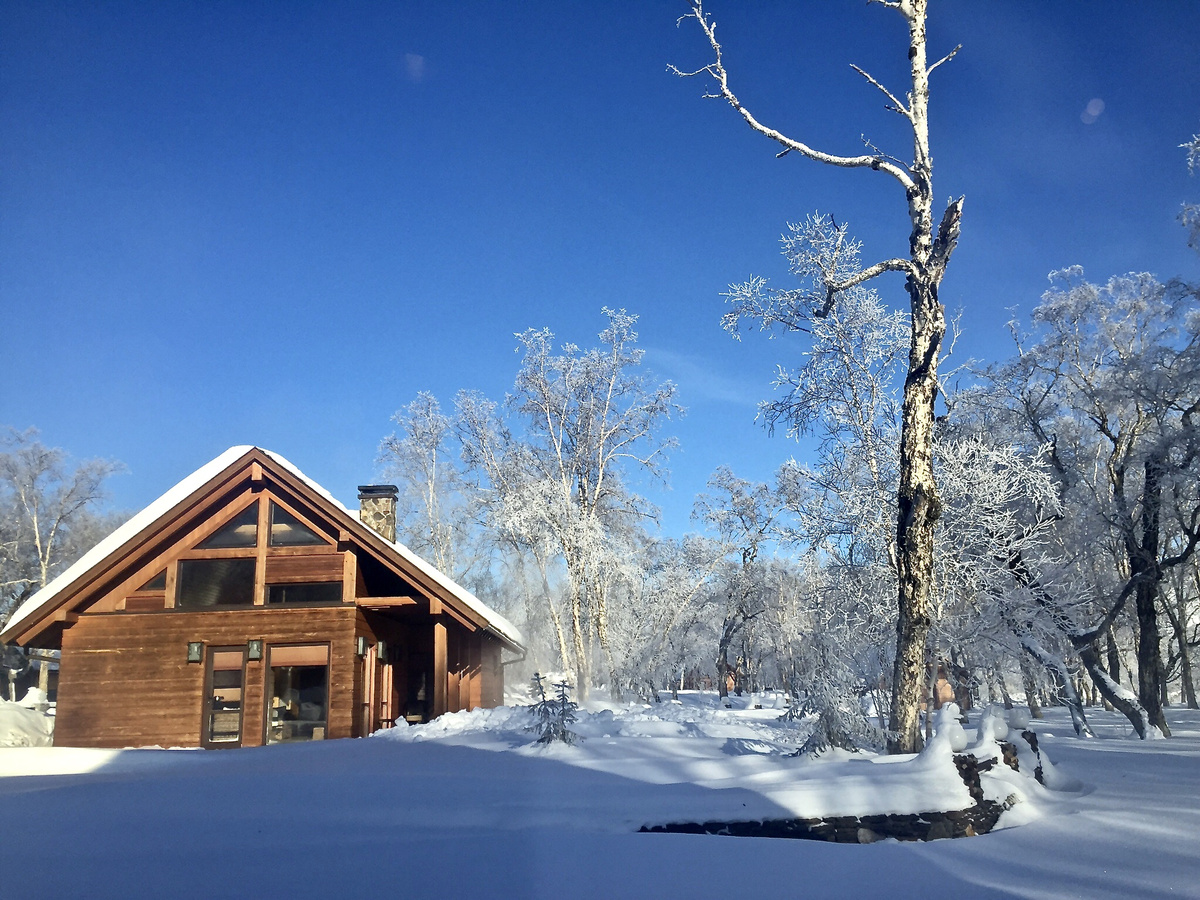
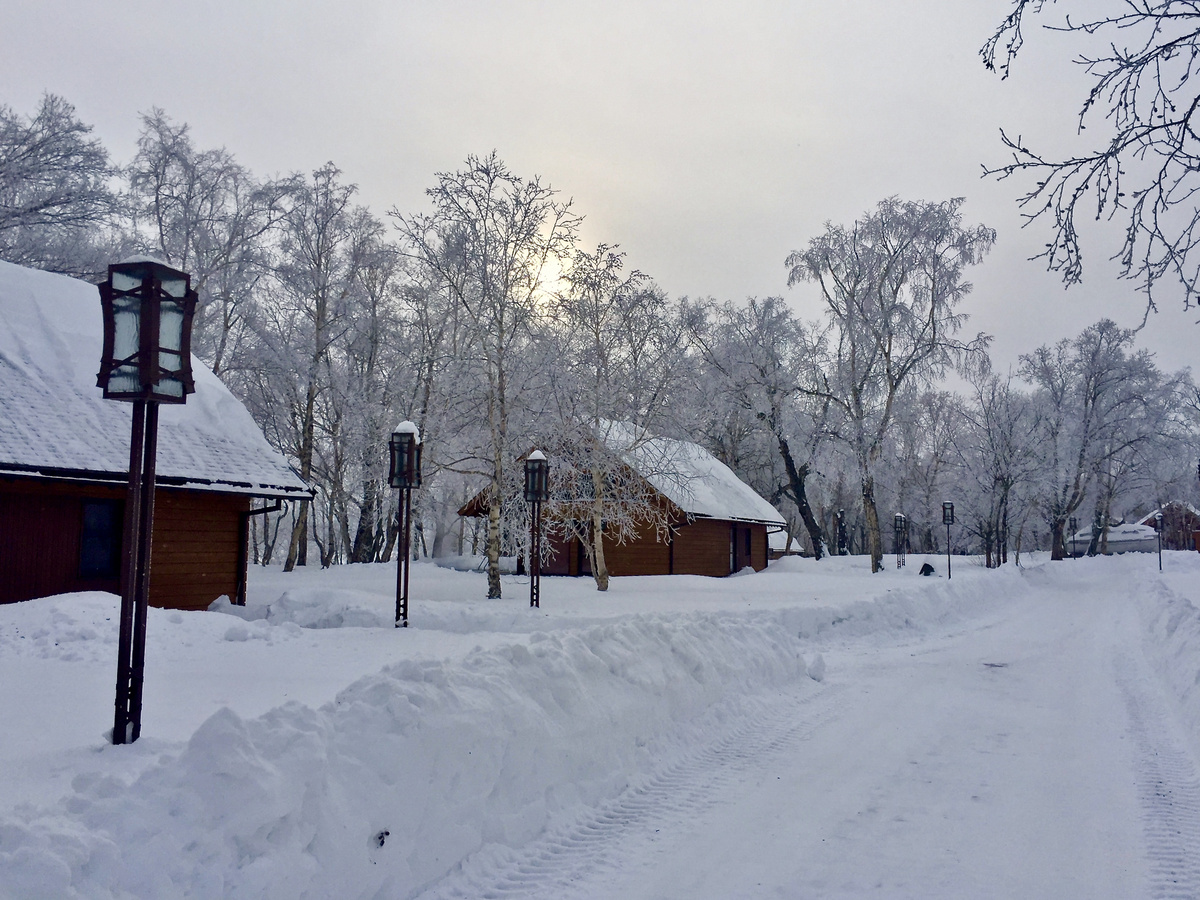
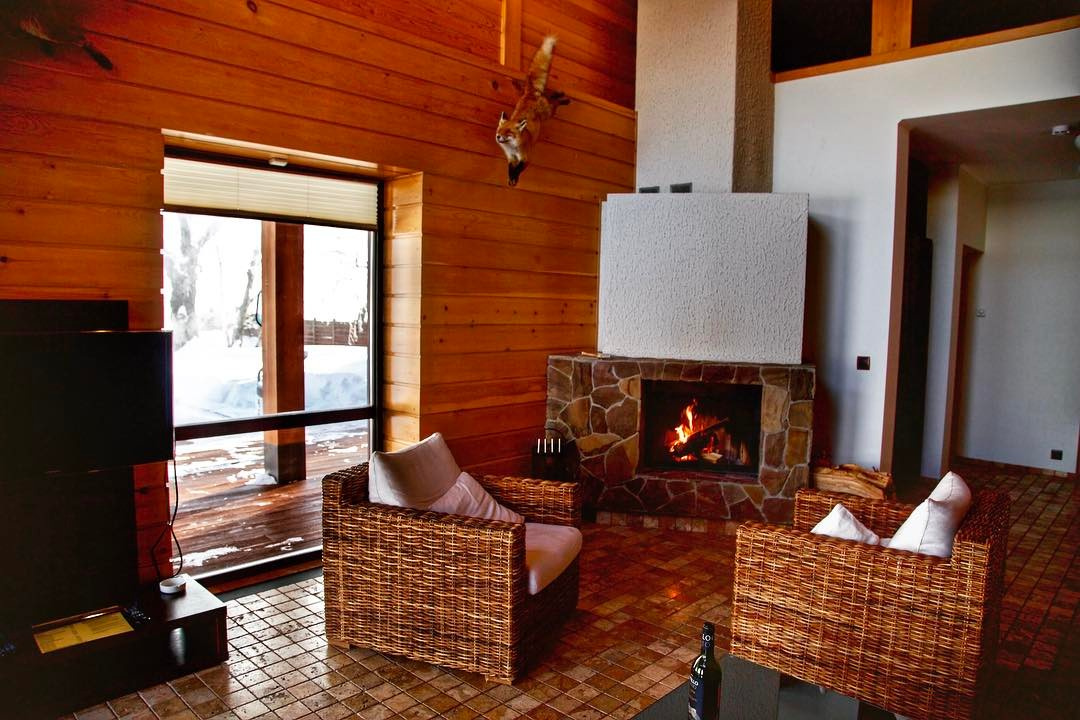
This was where the hotel made sense. Its luxury came from space, privacy, and an intelligent answer to the cold. The fireplace was meant to be lit. The pool belonged to winter. Both shaped every evening of the stay.
At around -27°C, I would sit in a chair by the fire with a book, a blanket, and a glass of wine while frost gathered on the windows. The pool waited a few steps beyond the bedroom door. Getting there meant a brief dash into the dark; then the water closed warm around me, steam lifted toward the stars, and the cold remained only on my face.
On weekends, local residents came to the hotel for its thermal pool. That told me something: even on a peninsula famous for hot springs, easy access to thermal water was not a feature to take for granted. I had it privately, outside my bedroom door.
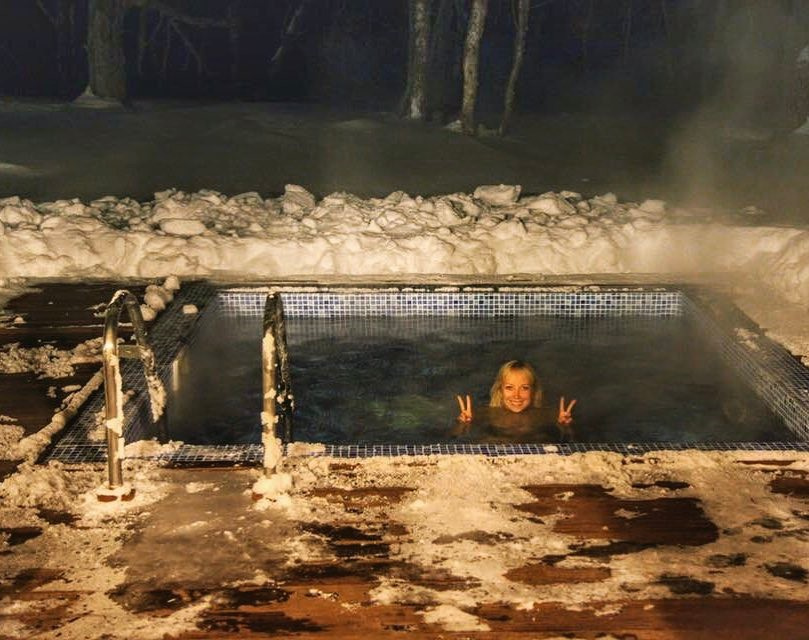
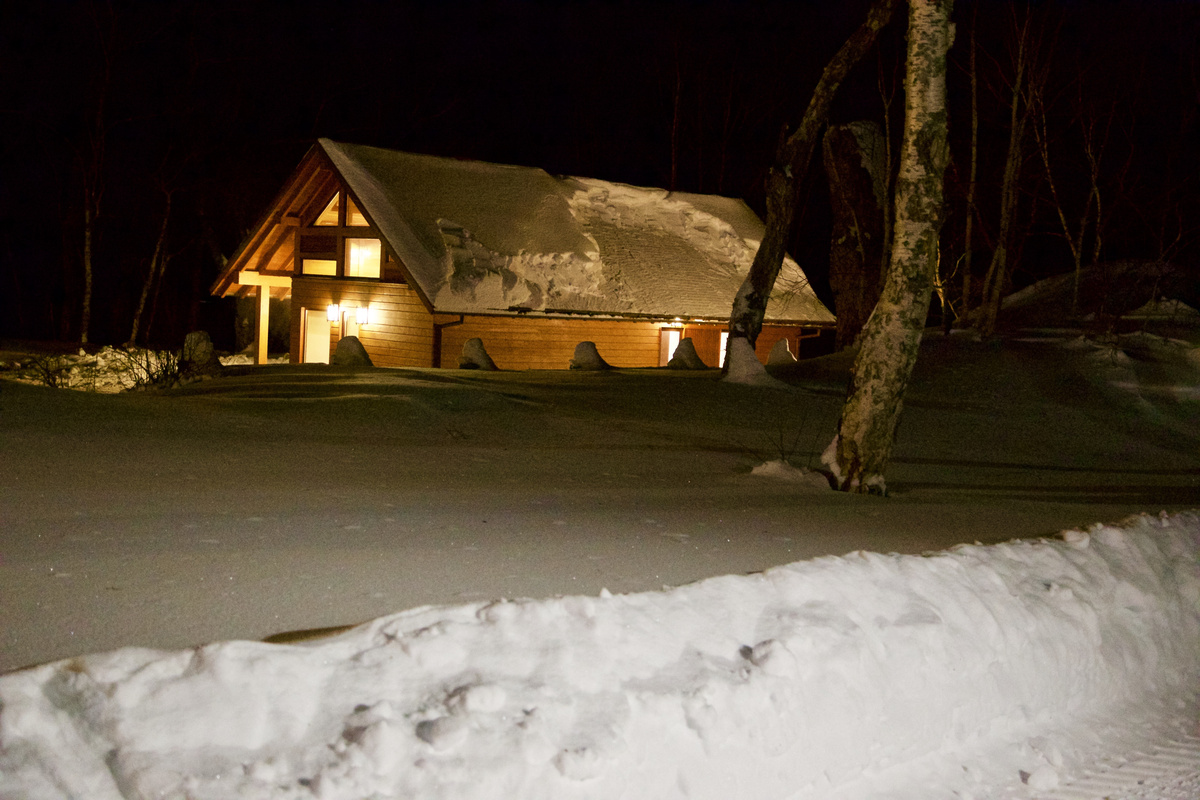
In another climate, a private pool is an amenity. In a Kamchatka winter, it became the rhythm of the cottage: cold and heat, darkness and fire, the difficult peninsula outside and a refuge that belonged to it completely.
Three ways into the snow
The cottage was most persuasive at the end of a day outdoors.
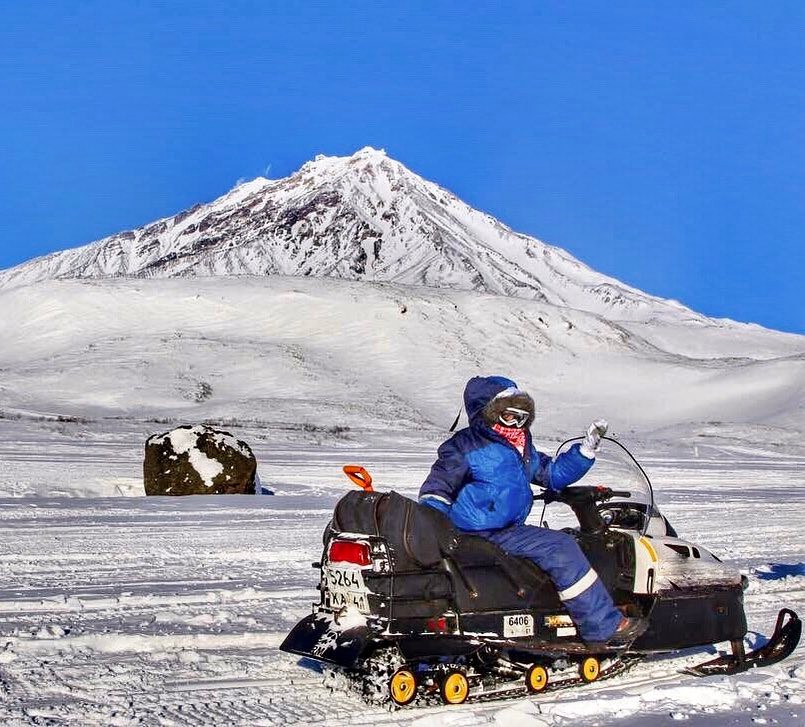
For the snowmobile excursion, the temperature was about -31°C. Our guide handed out extra cold-weather gear, explained the machines to a group of beginners, and then set off toward the Avachinsky volcano area at more than 60 kilometers per hour. The packed snow crunched beneath us. Machines tipped into deep drifts; riders climbed out; somebody hauled the snowmobiles upright; we carried on. The cold found every weak point in my clothing, while the volcano stayed dark against the white.
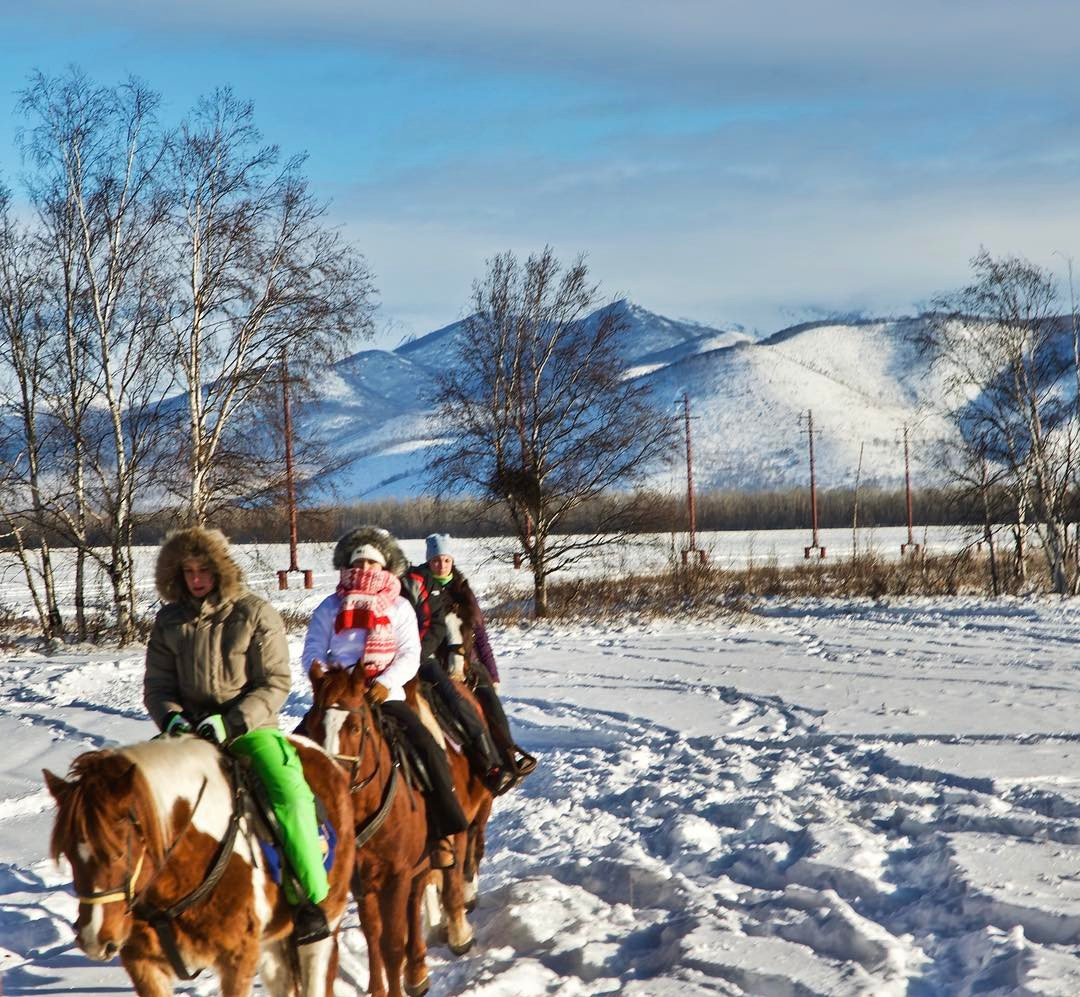
Two days later, at about -25°C, I was on horseback. I had wondered whether anyone sensibly rode in such weather until I saw the horses in their thick winter coats and the untroubled Kamchatka riders beside us. We passed through open tundra and snowy forest, by rosehip thickets and enormous poplars, toward an icy branch of the Avacha River. Trotting in deep snow was new to me. Staying out of the nearest snowdrift became a useful incentive to learn quickly.
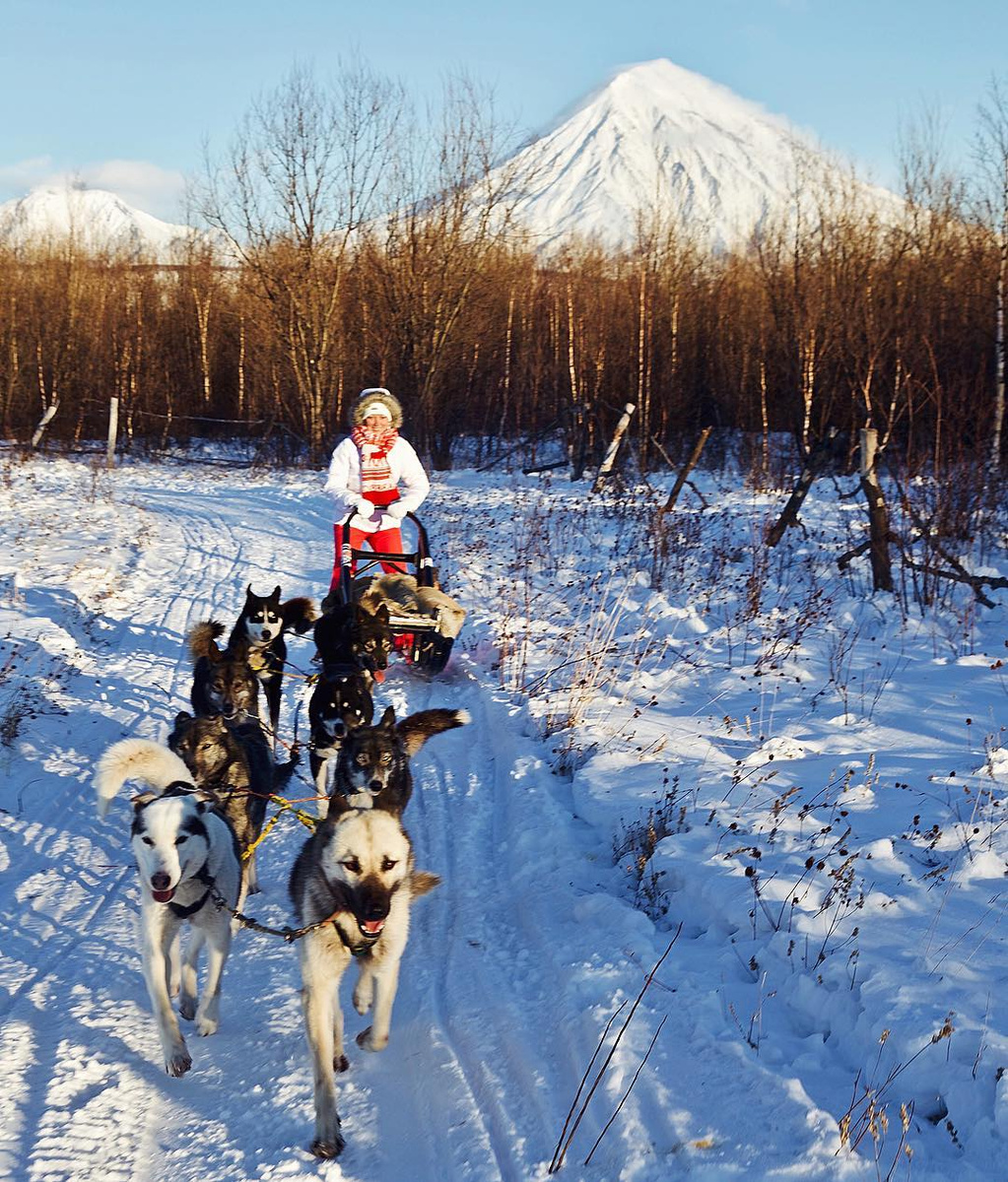
I approached the sled-dog kennel with more complicated feelings. I worried about the cruelty of asking dogs to pull for our amusement. Then the huskies, laikas, and huge malamutes met us with such noise and impatient energy that my tidy assumption became harder to maintain. I watched them around the teams and the people who worked with them, then drove a sled myself. For a little while, I was the musher. The visit did not settle every question about the activity, but it disturbed the easy answer I had brought with me.
There was a historical irony in those dogs, too. Alaska helped preserve and celebrate one northeast Siberian line: Chukchi sled dogs brought there in 1909 became the foundation of the modern Siberian Husky. Across Russia’s Far East, native sled-dog populations collapsed during the Soviet period, and Russia’s Dog Museum now describes Kamchatka’s own sled dog as being on the verge of extinction. The two dog traditions are not the same, and the animals at our kennel were a mix of huskies, laikas, and malamutes. Still, the contrast sharpened the thought I had been carrying since the airport: how much Alaska had preserved, and how much Kamchatka had nearly lost.
Each time we returned, the cottage completed the day. Wet layers came off, the heated floor did its work, and the pool sent steam into the dark. By then I understood the hotel from the outside in. It made a hard day in the snow easy to begin and the cottage irresistible to return to.
Five mornings of crab omelet
The restaurant was where isolation stopped feeling romantic.
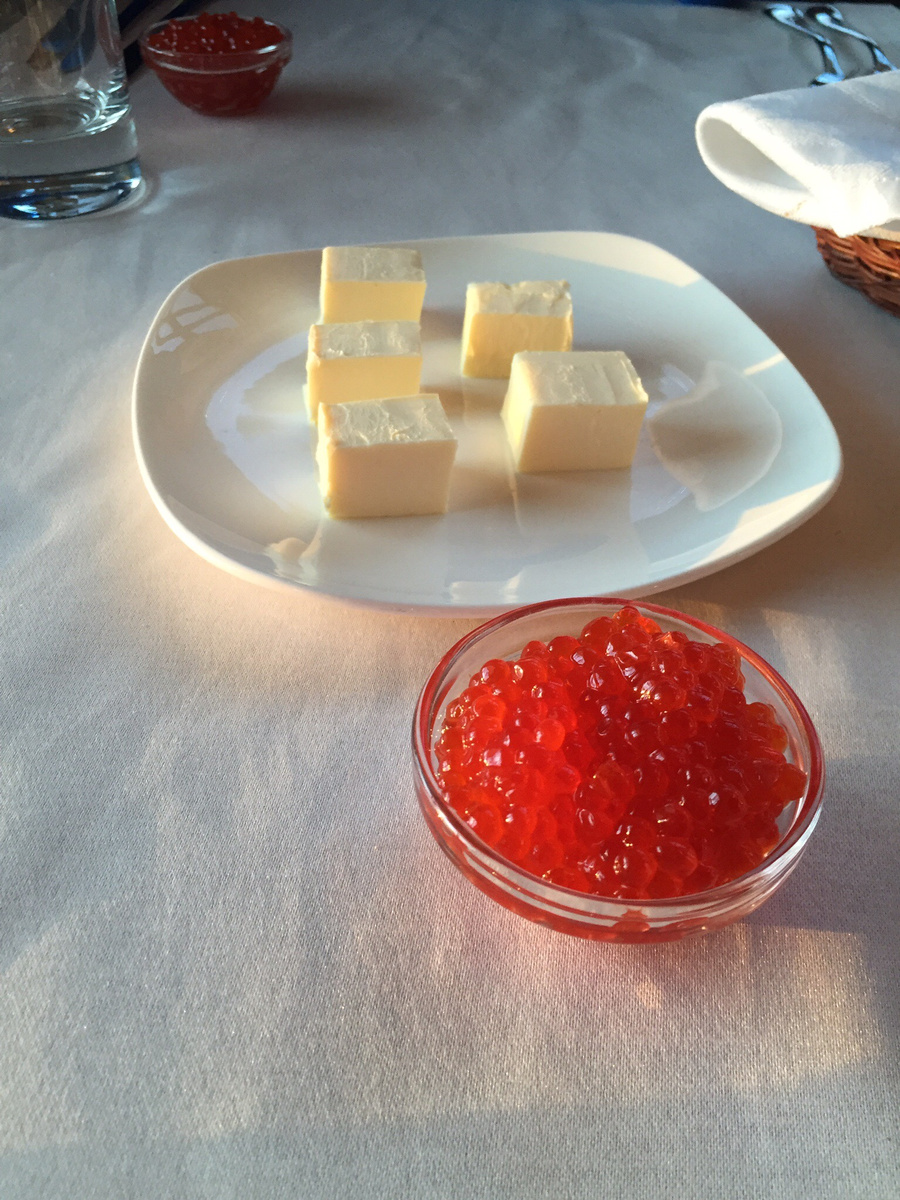
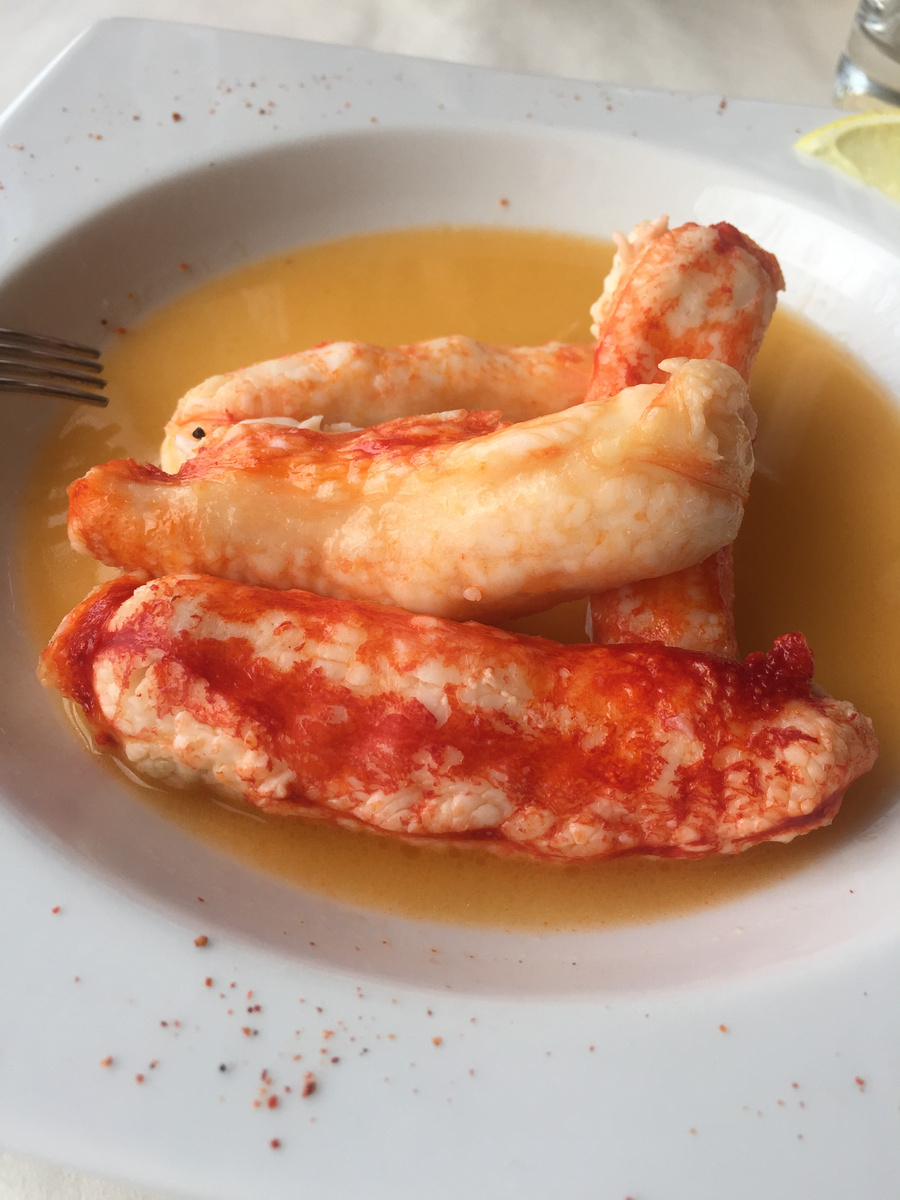
Breakfast could begin with red caviar or Kamchatka crab. Red caviar arrived in a glass bowl beside large cubes of butter, as casually as jam might appear elsewhere. The crab omelet was excellent. After five mornings, I had also learned that an excellent omelet can become boring.
The menu was short and barely changed. Much of it revolved around elk, bear, and other hunted game, which I do not eat because of my personal beliefs. Kostya had no such restriction and was entirely happy. I found myself circling the same couple of dishes. For a night or two, that would have been a minor inconvenience. Over a week, the only restaurant becomes part of the room rate.
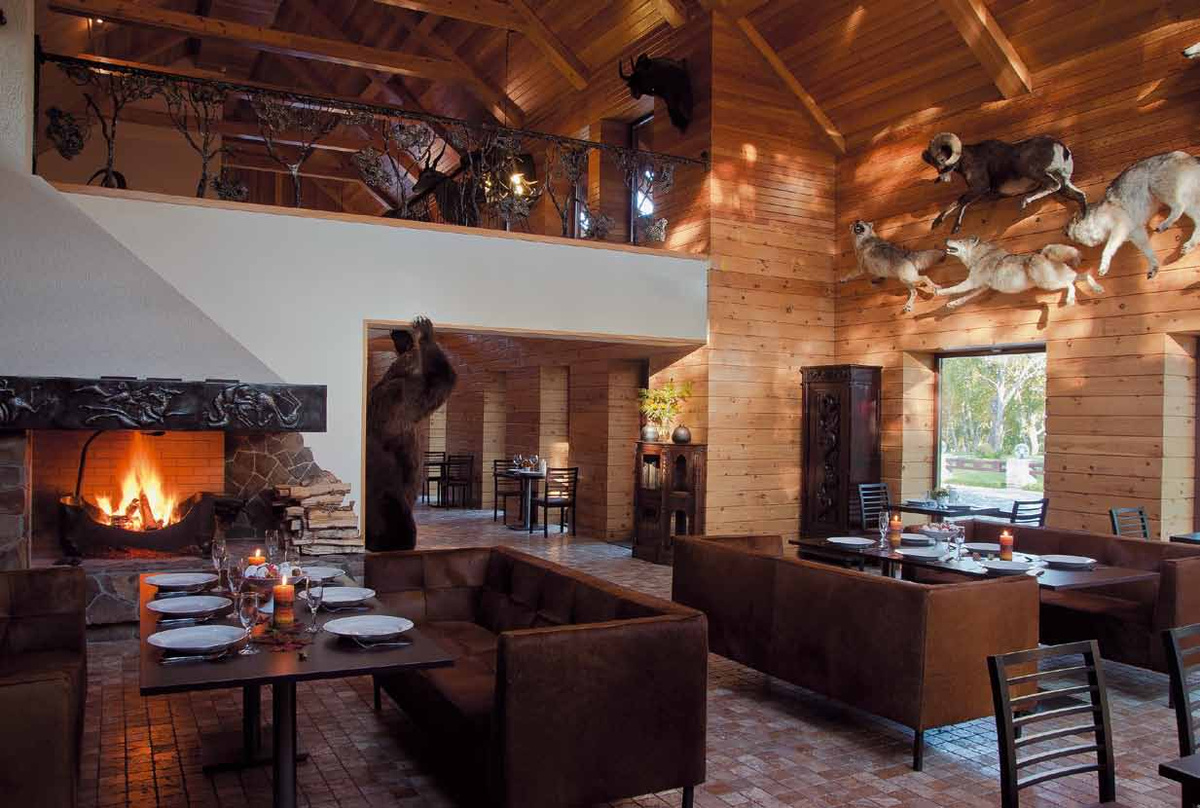
The mounted animals in the dining room made my discomfort harder to ignore. When I objected, a staff member told me that visitors from “the mainland” could not understand life in a place where a bear might appear five meters away on the road. The explanation did not change what I wanted on my plate, or how I felt about the animals on the walls. It did explain the distance between my idea of wildlife and theirs.
The cooking was never the problem. The crab proved that. Choice was. North Adventures gave me a cottage I could happily inhabit for a week and a restaurant menu I could not.
If I returned now
The restaurant is still called Season of Hunting, and the hotel continues to present seafood and game as its identity. Before a long stay, I would confirm the rate, payment method, inclusions, and full menu directly.
The welcome change is that Paratunka now seems to have more choice. These are names for my next trip, not places I can review from experience. Among the better-rated nearby options on Yandex Maps are Mishka and Los Losos. Mishka has a broad Russian and European menu, plus Italian dishes and a separate Lenten selection. Los Losos leans toward fish and seafood, with pizza and pasta for anyone who has had enough of Kamchatka crab.
The one I am most curious about is Bering at Kamchatka Chalet, a hotel that arrived long after my visit. Its menu is built around Kamchatka salmon, crab, scallops, shrimp, mussels, sea urchin, and seaweed. Meat and venison also appear, so I would still mention dietary limits when reserving.
If I were prepared to make an evening of it and go into Petropavlovsk-Kamchatsky, I would look at Dva morya, okean for its strong crab-and-seafood emphasis, or Restoran Kamchatka, where fish, crab, local berries, and herbs share the menu with venison. Both are well reviewed, but neither is an easy walk from Paratunka: dinner means arranging a transfer. Before leaving the hotel, I would settle how I was getting back, how I could pay, and what the kitchen could serve me. A star rating cannot answer any of those questions.
Back to the fire
At the time, I had found nowhere else in Kamchatka where I could come home from a volcano to my own wooden cottage, light a real fire, and step from the bedroom into a private thermal pool. North Adventures did not imitate a city hotel. Its luxury was an intelligent answer to the place.
That answer was sometimes provincial. The booking was improvised and the restaurant too narrow for a week, especially for me. I would return with a plan for dinner. I would also return to the same cottage without hesitation.
After the day below Avachinsky, the cottage appeared among the trees with firelight in its windows and steam rising beyond the bedroom. Outside was the dark, difficult peninsula I had travelled so far to see. Inside was exactly where I wanted to be.
Shared on

The post and its conversation
The photographs as they appeared on Instagram, with what readers said there. Likes and replies open on Instagram.



 Join the conversation on Instagram