
You have a ticket, arrive for your flight and discover that the airline cannot take everyone. Perhaps the aircraft has changed. Perhaps the gate agent is offering money to anyone willing to leave later. It is an unwelcome coincidence in a journey that, until then, seemed perfectly ordinary.
I have watched US airlines raise those offers: $100, $200, $300, $400. There is room for negotiation, but it helps to understand what the airline is trying to resolve. This is quite different from a hotel sending a guest to another property. At the airport, the most useful currency may be a few hours of somebody else’s time.
Why airlines sell more tickets than seats
A flight has a hard departure time. A hotel guest delayed by a few hours may still use the room that night; a passenger delayed by a few hours has missed the flight altogether. Connections add another source of uncertainty. The passenger may still be travelling, just on an inbound aircraft that will arrive too late.
Then there are changed plans, flexible tickets moved to another departure and passengers who simply do not turn up. These absences are frequent enough for airlines to build them into their sales calculations. Some deliberately accept more reservations than the aircraft has seats, forecasting how many people will actually present for that departure. American and Delta both describe this practice in their published policies.
If the forecast is right, the aircraft leaves full and nobody is left behind. If more people arrive than expected, a sound-looking calculation becomes a very real problem at the gate. An oversold flight and a passenger being denied boarding are therefore not quite the same thing: the first can pass without the second ever happening.
The hotel mechanism I explain in my overbooking article is different. Overlapping tour-operator allotments and delayed sales reports can leave the property with more confirmed guests than rooms. Airline overselling does not need that reporting gap. The reservation system can knowingly accept the extra bookings. That decision belongs to the airline. A travel agent’s GDS connects to the inventory; it is not an operator holding a separate hotel-style allotment of seats.
When the replacement aircraft is smaller
There is another route to the same unhappy announcement. The original aircraft develops a technical problem, or its inbound flight is running so late that the airline substitutes another aircraft to keep the departure moving. The replacement may be perfectly suitable for the route and still have fewer seats.
In that case the airline need not have oversold the original flight at all. The available capacity has fallen after the tickets were sold. Replacing the aircraft may save most passengers from a much longer delay or cancellation while creating a shortage for a few.
The difference need not be dramatic from the terminal window. The sketches below use four actual Delta layouts. Each seat symbol represents one seat; the outlines and spacing are simplified. These are airline configurations, not universal capacities attached to an aircraft name.
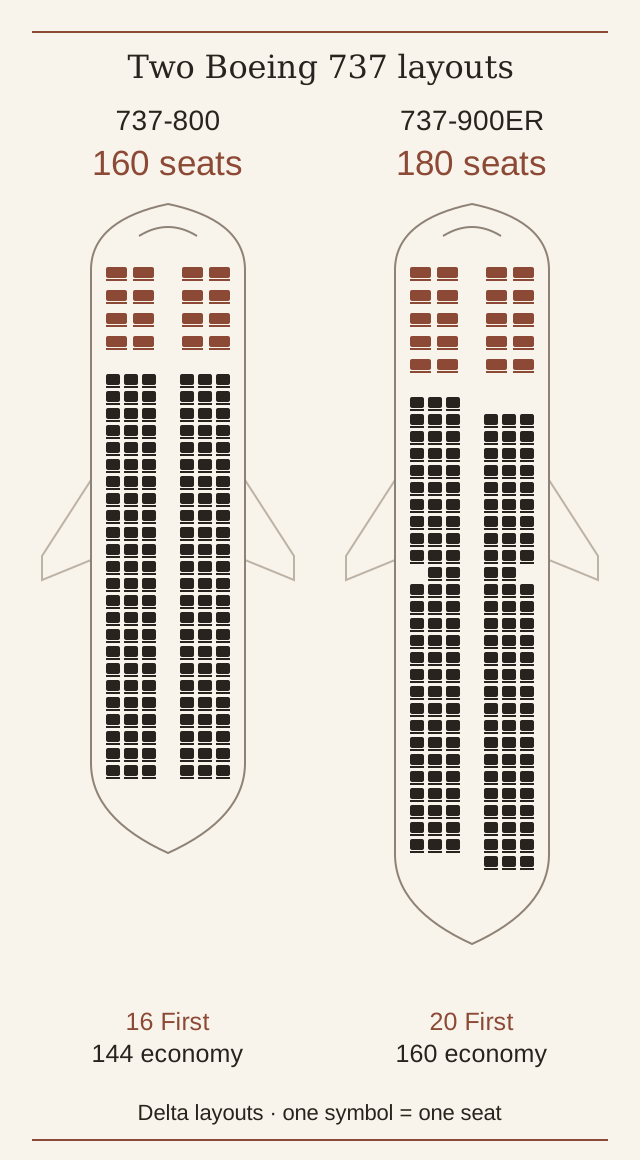
A full 180-seat departure moved from this 737-900ER to this 737-800 would be 20 seats short. Four of the lost seats are in First. The airline has to reconcile both the total passenger count and the cabins people bought.
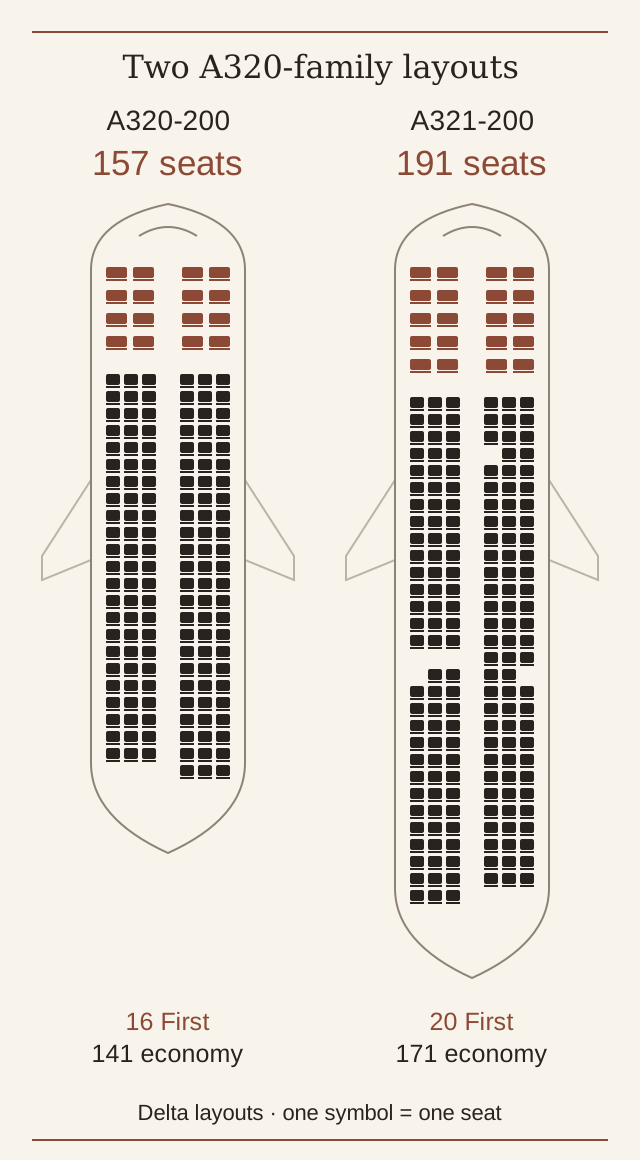
The Airbus comparison shows a larger change within the A320 family. Across the two illustrations, the 160-seat 737-800 and 157-seat A320 differ by just three places. Even that small difference matters when every seat has been sold and everyone arrives.
The same aircraft type can also have different interiors. More premium seats, different spacing, galleys and toilets all affect the layout. A damaged seat can reduce usable capacity without changing the aircraft at all; operating weight limits can constrain the load too.
A cabin shortage is not always a shortage of seats overall. A passenger offered economy instead of business is facing a downgrade, with different reimbursement rules from someone refused the flight entirely. Conversely, spare seats at the front may allow the airline to move people forward and free space in economy. Once the whole aircraft is full, an upgrade cannot create another place.
A hotel can change your address; an airline may need to change your day
At a hotel, the discussion can be about a better room in the same building or a suitable replacement nearby. You can still sleep in the destination that night. The negotiation concerns the standard of the stay, the move and the inconvenience.
An airline has fewer ways to preserve the original arrangement. Another aircraft going to the same destination is a separate departure, with its own capacity, boarding deadline and connections. Moving you to it may alter the whole journey. A more comfortable seat tomorrow does not replace arriving today.
That is why the airline first looks for people whose plans can absorb the change. A volunteer with a free afternoon may be quite content to take the next departure for an agreed payment. Someone travelling to a wedding, a cruise or an onward flight may have no useful flexibility to sell. The same offer can be generous to one passenger and worthless to another.
Why the offer is usually the airline’s own next flight
After an airline-caused missed connection on a through ticket, you may be rebooked on a partner airline. Yet at an oversold departure, the announcement often offers money and a later flight with the original carrier. Why not simply put the extra passengers on the competitor’s flight?
If the airline’s next departure has an empty seat, putting a volunteer on it avoids paying another carrier to provide the transport. An incentive to wait, plus any meals or accommodation, can cost less than transferring that passenger. That advantage shrinks if the later flight is full, the wait becomes expensive or the proposed journey does not suit the traveller.
Airlines do have agreements to carry each other’s passengers after disruption, including overbooking, and these can cross alliance boundaries. The receiving airline still has to accept the passenger and be paid. The applicable agreement may provide a negotiated rate or a settlement calculation rather than the last-minute retail price. Overbooking is not subject to a universal rule requiring the airline to buy a new full-price ticket.
At an oversold gate, the airline can also choose among passengers willing to accept that bargain. A missed connection has already stranded a particular traveller; a call for volunteers searches for someone whose plans fit the airline’s proposed solution. The airline is trying to resolve the shortage at an acceptable cost, and the passenger is deciding what the delay is worth.
A 2019 US Government Accountability Office review recorded the resulting pattern: industry representatives described interline agreements as used mainly for delays and cancellations, while overbooking volunteers typically accepted a later flight with the same airline. That describes the usual arrangement, not a prohibition on using another carrier.
A $400 offer tells you what the airline is prepared to pay you to wait. It does not reveal what another airline would bill it. I would judge the proposed journey and payment together, rather than assume that the competing flight’s retail price sets the limit of the negotiation.
The practical question, if the proposed journey does not work, is simple: “Is there a flight with another airline that you can put me on today?” A seat visible for sale elsewhere does not itself complete that transfer; the agent still has to arrange the booking and ticket. Nor does being a partner guarantee that the other flight has room.
There is also a legal distinction. On qualifying EU and UK journeys, the right to rerouting at the earliest opportunity can require consideration of other airlines. The UK regulator explicitly says the absence of an agreement must not become a barrier to arranging that rerouting. A carrier’s preference for its own next flight is not the same as the full extent of its obligations.
What the rising offers mean
I would read the rising figure as a sign that the airline has not yet found enough people willing to change their plans. It is buying flexibility, and the opening offer has not bought enough.
Waiting may produce a better offer. It may also produce nothing, because somebody else accepts and the airline has all the volunteers it needs. There is no reliable instruction to “always volunteer last”. The sensible question is whether the arrangement on offer suits your journey.
Before discussing the amount, I would establish the alternative: “Which flight can you confirm me on, and when would I reach my final destination?”
A confirmed place later that afternoon is different from standby, where you are waiting to see whether a seat becomes available. A replacement first leg is little help if it breaks the connection beyond it. If tomorrow is the proposal, the hotel, meals and transport belong in the conversation too.
Then consider what the payment actually is. Cash, a gift card and airline credit are different offers. Credit that expires before you expect to fly again, or cannot be used as you hoped, may be worth much less to you than its printed amount. Ask about those restrictions while deciding, rather than after accepting.
If the early offer is attractive, it is reasonable to ask whether any later increase would also apply to you. Some uncertainty can be removed by a direct answer; there is no universal promise that the first volunteer receives the last amount announced.
For a party, settle whether everyone travels together, in which cabin and what happens to checked bags. Once the agent accepts the arrangement, have the replacement flight and payment confirmed before leaving the gate. Showing interest in volunteering is not yet an instruction to miss your original boarding.
When the airline has to choose
If too few people volunteer, the airline may have to decide whom to leave behind. This is where the booking you already hold, and your existing relationship with the airline, can matter.
I have felt that high loyalty status has helped me in these situations. Published boarding priorities give that impression a concrete basis: Delta recognises specified elite tiers and premium passengers, while American lists elite status, paid premium cabins and check-in timing among its factors. Assistance needs can also affect the decision.
I have also associated having a paid, assigned seat with getting through these situations. The published terms give less support to that as a general rule. An ordinary seat-selection fee is different from buying a premium-cabin ticket, and even paid assignments can change after an aircraft substitution. These are details that may help explain why the airline selects one passenger rather than another.
If you do not want the proposed change, distinguish the request from the decision: “Are you asking me to volunteer, or telling me that I cannot board?” Agreeing to a volunteer offer and being refused carriage against your will have different compensation consequences. Accepting an alternative flight after an involuntary refusal does not, by itself, make you a volunteer.
The explanation affects the compensation
The voluntary payment is negotiated. Statutory compensation for involuntary denied boarding follows the applicable rules; it is not automatically added on top of a volunteer’s bargain.
For covered US departures, qualifying involuntary oversales compensation depends on the one-way fare and the arrival delay of the offered substitute transport. A smaller aircraft substituted for operational or safety reasons is an important exception to mandatory US denied-boarding compensation. The US Department of Transportation guide sets out the eligibility, amounts and exceptions.
EU and UK protections can apply to a lack of space caused by an aircraft change too. The US exception should not be assumed elsewhere. Depending on the journey, rights can include compensation, rerouting or refund, and care while waiting. The EU passenger-rights guide and UK Civil Aviation Authority guide explain their respective scope. A downgrade has its own rules.
The useful outcome at the gate is a journey you can live with. Sometimes that means taking an offer for a delay that barely matters to you. Sometimes it means explaining why tomorrow is too late and asking what other route is available. Once that arrangement works, accept it and let the journey continue.