
Two agencies can give you different answers about the same hotel. One confirms the room immediately. Another needs to ask the property. A third no longer offers it for those dates. They may all be doing their jobs correctly.
Behind those answers is a relationship the traveller normally never sees: the hotel’s contract with the tour operator. It determines how much the operator may sell without asking, when it must report those sales, and how the hotel can regain control as demand grows. The customer sees a confirmation or a wait for an answer. The working conversation happens between the businesses.
Why an operator can confirm immediately
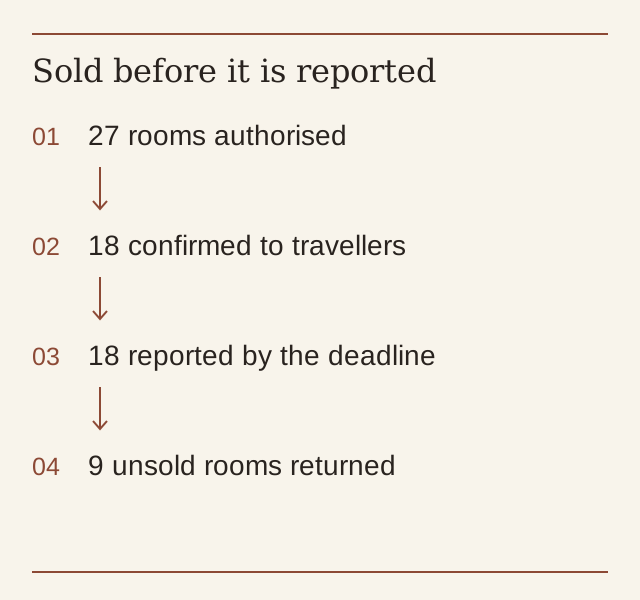
Imagine a contract giving an operator an allotment of twenty-seven standard rooms for specified dates, with a seven-day release period.
The hotel has authorised the operator to sell within that allowance. It need not seek a fresh yes for every customer, and under this reporting arrangement it need not tell the hotel about each sale as it happens. It must report the rooms sold no later than seven days before arrival. The unused balance then returns to the hotel’s control. Whether the operator still owes money for those rooms is a separate question: a commitment sets its financial obligation, not the reporting deadline.
Suppose the operator has sold eighteen rooms. Those travellers can already hold confirmed bookings, even though the hotel has not yet received all eighteen reservations. At the original reporting deadline, the hotel receives the sales and nine unused rooms come back. The deadline closes a gap in the hotel’s information as well as releasing unsold stock.
This is the arrangement I am following here. Some contracts require sales to be reported as they happen. The essential distinction is between permission to confirm a booking and the moment the hotel receives the report. A central, instantly updated booking system is not the only way to sell a room.
For an operator assembling flights, accommodation and transfers, that permission is valuable. It can finish the sale while the customer is ready to book, rather than wait for a hotel in another time zone to answer. The hotel gains a partner able to sell its rooms efficiently.
The hotel asks for the sales it cannot yet see
As business builds, the hotel needs a clearer picture than the reports already on its desk. There may be more confirmed guests in its partners’ systems than in its own.
It can ask an operator for a recap: a current report of all sales already made. The point is to reveal existing commitments, not to ask whether those customers would like to book. They have already booked. A recap alone does not end the operator’s selling authority; it gives the hotel the information needed to decide its next move.
I think this is the part most easily lost in a tidy account of online reservations. The hotel is managing both the rooms it knows are sold and the authority it has given other businesses to sell more. A recap helps it see how much of that authority has already been used.
When the hotel needs earlier reports
For arrival dates that are filling well, the hotel can amend the contract’s release terms. Changing seven days to fourteen days before arrival brings the reporting deadline forward by a week. It learns the confirmed sales sooner and takes control of the unsold balance sooner too.
In trade correspondence this can be called a release reduction. The operator’s late-selling flexibility is reduced, although the release number increases. It now has less time to keep selling without returning to the hotel for an individual answer.
At the other extreme, zero-day release lets the reporting deadline fall on the arrival day itself, at the agreed cutoff. It gives the operator the most late-selling freedom and the hotel the least warning.
The purpose of moving that deadline earlier is to reduce late surprises. An unreported sale reaching the hotel the day before arrival leaves much less time to resolve a shortage than one reported two weeks ahead. The amendment applies to the arrival dates specified; it need not change the whole season’s arrangements.
A closed allotment can still leave a bookable room
When the hotel wants tighter control, it sends the operator a stop-sale. In this relationship the message has two jobs: call in the sales already made and stop further confirmations from the allotment. The operator reports outstanding sales promptly under the notice’s reporting deadline.
The room does not necessarily become impossible to book. The operator can still sell on request: it asks the hotel about each new booking and waits for an answer before confirming it to the traveller. The hotel has brought that decision back under its own control.
That explains the change a customer may notice. Yesterday the agent could confirm immediately; today the same stay needs a response from the property. It also explains why a stop-sale does not cancel a guest whose booking was already made within the operator’s authority.
Why different operators receive different answers
The hotel can apply these controls selectively. It need not stop every contracted operator together. It may start with a less important business partner, or one whose short release period would otherwise allow reports to arrive very close to the guests themselves.
A valuable partner with dependable earlier reporting may retain its selling authority longer. Another is moved onto individual requests. The hotel is controlling the flow of sales and the uncertainty attached to each relationship, rather than declaring one universal availability status to the world.
This is why I would not treat one agency’s inability to confirm as the final word on a hotel. A different operator may still have an open allocation, and the first may still be able to obtain a room on request. The agency should make clear whether it is offering an accepted booking or waiting for one.
When the hotel wants more business
The hotel can move in the other direction when it has ample unsold capacity. A free-sale message encourages its partner to sell and makes the booking process easier: confirm under the agreed terms without asking the hotel about every reservation.
It need not come with a lower room rate. The incentive is partly practical. The operator’s sales staff can complete the booking more easily, and the message puts the property back in front of them as a hotel ready to take business. That can make it an easier recommendation at the agency counter.
Price and selling authority are separate levers. Committed capacity and package-only rates explain why a package may be cheaper; free sale explains why it may be simpler for the agent to confirm.
Why the hotel bothers with all these controls
Overlapping selling allowances and a sudden surge in demand can leave more confirmed bookings than rooms. Reports and selective restrictions help the hotel find that exposure early; the hundred-room example shows how it develops. Moving guests is expensive, and the hotel’s calculations should not leave the traveller accepting accommodation below the standard promised.
What the traveller actually needs to establish
At the agency counter, I want a clear answer to a simple question: can you confirm this stay now, or are you still waiting for the hotel? The operator’s internal reports and release dates are its work, not mine. While an answer is outstanding, I would leave any separate non-refundable flights unbought; another operator may still be able to confirm the hotel immediately.
If the booking is confirmed, keep the description of the room, meals and other important inclusions. If the hotel later cannot accommodate you, the issue becomes how the promised stay will be supplied through a suitable replacement—not how flexible you are willing to be to solve its inventory problem. I explain that conversation in why hotels overbook.