
A booking reference tells you where to find a reservation. A ticket number identifies a ticket. They are connected, but they are not interchangeable.
I would make that distinction before doing anything else with a flight confirmation. An attractive itinerary and an accepted payment do not, by themselves, answer every question about whether the airline has issued the travel document.
The record, the key and the ticket
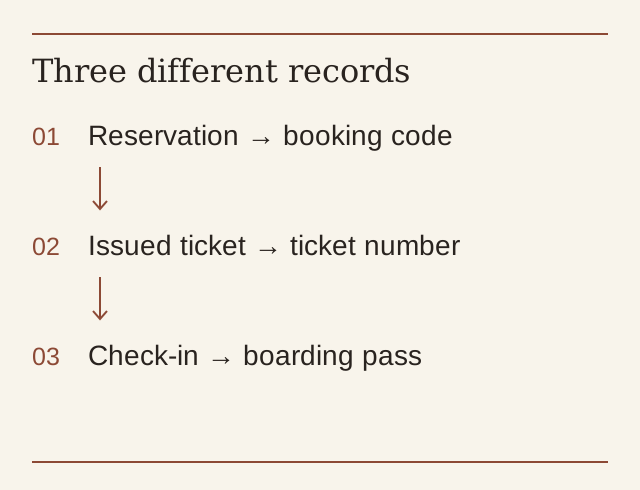
The PNR is the reservation record. Its record locator is the code used to retrieve it. In everyday conversation, airlines and agents often call that code the PNR, so a request for your “PNR number” usually means the booking reference.
The record can contain several passengers and flight segments, contact details and service requests. It is a working record, not a passport and not a boarding pass.
An e-ticket is issued against the journey in the conventional ticketing model. Its ticket number is commonly thirteen digits. The first three identify the airline in whose name the ticket was issued. That may differ from the operating airline, and an agent can have issued it on the airline’s behalf. A booking locator is often six letters and numbers, although formats vary. Do not decide that a document is valid simply by counting its characters.
| What you have | What it identifies |
|---|---|
| Booking reference or locator | A reservation in a particular system |
| Ticket number | An issued ticket |
| Boarding pass | A checked-in passenger’s flight and boarding details |
These are the usual distinctions for airline travel. Some carriers use ticketless processes, and airline retailing is moving towards orders. The useful question is whether the carrier confirms that your booking is ready for travel under its process, not whether every airline prints identical paperwork.
Why a reservation can exist before ticketing
An agent can create a reservation with a deadline for ticket issuance. There may be a hold, a payment still being processed or an action the seller must complete. If the relevant deadline is missed, the held space can be released.
That sequence is normal in parts of the industry. It becomes a problem when a traveller believes that receiving an itinerary means the whole sequence has finished. If the seller’s email says ticketing is still in progress, look for the promised ticketing confirmation rather than treating the first email as the last word.
For a conventional ticketed booking, I would ask the seller to confirm issuance and provide the ticket details. I would then retrieve the trip with the airline and check the passengers, dates and flight status. A payment receipt answers a money question; it does not replace that check.
Why your agent’s code may not work
Different systems may assign their own references. The agency can have one locator and the airline another. A partner airline may have a further reference for its part of the journey.
If the airline’s website rejects the code, ask for that airline’s booking reference. Check the surname spelling as entered in the reservation. Do not immediately conclude that the booking has disappeared—or buy a replacement ticket solely because one website failed to retrieve it.
Codeshares add another source of confusion: the airline whose code you bought may differ from the airline operating the flight. The operating airline’s reference can be useful for seat selection or check-in.
A seat assignment is another separate thing
A ticketed passenger may have no allocated seat yet. Some fares charge for advance selection; some seats are assigned later. The absence of a seat number is therefore not proof that no ticket exists.
The reverse mistake is also possible: seeing a seat selection in a booking should not become your only evidence that all ticketing and payment steps are complete. Reservation, ticketing and seat assignment are related operations, not three names for the same operation.
A special service request needs similar attention. Having a request recorded is different from having the airline accept and arrange it. For assistance or another essential service, ask for its confirmed status.
One reference does not settle connection protection
A seller may present several flights together under one order reference while issuing separate tickets. Conversely, an itinerary involving partner airlines can generate several locators even where the travel is ticketed together.
The through-ticket distinction helps establish responsibility when a connection fails. The number of codes in the email cannot establish it for you.
The few details worth keeping offline
Keep the itinerary, airline reference, ticketing confirmation and seller’s contact details somewhere you can reach without an internet connection. Check that the airline has usable contact information for disruption messages.
If something is unclear, the sentence I would use is simple: “Please confirm that every passenger’s booking is ticketed or otherwise fully confirmed for travel, and give me the reference the operating airline uses.” It asks the operational question without requiring you to become a reservations agent.
Why I would not post a full boarding pass
The reference that helps you retrieve a booking can help somebody else retrieve it too. On some airline websites, a surname and booking reference are enough to open Manage My Booking; even the flight date is not always needed. Depending on the airline’s controls and the booking, that access may allow seat or meal changes, and sometimes changes to the flights or cancellation. It does not necessarily give access to your entire frequent-flyer account, but interfering with this one journey would be trouble enough.
The barcode matters as much as the printed reference. A readable photograph can reveal data encoded in it, including a booking reference that you have covered elsewhere on the pass. A mobile boarding-pass screenshot has the same problem. Hiding the six-character code while leaving the barcode or QR code visible is not a reliable way to protect the booking.
I would leave the pass out of the social-media photograph. If it must appear, crop out or completely obscure the passenger name, booking and ticket references, loyalty identifiers and the entire scannable code. The same details can also appear on the accompanying baggage receipt.
Does the barcode contain your date of birth?
The booking reference is a lookup key, not a compact version of your personal history. You cannot obtain a birthday simply by decoding the reference itself.
The standard IATA boarding-pass barcode carries travel data such as the passenger’s name, booking reference, airports, flight and seat. Optional fields can include ticket or frequent-flyer details. Date of birth is not one of its standard defined fields. The dates used for the flight and the pass’s issue are not the passenger’s birthday. Airlines can add their own data, so this is not a guarantee about every barcode an airline might issue.
The reservation or passenger-information record behind the reference is a different matter. It may hold a date of birth and passport details supplied for the journey. Those are further information a poorly protected booking service could expose, rather than information necessarily written into the pass. The concern has a factual basis, but “every boarding-pass barcode contains your birthday” is the wrong explanation. Finding a discarded pass is not, by itself, proof that someone has everything needed to steal your identity.
What about the paper after landing?
A used boarding pass is not necessarily a harmless one. The outbound flight may be finished while the same booking reference still retrieves a return flight or an onward connection. Landing does not automatically close the booking or make a photograph safe to share.
After the entire journey, the risk of someone disrupting those flights has passed, but the printed identifiers and any data in the barcode remain readable. I normally use an electronic boarding pass when one is available. It is convenient, and there is no paper copy to leave behind. When I need a paper pass, I keep it while I need it as evidence of travel, then shred it, including the barcode and printed references. That is a sensible privacy habit—not a reason to believe every old boarding pass is a hidden copy of your passport.