
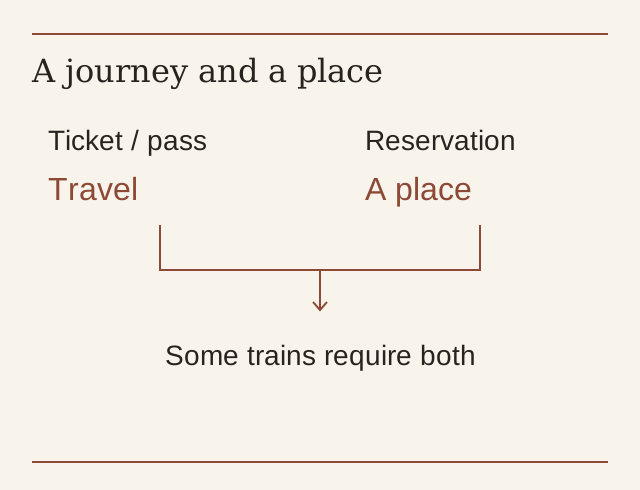
A train ticket and a seat reservation can be two different purchases. The ticket gives you permission to travel under its conditions; the reservation allocates a particular place on a particular service.
Sometimes they arrive together. Sometimes one is optional. Sometimes you need both before you can board. I would settle which arrangement applies before deciding that a fare is good value.
Three common booking arrangements
On an unreserved service, you buy the right to travel and take an available seat. At a busy time you may stand. On a service with optional reservations, the ticket and a reserved seat are separate choices, even if the website sells them in one transaction.
On a reservation-compulsory service, you need the required reservation as well as the travel entitlement. Eurostar and TGV high-speed services are familiar examples; sleeping accommodation commonly requires its own reservation too. The reservation may be included in a conventional ticket, while a rail-pass holder has to obtain it separately.
| Arrangement | What to establish |
|---|---|
| Unreserved travel | The ticket is valid for the service; seats are taken as available |
| Optional seat reservation | Whether your purchase includes an allocated seat |
| Compulsory reservation | That the necessary reservation is confirmed for your train |
The glossary distinguishes a seat reservation, a rail pass and a berth. Those labels describe different entitlements, not different ways of printing a ticket.
A flexible ticket does not make the seat flexible
Suppose your fare allows a choice of trains, but you reserve a seat on the 10:00 departure. If you choose a later service, the original reservation does not travel with you. You need a seat on the train you actually take, or you travel unreserved where that is allowed.
The reverse is equally important. A seat reservation for a train does not, by itself, make an otherwise invalid ticket valid on it. German long-distance seat reservations, for example, can be bought separately from the ticket. Buying one is not buying the journey.
In Britain, an Advance ticket can be tied to a particular departure without giving you an allocated seat on a service that does not offer them. “Reserved train” and “reserved seat” are worth distinguishing in the confirmation.
The rail-pass surprise
A pass can cover the fare while leaving reservations or supplements to be paid separately. Some services restrict the seats available to pass holders. You can therefore find tickets on sale while the pass-holder reservation you need is unavailable.
That is an inventory distinction, not necessarily evidence that every seat is occupied. For a trip built around one important departure, I would check the pass reservation before buying a pass on the assumption that it guarantees access to that train.
The Eurail reservation guide is useful when planning with that pass. A reservation does not replace the pass or its activation and journey-recording requirements.
Night trains sell more than a route
A night train may offer ordinary seats, couchettes and sleeper accommodation. A couchette is generally a simpler sleeping bunk; a sleeper can provide a different level of bedding, privacy and facilities. The exact product matters more than the romantic appeal of travelling overnight.
I would look at how many people share the compartment, whether the booking is for a whole compartment or one place, and whether the toilet and washing facilities are private or shared. “Sleeper” alone does not answer those questions.
For two people travelling together, check whether the reservations actually place you together. For a child, mobility requirement or bicycle, establish the relevant accommodation and reservation rules before treating the journey as settled.
Connections and changes need separate attention
A journey involving several trains can require several reservations. If a delay forces you onto another service, the original seat assignment belongs to the original train; a right to continue travelling does not conjure an identical seat on the replacement.
Whether the journey is sold as a through-ticket or as separate tickets matters when something goes wrong. The glossary explains that distinction; a single basket on a website is not sufficient evidence either way.
For the everyday booking decision, I would keep four details together: the trains the fare permits, the departure actually chosen, the coach and seat or berth, and the change conditions. They tell you more than the word “confirmed” on its own.
Read the seat assignment as part of the itinerary
Look for the date, train number, boarding and alighting stations, coach and seat. A seat may be reserved for only part of a train’s route, so the same place can legitimately serve another passenger later.
For a long journey, having the right place to sit is part of the value of the trip. I would rather compare the total cost of the journey I want—including the necessary reservations—than discover on the platform what the cheapest figure left out.