
“Only two seats left at this price.” It sounds like the end of a sale. Yet tomorrow the same flight might be cheaper, with more seats offered at the lower fare. That need not mean the airline lied today.
The number describes what it is prepared to sell now. Behind it is another decision, invisible to the passenger: what is the remaining space likely to earn if the airline waits?
I would start there to understand a changing fare. We see an aircraft leaving on a particular date and want a place on it. The airline sees a succession of possible customers, arriving at different times, willing to pay different amounts. Selling to one can mean losing the chance to sell to another.
The customer who has not booked yet
This problem predates online booking. In 1972, Ken Littlewood was working at the British Overseas Airways Corporation, a predecessor of British Airways. He presented a model for deciding how many lower-fare bookings to accept while preserving capacity for later, higher-paying demand. Its objective was revenue from a flight, rather than the greatest number of passengers carried.
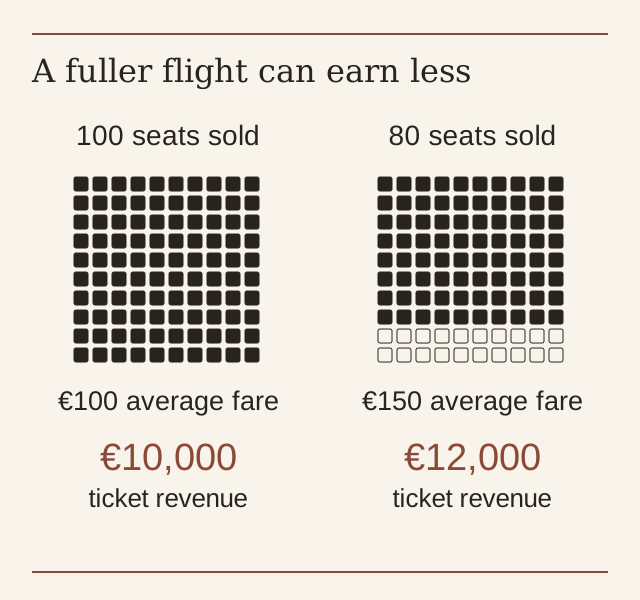
That distinction matters. In the hypothetical comparison below, the fuller aircraft earns less. Occupancy alone cannot tell you how successfully a flight has sold.
American Airlines introduced Super Saver fares in 1977. US deregulation the following year, and growing competition from low-fare carriers, sharpened the commercial problem. An established airline needed to attract holidaymakers without giving away the higher fares it could collect from people with less flexibility.
Advance-purchase conditions, minimum stays and restrictions on changes helped separate those customers. A holidaymaker could plan ahead and stay a week; someone arranging a short business trip at the last moment might need a different ticket. They could sit beside each other in economy. The distinction was between buying behaviour, not necessarily between cabins.
Through the 1980s, American developed increasingly sophisticated controls over how much to sell at each fare. The question was no longer merely whether a seat was available, but whether accepting this booking was better than preserving it for another. That is the central calculation in revenue management.
It is made under uncertainty. A cheap booking brings revenue now. The more valuable customer may never arrive. As sales build, cancellations appear or competing airlines change their offers, the forecast changes—and so does the value of holding back a seat. A higher fare today and a lower one tomorrow can be two answers to the same commercial question, made with different information.
How connections, business class and rewards affect pricing
On a network airline, that possible future customer may be buying a connecting journey. A seat on the first flight can be sold alone or as part of an itinerary through the hub. The airline must consider what the whole journey earns and what other bookings it prevents on each flight involved.
This is why maximising the revenue of every flight separately is not always enough. Capacity on one busy departure may be valuable to several different journeys. Conversely, a connecting itinerary may compete in a market where the airline needs a lower price to attract passengers. Two flights can consequently cost less than one: the fare reflects the market and the network, not simply the distance flown.
The calculation becomes particularly visible in business class. There are fewer seats, a separate pattern of demand and several ways to sell the same space. The airline might accept a discounted business fare now, preserve availability for a later flexible-fare buyer, or eventually offer an economy passenger a paid upgrade.
Those options affect one another. If late demand looks strong, holding back the cheaper business fare can make sense. If it weakens, a paid upgrade may become worthwhile. But making cheap upgrades too predictable would encourage customers who might otherwise buy business class to purchase economy and wait. The airline is considering both the next sale and the buying behaviour its prices encourage.
Reward bookings belong in this calculation too. A passenger using miles occupies capacity that could otherwise be sold for cash. That does not make the reward passenger commercially worthless: airlines sell miles to banks and other partners, and reserve part of earlier ticket revenue against miles earned from flying. Delta, for example, counts the award-travel income as passenger revenue when the redeemed flight is taken.
The decision is therefore about the value of accepting a redemption against the opportunity to sell that capacity another way. If a seat is likely to attract a high cash fare, releasing it cheaply for miles can displace that sale. If it is likely to remain empty, the tradeoff changes. That helps explain why reward availability or the mileage price can move even though the physical seat is unchanged.
Loyalty promises also shape what the airline can do. British Airways guarantees a minimum reward allocation on its Heathrow and Gatwick flights, including four business-class seats. Delta’s award offers can vary in mileage price and are subject to capacity controls. These are different ways of managing access to the same scarce resource. Reward availability is managed alongside cash sales, rather than simply decided after them.
The airline is balancing these possible uses of its capacity. A cash fare is one visible result of that wider calculation; it is not obtained by adding a fixed margin to the cost of carrying one more person.
How that calculation becomes the fare you see
Traditionally, the airline has a range of fares and controls which ones are available. It can close a cheaper booking class while continuing to sell a dearer one in the same cabin. Your seat, meal and legroom need not change when the quoted price jumps.
The cheaper class is not a row of seats reserved at the back of the aircraft. It is a selling control. Closing it means the airline has stopped accepting that offer, perhaps because it now expects to earn more from the remaining capacity. If the forecast later weakens, it can make a lower fare available again. An advance-purchase deadline can also remove a fare even when nobody has bought a seat since your last search.
Continuous-pricing systems give the airline more possible steps. Instead of jumping from an illustrative €180 fare to €240, it might generate a €207 offer. Some systems work alongside traditional booking classes; others are designed to price without those fixed boundaries. The commercial problem remains the same, even when the price can move in smaller increments.
Now return to the warning about two seats. “At this price” is the essential part. There may be plenty of room on the aircraft, but only two places available under the current offer. British Airways explicitly explains that its displayed number can sometimes increase, or a lower price can become available. The message can be both a genuine description of today’s availability and an effective prompt to buy. It says nothing certain about tomorrow.
It can also explain a price difference within the same search session. If you ask for four tickets when only two are available at the lower fare, the booking engine may price the whole party at the next level. Comparing the itinerary for one passenger and for the full party can reveal that effect. It does not follow that the airline raised the fare because it recognised you. Splitting the purchase would create separate reservations, so the lower total is only part of that decision.
A seat map offers no reliable way around these controls. Some passengers already have tickets but have not selected seats; other positions may be blocked from selection. The map cannot show how much low-fare demand the airline is prepared to accept, still less how it will reassess that decision tomorrow.
Why another seller may show a different number
The offer still has to reach the person buying it. That introduces another source of price differences: two sellers need not have access to precisely the same offers, even at the same moment.
A GDS, or global distribution system, connects an agent to airline content. The airline’s reservation system maintains bookings and availability; its revenue-management and pricing tools help decide what to sell. Those are different jobs, although a company such as Amadeus or Sabre may supply several of the systems involved.
Pricing products differ in their forecasting, inventory controls and ability to generate prices between traditional fare levels. An airline can buy them separately from its reservation system. But the airline sets its commercial policies: two carriers using the same software need not offer the same prices. The supplier’s name cannot reveal the forecast for your departure.
The more useful distinction is the content the seller receives. A traditional fare feed may differ from an offer constructed by the airline and delivered through NDC. A GDS can carry NDC offers too; it is not simply a choice between an agent and the airline’s website. This is the part worth establishing when two otherwise equivalent quotations differ. My GDS and NDC guide explains the connections in more detail.
An experienced agent can inspect current fare conditions and booking-class availability. That may explain why a price cannot be obtained for your party, or why a different itinerary produces another offer. It does not give access to the airline’s future decisions. Knowing the system behind today’s quotation is not a way to see tomorrow’s fare.
Why the calendar cannot settle the decision
All of this makes time important, but not in the mechanical way suggested by “book thirty days ahead”. As departure approaches, the airline has less time to sell and more evidence about demand. That can justify lowering a fare. It can also justify preserving the remaining seats for late buyers willing to pay more. The date alone does not tell you which calculation applies.
Booking-window studies describe patterns across many journeys. Google’s 2026 analysis of US departures found the lowest average domestic fares 39 days ahead, within a broader low-price range of 22–57 days. International departures had a different low range: 50–133 days. Thirty days falls within one of those ranges. That hardly makes it a dependable rule for every flight: the route, season and type of journey still matter.
The same problem affects the supposed cheapest weekday to buy. Google’s analysis favoured Wednesday, only about 1.4% below Sunday. Expedia’s 2026 US report, based on purchases on Expedia.com, instead put Friday first, with a 3% difference from Sunday. These datasets describe different collections of fares and purchases. They do not establish that leaving your particular booking until Wednesday or Friday will make it cheaper.
A study of purchased tickets can also compare different customers buying different journeys in each window. That is not necessarily the same as following an unchanged itinerary and measuring what happened to its price. A low average close to departure is not proof that the fare in front of you will fall if you wait.
The useful distinction is between choosing a cheaper departure and waiting for your chosen departure to become cheaper. A different date, a workable connection or another suitable airport changes the demand and competition behind the fare. I would compare those options first: each gives me a different price to consider now.
If only one itinerary suits my plans, I would judge its fare against comparable offers and the route’s price history, then book when it represents good value for that journey. I would not postpone that decision for a supposedly lucky weekday.
“Two seats left” tells me that an offer has limited availability. It does not turn an expensive ticket into a bargain. Equally, a good fare does not become a bad purchase merely because somebody might pay less tomorrow.