
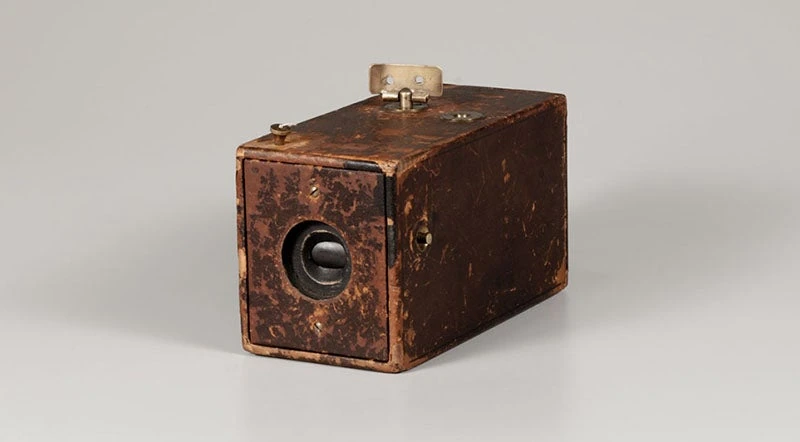
The original Kodak, introduced in 1888: one hundred exposures and a return journey to the factory. George Eastman Museum, via Linda Hall Library.
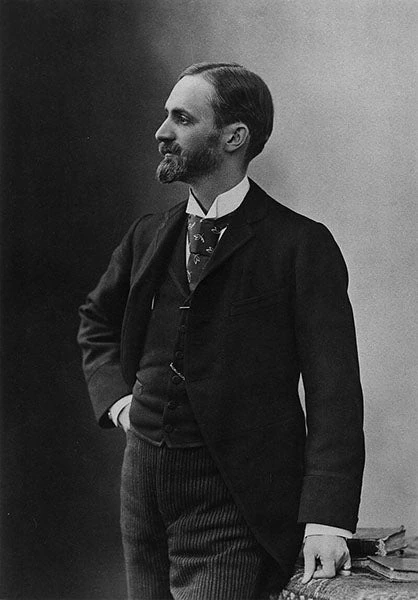
In the late 1870s, George Eastman was preparing for a trip to Santo Domingo.
He was not yet an industrialist, not yet one of the richest men in America, and certainly not yet the person whose name would become almost synonymous with photography. He was a young bank employee in Rochester, New York, interested in a possible property investment. A colleague suggested that he take photographs so he could bring back a record of what he saw.
It sounded sensible.
Then Eastman discovered what taking a camera on a trip actually meant.
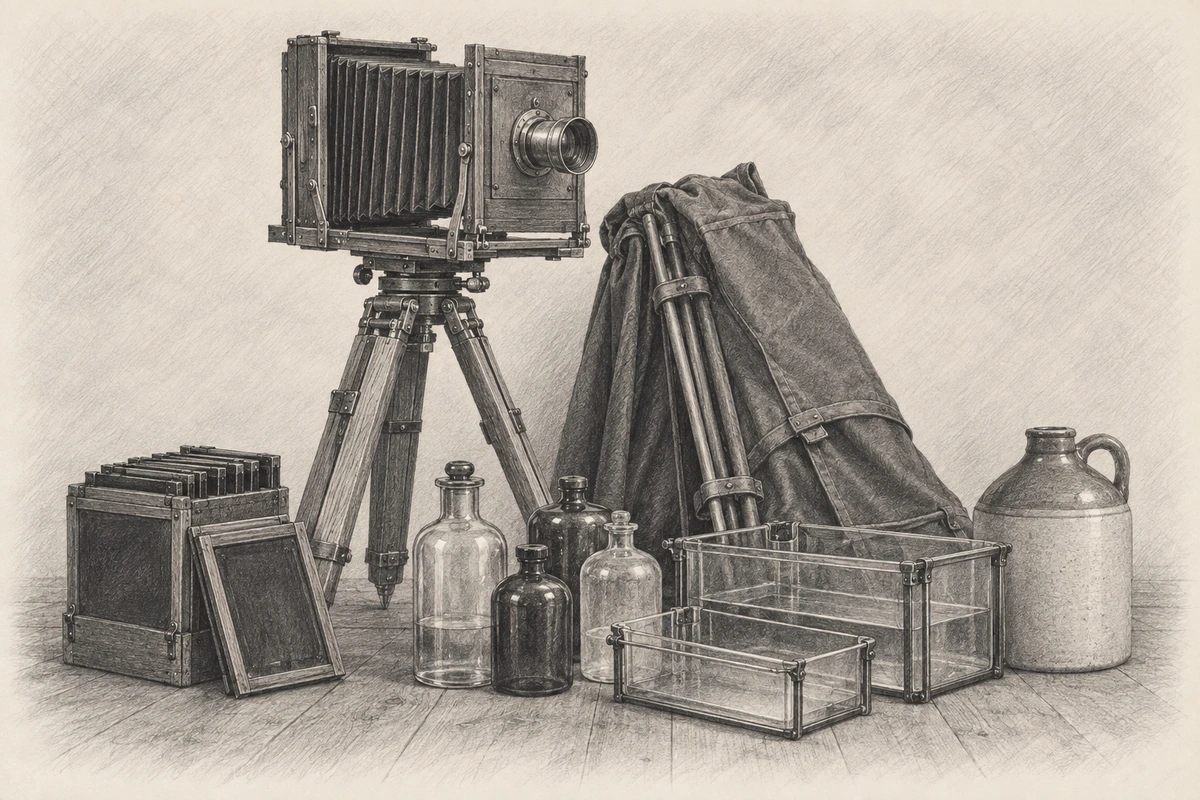
The camera itself was roughly the size of a small household appliance. It needed a heavy tripod. The wet-plate process required glass plates, chemicals, tanks, water and a dark tent because the photographic emulsion had to be prepared and the exposed plate developed before it dried. Eastman later described the complete apparatus as a “pack-horse load”.
The trip never happened.
One of travel photography’s great commercial stories began with luggage for a journey that was never taken.
The apparatus required an amateur to become part chemist, part porter and part laboratory technician. Eastman became absorbed in finding a simpler way to make a photograph.
Eastman spent the next decade removing those jobs from the person holding the camera.
The button
Eastman began with dry plates, following experiments reported in British photographic journals. He worked at the bank during the day and made emulsions in his mother’s kitchen at night. By 1880 he had patented machinery for coating plates and was moving into manufacturing.
The chemistry was inherited; making it reliable and repeatable became his business. With William Walker he developed a roll holder that could replace a camera’s glass-plate holder. Paper-backed film could be wound through the camera instead of loaded plate by plate.
Then, in 1888, came the object that changed the relationship between people and photographs.
The original Kodak was a small black box, preloaded with enough film for one hundred exposures. It had no complicated focusing system and no expectation that its buyer knew photographic chemistry. You aimed it, pulled a cord to set the shutter and pressed the button; a key advanced the film.
When the roll was finished, you sent the entire camera back to Rochester.
Kodak developed the film, made the prints, reloaded the camera and returned it to you.
The camera cost $25 with its first hundred exposures. Processing, prints and a fresh roll cost another $10.
Eastman supplied the slogan himself:
You press the button, we do the rest.
It is one of the finest product propositions ever written because almost every word describes something Eastman had deliberately removed.
You did not coat a plate.
You did not develop a negative.
You did not print an image.
You pressed a button.
The company did the rest.
The small black box was only the part the customer carried. The more difficult work had gone back to Rochester. Eastman had made a service look like a camera.
In 1889, Eastman’s young chemist Henry Reichenbach helped bring transparent celluloid film into production. The original Kodak had used paper-backed film; the chemistry kept changing behind the promise of simplicity.
The first Kodak was still expensive enough to be a luxury for many households. But Eastman kept pushing in the same direction. In 1900 Kodak introduced the Brownie for one dollar. By the end of 1905 more than 1.2 million Brownies had been sold.
Photography was becoming a habit. And habits travel exceptionally well.
The photograph that changed the holiday
A formal photograph required a gathering, a pose, a decision that the occasion deserved recording. The handheld snapshot made room for moments too slight to justify that ceremony.
A child running toward the sea. Someone leaning from a railway carriage. Horses by the roadside. A picnic. A hotel balcony. A friend laughing badly enough that nobody would ever have commissioned a formal portrait of the expression.
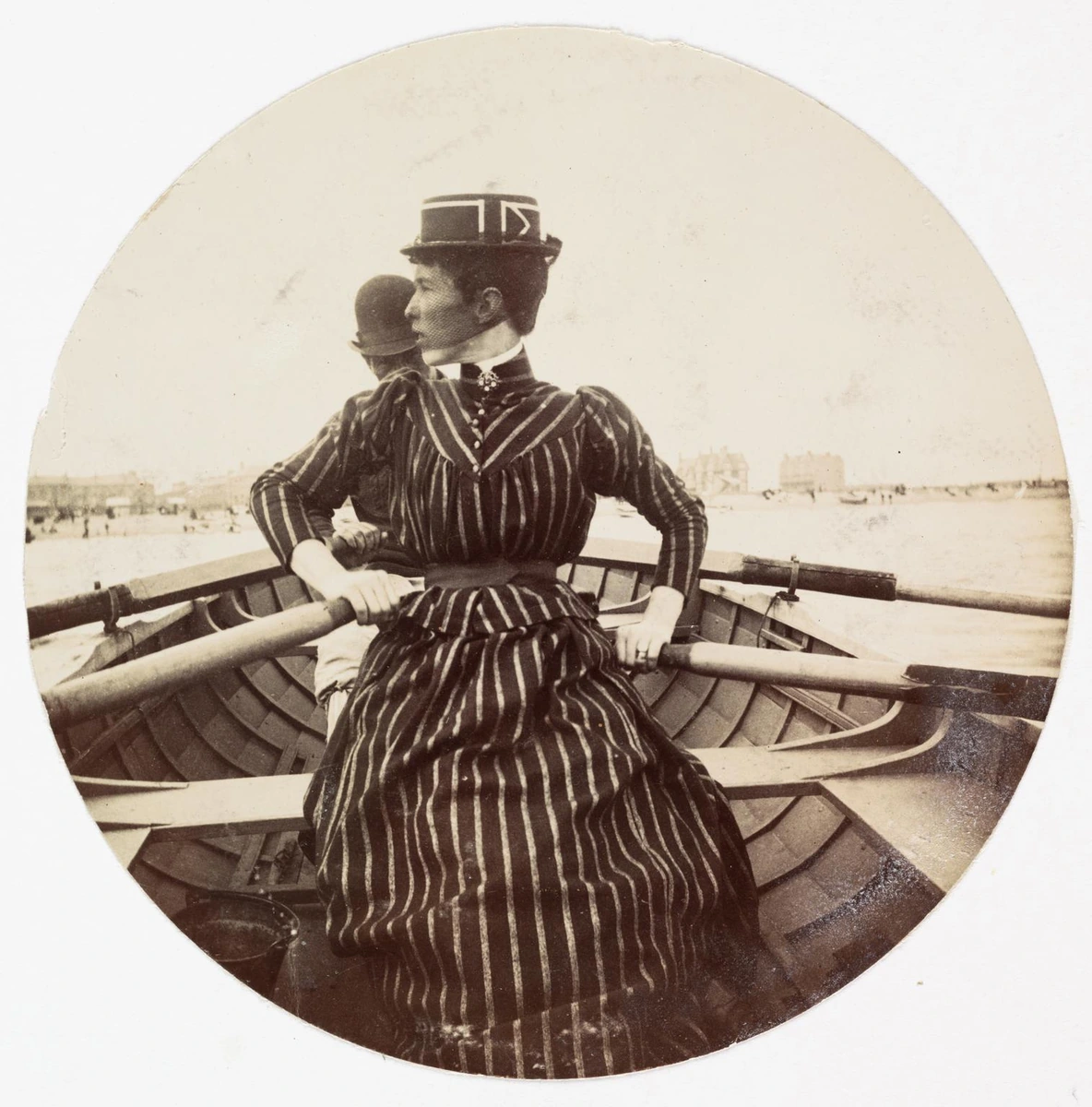
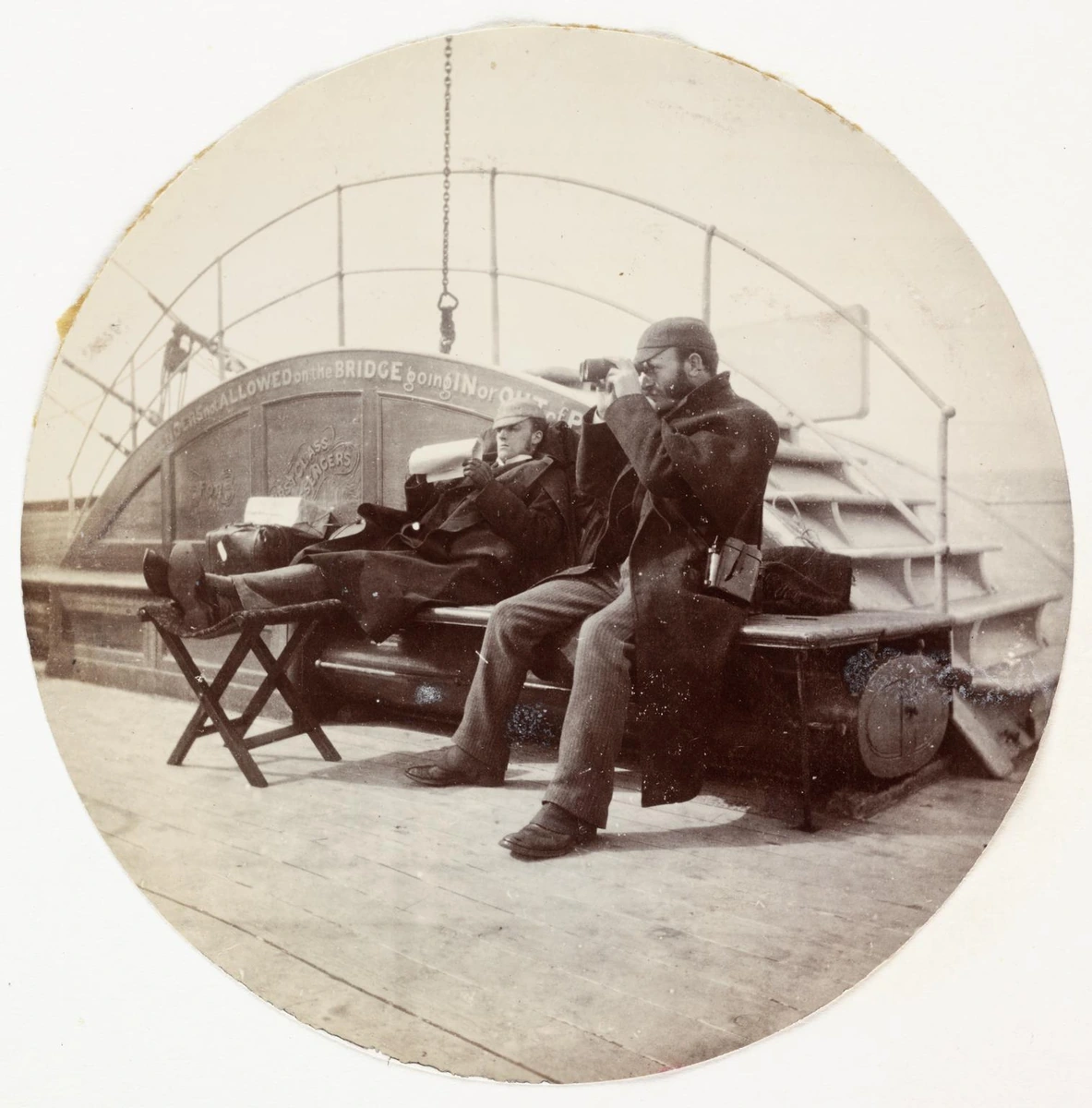
The snapshot gave those passing moments a place in the family record.
That mattered enormously to travel. A journey no longer ended when the traveller came home. It returned as a stack of small pictures that could be passed around a table, pasted into an album, mailed to relatives and looked at years later until the memory itself began to borrow details from the photograph.
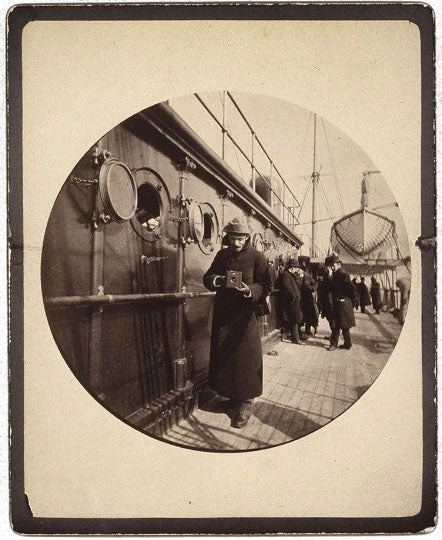
Kodak’s advertisements sold that possibility.
The company did not merely tell people that its cameras were technically convenient. It told them when a camera belonged in their lives.
On excursions and bicycles, at the seaside and in the mountains, on ships and motor journeys.
“Take a Kodak with you” became less an advertisement than an instruction for how to travel.
Eastman was creating demand not only for cameras and film, but for a new ritual:
Go somewhere, see something, photograph it, bring it home.
It is difficult to imagine tourism without that sequence now.
The woman in stripes
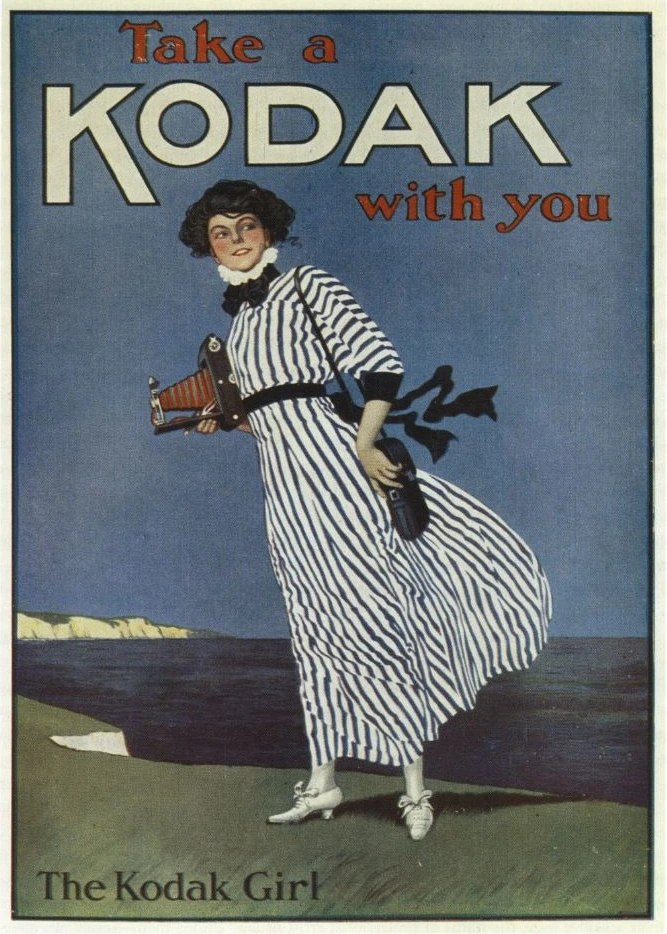
The camera has become something she wears into the world.
Beginning in the 1890s, Kodak repeatedly used a figure who became known as the Kodak Girl. She appeared in magazines and posters as young, fashionable, independent and mobile. She went outdoors. She travelled. She carried the camera herself. The Smithsonian’s account traces how that figure helped make a camera an essential accessory for women.
Here the advertisement completed what the factory had begun. A manageable camera needed a desirable owner: someone the customer could imagine becoming.
The Kodak Girl was not presented as a professional photographer who happened to be female.
She was a traveller.
Her camera is not the purpose of the excursion. The beach, the mountain, the city, the people and the road are the purpose. The Kodak is simply the thing that comes with her.
A woman travelling with a camera today can recognise herself in the advertisement. Kodak was selling cameras, but the invitation extended beyond the purchase.
She assumes that she may go.
She assumes that what she sees is worth recording.
She assumes that the world can be looked at through her eyes.
That is a very recognisable traveller.
The old photographic apparatus had made the camera an expedition in itself. Kodak reduced it until a woman in a long dress could carry one almost as casually as a handbag.
Later Kodak went even further. Cameras were marketed as fashion objects and made in colours and forms intended to complement clothing. But the deeper transformation had already happened: the camera had crossed from equipment into personal identity.
A century before the smartphone, Kodak had discovered that the most powerful camera is not necessarily the one with the best specification.
It is the one you decide to carry.
A business built on memory
The ease belonged to the customer. Inside the business, Eastman insisted on control, as PBS’s account of his working life makes clear. He scrutinised work down to the janitors’ methods and employed Pinkerton detectives to watch his salesmen. The man who offered amateurs freedom from photographic labour could be an exacting presence for those paid to do it.
That contrast was built into the arrangement.
A Kodak owner needed film. Film needed processing. Processing produced prints. Prints needed photographic paper and chemistry. Then another roll went into the camera.
Each holiday, birthday, child, picnic, road trip and sunset became another turn of the machine.
The mature Kodak business was therefore much stronger than a camera company. Cameras were merely the entrance to an ecosystem of film, chemicals, processing, paper, laboratories, retailers and services.
The customer experienced simplicity.
Behind that simplicity was one of the most sophisticated industrial businesses in the world.
Eastman’s phrase—we do the rest—was almost a corporate constitution.
Kodak would master the complexity so completely that consumers would never need to see it.
For decades the arrangement rewarded repetition.
The traveller received something close to magic.
Kodak received recurring revenue every time the traveller decided that a moment deserved to survive.
There was, however, a hidden assumption inside the model:
every additional photograph consumed something.
Another frame of film.
Another share of processing chemistry.
Another print.
Another little payment somewhere in the Kodak system.
That assumption would eventually disappear.
The camera inside Kodak that needed no Kodak
In 1975, more than four decades after George Eastman’s death, an electrical engineer named Steven Sasson was working in a Kodak laboratory in Rochester.
His assignment was to investigate a new type of electronic light sensor called a CCD.
Sasson assembled a strange machine from available parts: a lens from a Kodak movie camera, digital circuitry, batteries, a Fairchild CCD and a cassette recorder.
The result weighed about 3.6 kilograms.
Its photographs were black and white.
Its resolution was 100 by 100 pixels—0.01 megapixels.
And after the shutter was pressed, the camera required roughly 23 seconds to write the image onto cassette tape.
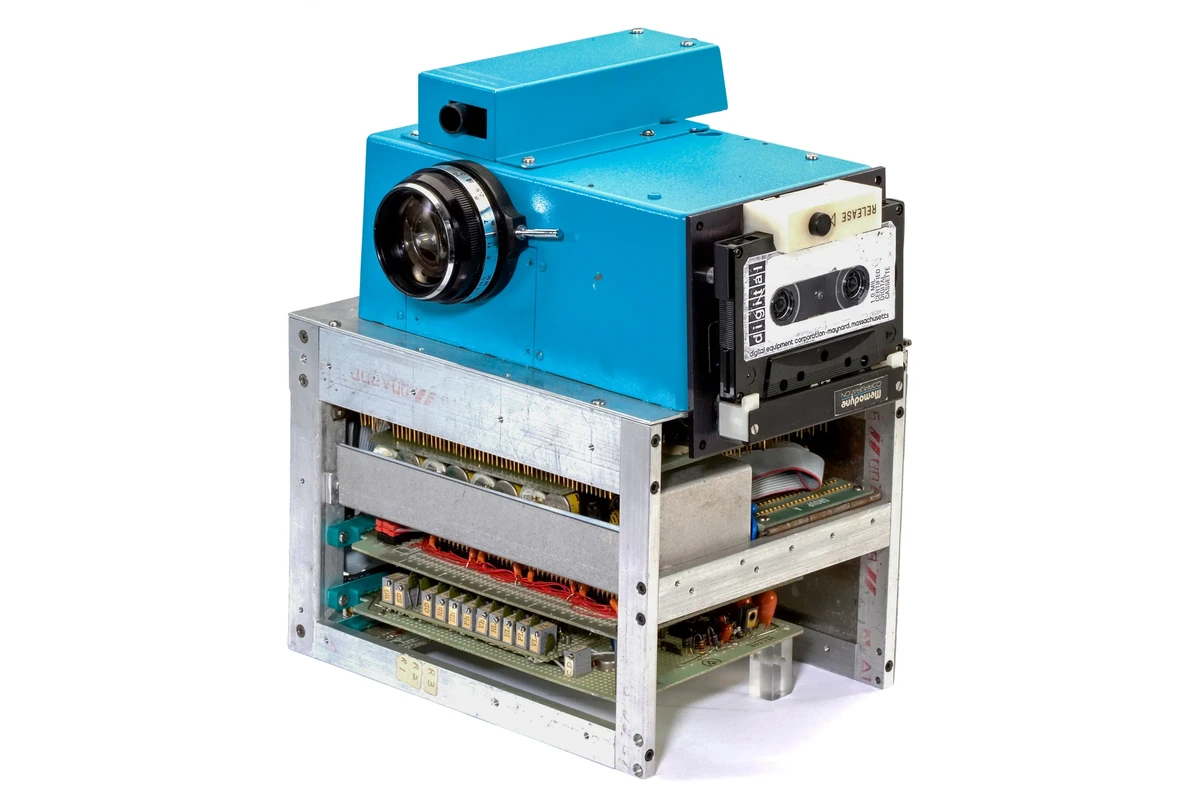
Its ungainly body contained an extraordinary departure.
No photographic film.
No chemical development.
No photographic paper.
No darkroom.
Sasson had created a camera that could take another photograph without consuming another piece of Kodak’s most profitable product.
Kodak’s response would unfold over decades. Sasson’s prototype stayed out of public view, but digital research continued inside the company.
The research produced professional digital camera systems, sensors, consumer cameras, printers, kiosks and online photo services. Its EasyShare products were designed around exactly the Eastman principle of removing technical friction.
By 2004, Kodak was the leading seller of digital cameras in the United States.
IDC data put Kodak at 21.9 per cent of the American digital-camera market in 2004. Kodak’s own 2005 annual report, again citing IDC, says it retained the number-one U.S. position in 2005 and rose to number two worldwide.
And it still could not save itself.
The perfection trap
The new technology was being invented in Kodak’s own laboratories. Selling it successfully posed a different problem: digital photography obeyed different economics.
Suppose a traveller with a film camera takes thirty-six photographs.
Kodak can potentially participate in the economics of all thirty-six.
Now suppose the same traveller takes three hundred and sixty digital photographs.
Each additional image needs no new frame of film, no chemical development and no paper print.
From the traveller’s perspective, this is paradise.
From the perspective of Eastman’s old business model, something fundamental has broken.
Kodak tried to rebuild the ecosystem around digital photography: cameras, EasyShare software, retail kiosks, online galleries, printer docks, home printers, ink and paper.
For a moment it looked plausible.
But the consumer had changed the question.
Film photography had asked:
Which moments are worth spending a frame on?
Digital photography asked:
Why not take another?
Then the smartphone asked something still more dangerous:
Why should photography be a separate activity at all?
The destination of the photograph was no longer necessarily a Kodak print.
It was a screen.
Then another screen.
Then a network.
Kodak’s 2005 annual report records digital product sales rising 40 per cent while traditional product sales fell 18 per cent; sales of film-capture products fell 31 per cent. Part of the digital growth came from acquisitions in commercial printing. The company was buying new businesses as well as teaching old customers new habits.
It was transforming.
It simply could not transform at the same economic rate at which its old world was disappearing.
On 19 January 2012, Eastman Kodak Company and its U.S. subsidiaries filed for Chapter 11 bankruptcy protection.
In its bankruptcy announcement, Kodak said roughly 75 per cent of its 2011 revenue already came from digital businesses. That broad category included commercial imaging; it did not mean consumer cameras had become as profitable as film.
The company had gone digital. It had not recreated the extraordinary business George Eastman had built around the physical photograph. Nor had the change removed the costs and obligations accumulated in the old one: factories, laboratories, employees and pensions. A growing share of revenue was not a replacement for dependable profit.
The company emerged from bankruptcy in September 2013, with commercial imaging and printing at the centre of its reorganised business.
Its former place in ordinary life was harder to recover. The photograph had already found routes from camera to viewer that required no Kodak purchase.
Eastman’s real invention
Eastman died in 1932. The decisions that led to bankruptcy belonged to later generations, operating in a world he never saw. Yet the strength of what he had built helps explain the scale of what they had to replace.
Kodak had hidden tremendous technological complexity behind effortless consumer behaviour, protected by a familiar brand and reinforced by a recurring need.
Eastman did not merely make a camera smaller.
He made the decision to take a photograph smaller.
That may be the more important invention.
Photography had demanded preparation. Eastman helped make it something one did because the light looked beautiful, because the children were laughing, because the horse turned its head, because the hotel balcony opened onto the sea, because this road would probably never look exactly like this again.
And Kodak taught travellers that failing to photograph such a moment was almost a form of waste.
Digital photography eventually destroyed Kodak’s film economics by making photographs practically unlimited.
Yet the freedom to keep taking pictures carries Eastman’s promise further.
No darkroom, no chemicals, no meaningful cost for pressing the button one more time.
Today the camera is smaller than anything the Kodak Girl could have imagined. It is already in our pocket before we decide to travel. It knows where the photograph was taken. It edits the image, stores it, finds it years later and sends it across the world before we have left the place where we pressed the shutter.
The Kodak name is no longer required. The habit remains.
Whenever we walk out of a hotel, board a train, stop the car beside a view, climb onto a horse, turn down an unfamiliar street or sit down at a table and instinctively reach for a camera, we are living in the world George Eastman helped design.
The Kodak Girl would recognise us immediately.
She would probably just wonder why our cameras no longer need cases.