
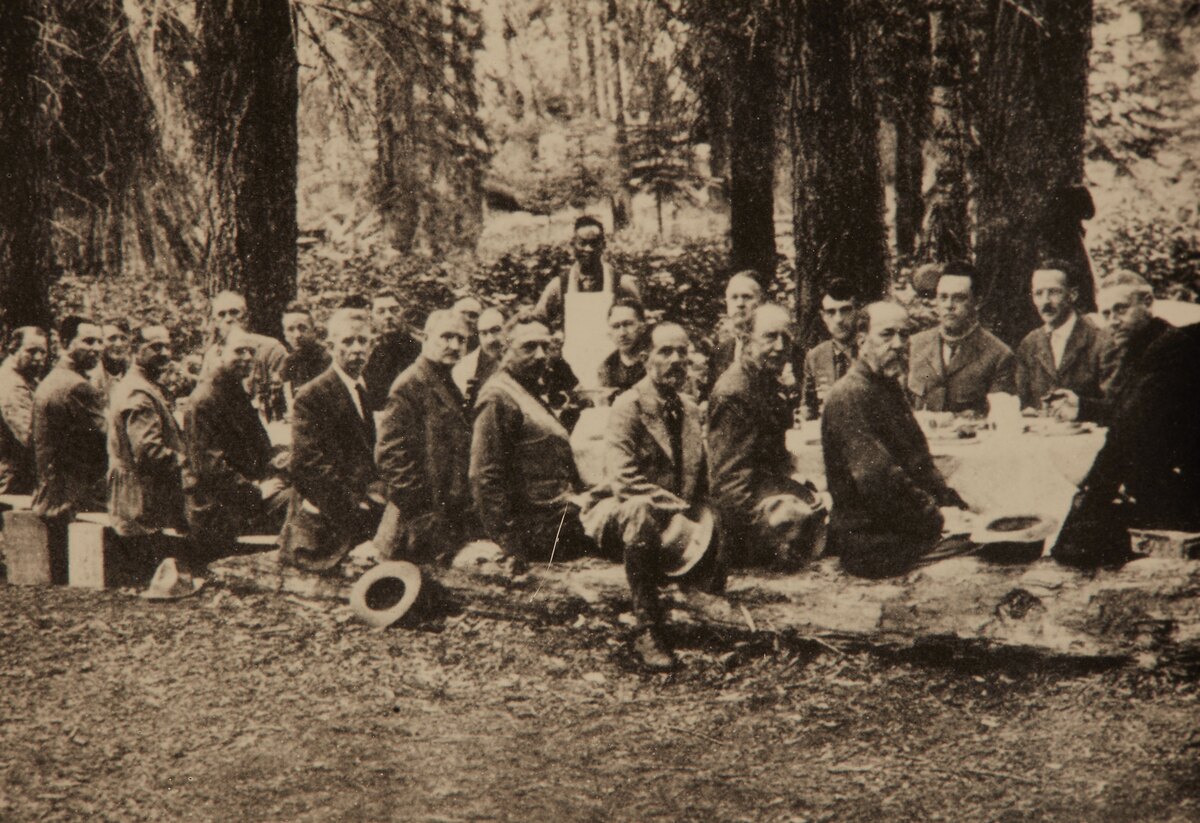
On the evening of 15 July 1915, under the sequoias of the Giant Forest in California, a party of men sat down to dinner at a long table laid with white linen. They had spent the day in motor cars on the Colony Mill Road, sixty miles and six thousand feet of ruts so bad that the passengers kept climbing out to push. Halfway up, finding a campsite strewn with tin cans and paper, their host had stopped the cars, set a congressman and a railway vice-president to picking up rubbish, and left a sign behind: “We have cleaned your camp. Keep it clean.”
The guests were chosen men. There was the ranking Republican on the House Appropriations Committee, the editor of National Geographic, the president of the American Museum of Natural History, a vice-president of the Southern Pacific Railroad, a popular novelist, and Burton Holmes, the most famous travel lecturer in America, with his cameraman. Their host was a Chicago borax millionaire named Stephen Tyng Mather, who had been working for the government for six months.
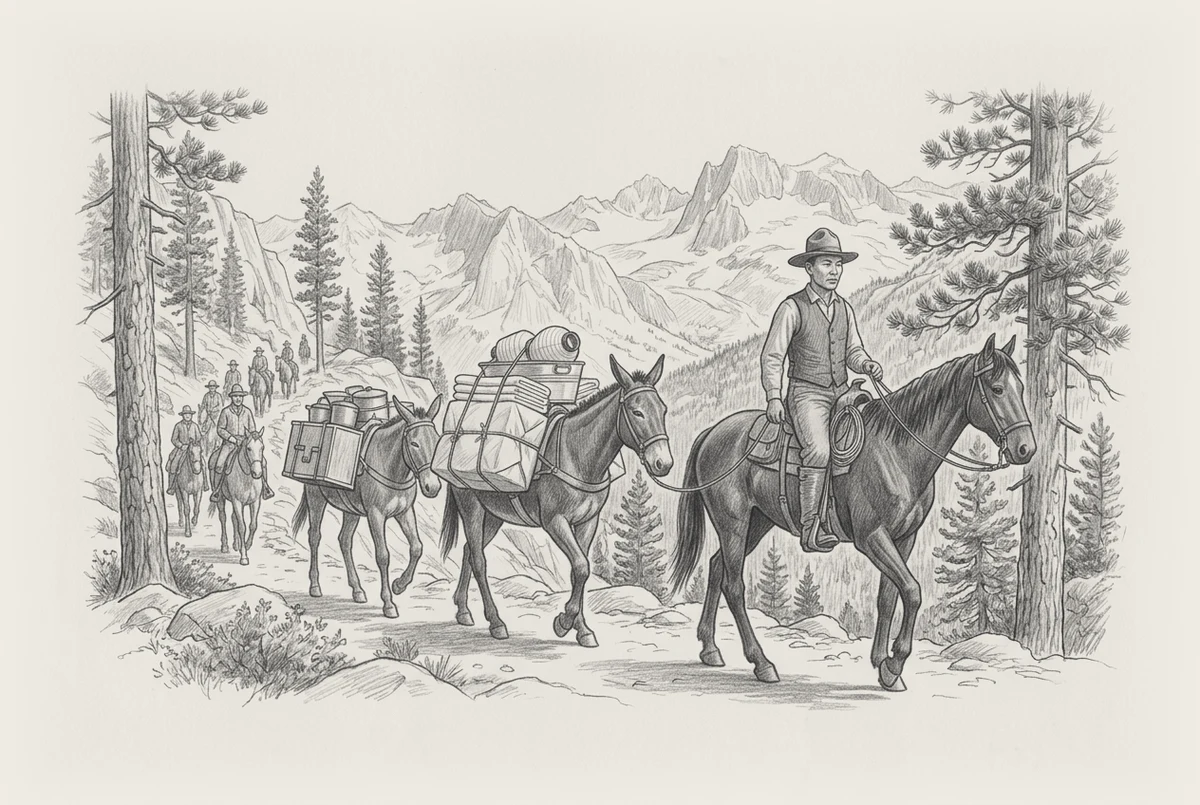
The linen was deliberate. For the next two weeks, as the party rode over the Great Western Divide towards Mount Whitney, one mule chosen by the cook, Tie Sing, carried tablecloths, silver, china, washtubs and Japanese paper lanterns. A second carried two sheet-metal stoves and a sourdough starter, which Sing packed each morning against the animal’s warm body so the dough would rise on the trail. The linen was washed and ironed every day. Mather had supplied the sleeping bags and the new air mattresses. When the mule with the delicacies wandered off, there was still soup, fried chicken, venison and apple pie. When another went tumbling down a rock face and the sourdough was lost, dinner came at ten at night under the lanterns, with applesauce made from the bruised fruit. Holmes did not stay to taste it. After Mather entertained the party with tales of bones along the trail, the fearless world traveller discovered an ulcerated tooth and waited at Mineral King for the stagecoach.
Mather gave his method a sentence that the National Park Service still likes to quote: “Scenery is a hollow enjoyment to a tourist who sets out in the morning after an indigestible breakfast and a fitful sleep on an impossible bed.” The Mountain Party, as it came to be known, was a lobbying trip conducted with a tablecloth. The United States had owned national parks since Yellowstone in 1872, but it had no agency to run them, few decent roads into them and little to persuade most Americans to go. Mather wanted men who could change that to meet the High Sierra well fed and well rested, and to go home talking. Thirteen months later, on 25 August 1916, President Wilson signed the act that created the National Park Service.
Mather did not discover a canyon or a geyser. The national park was forty years older than his interest in it, and John Muir, the railway companies and many others had argued for these places before him. What he gave them was the visit. The road that delivers a family to the gate, the gate itself, the lodge of logs and boulders, the campground with its numbered sites, the ranger who leads a walk in the morning and talks by the fire at night: most of what the world now recognises as an American national park was arranged, promoted or licensed by Mather and his young assistant Horace Albright between 1915 and 1929. The land was ancient. The experience was new, and largely theirs.
The front door
To a European, the first surprise is that an American national park has a front door.
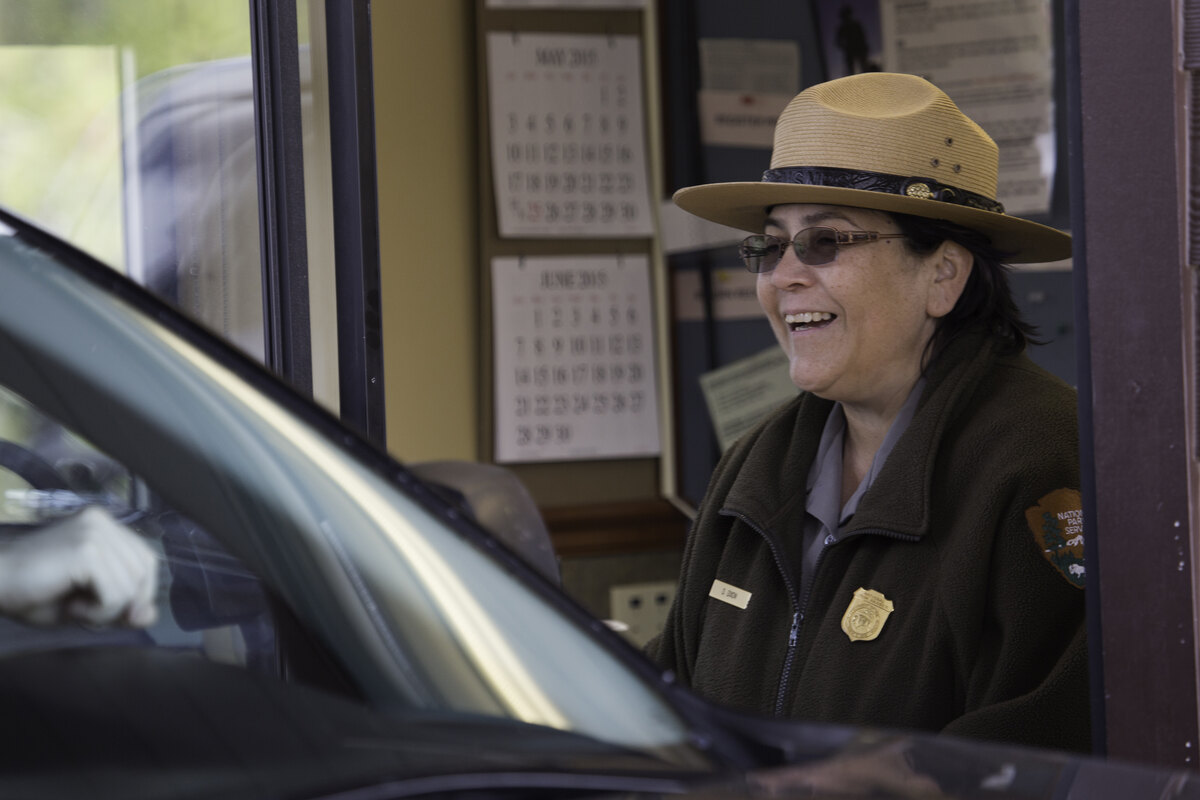
The highway arrives at a row of small booths, like a toll plaza in the forest. Cars and motorhomes wait in line. A ranger in a flat-brimmed hat leans from the window, takes payment—at Yellowstone, $35 a car for seven days, and since January 2026 a further $100 a head for visitors aged sixteen and over who do not live in the United States—and passes through a folded map and a newspaper. The map shows a loop of road. From that moment the car is the unit of travel. You drive, you pull over, you park, you walk a few hundred yards on a boardwalk or a paved path to the thing you came to see, and you drive on.
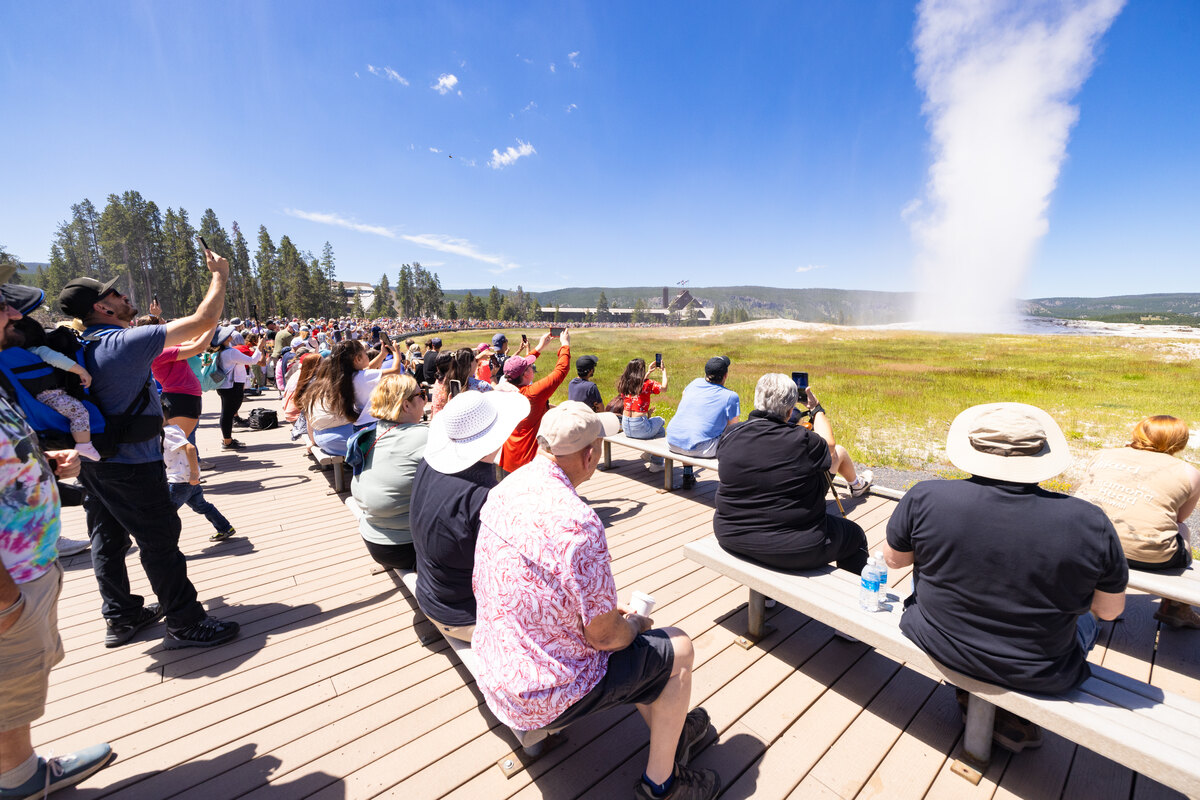
Scale explains much of it. Yellowstone covers 8,991 square kilometres, three and a half times the area of Luxembourg, laced with 392 miles of paved road. Inside are nine hotels and lodges with more than two thousand rooms and cabins, eleven campgrounds, and eleven visitor centres, museums and contact stations. At Old Faithful the Park Service posts the predicted time of the next eruption, and the benches fill before the appointed hour like seats before a curtain. Bison stop the traffic. Children complete a Junior Ranger booklet, raise a hand for the pledge and receive a badge. For many Americans the park belongs to a life: first seen from the back seat of the family car or on a school or scout trip, then again decades later from the driving seat of a rented camper, with their own children in the back.
To a first-time visitor the effect can feel a little like Disneyland. The comparison runs in a curious direction. When Disney built its Wilderness Lodge at Walt Disney World in 1994, the architect, Peter Dominick, took as his models the great national park hotels, above all Yellowstone’s Old Faithful Inn. The theme park borrowed from the national park.
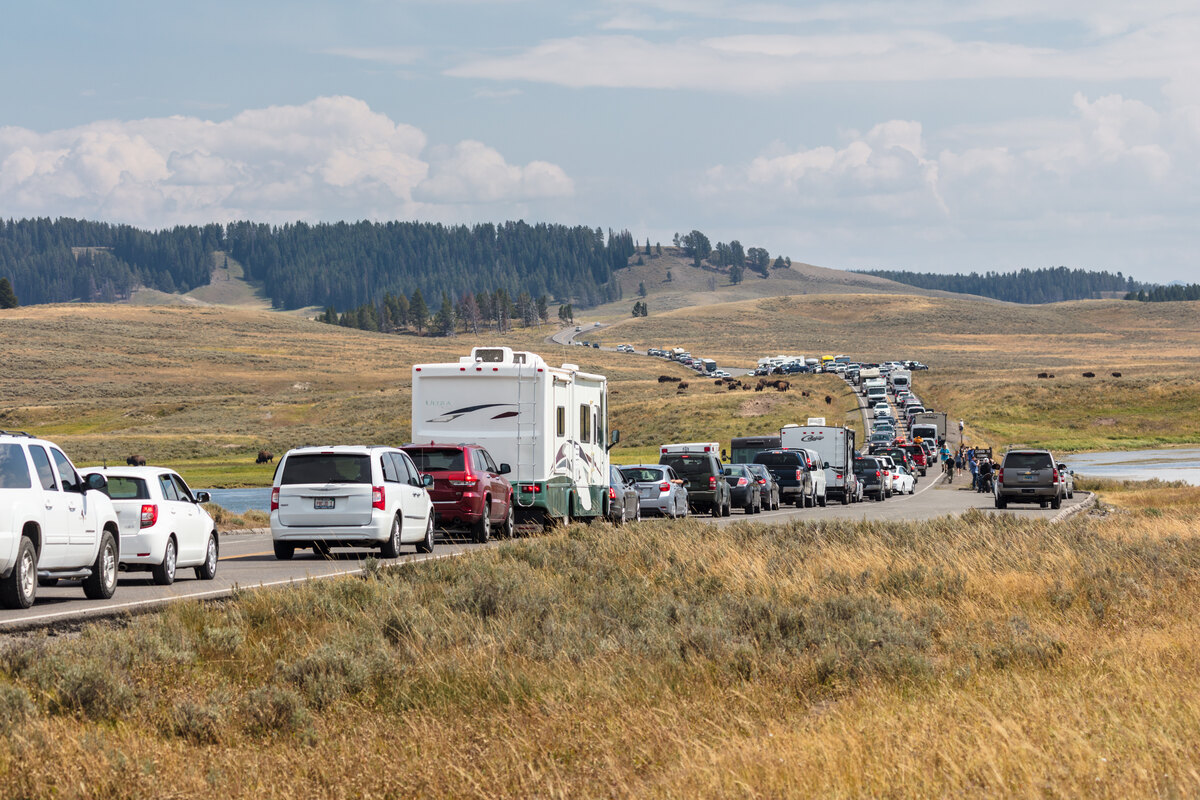
Europe arrived at its parks by a different road. The Swiss National Park in the Engadine was founded on 1 August 1914, the oldest in the Alps, and its 170 square kilometres were set aside for nature and science first. You arrive by train and post bus. There is no loop road, only one road passing through; visitors must keep to the marked paths, and camping, fires and dogs are forbidden. In the Alps, comfort at altitude had long come from mountain huts reached on foot, while the hotels stayed below in the villages. Britain’s national parks, created from 1951 onwards, are lived-in country, with farms, towns and private land inside their boundaries. In much of Europe a walker can cross into a national park without noticing. In the United States the car passes a gate, a sign and a ranger, and the traveller has unmistakably arrived.
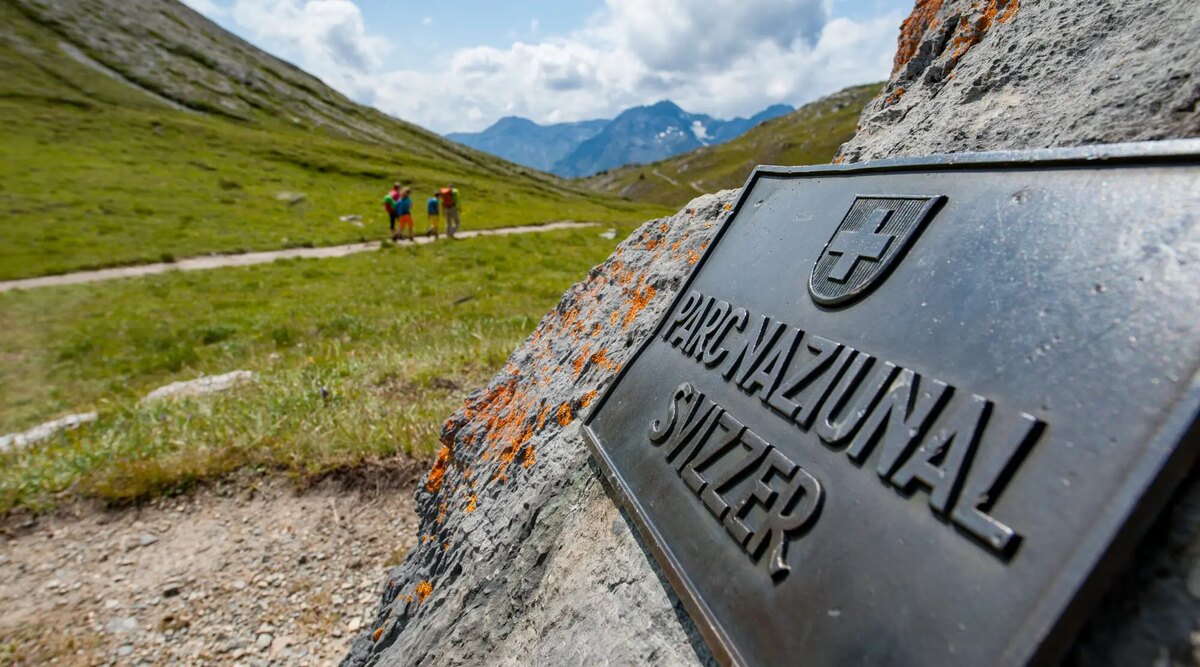
The European park is somewhere you walk into. The American park is somewhere you are admitted. The difference was not written in the geology. In 1915 the national parks admitted almost nobody.
Twenty mules
Stephen Tyng Mather was born in San Francisco on 4 July 1867, into a family with old New England roots. He graduated from the University of California in 1887 and spent five years as a reporter on the New York Sun, where he learned how a story is placed. In 1893 he joined the Pacific Coast Borax Company, where his father worked, and soon ran its promotion.
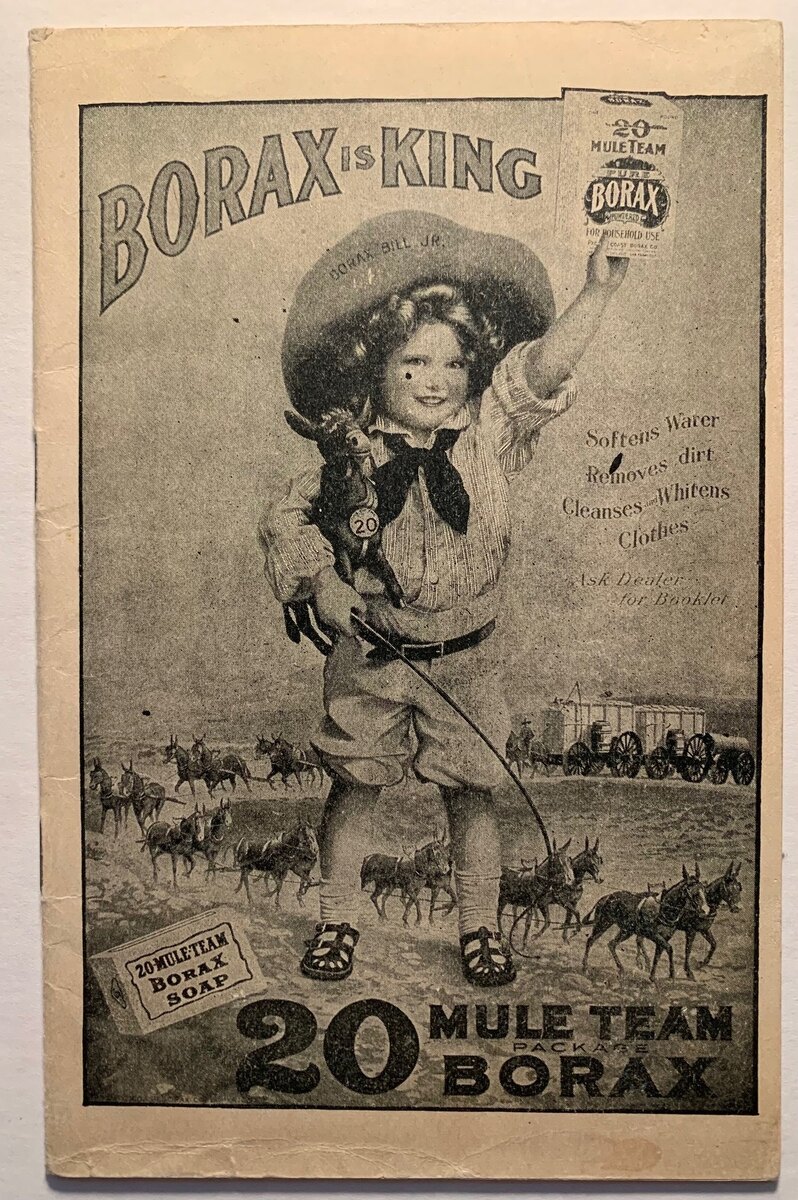
Borax was a white mineral powder useful for washing, glazing and preserving. Mather set out to put a package of it on every kitchen shelf. He wrote letters for women’s magazines, planted stories through friends in the newspaper business, and gave the company’s picture of a mule team a name that would outlive him: 20 Mule Team Borax.
The teams themselves were already history. From 1883 to 1889, great wagons had hauled borax from the Harmony works in Death Valley to the railhead at Mojave, 165 miles and ten days across the desert, pulled by twenty mules and dragging their own water. The haul had ended before Mather arrived. What he sold was its image: heat, distance, endurance and a heroic crossing, shrunk to a trademark on a box of laundry powder. The customer bought the hardship as a picture and was spared the journey.
He worked at everything with the same electric force, and in 1903 it broke him. He spent four months in a sanitarium in Wisconsin, relapsed each time he returned to work, and was sent by his doctors to Europe for eight months; he saw Switzerland in 1904. His employer, Francis Marion “Borax” Smith, stopped his salary a month after he sailed. Mather joined his friend Thomas Thorkildsen in a rival company, Thorkildsen-Mather Borax, and it made them both millionaires. What his family called nervous breakdowns would now be recognised as the swings of manic depression. For the rest of his life the mountains were part of the cure. He joined the Sierra Club, climbed Mount Rainier in 1905 and met John Muir on a trail in Sequoia in 1912.
Dear Steve
The best-known story about Mather is that in 1914, after an unhappy holiday in Yosemite and Sequoia, he wrote an angry letter to the Secretary of the Interior, Franklin K. Lane, an old friend from Berkeley, and received a famous reply: “Dear Steve: If you don’t like the way the national parks are run, why don’t you come down to Washington and run them yourself?”
Horace Albright, who helped the story into circulation, admitted near the end of his long life that it was probably legend. Lane and Mather had not known each other at university, and nobody Albright knew had ever seen either letter. What happened was more ordinary and more revealing. Lane asked a Chicago friend, the law dean John Wigmore, about Mather, and Wigmore arranged a lunch at the Blackstone Hotel, where Lane took the measure of a rich, restless Californian who wanted to give his energy away.
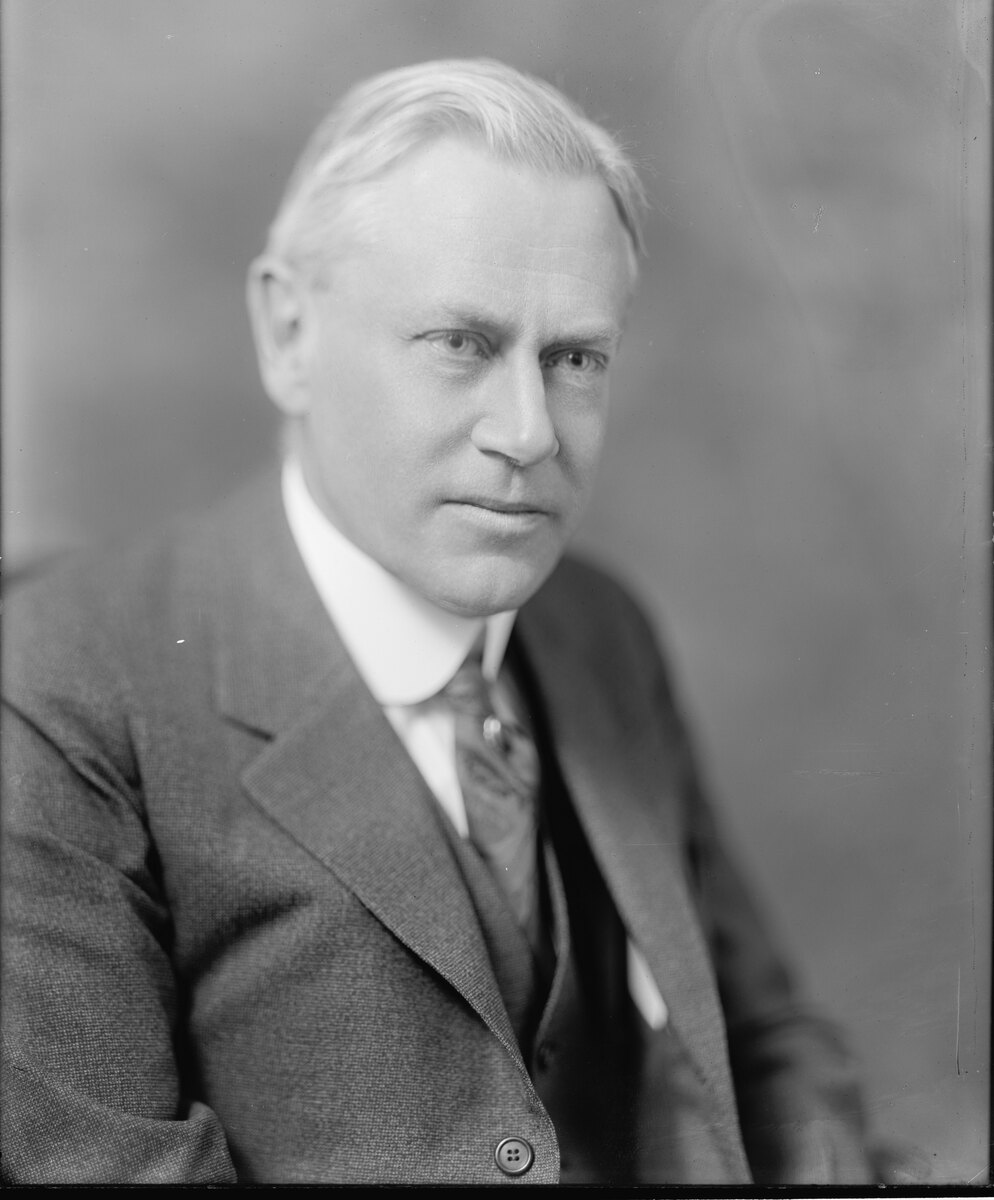
Lane offered him the parks. Mather, appalled by government procedure, agreed to serve for one year, and only if Albright, then in his mid-twenties, stayed with him “to keep me out of jail.” He was sworn in as assistant to the secretary on 21 January 1915. Albright remembered a man a little over six feet tall, with prematurely white hair, piercing blue eyes and “a lightning fast brain with an electric nervous energy to go with it.”
What Mather inherited was less a system than a scattering. The parks were orphans spread among three government departments. Soldiers guarded Yellowstone. Cattle and sheep grazed the meadows of the Sierra. Some of the roads in were private toll roads. The hotels, where they existed, had mostly been built by railway companies for passengers who came by train and stagecoach. In 1915 the national parks counted 314,299 visitors.
Mather’s first great act in office was a dinner. In March 1915, at the Palace Hotel in San Francisco, he gathered a group of prosperous men and told them he held an option on the Tioga Road, an old mining road across the high country of Yosemite built by Chinese labourers in 1882–83. “I got you all together to call for contributions to buy the Tioga Road toll rights,” he said. He had put up a thousand dollars himself and a thousand of his partner’s. “If each of you put in one thousand, the deal is closed.” He had his pledges that night. Many were never paid, and Mather covered the difference himself. The road was given to the nation, and Yosemite had a new entrance from the east.
The portfolio
The Mountain Party was only one part of the campaign. With his own money Mather hired Robert Sterling Yard, a friend from the Sun, as the parks’ publicist. Together they produced The National Parks Portfolio, first issued in June 1916: a handsome collection of photographs and text sent to 275,000 carefully chosen Americans, drawn from the rolls of clubs, professional societies, universities, social registers and chambers of commerce. It cost $48,000, far more than the government would pay. Mather put in the first $5,000 and persuaded seventeen western railway companies to supply the rest. Every member of Congress received a copy.
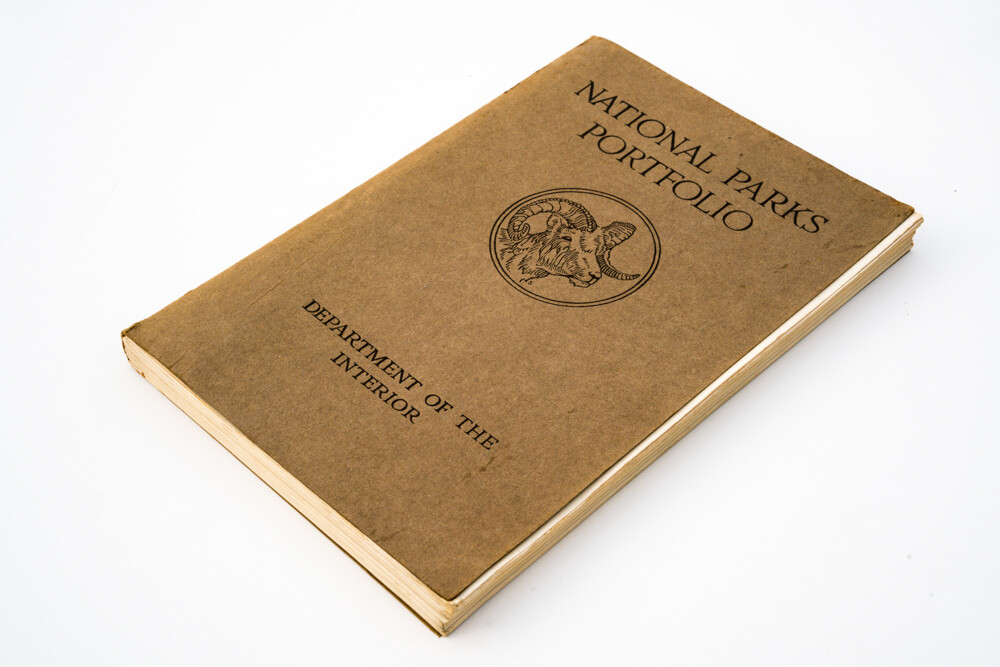
The campaign had a rival, and the rival was Europe. Before the First World War, prosperous Americans had crossed the Atlantic for their scenery. A movement launched at Salt Lake City in 1906 had been urging them, “See Europe if you must, but See America First.” The war closed the Atlantic to pleasure travel and gave the argument its moment. The Park Service’s report for 1917 worried openly about the peace, when Americans would resume spending $500,000,000 and more a year abroad. Swiss glacier scenes, it complained, still went into American schoolrooms, because teachers had never seen the glaciers of Mount Rainier. The American national park was conceived partly as an answer to Switzerland.
The act that President Wilson signed on 25 August 1916 gave the new service a double duty that it has argued over ever since: “to conserve the scenery and the natural and historic objects and the wild life therein and to provide for the enjoyment of the same in such manner and by such means as will leave them unimpaired for the enjoyment of future generations.” Protection and enjoyment shared one sentence. Mather’s genius, and the trouble he left behind, lay in his conviction that the second would secure the first.
The motor car
Before Mather, a visit to Yellowstone meant a train, a stagecoach, a circuit of hotels and an itinerary sold by the companies that ran them. In the summer of 1915 private automobiles were let in, on a schedule arranged so as not to interfere with the horse-drawn coaches. The experiment, an Interior Department report said the following year, had proved “a tremendous success.” In 1917 Yellowstone’s stagecoaches gave way to motor buses.
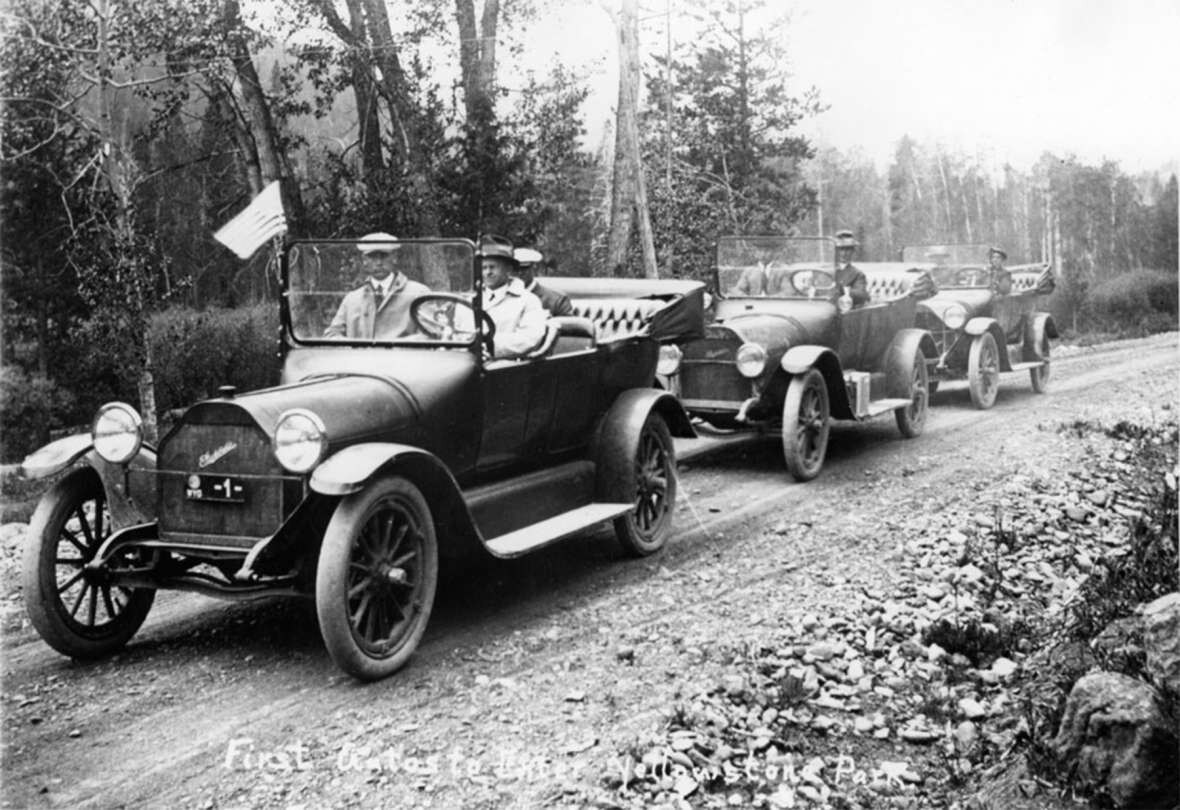
The motor car was Mather’s natural ally because it turned a luxury into something a family could decide on for itself. His report for 1920 counted the change: 54,692 private cars had entered the parks in 1917; in 1920 there were 128,074. More than half the motorists, it noted, carried their own supplies and camping equipment. Free public campgrounds were being cleared, with water and sanitation, for travellers who wanted no hotel at all. For the first time more than a million people had visited the national parks and monuments in a single year. “Our people have turned to the national parks for health, happiness, and a saner view of life,” Mather wrote. Then came the line that tells you how he measured success: “They are using them.”
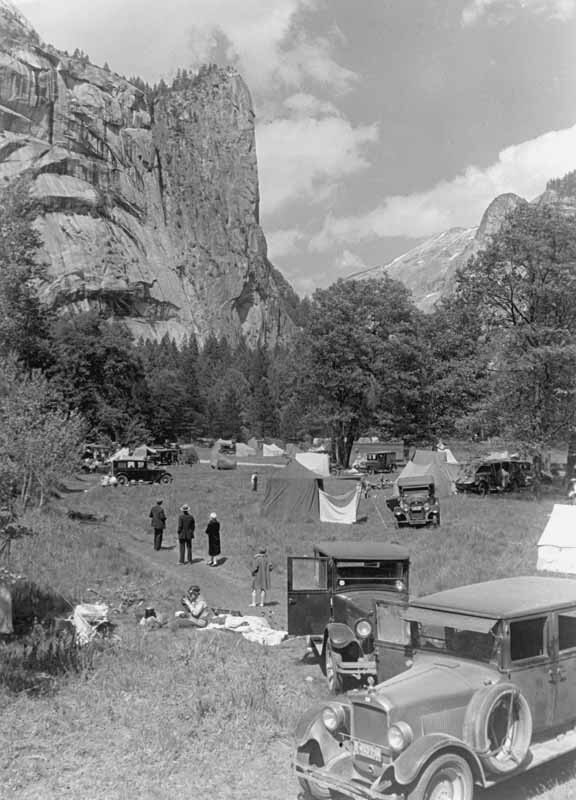
That August the National Park-to-Park Highway was dedicated in Denver, on the service’s fourth birthday: a loop of some 5,600 miles, most of it unpaved, linking twelve western parks. A caravan of motorists set off to prove it could be driven. The parks were no longer separate destinations reached by train, but stops on a road trip, and the road trip had become the holiday. The rest of the century supplied the paving, the station wagon and the motorhome. The idea that a family car might tow its own household into the wilderness belongs to the same story as Wally Byam’s Airstream; the notion that a car could simply go somewhere had been proved long before by Bertha Benz.
By 1929, when Mather left office, the parks counted 3,010,912 visits. In 2025 the figure was more than 323 million.
The creed
The man who opened the parks could not always hold himself together. In January 1917, months before he was to become the Park Service’s first director, Mather broke down at the Cosmos Club in Washington. He was taken to a sanitarium near Philadelphia, where, Albright later learned, he twice tried to kill himself. For most of the next two years the new service was run by Albright, then twenty-seven, while Lane insisted that the illness remain “our secret to keep.”
It was Albright who drafted the service’s founding rules, and Albright who suggested they be issued as a letter from Lane to the absent director, dated 13 May 1918. The letter reads today like the operating manual for an American park holiday. The parks must be kept “in absolutely unimpaired form,” yet they were also “set apart for the use, observation, health, and pleasure of the people.” “Automobiles and motorcycles will be permitted in all of the national parks.” “Low-priced camps operated by concessioners should be maintained, as well as comfortable and even luxurious hotels.” Roads, trails and buildings must harmonise with the landscape. There would be no summer homes and no hunting. And the private companies that ran the hotels and transport “must be given a large measure of protection,” with competition generally excluded while a concession met the government’s requirements.
That clause gave the American park its peculiar economy: one licensed company running the lodges, dining rooms, stores and buses inside a park, at regulated rates, under a federal contract. It is why a visitor can eat, sleep, shop and buy fuel without leaving the park, and why so many of those buildings share a family likeness of logs, boulders and deep roofs. Mather did not invent the grand park hotel—the Old Faithful Inn opened in 1904—but he made its descendants a policy. In Yosemite he urged a first-class hotel that would bring the wealthy and influential into the valley. The Ahwahnee, designed by Gilbert Stanley Underwood, opened in 1927.
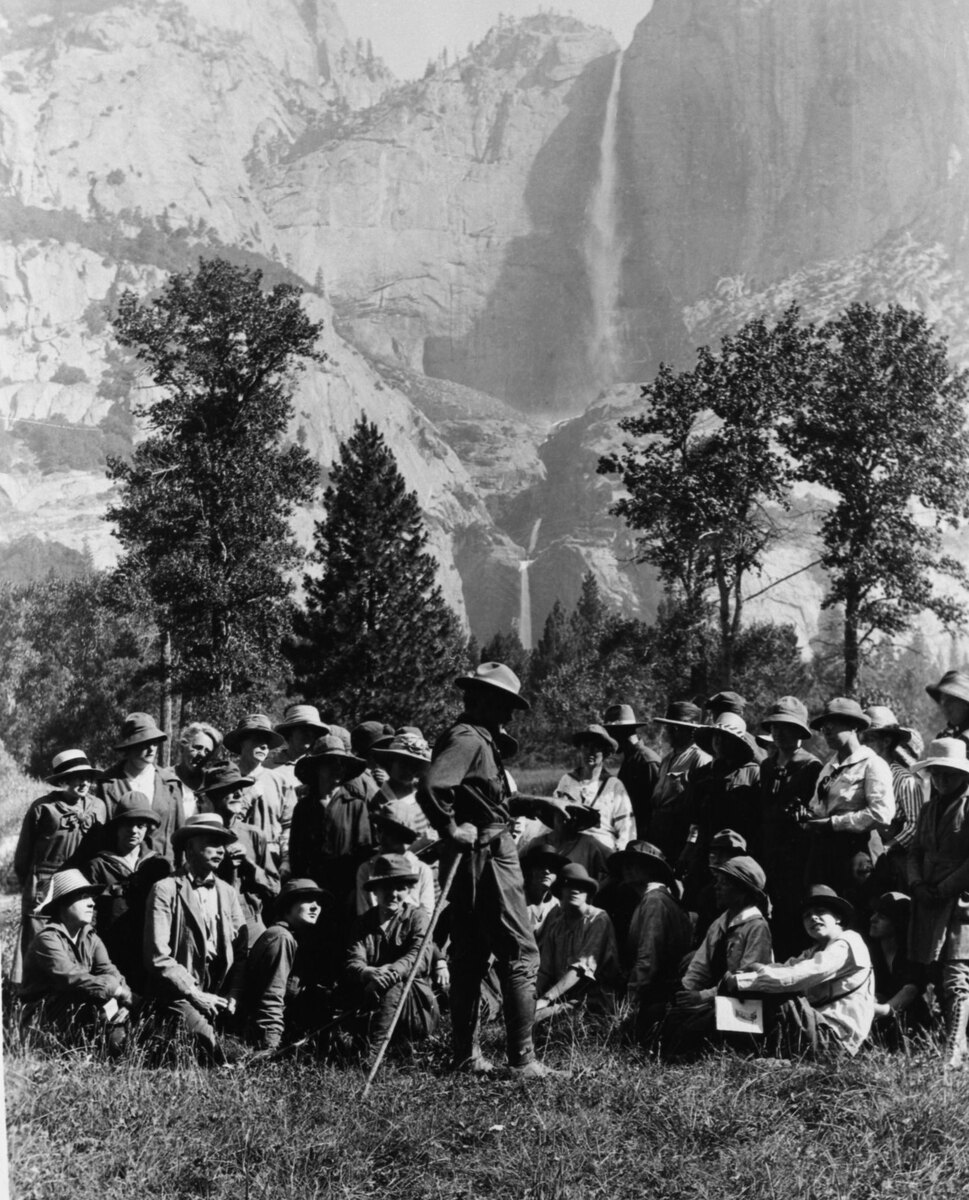
Mather recovered and returned, as ebullient as before, and added the one element of the visit that money alone could not buy. In 1919, at Fallen Leaf Lake near Lake Tahoe, he heard two naturalists, Harold Bryant and Loye Miller, leading nature walks and giving evening talks to resort guests. The next summer he brought them to Yosemite, where they ran a free nature guide service: daily walks, evening campfire talks and illustrated lectures at Camp Curry. The ranger-naturalist and the campfire programme spread through the system. Mather’s 1920 report called for museums in every park. Scenery now came with an explanation.
Fire and bears
The American park also learned to put on a show, and Mather’s service did not discourage it.
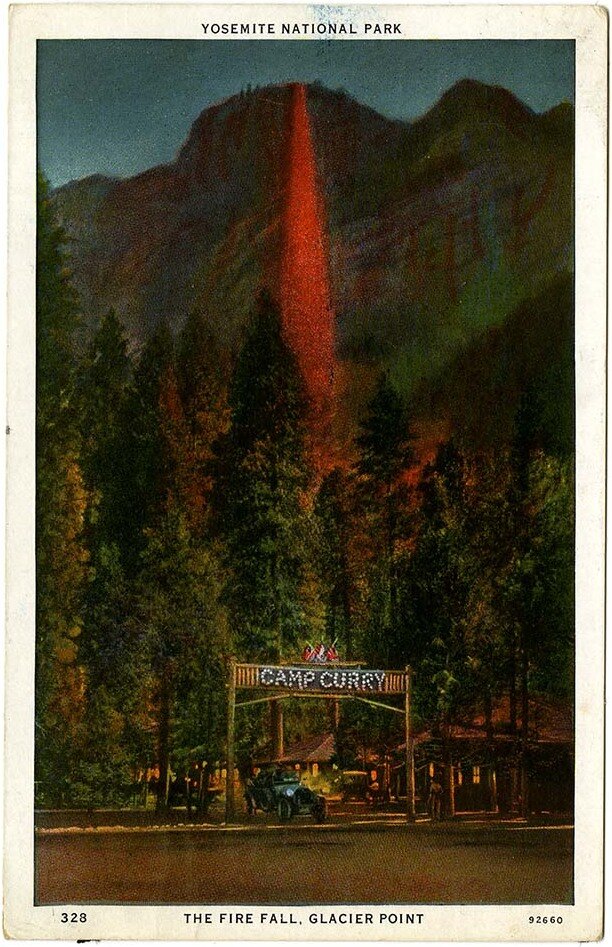
In Yosemite, the Curry family’s camp had long staged a nightly spectacle: embers from a bonfire on Glacier Point, some three thousand feet above, were pushed over the cliff to fall in a glowing ribbon while the crowd in the valley watched. The Interior Department had stopped the Firefall in 1913 in a quarrel with David Curry. In March 1917, under the new Park Service, Lane granted the Curry company a fresh lease and allowed the Firefall to return. Apart from the war years, it fell on summer nights for another half-century.
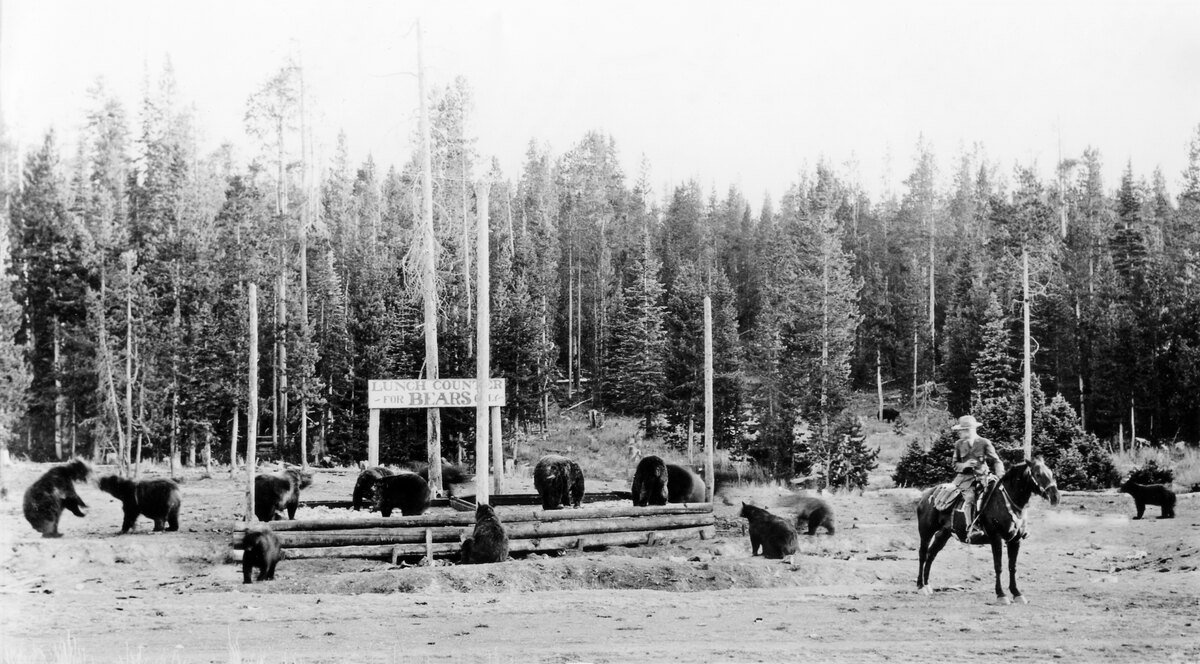
At Yellowstone, from 1921 into the mid-1930s, a feeding platform at Old Faithful bore the sign “Lunch Counter—For Bears Only,” and visitors watched bears eat hotel scraps. Albright, superintendent of Yellowstone through the 1920s, went on defending roadside bears long after scientists objected, on the ground that not every visitor could be expected to go into the wilds to find one.
This is where the Disneyland feeling began: with a service so eager to be used that it put nature on a timetable. The Park Service itself ended it. In January 1968 its director, George Hartzog, stopped the Firefall, which he judged as appropriate to Yosemite Valley as “horns on a rabbit.” Around the same time, bears began to be weaned from roadside handouts and garbage.
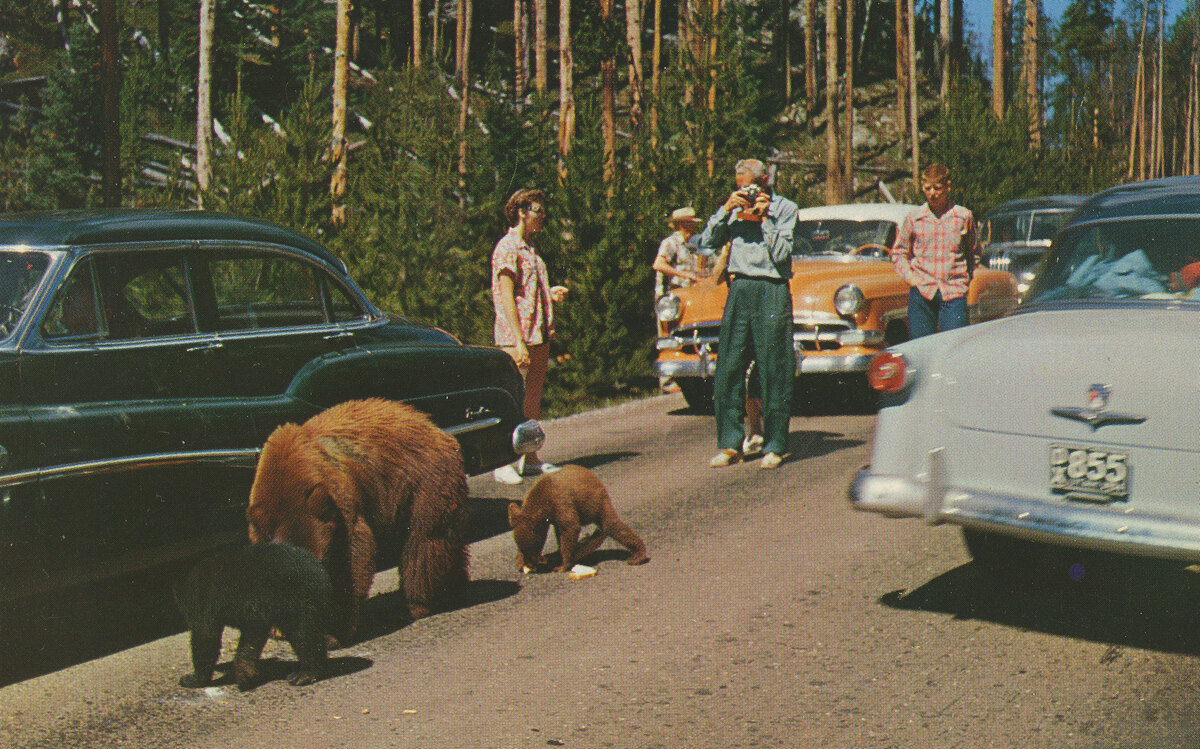
Other costs were quieter. Mather wanted the parks cleared of predators, and the killing went on while letters of protest from the zoologist Joseph Grinnell lay on his desk. Many parks had been made on land from which Native peoples had already been pushed out.
Death Valley
Mather’s two lives met in the desert where the twenty-mule teams had once set out.
By the mid-1920s the Pacific Coast Borax Company was moving its mining to a richer deposit at Boron, and its railway into Death Valley needed passengers. It turned to tourism. On 1 February 1927 it opened the Furnace Creek Inn, twelve rooms at ten dollars a night, meals included. A local paper had once joked that the valley offered “all the advantages of hell without the inconveniences”; the company now meant to supply the advantages. It also wanted the valley protected. In 1926 it had invited Mather and Albright to visit, and because Mather had once worked for the company it avoided any appearance of favour by campaigning in public instead, sponsoring among other things a radio programme called Death Valley Days.
Mather did not live to see the result. A stroke ended his work, and he resigned in January 1929. He died in Brookline, Massachusetts, on 22 January 1930. Albright succeeded him. In February 1933 President Hoover proclaimed Death Valley a national monument; in 1994 Congress made it a national park. On 4 July 1932, what would have been Mather’s sixty-fifth birthday, the first bronze plaques bearing his profile were set up in ten parks, with a line still read by people waiting for the next thing to happen: “There will never come an end to the good that he has done.”
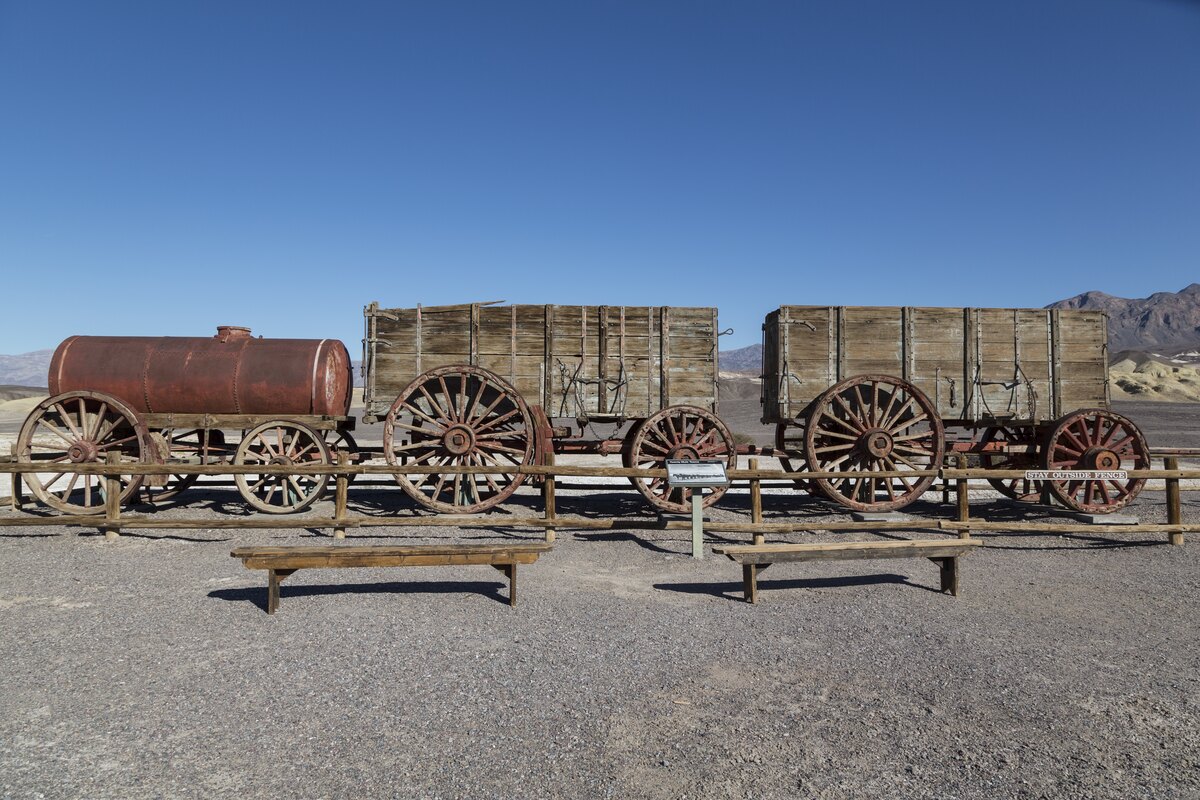
At Harmony Borax Works today, a short walk from the car park, stand original twenty-mule-team wagons, explained on signs by the service Mather built. From the inn, which still stands, a family can drive to them in minutes with the air conditioning on, cross the valley floor before lunch and be back beside a spring-fed pool by the afternoon. The wagons once meant ten days of heat and thirst to Mojave. Mather turned them into a picture that sold laundry powder, and then did the same for the American wilderness: he kept the grandeur, removed the ordeal, and set a table where the hardship used to be.