
You find a flight and a week at a good hotel in the travel agency beside your local supermarket. The whole package costs less than the same week’s accommodation on Booking.com. Same hotel, same room category, same meals. How can adding flights make a holiday cheaper?
I would take that offer seriously. A package can be a genuine bargain because the operator bought on different terms, took a risk before you arrived, or has access to a price that cannot be sold as a room on its own. The product can be every bit as good. What has changed is the commercial route by which it reaches you.
After some twenty years leading a destination management company, I find that route more revealing than the shopfront. To understand a hotel booking, follow who has the right to sell the room, who bears the cost if it stays empty, and how the hotel learns that you are coming.
What the travel agency is selling
The agency in the supermarket can be a retail outlet for a tour operator. It sells the operator’s holiday and earns its agreed remuneration; it does not have to buy the room and flight at the public prices you see today.
Behind that offer, the operator may have contracted hotel rooms months earlier, chartered aircraft or reserved blocks of seats. It can also assemble a package from prices available when you enquire. Both models exist, and a single operator can use a mixture.
A hotel meanwhile sells through its own reservations office and website, online agencies, wholesalers and tour operators. Each channel can have different prices, stock and conditions. Booking.com shows the offers available through its channel for your search. It is a useful comparison, not the hotel’s universal price list.
Commitment buys a different price
With a commitment, the operator accepts an agreed financial obligation for capacity, including the risk of places it does not sell. The hotel gains some certainty about its income; the operator negotiates a favourable buying price in return. An airline or charter arrangement can create a similar obligation on the transport side.
That is a substantial difference from receiving a commission only when someone books. If demand is strong, the operator’s buying price can leave more room for margin. It has been rewarded for taking the risk. If demand is weak, it may still owe for empty rooms and seats. A generous margin on the holidays sold has to be considered alongside the cost of those left unsold.
For the traveller, the opportunity is simple: the operator can sometimes sell the whole holiday below the public price of its separate parts and still make a worthwhile sale.
A package cheaper than the room alone
Take an illustrative seven-night holiday for two adults sharing one room. The hotel is offering that room at €200 a night through a public booking channel: €1,400 for the stay. Suppose the operator’s contracted cost for the identical room category and meal plan is €100 a night.
Its simplified figures might look like this. The supplier amounts are assumed to include their compulsory charges; they are invented to explain the calculation, not a quotation for a real trip.
| Part of the holiday | Operator’s cost |
|---|---|
| Seven nights in one room | €700 |
| Two return flight seats | €300 |
| Transfers for the pair | €50 |
| Total travel components | €1,050 |
At a package price of €1,200, the operator has €150 left for selling, servicing and profit. That is not €150 of net profit: the retail agency’s remuneration and the operator’s other costs still matter. Yet the customer receives the hotel, flights and transfers for €200 less than the publicly offered accommodation alone.
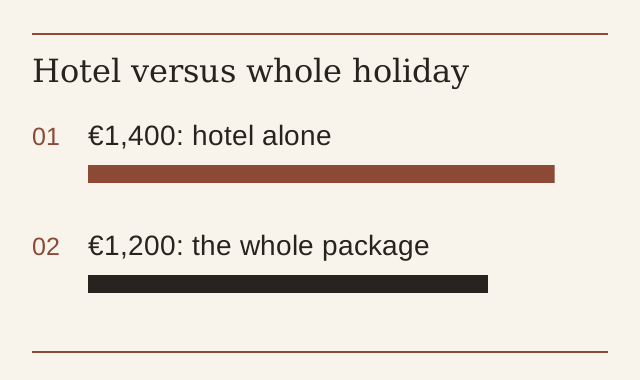
Nothing in this example requires a worse room or a smaller breakfast. The hotel accepted a different buying price in a different commercial arrangement. I would compare the room, meals and conditions carefully, but I would not assume there must be something inferior about the stay simply because the package is cheaper.
Why some rates are package-only
A hotel can also authorise a lower rate specifically for a package. The customer sees the combined holiday price, while the hotel’s individual contribution is not separately exposed as a room-only bargain.
That gives the hotel another way to reach price-sensitive customers without reducing its visible public rate for everyone. The discounted room can be the same category sold at a higher standalone price. This arrangement does not require the operator to have guaranteed a block of rooms: package pricing and commitment are separate reasons a deal can be attractive, and they can work together.
It also explains why an agent may be unable to sell you just the hotel portion at the implied price. The rate is conditional on the eligible package, not a secret room-only price the agent is refusing to reveal. And it is not limited to high-street agencies: online package sellers can have such rates too.
Where the last-minute offers come from
Now imagine that the departure is close and the operator has too many committed rooms and seats left. Returning them without cost may no longer be possible—or may never have been part of the agreement.
The commercial question changes. The operator would like to recover the full cost and earn its margin, but a lower sale can be better than collecting nothing on capacity it must pay for anyway. It still has to account for costs triggered by the extra booking, such as a transfer or other included service. Sometimes it accepts a loss on the package to reduce a larger loss on unsold stock.
That is the logic behind some late deals, flash offers and what certain markets call “hot offers”. The advertisement is a sales label; the underlying opportunity can be quite real. A good hotel does not become a bad hotel because an operator has failed to fill a particular departure.
These bargains are most useful when you can accommodate the operator’s problem: its remaining dates, departure airport, duration or room allocation. If your holiday must fit one school week and one exact hotel, waiting for distressed stock is a different gamble. When demand is strong, the operator can sell its remaining capacity dearly instead. I would look for an existing opportunity, not plan the trip around a promised collapse in price.
The rooms an operator can still offer
An allotment is part of the contract between hotel and operator. It can authorise the operator to confirm a specified number of rooms without asking the hotel about every sale. The guest receives a confirmation; the hotel may receive the individual reservation later, under the agreed reporting timetable.
Take an allowance of twenty-seven standard rooms with sales due to be reported no later than seven days before arrival. The operator can be selling within that authority while some of its confirmed bookings are still absent from the hotel’s own records. At the deadline, it reports the sales and returns the unused balance. That is why the release period matters to the businesses: it limits the operator’s late-selling flexibility and sets the latest point at which the hotel should receive its sales report.
These are backstage arrangements. A traveller normally notices only their result: one agency can confirm the hotel immediately, while another cannot or needs to ask first. An open allocation can be valuable access to stock as well as a favourable price.
How the hotel takes back control of sales
As demand grows, the hotel asks for current sales reports, brings reporting deadlines forward and closes selected partners’ allotments to further sales. New bookings can still be accepted individually, and another operator may retain permission to confirm immediately. The allotment guide follows each control and explains why different agencies can give different answers about the same stay.
When several operators sell the same capacity
Imagine a hotel with 100 usable rooms, all in the same category, for a particular night. It gives three operators allowances of forty rooms each. The combined selling authority exceeds the hotel’s capacity, but its forecast assumes each operator will sell about twenty-five. It expects unused allowances to be returned and uses reports and sales controls to manage the exposure.
The difficulty is that the hotel may not know all the sales already made. Suppose a widely shared Instagram post makes the destination suddenly fashionable. During the same week, all three operators fill their forty-room allowances before the hotel has a complete updated picture and has closed further allotment sales. Each operator may have acted within its authority.
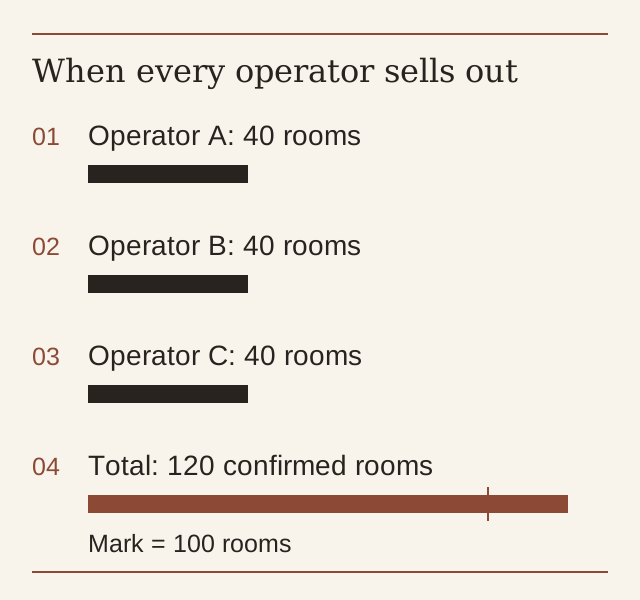
The reports now reveal 120 confirmed room bookings against 100 rooms. The demand surge has travelled through several sales channels together. At release, none of those fully sold allowances has unused rooms to give back. A late stop-sale cannot cancel the twenty excess bookings into non-existence.
This is why the hotel asks for recaps, changes reporting deadlines and closes partners’ allotment sales selectively. It wants to discover and control the commitments before there is a shortage. The allotment guide follows that working relationship step by step.
Hotels can prepare for a relocation by agreeing arrangements and rates with neighbouring properties. That gives the reservations team somewhere to turn when it needs a suitable room quickly. It does not reserve an unlimited supply of empty rooms: the same destination-wide surge may have filled those hotels too. A full hotel with guests it cannot accommodate is an expensive failure. A four-star property can end up paying to move guests into a much dearer five-star hotel because that is the suitable accommodation available. It can lose far more on putting the booking right than it earned on selling it. The traveller should receive a suitable replacement, not be pressed into accepting a downgrade to reduce that loss.
How the reservation reaches the hotel
The commercial arrangement and the technology are separate layers. A hotel can administer tour-operator contracts electronically while also selling connected, constantly updated inventory through its own website and online agencies.
Its property management system holds the operational reservations and guest accounts. A central reservation system may handle distribution across a group, while a channel manager exchanges rates, availability and bookings with sellers. These functions may be bundled into one product.
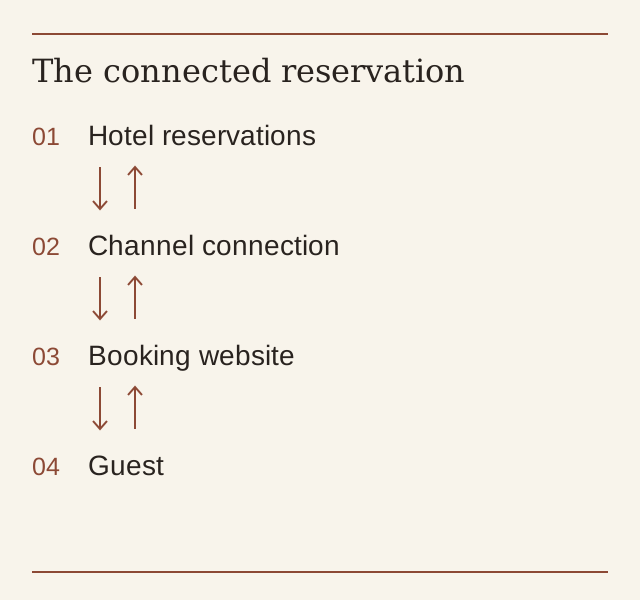
With pooled inventory, five rooms displayed on three connected sites can be the same five rooms. After one sells, the revised balance is sent to the other channels. The hotel has not given each site an independent right to confirm five additional rooms regardless of the shared balance.
Messages travel through APIs, commonly supplied by specialist connectivity providers. Updates can still arrive late, categories can be mapped incorrectly, and two customers can complete a booking around the same time. Good software reduces these failures. It cannot make a hotel’s deliberate decision to promise more capacity than it can supply cease to be a risk.
Why the hotel wants you back through its own website
A booking platform brings visibility, comparison tools and customers the hotel might struggle to reach alone. The hotel pays for that distribution, commonly through a commission calculated on the reservation value. If much of its business comes from one platform, its position in that platform’s results and its participation in promotional programmes become commercially important.
That explains the parallel effort to win direct bookings: a member rate, breakfast included, or a benefit offered on the hotel’s own website. A direct sale can avoid the platform commission, although the hotel still has marketing, payment and booking-system costs. It has room to make a different offer; it is not obliged to make the cheapest one.
The rules on matching prices across channels have also changed. For properties in the European Economic Area—the EU plus Iceland, Liechtenstein and Norway—Booking.com cannot prevent a hotel offering different prices or conditions on its own website or another channel. That is part of its obligations under the Digital Markets Act.
The practical result is worth comparing: the platform may be where you discover a hotel, while the property’s own offer includes something more useful. Check the same room, meals and cancellation terms. A direct-booking perk is a commercial incentive, not protection against being moved if the hotel cannot accommodate you.
Follow the money when you need a change
Your payment may travel differently from the reservation. A hotel may collect it directly, a platform may collect and settle separately, or a tour operator may pay under its own contract. The property may receive a virtual payment card or an intermediary’s reference rather than the details you expect.
Reception can consequently recognise your stay while being unable to refund the retail price you paid. The seller may have to handle that transaction. The hotel may not even see the final package price, because its own accommodation payment is only one component.
For a package, keep the organiser’s and retailer’s details as well as the hotel confirmation. For a hotel-only purchase, keep the seller, payment recipient, inclusions and cancellation terms. If reception cannot find the reservation, ask the seller to contact the property and have it acknowledge your booking. Tracing the reference and any outstanding sales report is the seller’s work. If the booking is present but the hotel cannot supply a suitable room, the next conversation is about overbooking and a replacement.
How I would use this as a traveller
I would compare a package even when I had originally intended to book independently. A supermarket travel desk can have access to a commercial arrangement worth more than the sophistication of a booking website. Equally, a cheap package is useful only if its actual dates, flight times, room and inclusions suit the trip.
Put the offers beside each other: the exact hotel and room category, meals, usable nights at the property, flights, baggage, transfers, total price and change conditions. Then take a genuine saving seriously. Sometimes another business’s willingness to take a risk months ago is the reason you can afford a better holiday today.