
In Cartagena, I booked the only rooftop suite at a small luxury hotel. The owner arrived and took it. The hotel left me with the choice of accepting a standard room or leaving.
That was a decision to displace me. It was not a mystery in the booking software, and it was not a destination suddenly running out of rooms. I had paid for something the hotel chose to give to someone else.
I start with that experience because “we cannot give you your room” can describe different failures. Before deciding what to ask for at reception, establish which one you are facing. Before the trip, think about who will stand beside you commercially if the hotel decides you are the guest it would rather move.
A missing suite is different from an overbooked hotel
A property may have hundreds of rooms but only one penthouse, or a handful of suites with the particular view you booked. If one becomes unusable because of a plumbing failure or a serious pest problem, there may be no equivalent room left in that hotel. This is a loss of usable inventory—an inventory drop—rather than too many ordinary rooms having been sold.
The scarcity of that category makes the solution difficult and potentially expensive. The hotel may need to arrange a comparable suite, or a higher category, at another property. Offering a standard room in the original building does not reproduce what the guest bought merely because it is available.
A management decision can also remove a room from your booking. Allowing an important guest to extend, or an owner to take the suite, is different from an unavoidable repair. My Cartagena experience belongs here: the room existed, but the hotel gave priority to its owner. The explanation matters when you describe the failure to the seller or management; it does not make the lower-category offer acceptable.
I would separate both situations from the overbooking problem discussed below: a hotel’s distribution has produced more confirmed room bookings than its capacity can accommodate.
How overlapping sales become a shortage
An operator can confirm rooms from an allotment before it has reported all those sales to the hotel. If several operators’ selling allowances overlap, the property is managing exposure as well as the bookings already visible on its own system.
The hotel calls for current reports, brings reporting deadlines forward and closes selected partners’ allotment sales while allowing new bookings on request. Those controls are meant to prevent a shortage. But a sudden burst of popularity can fill several operators’ allowances together before the hotel has the complete picture and has acted on it.
An Instagram post making a destination fashionable is an easy way to imagine that demand arriving through several sellers at once. By the time their reports reveal the total, the customers already have confirmations. The hundred-room example follows the arithmetic; the allotment guide explains the reporting relationship.
The hotel then has to decide which guests it can accommodate and which it will relocate. That is an expensive decision, with consequences beyond tonight’s room bill.
The hotel is choosing a business relationship too
When a hotel chooses whom to move, it is also choosing whose customer it will disappoint. The guest’s inconvenience is obvious. Behind it are complaints, compensation, future bookings and the hotel’s relationship with the business that supplied the guest.
This is why I look beyond the familiar advice to book direct or use the biggest website. The question I find more useful is: who will actually intervene, and what does the hotel risk by disappointing them?
A direct booking does not make you untouchable
Booking on the hotel’s own website gives you a direct transaction. I would not mistake that for protection against being moved. As a one-off guest without a wider relationship, you may be the complaint the hotel considers easier to absorb. There is no tour operator behind you whose future business enters the calculation.
Loyalty status can change that position. A valuable repeat guest, a recognised status level and a clear route to brand management give the hotel more to consider. Some programmes also attach formal benefits to a failed reservation. Marriott Bonvoy, for example, has an Ultimate Reservation Guarantee for eligible elite stays, providing nearby accommodation for that night and compensation under its rules. That is a specific benefit to invoke, not a promise that the original room cannot disappear.
A large platform is not the same as a personal advocate
Booking.com and Expedia bring hotels a great deal of business. That does not mean the weight of the whole platform automatically enters your individual conversation at reception.
In my experience, their help has tended towards a refund and another booking, rather than someone negotiating at the desk to preserve the stay I chose. That may solve an administrative problem while leaving the traveller to find an acceptable holiday at the prices available that evening.
I would still contact the platform and use its support. I simply would not count its overall sales volume as a personal shield against relocation. If offered a refund, establish what suitable accommodation is actually available and who will cover a higher replacement cost before allowing the conversation to end there.
My preference is a reachable agency backed by a strong operator
Where a package suits the trip, my preference is a local travel agency selling a package from an established operator—TUI or Apple Vacations, for example. The office beside the supermarket can be a more useful ally than its modest setting suggests.
There is a local business you can contact again, with its own customer relationship to protect. Behind it can be a substantial operator with contracted hotel business, flight capacity and people responsible for resolving problems at the destination. The hotel is weighing the risk to that continuing relationship, not only the cost of one dissatisfied guest.
That is the combination I favour: an accountable person at the retail end and commercial weight behind the booking. It is not enough simply to find a shop selling a hotel reservation. Ask who organises the package, who handles problems after departure and how to reach them while you are away.
The legal protection belongs to the booking as well. A qualifying EU or UK package places responsibility for the agreed services on its organiser. A local address alone does not create that protection. I want both a useful commercial relationship and clear responsibility for the holiday, while recognising that neither can make every room failure impossible.
Keep your booking details within reach
I would keep the booking confirmation or accommodation voucher and a screenshot of the booked room description together on my phone. If I paid for a suite with a particular view, those are the details I want to show the manager when a standard room is offered instead.
For a package, I would save the agency’s number and the operator’s during-travel assistance number from the travel documents in my phone’s contacts. That lets me bring them into the conversation at reception while the hotel is proposing a replacement.
At reception, negotiate the solution
By the time the hotel tells you it will move you, it may already have chosen the booking and weighed the commercial consequences. Shouting rarely changes that calculation. Nor does insulting the receptionist give that person another suite or greater authority.
What can still change is the solution—and its cost to the hotel. A replacement booking, an upgrade, transport and the length of the replacement stay are not one fixed charge. There is room to negotiate an arrangement that preserves more of your holiday.
Establish whether it is your particular category that is unavailable or whether the property is short of rooms overall. Ask for the manager who can authorise a solution, and bring your agent, operator’s representative or booking support into the conversation while the decision is being made. I would proceed in this order.
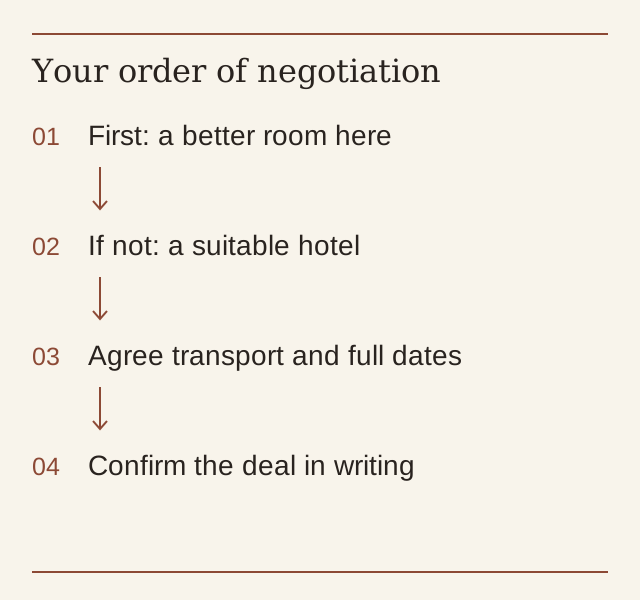
First, find out what is available in the same hotel
Start by asking about availability in the hotel’s other categories. The room you booked being unavailable does not establish that every room in the property is occupied. Leave the question of payment until you know what could be offered.
A question about availability might be: “You’re saying the Deluxe Ocean View room I booked is unavailable, and proposing two nights at another hotel. I noticed you have a Royal Club category. Are there any rooms available there?”
If the answer is yes, establish which nights are available and whether the room suits your party. Then discuss providing it as the replacement for the room the hotel cannot supply, and who covers the difference.
An upgrade can be easier for the hotel to absorb than paying another property to take you, while preserving the location and plans you chose.
If moving, agree the room and the transport together
Get the name of the replacement property, the exact category and its inclusions. Judge it against what you booked: location, beds, meals, access requirements and the features that made the original hotel worth choosing. A higher star count is welcome, but it does not replace a beachfront location or a second bedroom.
Have the receiving hotel confirm the booking before leaving. The move should include the transport, with payment arranged—not an instruction to find a taxi and hope to sort out the bill later. Establish any additional transfers the relocation creates, including the eventual departure transfer where it was part of your package.
The conversation I want is: “Please confirm the room, the included meals and the transfer you are arranging and paying for.”
Explain why returning could make matters worse
Hotels can offer to move you for two nights and bring you back afterwards. The cost to the guest is more than another round of packing. Returning to the reception desk where the holiday began badly can bring the whole experience back, especially after settling into a more comfortable property.
I would explain that calmly. I would be returning with less goodwill, and smaller disappointments could become part of the same unhappy story. A detailed negative review on TripAdvisor would carry that experience beyond the reception desk to future customers. For a guest without a strong agency or loyalty relationship behind them, that reputational consequence may be one of the few remaining arguments the hotel has a reason to take seriously. The hotel still has an opportunity to resolve the incident well; a whole-stay arrangement can give both sides a fresh start.
I might say: “I understand you’re offering two nights at a more expensive hotel, then a return to the room I expected here today. But this has already been an upsetting start. Coming back to this desk would remind me of it, and I’m worried that would affect the rest of my stay here. I can see that ending in a detailed negative review on TripAdvisor. I would rather we found a way to put it right now. Could we settle this for the whole holiday instead? I’m happy with the same or a better room category at another hotel in this area, so I can unpack once and put this behind me.”
Being open to a suitable hotel of the same standard gives the manager more ways to agree. I want the hotel to see how one satisfactory move can settle the problem, instead of arranging an unhappy return that may leave it with a longer complaint.
Treat a temporary downgrade as a separate bargain
A short move into a lower category is a different proposition. If I wanted to return to the original room once it became available, I might consider that temporary arrangement with an agreed price adjustment or compensation, a firm return date and both transfers covered. I would not accept it as though the original booking had simply been fulfilled.
Settle what is being given up, for which nights, and what the hotel will provide in return. A vague promise to discuss compensation after the holiday leaves the most important part of the conversation unfinished.
Keep rights and requests distinct
A suitable replacement without additional guest cost can be a contractual obligation; a particular upgrade or a whole-stay arrangement at your preferred alternative may still need negotiating. Keeping those separate makes the conversation more effective.
For example, Booking.com’s partner terms require the property to seek suitable equal-or-better accommodation without an extra guest charge and to cover reasonable relocation expenses. For an EU-protected package, the organiser must resolve a failure to provide the agreed service at no extra cost. Those responsibilities are useful even when the first practical offer disappoints you.
When the hotel has put things right
From the industry side, moving guests is a costly failure to prevent. The hotel pays for replacement accommodation and transport, can face contractual penalties, and risks the relationships that bring it future business. It is not trying to end the day with guests it cannot accommodate.
There is a tension in the convenience we enjoy. An operator’s authority to confirm immediately makes a holiday easy to buy, but sales can get ahead of the hotel’s reports. A sudden surge in a destination’s popularity can expose that gap across several operators at once. The hotel’s controls are there to keep these failures exceptional. When they fail, the hotel has to put the booking right.
If it offers a genuinely suitable replacement of the same or better value, with the agreed dates, inclusions and transport covered, I would accept a fair resolution. Read any settlement or waiver, understand which claims it settles, and sign it only if that matches the resolution you are accepting. Once the arrangement is agreed, there is little to gain by keeping the argument alive. Accept the solution, let the staff get on with arranging it, and enjoy the holiday.