
Two agents can look for the same flight and come back with different offers. One may include a bag; another may have a fare the first cannot access. This is not necessarily carelessness. They may be shopping through different connections, under different commercial arrangements.
I would judge a booking service by the journey it can sell and support. Understanding GDS and NDC helps explain why those two abilities do not always arrive together.
What sits behind the agent’s screen
A global distribution system, or GDS, is a shared booking environment through which an agent can search and sell flights from many airlines, alongside hotels and other travel services. These systems grew out of airline reservations technology extended to travel agencies. Amadeus, Sabre and Travelport are familiar names: the agent can compare suppliers without working through each one’s consumer website.
An airline’s own reservation and inventory systems still matter. A GDS is not a warehouse holding every seat in the world, and no single distribution channel necessarily contains every fare, product or supplier. Access depends on participation, content agreements and the connection being used.
Hotels can reach the same agent through reservation and distribution connections; those routes sit alongside the contracts explained in how hotel booking works.
What NDC changes
NDC is a data-exchange standard, not an airline, a booking website or a guarantee of a cheaper ticket. It gives airlines and sellers a way to exchange offers with richer product information and to manage orders.
The airline can construct an offer that includes the flight and relevant extras, rather than relying only on a seller assembling a comparison from traditional fare and availability messages. That can make differences between products easier to show: baggage, seats and a fare’s included services need not be reduced to a bare fare figure.
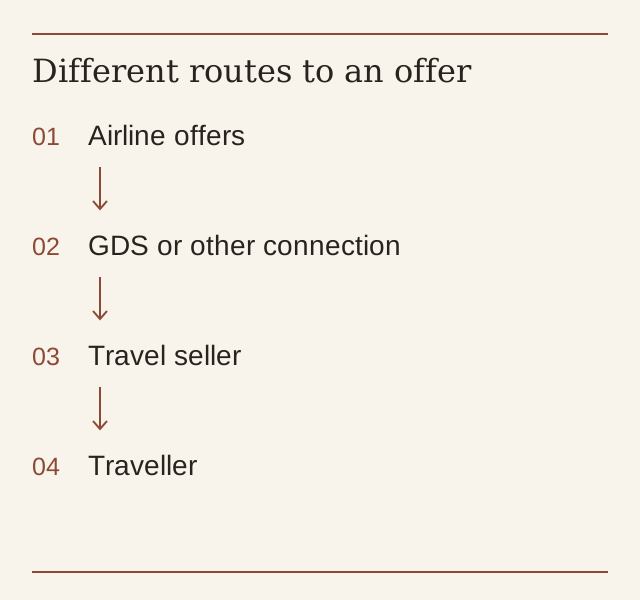
The connection can reach an agent directly, through a specialist aggregator or through a GDS. This is where the familiar “GDS versus NDC” headline becomes misleading. One is a distribution business and system; the other is a standard that a distribution business can use.
Different content does not always mean a better deal
Distribution has a cost, and airlines do not charge for every sales route in the same way. Lufthansa Group, for example, applies a distribution charge to traditional GDS bookings and some NDC bookings, while its own sales and certain agreed NDC connections are exempt. Two sellers can therefore quote different totals for the same flight because their commercial connections differ—not because one has found a different aircraft.
Airlines can also make particular fares or bundles available through some connections and not others. The label “NDC” alone does not tell you whether a charge applies or whether every offer is available.
But “available through NDC” does not tell you whether the offer suits you. Compare the whole product. A lower price for less baggage or more restrictive changes is not a saving on an identical ticket. Nor should an NDC label be mistaken for direct booking: the seller may still be an intermediary.
I would ask an agent about a useful missing offer rather than assume its screen must display everything. A competent answer might explain the channel, the restrictions or an alternative. “The system says no” is the beginning of that explanation, not its end.
Selling the ticket is only the first test
Booking is an orderly transaction. Travel is less orderly. A flight changes, a traveller wants a different date, a refund becomes due, or one person in a family needs to travel separately.
Those actions require the airline, seller and their systems to support the relevant servicing process. Capabilities differ by connection and implementation. A tool that can display and sell an offer may not offer the same range of changes as another route to that airline. For example, an agent may be able to issue a ticket online but need its support desk to handle a date change manually. What matters to the traveller is whether the seller can complete that change promptly, not which system appears on the agent’s screen.
For a simple trip, that may be an acceptable trade. For a complex itinerary I would want to know who handles changes, how to reach them outside office hours and what their fees are. The useful question is “Who can fix this booking?” rather than “Which acronym is newer?”
Why there are still several reference numbers
The industry is moving towards offers and orders: a single airline order is intended to bring together the purchase and its fulfilment, replacing the separate reservation, ticket and service documents used today. That is a transition, not a switch already thrown for every airline.
You can still encounter an agency reference, an airline locator and a ticket number on the same trip. The distinctions are set out in PNRs, booking references and e-tickets. A new distribution connection does not mean every familiar document has vanished.
What matters when choosing where to book
I would compare the total price and inclusions first, then the seller’s ability to support the trip. For an itinerary involving several airlines, the through-ticket distinction matters as well.
Neither a GDS nor NDC is a personal quality seal. They are part of the machinery. A good seller understands what its machinery can do and tells you plainly where its responsibilities begin.