
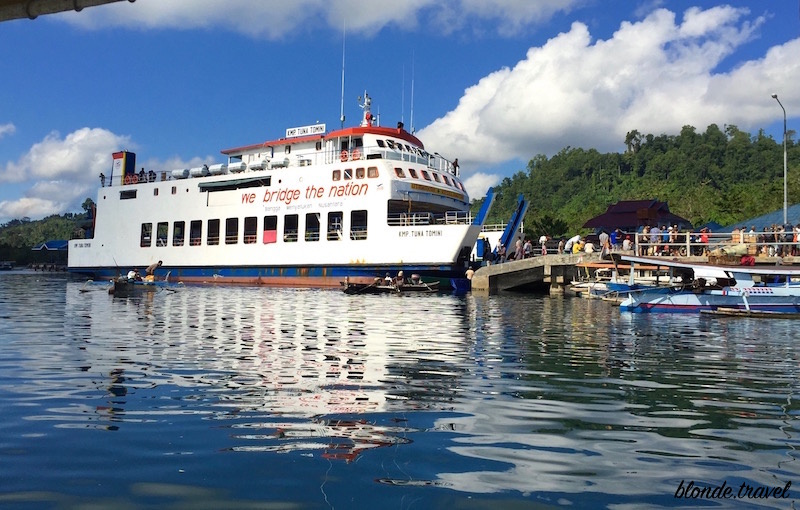
The Togean Islands lie in the Gulf of Tomini, in Central Sulawesi, just south of the equator: a scatter of forested volcanic islands with untouched reefs and almost nothing else. Getting there is slow. If you like adventure, you will enjoy the journey; once you arrive, you understand why it was worth it.
We came for a lake full of jellyfish that do not sting, the last stop on a long Indonesian journey built around unusual underwater places. This is how we reached the islands, and how I would plan the trip today.
Wakai first
Every journey aims for Wakai, a small port village on Batudaka that serves as the hub for all the ferries in the archipelago. Once you are there, the rest is easy. If you have booked a hotel, it will usually send its own boat to meet the ferry; if you have not, plenty of local boatmen gather on the jetty when a ferry arrives, and they will take you to whichever island you choose.
The decision that matters is which side of the gulf you approach from.
North or south
From the north, through Gorontalo. Gorontalo has its own airport, and the port is about forty-five minutes away by road. The catch is the sea: Wakai is roughly a hundred kilometres from Gorontalo, and the only ferry is the Tuna Tomini, an overnight car ferry that runs twice a week and takes around twelve hours.
From the south, through Ampana. Wakai is only about forty kilometres from Ampana, and the crossing is far shorter: a daily speedboat now does it in about an hour and a half. Reaching Ampana is the slow part. The usual route is a flight to Luwuk followed by a drive of around five hours, which normally means a night in Ampana before the morning boat.
On our journey we chose the north, because a chain of connections made it possible to do everything in a single day: Sorong to Manado, Manado to Gorontalo, and the evening ferry. Any delay would have cost us half a week. We took the risk.
Manado between flights
The Wings Air flight from Sorong, in Papua, took two hours in a twin-engine turboprop of the kind that carries most traffic in this part of Indonesia. At check-in in Sorong it took a second member of staff to send our luggage all the way through to Gorontalo; in Manado I still went looking for someone from the airline to make sure it would.
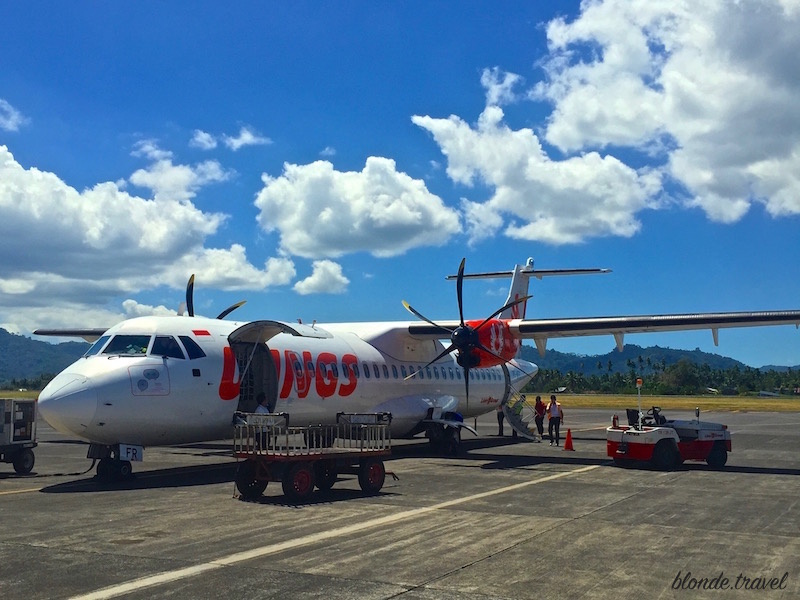
With six hours to spare, I collected every leaflet in the arrivals hall over a cappuccino. Most of them sold boat trips: to the Togean Islands, to Una-Una, to Bunaken, the marine park that makes Manado famous among divers. On land there was a Chinese temple, Ban Hin Kiong, and the Tangkoko reserve. We settled for a look at the centre and the harbour, and were glad we had not been more ambitious. A ride that should have taken twenty minutes took over an hour in traffic, through grey streets, dust and endless horns. We took refuge in a shopping centre, where people smoked indoors above their lunch. Perhaps I had simply not yet left the quiet of Raja Ampat behind, but Manado did not win me over.
The race to the ferry
The flight to Gorontalo takes about forty minutes. We landed before five; the ferry was scheduled for six, and I had read that it never left before seven. There was time.
The taxi drivers at Gorontalo airport asked a hundred dollars for the forty-minute ride to the port, a startling price for Indonesia. Outside the terminal the offers were higher still, and when we went back to the first driver, his price had risen. We agreed.
Then the traffic thickened. It was Friday, and some great celebration was under way; however I asked, I never learned its name. Mopeds surrounded us, then cycle rickshaws, then whole processions of people in masks and feathers. We moved a metre a minute. At seven o’clock we had covered less than a third of the way, and I began counting the hotels along the road. Our driver, unhurried and silent, kept going as though he knew something. He did.
We reached the port at eight. Hundreds of people with bundles and sacks filled the dark quay, and there, swaying under a few lamps, was the Tuna Tomini. We sailed at nine.
A night on the Tuna Tomini
At the ticket window only one class remained, so we bought it, and I glanced past a price in the millions without thinking. That was the cabin price. The ferry has only a handful of private cabins, and later that night I would have paid anything for one.
A ticket guarantees a class, not a seat, and we were the last to board. The open lower deck was covered with families sitting on newspaper and flattened cardboard, with mopeds tied to the rails, cars, a lorry already occupied by passengers, crates of chickens and a refrigerator. Our “VIP room” on the second deck had reclining seats, air conditioning and sockets, and twice as many people as seats. Every gap held someone asleep, or their luggage.
None of this shocked me; I had travelled this way in Asia before. My husband had not, and his face told me at once that a night ferry had been too much for a first encounter. I ran to find a crew member and begged for a cabin. He shook his head: there were none left.
The third deck saved the night. It was open to the sky, and the mood there was entirely different: mostly foreign travellers in sleeping bags, someone playing a guitar, a group talking quietly over beer. I squeezed into a place at the stern and watched the lights of the coast disappear until there was nothing but black water and stars. Late at night two seats came free below, and while we slept the ferry crossed the equator.
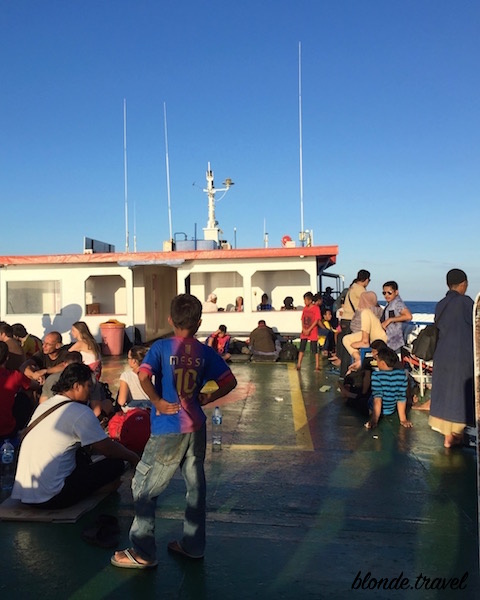
In the morning everything looked far more reasonable, as mornings do. Coffee and biscuits came from the second deck. When the foreigners began edging towards the exit, we followed, with our heavy luggage, and waited about an hour by the ramp. At around ten we walked off at Wakai.
Our names were on a sign at the end of the jetty. Fifty metres later we were climbing into a narrow wooden boat, and twenty minutes after that we were on Kadidiri, at Black Marlin Dive Resort.
Leaving the islands
We did not take the Tuna Tomini back. Instead our hotel arranged a private boat from Kadidiri to Bunta, a town east of Ampana that is closer to Luwuk airport, where we flew out. The crossing took four hours. Such a charter is expensive by local standards, but it can save a day, and island hotels can book one for you.
How I would plan it now
Choose the south for comfort, the north for adventure. If you are new to travel in remote Indonesia, or simply value sleep, approach through Luwuk and Ampana and take the daytime speedboat. If you know public transport in Asia and enjoy it, the night ferry from Gorontalo is an experience you will not forget, but book a private cabin if one is available.
Confirm the timetable twice. Ferry schedules in the gulf change and published times disagree. At the time of writing, the Tuna Tomini sails from Gorontalo on Tuesdays and Fridays, and the speedboat from Ampana runs daily in the morning; this regularly updated guide is a useful starting point. Ask your island hotel for the current departures before booking flights, and treat the scheduled departure time as the start of boarding.
Arrive early and travel light. On the night ferry, seats are not assigned; the earlier you board, the better your place. There is no proper luggage hold, and heavy bags make the ramp at Wakai a slow business.
Leave room for delay. Domestic flights in this part of Indonesia are often late, and the ferries run only on certain days. A one-day dash like ours can work, but a missed connection may mean several days in a town where you did not plan to stay.
Where Sulawesi’s divers go
The leaflets I collected over that cappuccino in Manado were, I realised later, a map of Sulawesi underwater. The island sits in the Coral Triangle, and its diving falls into a handful of very different places. Choose by the kind of diver you are.
Bunaken, for walls. The marine park off Manado, protected since 1991 and covering some 89,000 hectares, is famous for coral walls that drop away almost from the shoreline into very deep water, with visibility that can reach forty metres. It is the classic first taste of Sulawesi. Stay on Bunaken or one of the neighbouring islands rather than in Manado itself: the city is for changing planes.
Lembeh, for strange creatures. About an hour and a half by road from Manado, near Bitung, the Lembeh Strait is the world capital of muck diving: dark volcanic sand where hairy frogfish, mimic octopuses and flamboyant cuttlefish live. It is diving for patient eyes and macro cameras, and it makes the perfect counterweight to Bunaken. North Sulawesi’s best trip combines the two.
The Togean Islands, for solitude. In the Gulf of Tomini, atolls, a barrier reef and fringing reefs all lie within a small area, one of very few places on earth where you find all three. Una-Una, the volcanic island right on the equator that was buried in ash by its 1983 eruption, has the archipelago’s best diving, with famous sites such as the Pinnacle. Come for emptiness rather than convenience.
Wakatobi, for ease. In the far south-east, the Wakatobi islands form a national park that UNESCO named a biosphere reserve in 2012. Wakatobi Dive Resort runs its own charter flight from Bali, under three hours, and its house reef is one of the most admired in Indonesia. This is the polished way to dive Sulawesi, for those who want the reef without the expedition.
Taka Bonerate, for the far horizon. South of Selayar lies the third-largest atoll system in the world, after Kwajalein in the Marshall Islands and Suvadiva in the Maldives. It is reached only by liveaboard, which keeps it almost untouched.
When to go. North Sulawesi can be dived all year, and Lembeh’s creatures care little for the calendar. Across the island, March to November is the safer window for calm seas and clear water, with April and October often the sweetest months. Manado is also the easiest gateway from abroad, with flights through Singapore.
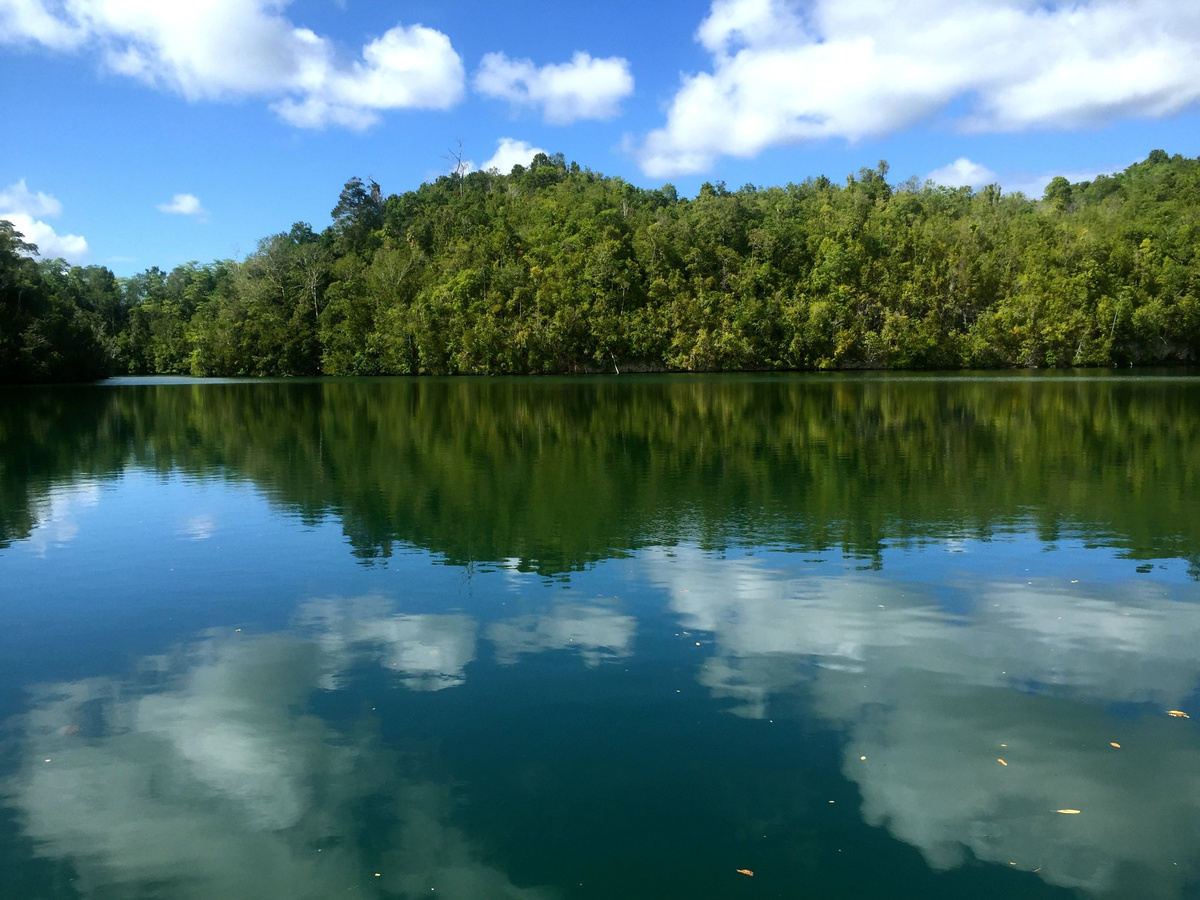
We came for something rarer still, Mariona, the lake where we swam among jellyfish that do not sting. I wrote about it in my review of Black Marlin Dive Resort.
Una-Una, the reef off Kadidiri and Mariona are together in my Togean diving and snorkelling list in Google Maps, ready to follow.