
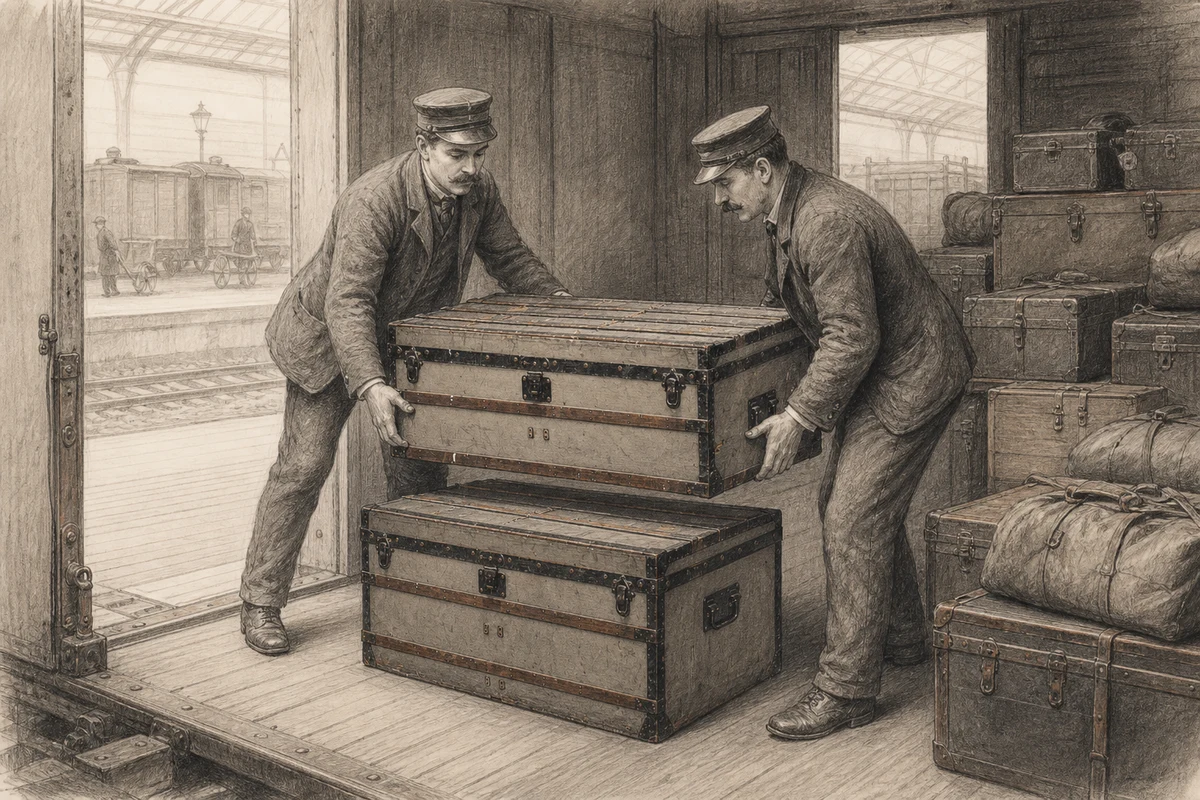
Put a domed trunk on the floor of a railway luggage van and it keeps one small territory entirely to itself.
Its curved lid may shed rain, but nothing can stand securely upon it. The air above becomes unusable. Add twenty more trunks, hatboxes, carpetbags and parcels, then ask a porter to fit them into a moving compartment before the train departs, and an elegant old shape becomes an industrial nuisance.
By the middle of the nineteenth century, travel was changing faster than luggage. Railways and steamships were carrying more people farther, more regularly and with possessions that might be separated from them for much of the journey. A trunk now had to pass through a system: carriage, platform, trolley, baggage van, dock, hold, hotel cart. It would be lifted, stacked, jolted, exposed to weather and entrusted to strangers.
Louis Vuitton understood that the trunk could no longer behave like a private piece of furniture.
It had to behave like cargo.
His achievement was to make that surrender feel like luxury.
A professional packer
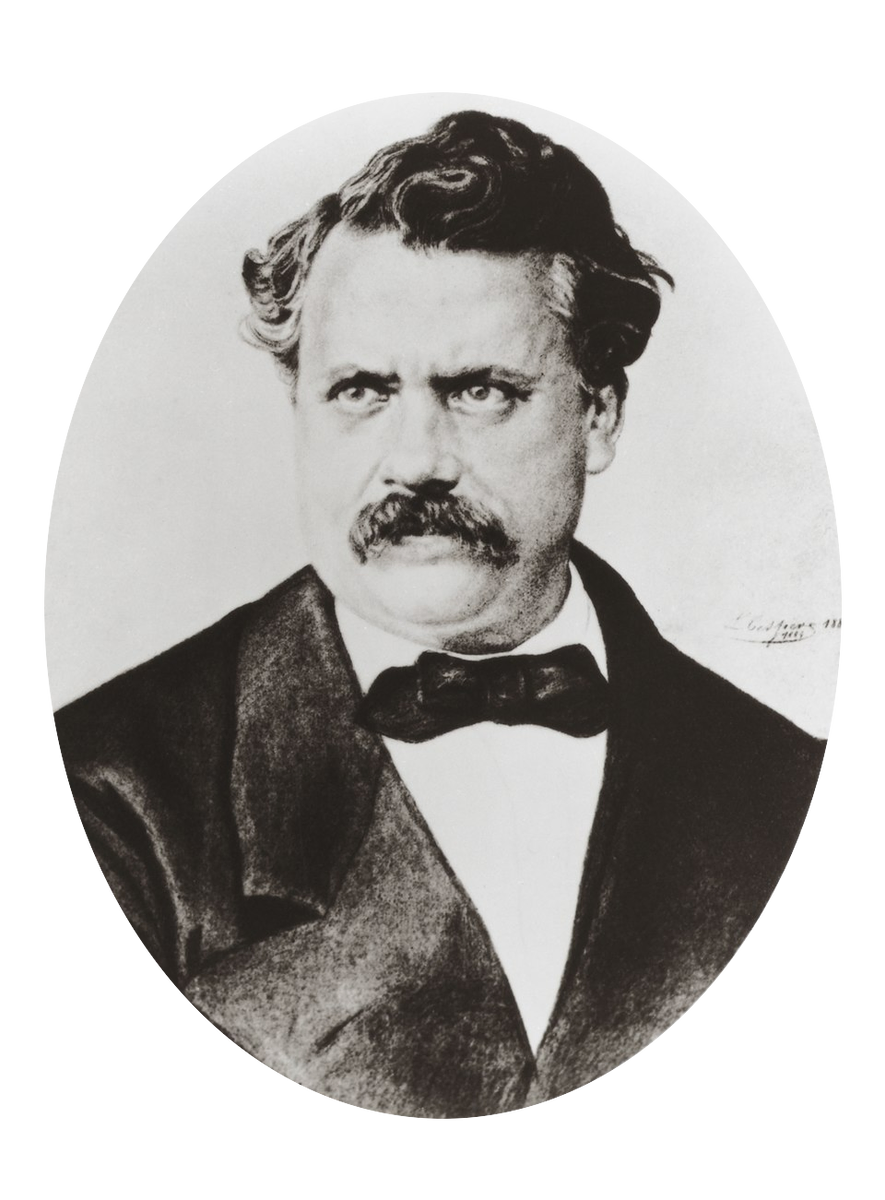
Vuitton was not an industrial engineer by title. Born in 1821 in the Jura and apprenticed in Paris as a layetier-emballeur—a maker of boxes and a professional packer—he belonged to a trade that sat unusually close to the practical failures of travel.
A fashionable client did not simply buy a container. The packer might come to the house, assess a wardrobe, build or select the necessary cases, arrange fragile objects and make certain that silk, hats, gowns and accessories survived the journey in order. Vuitton’s appointment as a packer to Empress Eugénie placed him near the most elaborate version of this problem: luxury understood not as decoration, but as the safe movement of difficult possessions.
This was an education in applied mechanics conducted through other people’s clothes.
He learned where weight accumulated, where moisture entered, where fabric acquired an odour, where a lid failed and how empty space was wasted. He also learned that wealthy travellers were not buying a trunk merely to own it. They were buying confidence that their private world could be dismantled, transported and reconstructed somewhere else.
When Vuitton opened his own shop near the Place Vendôme in 1854, he did not enter travel through romance. He entered through the irritating physical facts that romance prefers to leave to porters.
The right angle
The traditional domed lid had a sound purpose: it encouraged rain to run off. Vuitton’s answer was not simply to flatten it. A flat lid that leaked would have been a geometrically pleasing failure.
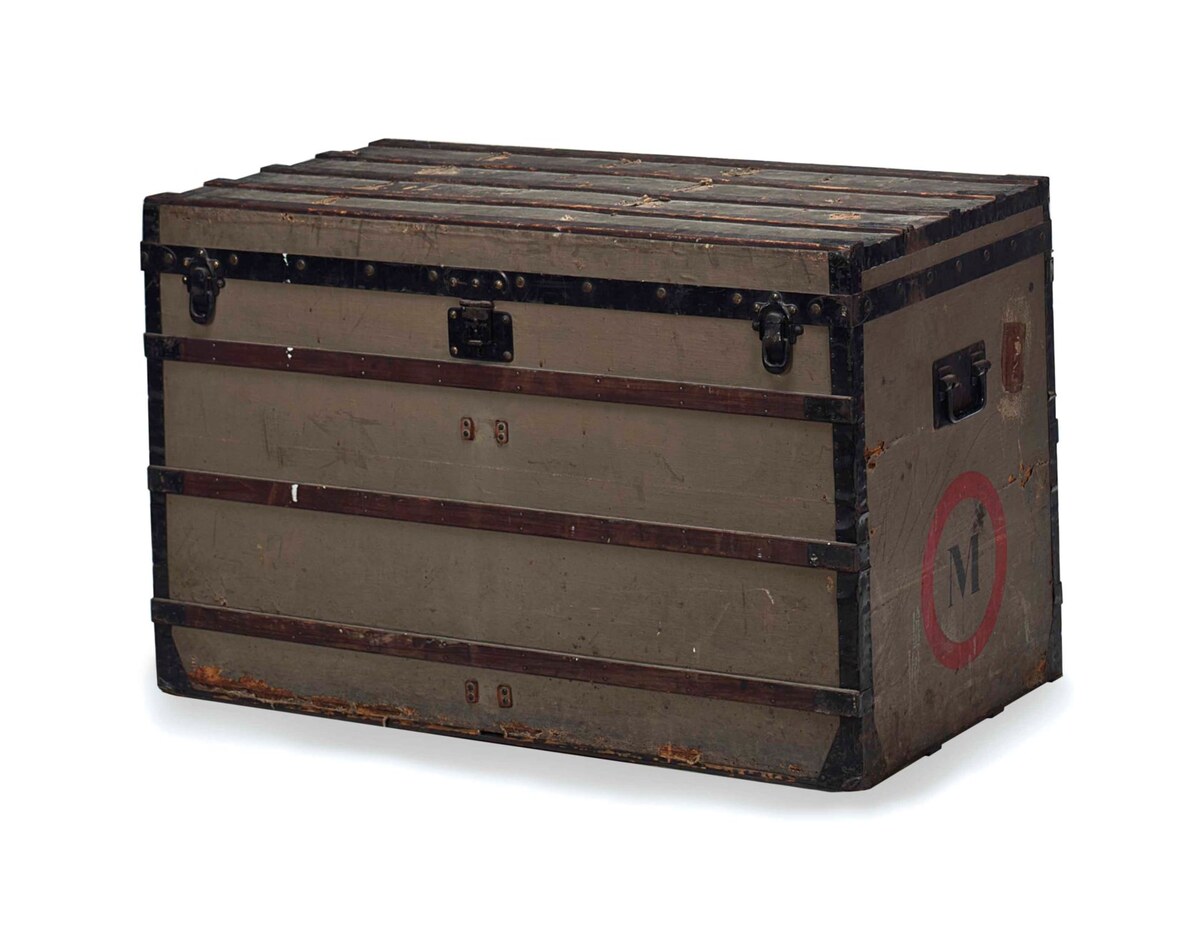
He developed a light wooden shell—poplar for the body, beech for the reinforcing slats—with iron-bound edges and a glued canvas covering. The pale material became known as Trianon Grey. Compared with leather, it was lighter, resisted water better and did not carry the same persistent smell. The reinforcing slats and metalwork protected the box from impact. The flat top allowed another trunk to stand on it.
The Victoria and Albert Museum cautiously credits Vuitton with introducing the flat-topped trunk to the French market in 1858. That wording matters. Rectangular chests were not metaphysically impossible before Louis Vuitton, and travel technology rarely has a single immaculate inventor. His contribution was the intelligent redesign, commercialisation and eventual standardisation of a form for the new transport conditions.
Once the top was flat, the trunk ceased to be an awkward individual object and became one unit in a larger arrangement. It could sit against a wall, beneath a shelf or on top of another trunk. A railway employee or ship’s steward could plan with it. Storage became vertical. Volume became calculable.
Stackability sounds like a minor convenience until a transport network has to move thousands of objects that do not stack.
Then it becomes infrastructure.
The factory beside the railway
In 1859 Vuitton moved production to Asnières, northwest of Paris. The location explained the business almost as clearly as the trunk itself. The new railway was close enough to carry workers and goods; the Seine brought poplar wood. Craft and logistics occupied the same address.
The workshop preserved the individual attention of the packer while giving it the repeatability of manufacture. The useful elements—light shell, flat lid, slats, rivets, metal corners, canvas skin—could be made again and again. Interiors could still be adapted to dresses, shoes, hats or instruments, but the exterior obeyed a common transport logic.
Vuitton protected that logic. At the 1867 Paris Exposition he presented the trunk internationally and received a bronze medal. That year he secured a fifteen-year patent for his packing and travel trunk. Competitors copied the pale grey surface, so in 1872 he introduced a striped canvas that made his work easier to recognise.
The sequence is revealing. First came the useful shape. Then came the visual distinction.
Modern memory often reverses the order.
We think of Louis Vuitton as a pattern before we think of it as a machine. Yet the Monogram canvas did not appear until 1896, four years after Louis died; it belonged to the next generation under his son Georges. The famous identity grew around an engineering proposition that had already succeeded.
Luxury without fragility
The flat trunk did not make travel egalitarian. It made expensive travel work better.
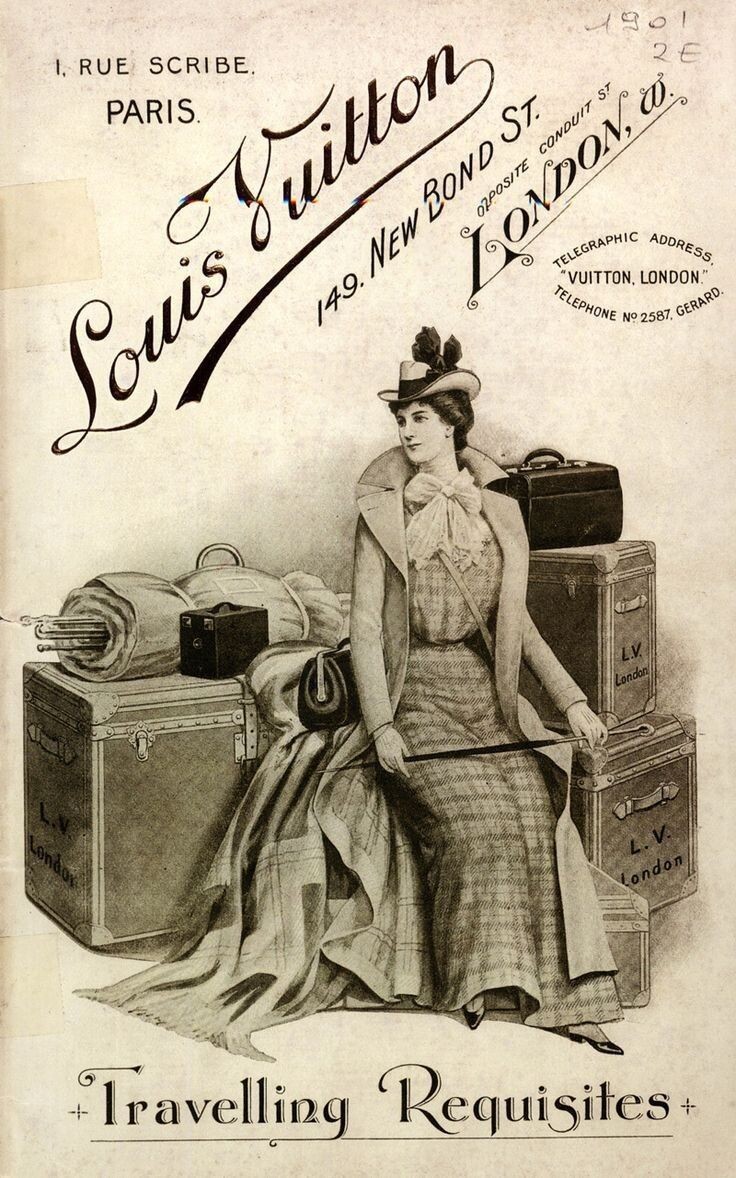
A large wardrobe trunk was still heavy, still required labour and still announced that its owner travelled with more than necessity. Its precisely divided interior could preserve the social order of a wardrobe throughout a journey. Its locks and fittings protected valuable possessions. Its size presumed tickets, porters, hotel rooms and enough time to unpack.
But this was not luxury opposed to industry. It was luxury produced by industrial discipline.
Vuitton understood that refinement could reside in the removal of difficulty: less weight, less damp, less damage, less wasted space, fewer moments when a beautiful object became unmanageable. The trunk’s prestige came partly from workmanship and association, but also from competence. It was expensive because it promised not to fail at an expensive task.
That idea still governs the best travel design. A first-class cabin, a silent suitcase wheel, a perfectly positioned reading light and a hotel transfer that appears at exactly the right door all convert logistics into ease. Luxury often looks effortless because somebody has engineered the effort out of sight.
What did one cost?
No public price list for Vuitton’s original 1858 flat trunk has survived in the sources used for this story. The closest useful figure is a documented purchase twenty-six years later.
On 25 August 1884, the American traveller Gideon Hixon bought a trunk at Louis Vuitton’s shop at 1 Rue Scribe in Paris. The surviving receipt records 60 francs for the trunk and another 10 francs for its strap. The historical society that holds it notes that a porter who might have carried such a trunk earned less than 60 francs a month.
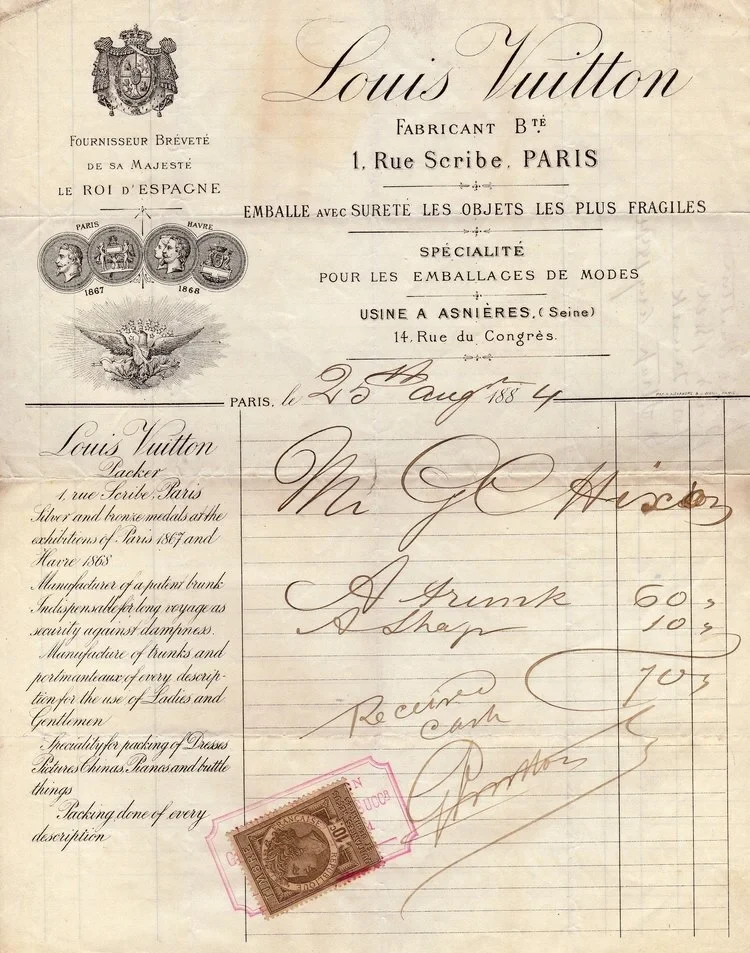
There is no honest single conversion into today’s money. Consumer prices, wages, gold and social status tell different stories across 142 years.
One deliberately narrow comparison is the currency’s gold content. Under France’s nineteenth-century monetary standard, a 20-franc coin contained 5.805 grams of fine gold. Sixty francs therefore represented 17.415 grams. At the euro gold price on 27 August 2026, that metal was worth roughly €2,200; including the strap, roughly €2,600.
That figure is mathematically tidy and socially incomplete. The porter’s wage is the better reminder that the purchase belonged to a very different level of consumption. It was not the nineteenth-century equivalent of picking up a competent suitcase. It was a serious luxury object bought by someone wealthy enough to require both the trunk and the labour surrounding it.
The modern catalogue provides another answer. Louis Vuitton’s current Malle Courrier 110—a large, flat-topped descendant made from poplar, okoumé and beech, covered in Monogram canvas and fitted with metal hardware—was listed in Germany at €45,000 in August 2026.
So the most truthful answer is a range of meanings rather than a converted price: about €2,200 by gold content, more than a worker’s monthly income in its own period, and €45,000 for the closest modern expression of the idea.
The engineering became universal.
The original kind of luxury did not.
The trunk enters the system
A surviving Vuitton Malle Haute of about 1910 in the V&A carries labels from ocean liners. Its surfaces are scarred, its edges darkened and its sides crowded with the residue of journeys. It is a luxury object, but no longer a precious object protected from use. It has been handled as freight.
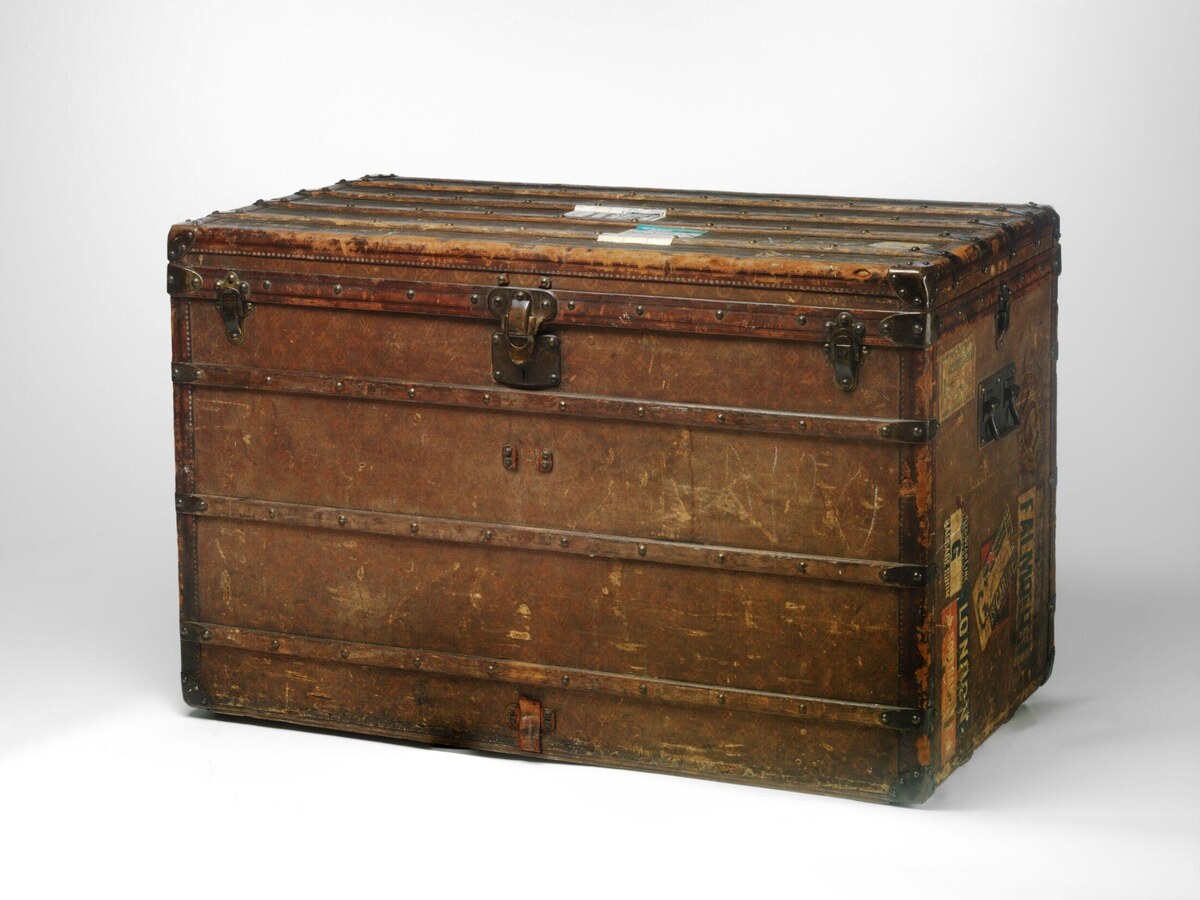
That is Vuitton’s larger contribution to the culture of travel.
He reconciled the private and the industrial. The trunk could contain the intimate architecture of one person’s life while accepting the impersonal rules of a network. It was made for an individual, then shaped to cooperate with everybody else’s luggage.
The flat form spread far beyond his house. It became so ordinary that its original argument is now difficult to see. Suitcases became smaller; automobiles replaced many great trunks; aircraft imposed harsher limits on weight and dimensions; wheels and telescopic handles turned the traveller into her own porter. Yet modern luggage still submits to the principle that the transport system must be able to count it, align it, stack it and use the space around it.
At an airport carousel, the descendants arrive as rectangles. In an aircraft hold, they fit into a loading plan. In a hotel luggage room, they stand against one another without ceremony. Even the cabin case rolling down an aisle carries the old compromise: a private world reduced to a geometry the machine will accept.
Louis Vuitton’s name became shorthand for luxury. His deeper mark on travel is less conspicuous.
It is the right angle.