
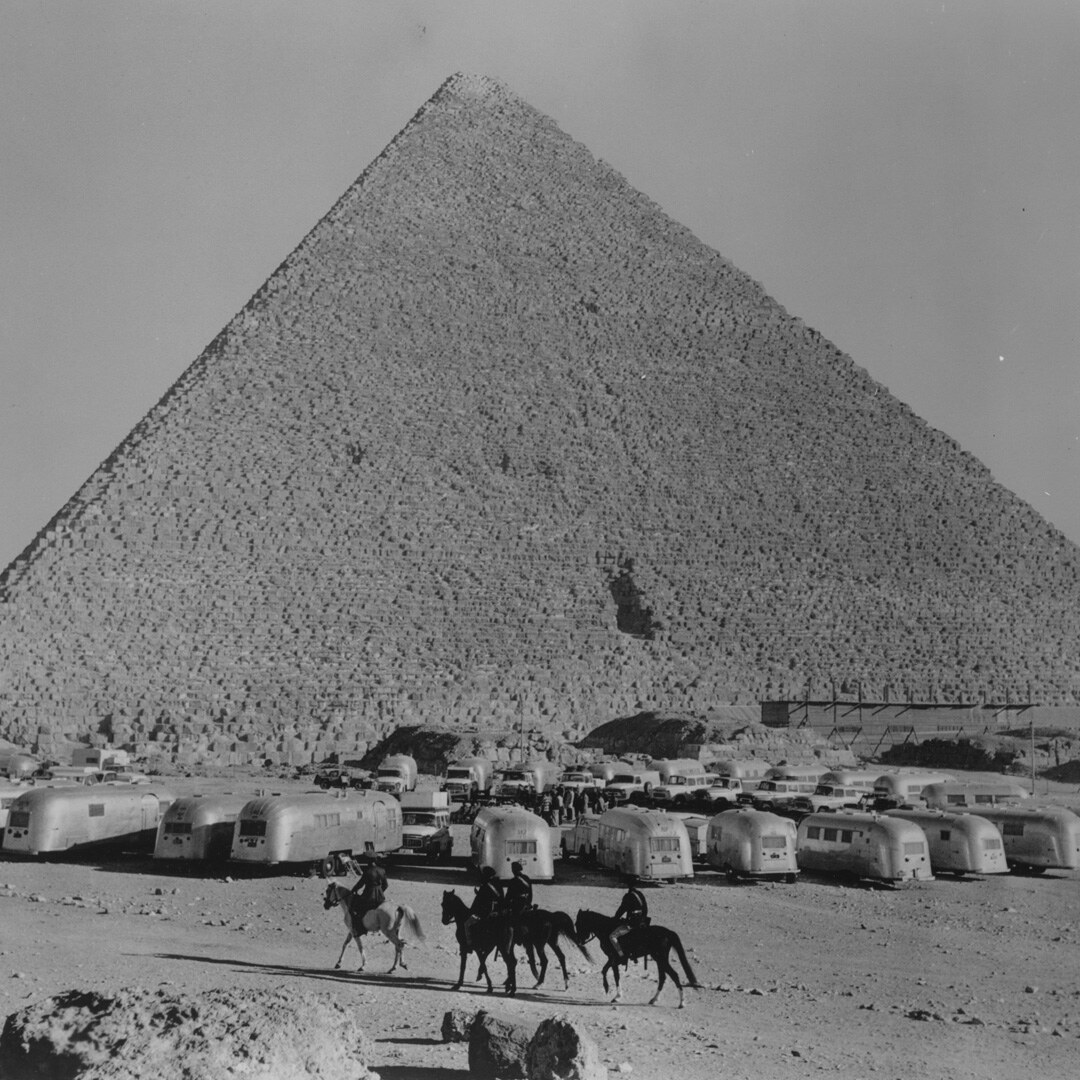
In February 1960, a small American suburb appeared beneath the Pyramids.
There were no lawns and no mailboxes, but the domestic geometry was unmistakable: automobiles, folding chairs, kitchens, beds, cupboards, water tanks, families. Twenty-nine polished aluminum trailers stood on the sand at Giza, their curved skins catching an Egyptian sun for which they had never been designed. At the beginning there had been forty-one Airstreams and 106 people, aged from six to eighty-six. They had left Cape Town the previous July and spent seven months covering more than 12,000 miles through Africa.
Some days they made two miles.
They repaired roads. They pulled vehicles from mud by hand. Axles and springs broke; trailers loosened from their frames; people became ill. One member of the caravan underwent an emergency operation in the Ethiopian wilderness. Some owners abandoned the journey. Others put their rigs on railcars or boats where geography defeated wheels. They visited Victoria Falls, met Emperor Haile Selassie, crossed landscapes where the road occasionally ceased to deserve the name, and arrived in Cairo two months later than planned.
Wally Byam had negotiated permission from the Egyptian Department of Antiquities to camp beside the Pyramids. On February 6 he sent a telegram home to his cousin and caravan organizer Helen Byam Schwamborn.
“Because the impossible takes a little longer, we arrived a little late…”
The rest was triumph: the Cape Town–Cairo caravan was now history.
It is tempting to classify the expedition as a magnificently excessive publicity stunt, one of those gestures mid-century companies once seemed capable of making before marketing departments learned to measure everything in impressions. Certainly it was publicity. Byam had been an advertising man and magazine publisher before he became a manufacturer, and he understood spectacle instinctively.
But he was demonstrating something larger than the durability of an Airstream.
He was demonstrating a new relationship between comfort and distance.
For most of travel history, comfort had belonged to places. A good bed was in a good hotel. A bath required a building. Dinner belonged to a dining room. Luxury travel meant moving elegantly between islands of civilization—grand hotels, ocean liners, sleeping cars, resorts—whose existence depended upon infrastructure built in advance.
Byam inverted the proposition.
What if civilization could move?
What if the bedroom, kitchen, shower, refrigerator, books, clothes, water and private rituals of home could be compressed into a light machine and pulled behind an automobile? What if the traveler did not have to wait for the hotel, railway or campground to arrive first?
Then the world beyond the road ceased to be merely wilderness.
It became somewhere you could stay.
That was Wally Byam’s real product.
Not the trailer.
Travel independence.
The wagon
Wallace Merle Byam was born on July 4, 1896, in Baker City, Oregon, near one of the great tracks of American migration: the Oregon Trail.
His childhood would later acquire the suspicious neatness that corporate biographies often give to founders. His grandparents had crossed west in a mule-drawn wagon. As a boy he spent time on an uncle’s sheep operation and lived for a period in a shepherd’s wagon—a compact wooden shelter containing the necessities of isolated life. He also went to sea, working aboard vessels and joining the seamen’s union.
It would be easy to make the shepherd’s wagon into prophecy. Innovations rarely emerge so obediently from childhood memories. But the image matters because Byam had encountered early the ancient equation underlying every expedition vehicle:
mobility + shelter + provisions = independence.
The nautical influence may be even more revealing.
A ship is not simply transportation. It carries its habitat with it. A railway passenger temporarily inhabits somebody else’s infrastructure. A motorist traditionally moves from building to building. A sailor takes the building along.
Decades later Airstream would name trailers Clipper, Flying Cloud, Caravel, Trade Wind and Land Yacht. Interior walls became bulkheads. Airstreams were vehicles, but Byam repeatedly imagined them as vessels.
His road machine would inherit the logic of the ship.
Before any of that, though, he became something apparently unrelated: a publisher.
At Stanford he was known as Wallace M. Davis, taking the surname of his stepfather. Contrary to a long-repeated version of the story that made him an engineer or lawyer, archival work by Airstream historians shows that he studied history and pre-law and graduated in 1921 with a bachelor’s degree in history.
That correction is more than biographical housekeeping.
Byam was not an engineer who later discovered marketing.
He was a storyteller and salesman who learned engineering because the story he wanted to sell required a better machine.
In Los Angeles he worked in journalism and advertising and eventually owned several magazines. He learned how desire is packaged, how a complicated idea is made legible, how an audience can be taught to imagine itself inside a life it does not yet live.
Those skills would become as important to Airstream as aluminum.
The wife who refused the ground
The founding anecdote begins with a domestic disagreement.
Byam liked camping. His first wife, Marion, did not like sleeping on the ground.
There is a miniature history of modern tourism hidden inside her objection.
By the 1920s the automobile had made landscapes newly accessible to middle-class Americans. Nature could be reached without a railway. But access was not hospitality. A family could drive into the countryside and discover that the final price of freedom was a wet tent, a bad mattress and breakfast made while crouching in the dirt.
Marion’s refusal identified the problem precisely.
The outdoors was attractive.
Camping often was not.
Byam experimented around 1929 with a tent arrangement mounted on a Model T chassis. It unfolded into accommodation at the destination but was awkward and provided little protection. He replaced it with a permanent teardrop-shaped body containing sleeping space, a stove and an icebox.
Other people wanted one.
Here the publisher behaved like a publisher. Before becoming a serious manufacturer, Byam sold do-it-yourself plans. Eventually demand for completed trailers followed, and in 1931 he established Airstream in California.
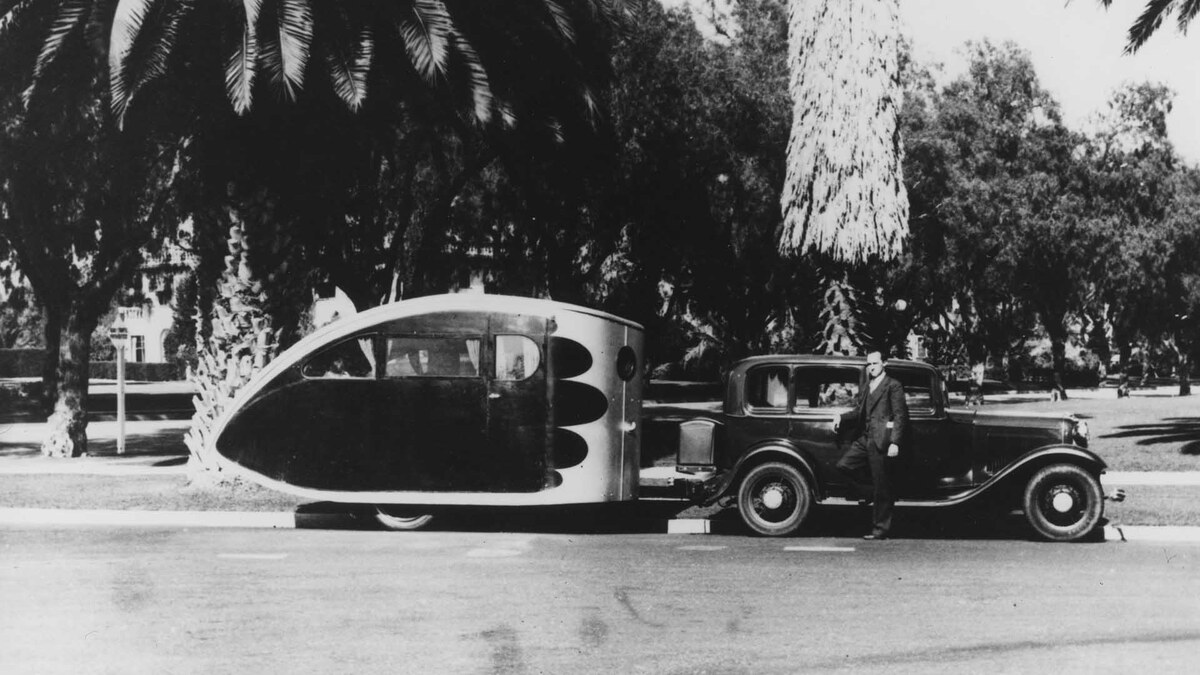
The name already contained the ambition. This was not a “camping cottage” or a “motor cabin.” It belonged linguistically to the age of speed, streamlining and aviation.
But the first Airstreams were not yet the silver objects we recognize instantly today.
And this is where the clean founder mythology must be interrupted.
The aluminum Airstream had another father.
The man from the Spirit of St. Louis
His name was Hawley Bowlus.
Bowlus came from aviation. He had been involved in the construction of Charles Lindbergh’s Spirit of St. Louis and understood a discipline that aircraft engineers had learned under unforgiving physical constraints: every unnecessary pound is an enemy; curved structures can be immensely strong; thin metal skins, ribs and rivets can produce something both light and rigid.
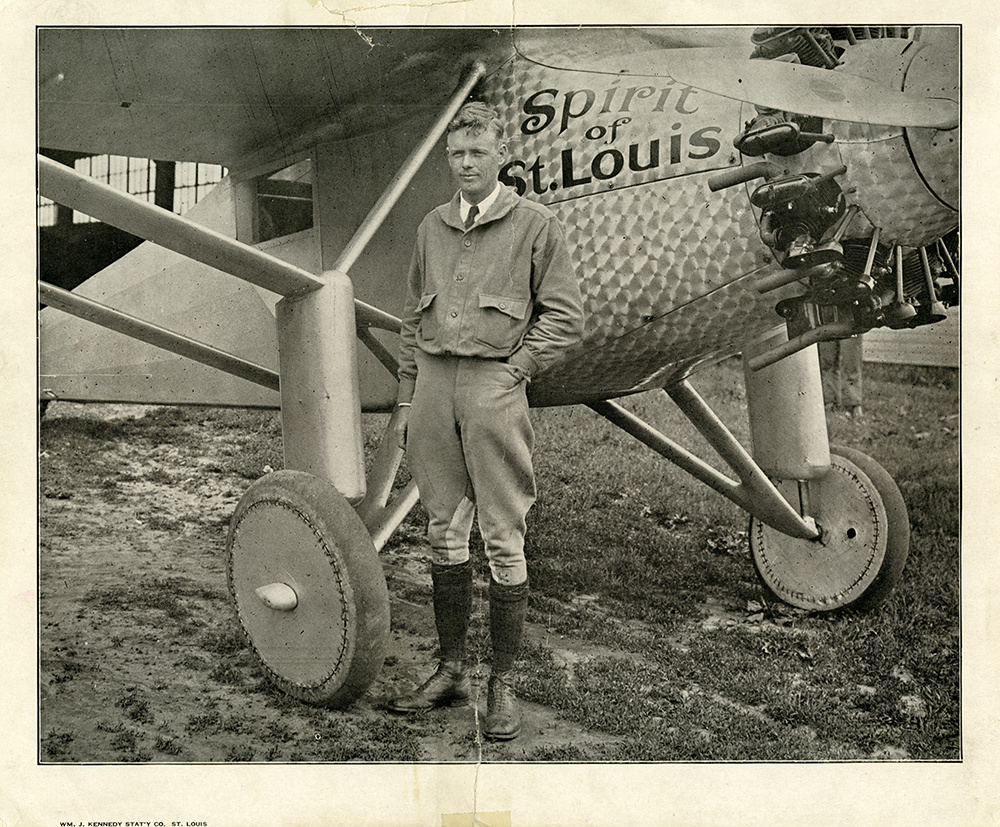
In 1934 Bowlus applied aircraft construction to a travel trailer.
The Bowlus Road Chief looked astonishingly unlike the small wooden houses that many trailers still resembled. It looked like a fuselage that had escaped from an airfield: streamlined, riveted, aluminum, almost implausibly modern.
Byam knew Bowlus’s work and admired it. The precise commercial relationship between the two men remains less tidy than corporate folklore sometimes suggests; even the Airstream Club historian’s chronology cautions against oversimplifying who sold what for whom. What is clear is that Bowlus had put an aircraft-derived riveted-aluminum trailer on the road before Airstream introduced its aluminum Clipper in 1936.
The distinction matters.
Wally Byam did not descend from a mountain carrying the silver trailer as a complete revelation.
Bowlus was the technological precursor.
Yet history is full of technologies whose inventors did not create their cultural meaning.
The consequential entrepreneur is often the person who sees an existing object and asks a different question.
Not What is this?
But What kind of life can be built around it?
Bowlus translated aircraft technology into a trailer.
Byam translated the trailer into a category, brand, community and method of travel.
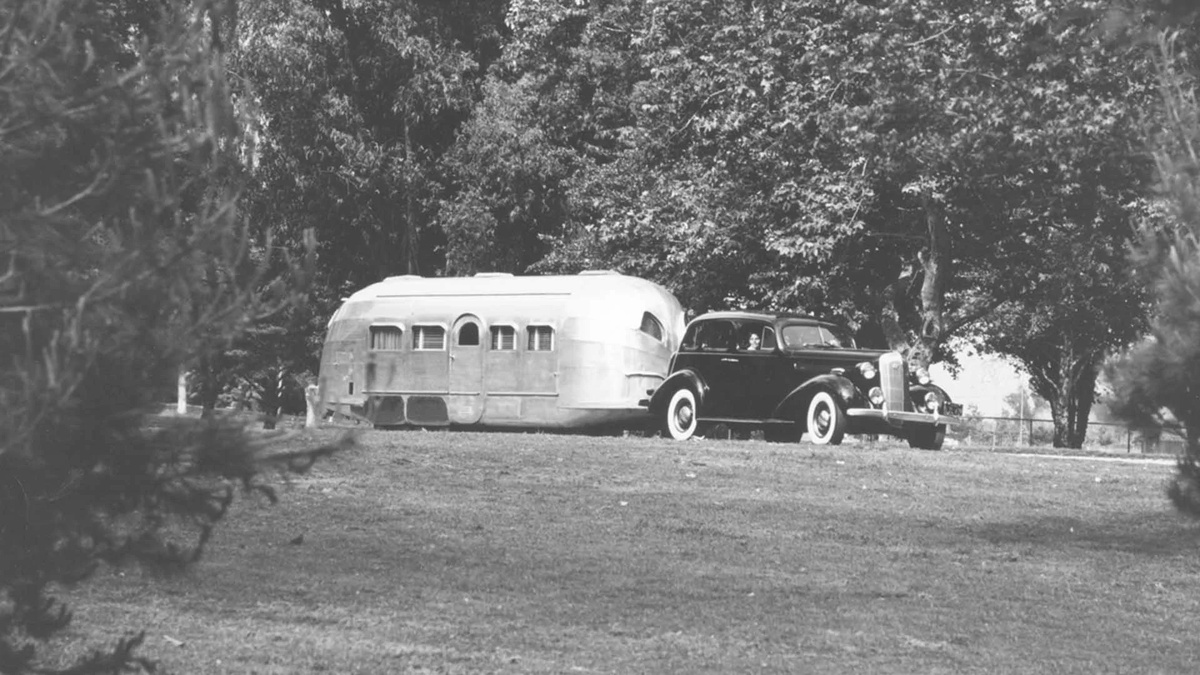
The difference is visible in the businesses themselves. Bowlus’s company failed. Airstream survived the Depression while hundreds of trailer makers disappeared. Byam was careful about production, adapted trailers to customers and kept refining both the inexpensive Masonite models and the much more expensive aluminum Clipper.
He did not merely admire a beautiful machine.
He understood how to make people desire what the machine made possible.
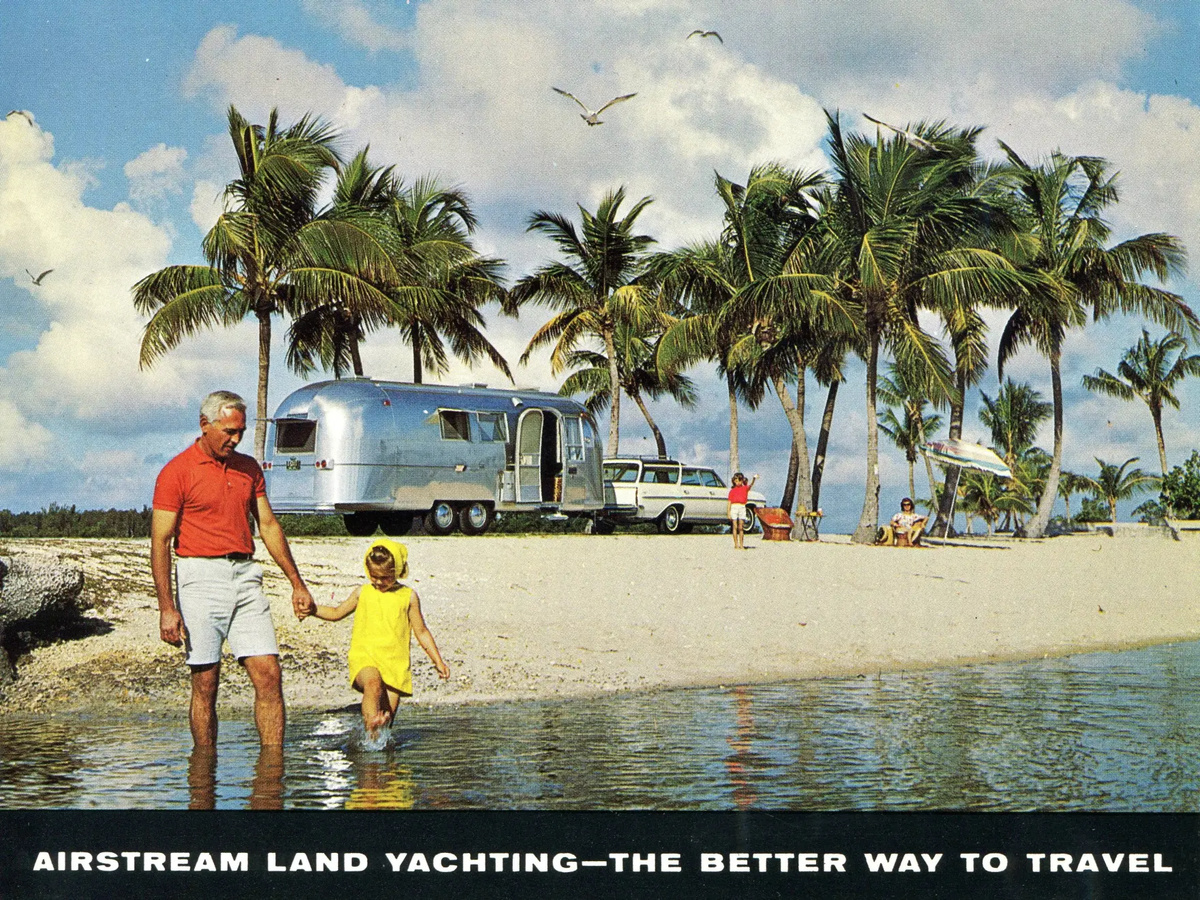
The war that taught him aircraft manufacturing
Then the Second World War stopped civilian Airstream production.
Aluminum became a strategic material. Trailer production disappeared into the demands of war. Byam entered the aircraft industry and eventually worked at Curtiss-Wright as a certified manufacturing engineer.
The interruption was almost perversely useful.
The publisher who had taught himself trailer building now spent the war inside the industrial culture from which the silver trailer had borrowed its techniques: precision, riveting, light structures, repeatability, weight discipline, production engineering.
When Airstream returned after the war, Byam was no longer merely an ingenious amateur building clever camping equipment.
He had learned the factory language of aviation.
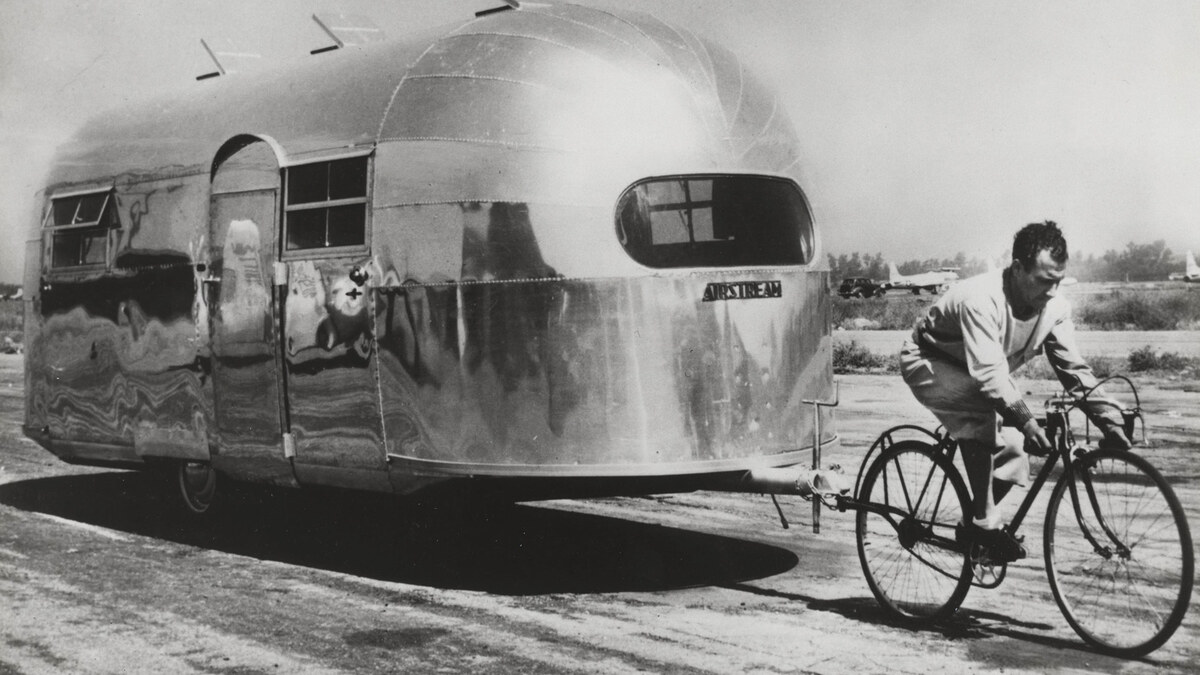
This ancestry is still visible in an Airstream before the door is even opened.
A conventional caravan can resemble a small house that happens to have wheels. An Airstream does not pretend to be stationary architecture. Its curved shell, rivets and metallic skin announce movement. It is not trying to conceal the fact that it is a machine.
It looks as if it expects to leave.
Postwar America was becoming the perfect laboratory for such a machine. Car ownership expanded. Roads improved. Wartime manufacturing capacity poured into consumer goods. Paid leisure broadened. The great American highway system was beginning to reorder geography around the automobile.
The car democratized the route.
Byam wanted to democratize accommodation at the end of it.
But even that description is too modest, because he did not want merely to make camping cheaper.
He wanted to make it civilized.
Comfort was not the enemy of adventure
There is a durable romantic idea that serious travel requires discomfort.
The traveler proves authenticity by carrying less, sleeping rough, eating badly and returning home with evidence of hardship. Comfort belongs to tourists; difficulty belongs to explorers.
Byam rejected the distinction almost instinctively.
His answer to wilderness was not to strip domestic life away. It was to engineer domestic life until it could accompany you.
A proper bed. Refrigeration. Cooking. Water. Heat. A toilet. A shower. Storage. Electrical systems. Screens against insects.
Each improvement removed another dependency on the outside world.
In 1958 Airstream introduced the International package, which the company describes as its first fully self-contained travel trailer, designed to operate without conventional water and electrical hookups.
The model name was perfect.
International.
The destination was no longer the campground.
The destination was wherever a vehicle could plausibly arrive.
Byam’s own creed later expressed the objective with unusual precision: “complete travel independence, wherever and whenever you choose to go or stay.”
That sentence contains an entire branch of the travel industry.
The £200,000 expedition truck with a wine refrigerator. The immaculate Land Cruiser with a deployable kitchen. The off-grid camper with lithium batteries, Starlink, a hot shower and an espresso machine. The luxury safari vehicle. The glamorous revival of “overlanding.” Even some forms of glamping inherit the same paradox.
Go farther away without giving up the things that make you feel at home.
Byam understood that comfort need not diminish adventure.
Comfort could be the technology that made greater adventure possible.
A bathroom in the wilderness does not necessarily make the wilderness less wild.
It may simply persuade someone to go there.
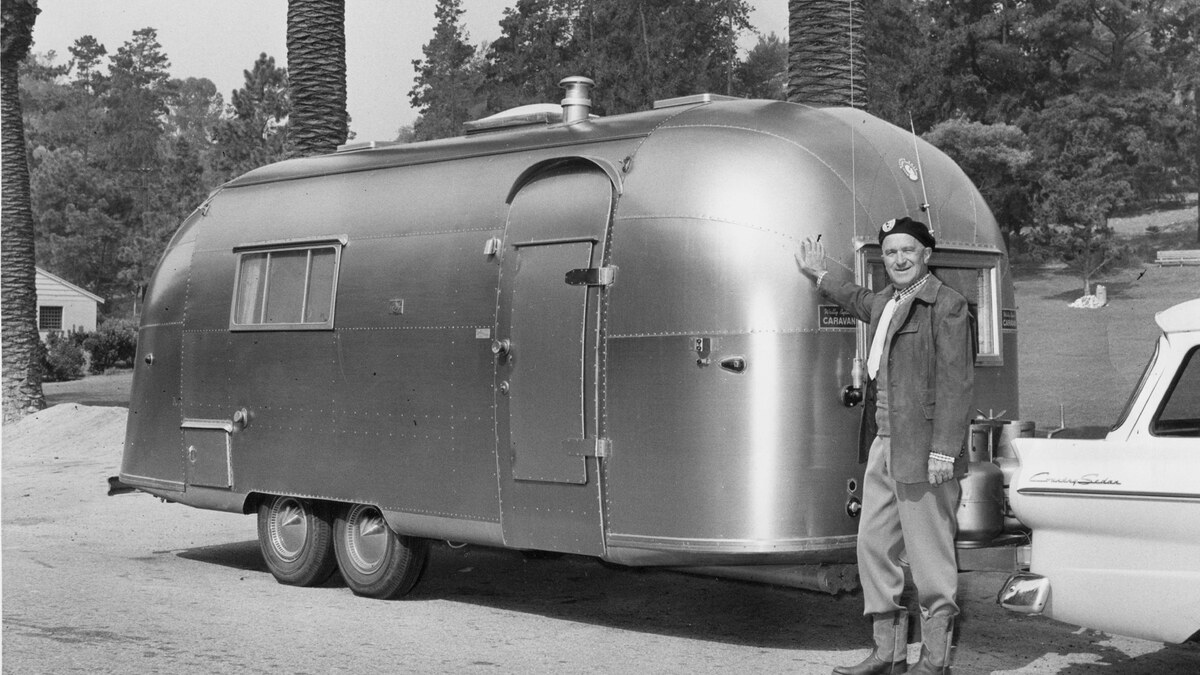
The product still lacked one component
Courage.
Buying an Airstream did not automatically make a middle-class American family capable of driving into Guatemala. A machine could provide a bed and water; it could not provide confidence about borders, fuel, languages, repairs, illness, road conditions or what might exist beyond the next mountain.
So in 1951 Byam created something which, viewed from another industry, looks suspiciously like a tour operator.
He led a group of Airstream owners into Mexico and Central America.
The trip was not a parade of polished trailers gliding over perfect highways. The caravan crossed Mexico, Guatemala, El Salvador, Honduras and Nicaragua. When the Pan-American Highway failed them, trailers and tow cars went onto railcars. There were broken axles, overheated vehicles, bad bridges and failed equipment. Only fourteen trailers completed the entire journey.
Byam himself finished exhausted, lighter and grayer. According to Airstream’s account, he announced that he would never lead another caravan.
He changed his mind.
That decision may have been more important than any single improvement to the trailer.
Because the company stopped merely selling an object used for travel.
It began producing travel itself.
The caravans were simultaneously expeditions, demonstrations, owner events, product tests, publicity campaigns and temporary societies. Customers encountered problems no engineering department in California could reproduce convincingly. Byam traveled with them, watched failures and sent instructions back to the factory.
The road became his test laboratory.
Airstream’s creed would eventually make the method explicit: refine the product through continuous travel-testing.
This is an unusually pure feedback loop.
Build the machine.
Travel with the customer.
Break the machine.
Improve it.
Travel farther.
But there was another discovery hidden inside the caravans.
Customers were braver in company.
A lone retired couple might reasonably hesitate before towing a trailer across Central America. Put them among twenty or forty other owners, add mechanics, scouts, route knowledge and a charismatic leader in a blue beret, and the psychologically impossible becomes merely complicated.
Byam had turned community into travel infrastructure.
Helen built the tribe
This is where another person deserves to enter the portrait.
Wally Byam’s cousin Helen Byam Schwamborn did not design the Airstream, but she helped build the world around it.
Byam recognized her organizational ability and, in 1955, brought her into the company to manage caravans and help establish an owners’ club. She became central to the Wally Byam Caravan Club, the publications and the formidable logistics required to move groups of trailer owners across borders.
Byam was the visionary and public face. Helen was one of the people who turned charisma into a repeatable institution.
This distinction is essential because founder stories often confuse the moment of inspiration with the mechanism that allows inspiration to survive.
A caravan led personally by Wally Byam is an adventure.
A system that can organize the hundredth caravan after Wally Byam is dead is an industry.
The club gave Airstream a social architecture almost as distinctive as its aluminum body. Owners had numbers. They joined rallies. They traveled together. They exchanged technical knowledge. They acquired friends through ownership.
The product became an admission ticket to a tribe.
Decades later, when The New Yorker sent Calvin Trillin on an Airstream caravan, owners told him in effect that the programs surrounding the trailers were part of the reason to buy one at all.
Byam had discovered something that many premium brands now spend fortunes trying to manufacture:
the most durable luxury may be belonging.
A beautiful object ages.
A community gives the object a life.
Africa
By the end of the 1950s Byam needed a journey large enough to contain the idea he had built.
Cape Town to Cairo had possessed almost mythological status since the age of imperial maps. Cecil Rhodes had imagined a British corridor through Africa; railways, roads and explorers had spent decades trying to stitch the continent together. By 1959 the political meaning of the route was changing violently. European empires were retreating, independence movements were accelerating, and the caravan would travel through Africa at the hinge of decolonization.
Byam’s expedition belonged unmistakably to its American mid-century moment. Its publicity sometimes viewed Africa through the period’s language of exoticism; the fantasy of bringing polished American domesticity through “trackless” landscapes could carry an undertone of cultural self-confidence that reads differently today.
But the journey was not imaginary.
Forty-one Airstreams arrived in Cape Town.
There were 106 participants and three support trucks. Years of planning went into fuel, food, vaccinations, visas, officials and routes. Two advance scouts—Dale “Pee Wee” Schwamborn and Nick Charles—moved ahead to examine roads and find places where dozens of vehicles could obtain fuel, provisions and somewhere to stop. A mechanic traveled with the group.
The participants themselves were not a troop of young expedition professionals. Twenty-five of the forty-one families had never even joined an Airstream caravan before.
That is the astonishing detail.
Byam was not proving that hardened explorers could cross Africa.
Everyone already knew explorers could cross Africa.
He was attempting to prove that customers could.
Families.
Retirees.
People carrying cupboards.
People who expected beds.
People who changed clothes for dinner.
This was not the rejection of domesticity in pursuit of adventure. It was the transplantation of domesticity into adventure.
The distinction is the whole Byam idea.
Two miles
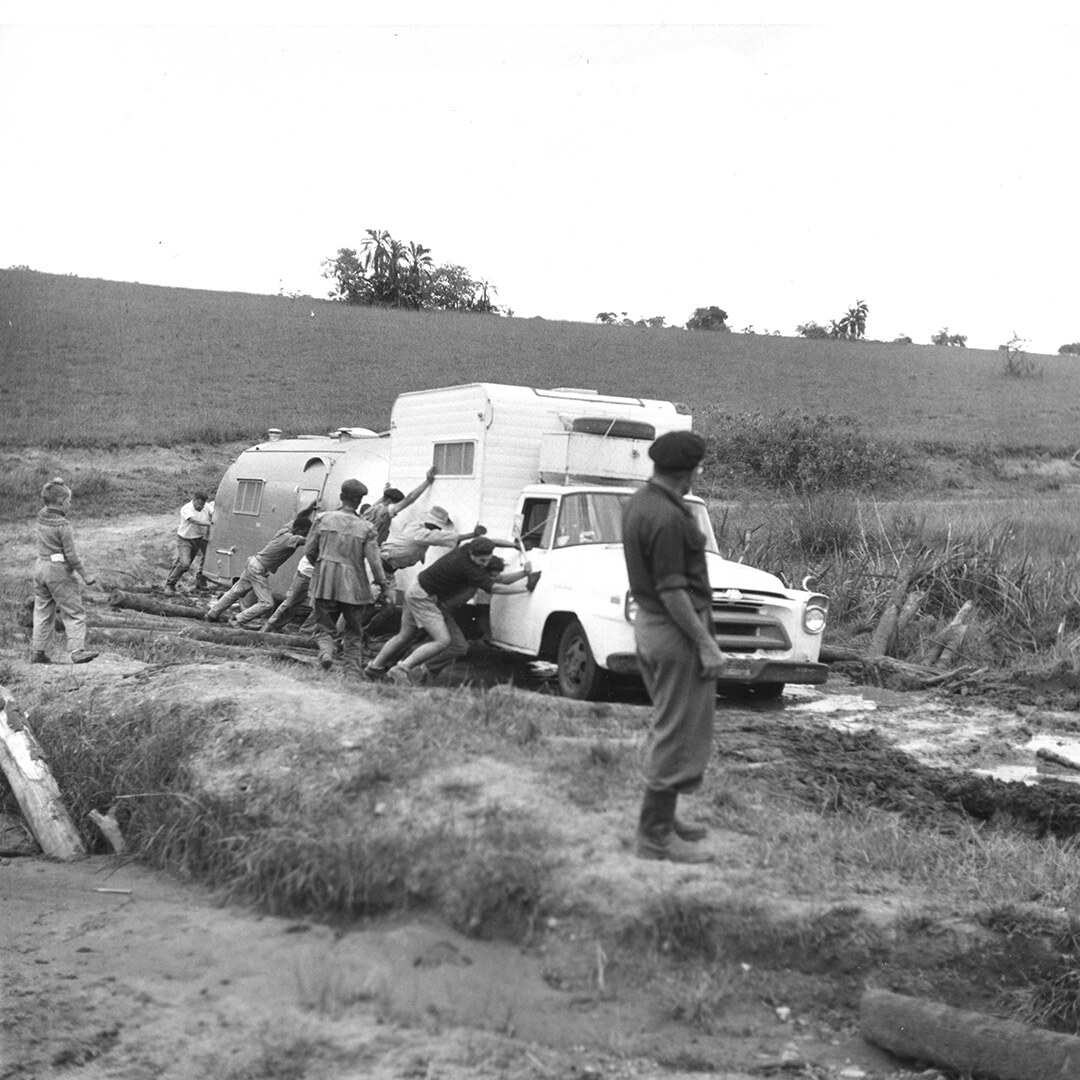
The journey punished the idea severely enough to make the eventual mythology credible.
Some days the caravan covered only two miles. Roads became mud. Vehicles broke. Trailers suffered structural damage. One had to be bolted back onto its frame using locally fabricated U-bolts. Illness spread through some families. At Khartoum, sand and dust had to be cleaned from the interiors after the Nubian crossing.
Not everyone continued.
By Cairo only twenty-nine of the original forty-one Airstreams remained with the caravan.
A less interesting company history might conceal this number because it weakens the image of indestructibility.
It does the opposite.
A machine that crosses a continent without difficulty proves very little about travel.
Byam’s Airstreams broke, were repaired and kept moving. Their owners became tired, sick and frightened, and most kept moving too.
That is what expedition equipment actually does. It does not abolish difficulty. It changes which difficulties are survivable.
The most revealing scenes are not necessarily of silver trailers against African landscapes. They are of caravanners pushing a tow vehicle through mud, repairing a road, improvising a broken part, then eventually closing the door of the trailer behind them.
And inside that door was the Byam proposition.
After a day in which the road had disappeared, there was still a bed.
There was still a cupboard containing your things.
There was still the possibility of making coffee.
The wilderness remained outside.
Home had moved.
A strange sort of hotelier
Byam is usually placed in the history of recreational vehicles.
He also belongs, more unexpectedly, in the history of hospitality.
A hotelier asks: how do I make an unfamiliar place feel inhabitable?
Byam asked the same question but removed the building.
The hotel solves anxiety by making a destination predictable. The room is prepared before the guest arrives. There will be a mattress, water, a lock on the door, somewhere for the suitcase, a light that works.
Byam transferred those assurances from destination to vehicle.
This had a profound psychological effect.
If the traveler carries the room, the destination can become more uncertain.
The farther the infrastructure recedes, the more valuable the self-contained habitat becomes.
That is why Airstream’s polished shell, for all its association with American campgrounds and national parks, was never conceptually confined to camping. Byam wanted the machine in Europe, Mexico, Central America, Africa, eventually Asia. He imagined trailers behind the Iron Curtain and beside monuments. He wanted them wherever normal travel arrangements became complicated.
His caravans therefore resemble a hybrid of hotel company, tour operator, expedition outfitter and automobile club.
The accommodation followed you.
The tour leader created the route.
The club supplied the social life.
The factory supplied the technical support.
The customer owned the room.
No major category of tourism quite describes it.
The salesman traveled with the customer
There is another quality that separates Byam from the ordinary mythology of the founder.
He repeatedly exposed himself to the consequences of his own promises.
A manufacturer can advertise “adventure” from an office.
Byam went to Africa.
A marketing department can call a product rugged.
Byam slept in it after the road destroyed something.
An executive can ask engineers for continuous improvement.
Byam traveled with the defects.
On caravans he remained involved with the company, dictating correspondence and sending instructions from the road. He saw how people actually occupied the trailers: what broke, what irritated them, what they improvised, what they carried, what they wished had been designed differently.
This was ethnographic product development before anyone would have called it that.
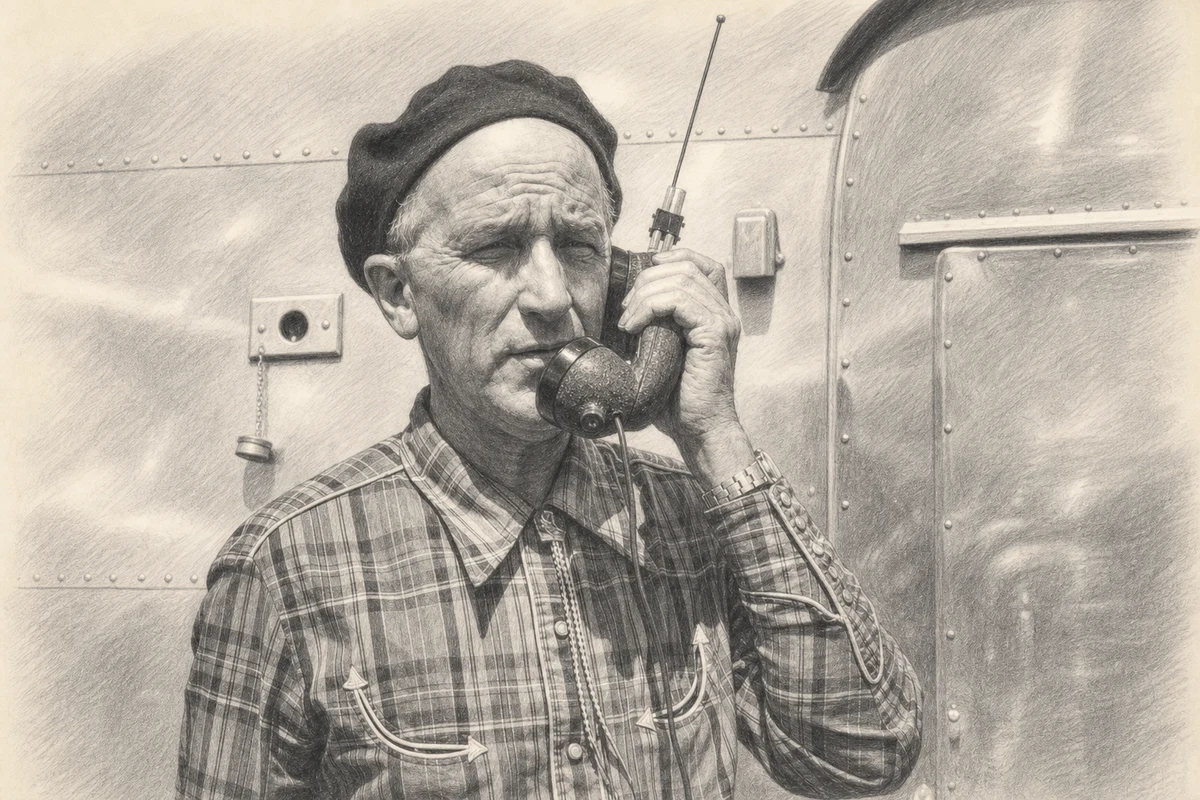
The founder lived inside the use case.
It also explains why the distinction between Byam the publisher and Byam the engineer is false. He became both.
He understood that a travel product has two architectures.
There is the architecture of the object: aluminum, rivets, plumbing, weight distribution, storage.
And there is the architecture of the dream: Where will I take it? Who will I become there? What will I dare to do because I own it?
Most companies are better at one.
Byam obsessed over both.
The contradiction inside the silver shell
Airstream sold freedom, but it did so through ownership of a large, expensive consumer object.
It sold escape from infrastructure while depending on the most infrastructure-intensive transformation of twentieth-century America: mass automobile ownership, cheap fuel, highways and the enormous landscape remade around cars.
It sold individuality, then gathered owners into highly organized caravans with route captains, numbers, meetings and rules.
It sold the unknown while making the unknown reassuringly domestic.
These are not flaws in the story.
They are the reason the idea worked.
Modern travel is full of similar contradictions. We want remoteness with Wi-Fi. Wilderness with a good mattress. Discovery with a reservation. Local authenticity with reliable plumbing. Freedom with roadside assistance.
Byam did not resolve that tension.
He designed for it.
His travelers did not want to become nomads in the anthropological sense. They wanted to remain themselves while moving through unfamiliar geography.
Airstream allowed identity to travel with the body.
You could go very far away without becoming someone else first.
The journey he missed
Byam’s health began to fail in the 1950s. After a heart attack he gradually shifted executive responsibility to Andy Charles in Ohio and Art Costello in California, though he remained deeply involved with the company and caravans.
He had one expedition left in his imagination.
Around the world.
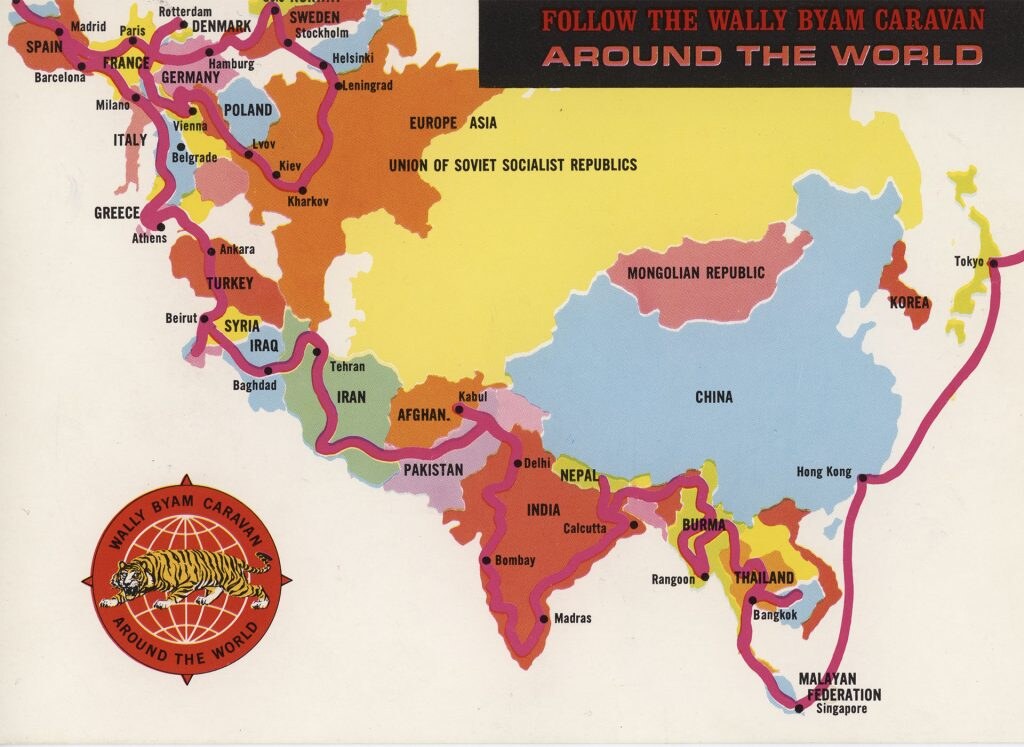
Not metaphorically. Airstreams would be shipped where oceans interrupted the road and then towed across Asia, the Middle East, Europe and territories that few American leisure travelers would have contemplated crossing by automobile.
Byam did not live to see it.
He died of cancer at his California home on July 22, 1962, aged sixty-six.
The following year Andy Charles kept a promise he had made to him. Helen Byam Schwamborn helped turn years of preparation into logistics. In 1963, 105 people set out on the Around the World Caravan. They began the overland portion in Singapore, traveled through more than thirty countries and covered tens of thousands of miles before reaching Cabo da Roca in Portugal in 1964. They visited Angkor Wat, India, the Middle East and Eastern Europe; Airstreams eventually appeared near the Kremlin and St. Basil’s Cathedral.
The founder was gone.
The system traveled without him.
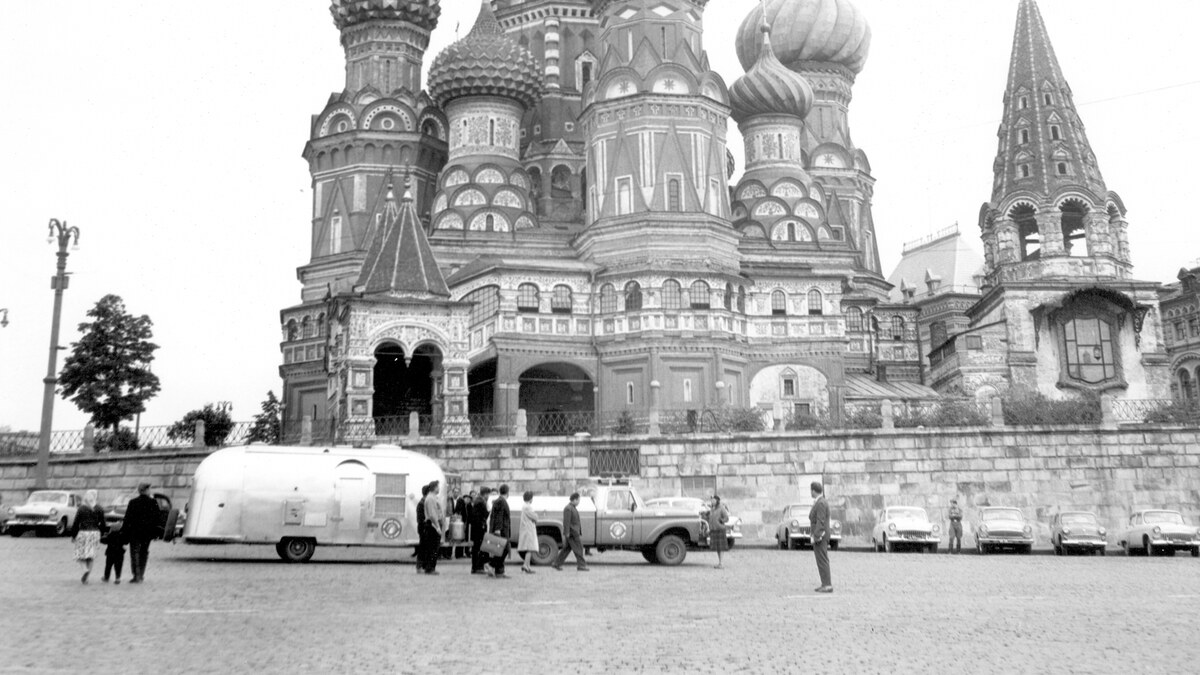
For an entrepreneur, there may be no cleaner proof that an idea has become a culture.
The house that learned to travel
Seven years after Byam’s death, another Airstream appeared in one of the defining travel images of the twentieth century.
After Apollo 11 returned from the Moon in 1969, Neil Armstrong, Buzz Aldrin and Michael Collins entered a modified Airstream Mobile Quarantine Facility aboard the USS Hornet. Similar units were used for Apollo 12 and 14.
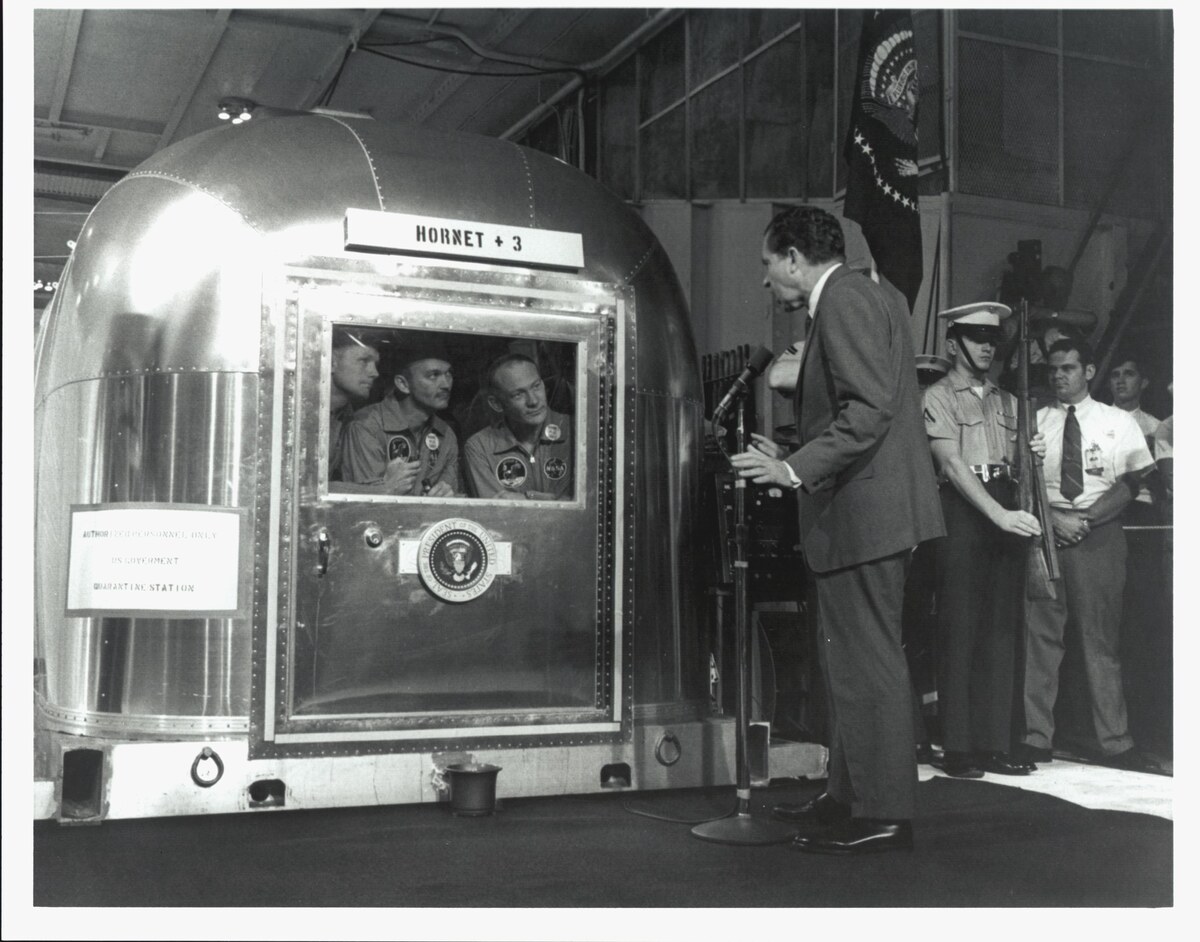
It would be too neat to claim this as Byam’s achievement. NASA’s use came after his death and answered a very different technical problem.
But visually the lineage is irresistible.
An object descended partly from aircraft construction, created to carry domestic life beyond normal hospitality infrastructure, became the temporary home of men returning from another world.
The Airstream had traveled farther in the imagination than any road could take it.
And yet Byam’s more important inheritance is visible in less spectacular places.
It is present whenever a traveler looks at an empty landscape and thinks not, There is nowhere to stay, but:
I can bring the stay with me.
That mental reversal changed road travel.
It helped create an enormous culture of RVs, caravanning, motorhomes and overlanding. It survives in the belief that comfort and exploration need not cancel each other out. It survives in travel brands that understand a community can be more valuable than a customer list. It survives in products developed by taking them into the places where they are supposed to work rather than merely testing them in laboratories.
And it survives, almost absurdly intact, in Airstream itself.
The polished aluminum body still looks less like a house than a machine that has captured a house.
That was Byam’s essential trick.
He did not persuade travelers to abandon civilization.
He made civilization light enough to tow.