
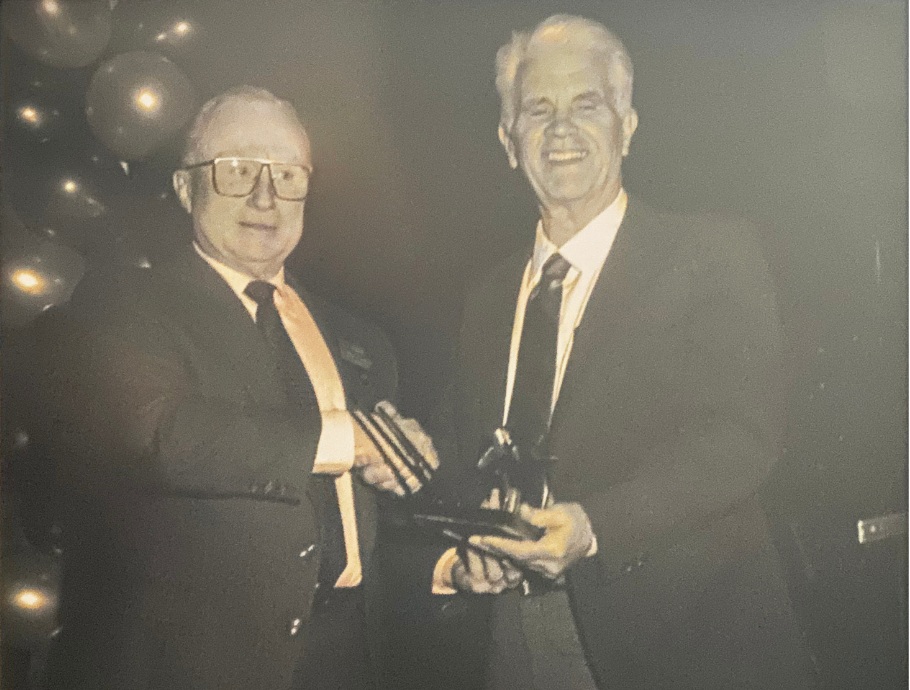
John Cronin, left, and Ralph Erickson. Photograph: PADI.
There is a particular flag that appears at the edges of the inhabited world.
You see it outside polished dive centres in the Maldives, beside swimming pools in enormous Caribbean resorts, on boats tied to tropical jetties, and above little shops on islands where the airport may be a strip of asphalt and the electricity an intermittent privilege. The building beneath it may be concrete, bamboo, timber or corrugated metal. The instructor may be German, Japanese, Dominican, Australian or local. The compressor may be humming behind the wall.
But the flag is the same.
PADI.
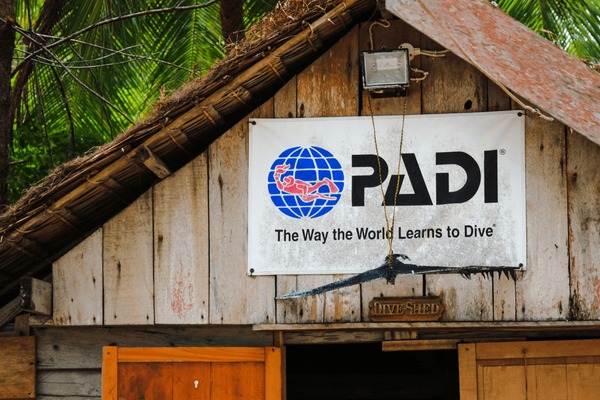
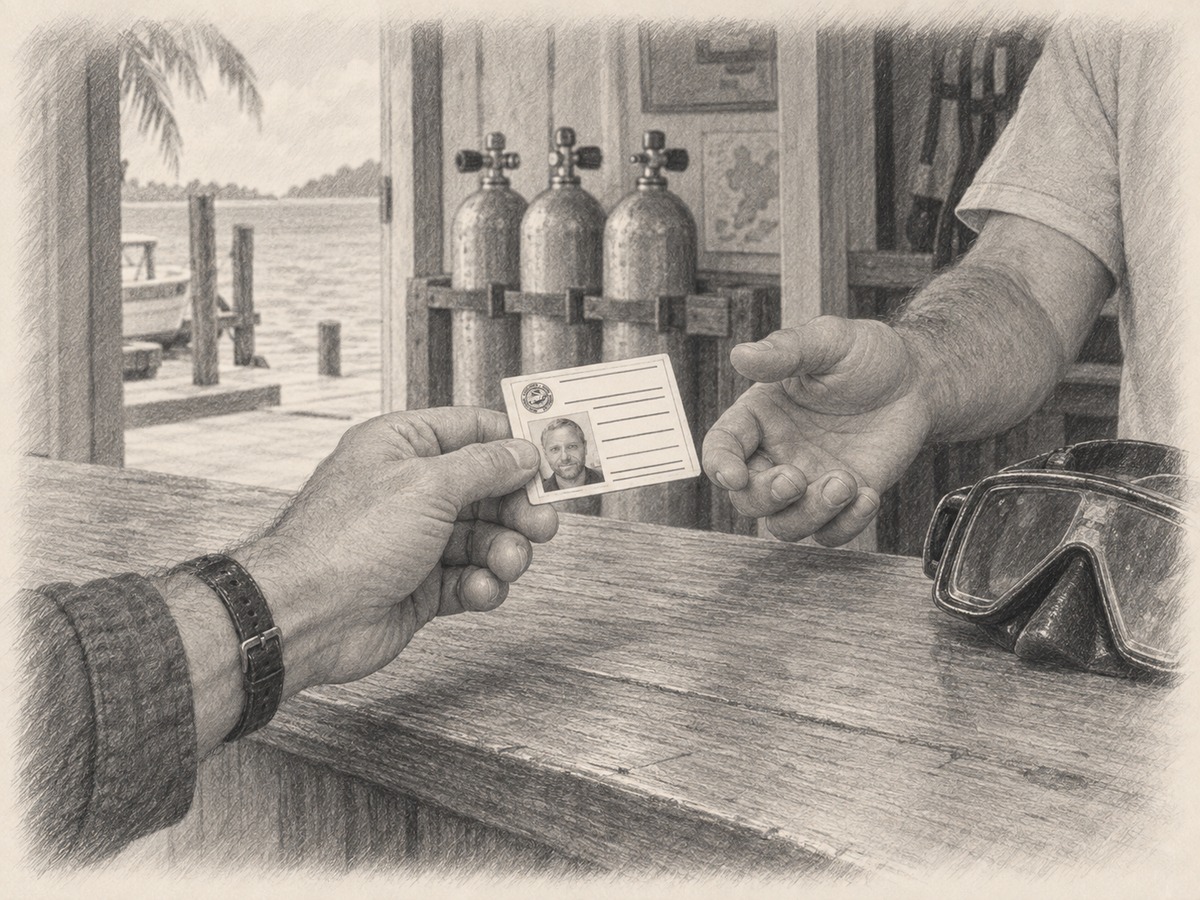
For a traveller, those four letters perform a small miracle. You may know nothing about the shop. You may never have met the instructor. You may not speak the local language particularly well. Yet you can walk in, produce evidence that somewhere else—perhaps years earlier, perhaps on the other side of the planet—somebody taught you to clear a mask, recover a regulator, control your buoyancy and return safely to the surface.
The stranger behind the counter understands what that means.
This is so ordinary now that its strangeness has disappeared.
Scuba diving asks a human being to enter an environment in which humans cannot breathe, carrying a pressurised cylinder, regulators, gauges and other life-support equipment, and then to trust a person he may have met that morning. It ought to be one of the least portable activities in tourism. Instead, it has become one of the most portable.
A guest can arrive at a beach resort as an ordinary holidaymaker, notice a sign near the swimming pool, spend part of the week learning, and leave with a qualification accepted by dive operators in another ocean.
One of the men who made that system travel was a salesman named John J. Cronin.
The ocean already had its hero
By the time Cronin founded the Professional Association of Diving Instructors with Ralph Erickson in 1966, the great romance of recreational diving had already been written.
Jacques-Yves Cousteau and Émile Gagnan had developed the Aqua-Lung during the Second World War. Cousteau then did something perhaps even more important for the imagination: he showed ordinary people what the underwater world looked like. The Silent World, his 1956 film with Louis Malle, carried colour images of that world into cinemas and won both the Palme d’Or and an Academy Award.
Cousteau made the sea desirable.
Equipment companies made it physically accessible.
But desire and equipment do not yet make a tourism industry.
There remained an awkward problem between the hotel room and the coral reef: who could be trusted to teach a civilian to use this machinery, and how could another person, somewhere else, know that the teaching had been adequate?
Early recreational diving carried the culture of the institutions from which it had grown: navies, clubs, scientific diving, physically demanding training and small communities in which reputation travelled by word of mouth. The YMCA was training scuba instructors nationally in the United States by the end of the 1950s; NAUI followed with its first instructor course in 1960. Serious organisations already existed.
What did not yet exist at anything like PADI’s eventual scale was a consumer system capable of following the traveller.
Cronin understood this problem from a revealing vantage point.
He sold things.
Born in Albany, New York, in 1928, Cronin had served in the U.S. Marine Corps before entering the young diving business. He began diving in 1954 and started his own training programme two years later. He later joined U.S. Divers, the American company distributing the equipment lineage created by Cousteau and Gagnan, and moved to the Midwest as a sales representative.
A salesman sees the moment when enthusiasm fails to become a purchase.
Cronin travelled among instructors, retailers, equipment and customers. He could see that the new sport had a distribution problem disguised as a training problem.
Three hours on bad roads
PADI’s own account of its beginnings turns on a wasted drive.
In 1966 Cronin drove roughly three hours over poor roads to give a presentation at an instructor-certification course. When he arrived, he discovered that the class had been cancelled.
Nobody had told him.
He was furious.
Later, he contacted his friend Ralph Erickson, a swimming coach, educator and diving instructor. PADI’s own history preserves the wonderfully uncorporate details: Cronin arrived at Erickson’s apartment in Morton Grove, Illinois, with a bottle of Johnnie Walker Black Label and $30.
They began talking about what was wrong with diving instruction.
Erickson wanted an association of diving instructors. Cronin was adamant about another word.
Professional.
The name they eventually assembled—Professional Association of Diving Instructors—can sound bureaucratic today. In 1966 the first word contained almost the entire ambition.
Cronin had just wasted half a day because somebody running a diving course had not behaved professionally. He wanted an organisation whose identity itself promised a standard.
PADI began in the basement of Cronin’s house in nearby Niles. His neighbour worked part-time as a secretary. His son helped stuff envelopes. Erickson designed the early logo: a diver carrying a torch before a globe.
The globe was aspirational to the point of comedy. By the end of the 1960s PADI had only about 400 members and remained a struggling organisation.
But the logo was already telling the truth about Cronin’s idea.
This was never supposed to be merely a good diving school in Illinois.
It was supposed to travel.
The other founder
If Cronin was the architect of scale, Ralph Erickson was the architect of teachability.
Their partnership worked because the two men attacked different sides of the same obstruction.
Erickson had studied physical education and earned a master’s degree in education. He had coached swimming and operated his own underwater swimming school. When he designed PADI’s early instructional system, he brought ideas that now appear obvious precisely because systems like his succeeded: explicit performance objectives, defined certification levels, progression from basic competence toward more advanced training.
He helped turn “learning to dive” from an initiation into a curriculum.
A demanding instructor can produce excellent divers. But a demanding instructor is not a scalable system.
A scalable system has to answer different questions. What exactly must a student be able to do? In what order should skills be learned? Which competencies are prerequisites for the next ones? How does another instructor know what has already been taught? How can the same educational promise survive when the teacher changes?
Erickson constructed much of that grammar.
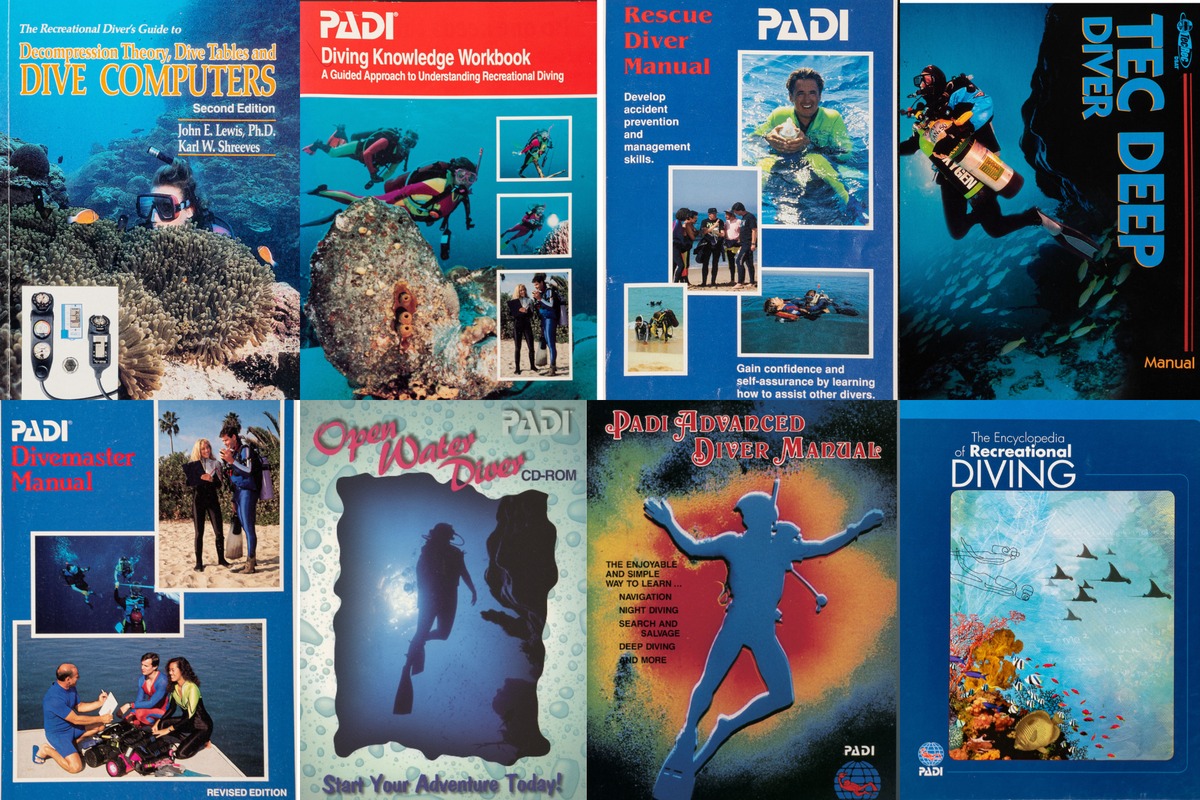
PADI introduced recreational certification requirements, advanced training and specialty programmes in its early years. In 1972 it made Open Water Diver its preferred entry-level certification. In 1978 came the transformation that made the model unmistakably industrial: an integrated modular scuba programme built around coordinated student materials, audiovisual instruction, tests and instructor guides.
The course was no longer only something an instructor knew how to teach.
The course had become a reproducible product.
Knowledge could move without its original teacher.
A passport with a photograph
Cronin grasped another part of the problem with equal clarity: the student had to move too.
At a National Sporting Goods Association show in New York, Paul Tzimoulis of Skin Diver magazine suggested putting the diver’s photograph on the certification card. PADI adopted the idea in 1968.
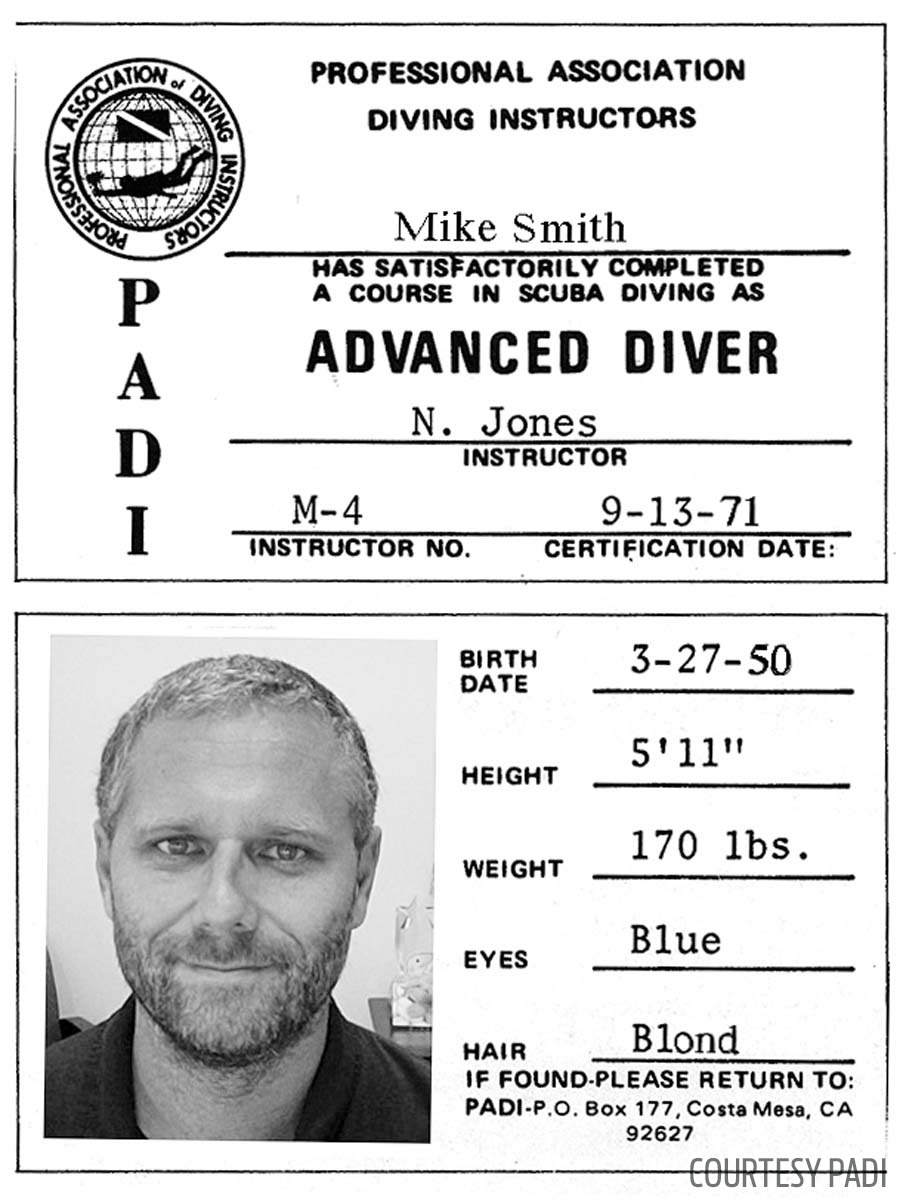
It sounds like stationery. It was infrastructure.
Consider what a certification must accomplish in a local club. Very little identification is necessary. Everybody knows who trained whom. Reputation is social.
Now consider a traveller arriving at a dive centre on another continent.
The dive operator does not know the customer. He does not know the original instructor. He may not know the school. Yet he has to decide whether this visitor is qualified to descend from his boat into deep water.
The photo identification card helped turn competence into something portable.
A diver could carry his training history away from the community that had taught him.
This is the same conceptual leap that appears again and again in the history of travel. Money becomes useful abroad when strangers recognise the instrument carrying value. A hotel brand becomes useful when a name reduces uncertainty in an unfamiliar city. A passport allows one authority to make a claim about a person that another authority will accept.
PADI did something analogous for an experience.
The little card said, in effect:
You do not know this diver. You know the system that certified him.
Cronin was building trust that could cross geography.
Dive today
There was still another barrier.
Even a portable qualification is irrelevant if tourists never begin.
Traditional diving instruction had inherited an understandable seriousness. The underwater environment is unforgiving, and early equipment was less refined than the equipment sitting in modern resort dive centres. Training frequently included substantial swimming, breath-hold work and theory before a beginner spent meaningful time doing the thing he had actually come to do.
PADI kept pushing in the opposite direction: make the route into diving safe, structured—and immediate.
In 1981, PADI put new students into scuba equipment during their first confined-water or pool sessions, bringing the experience of breathing underwater to the beginning of the course. It called the approach:
Dive Today.
The significance is easiest to see from a hotel terrace. A beginner’s first encounter with scuba can take place in the resort pool, close enough to the sun loungers to catch the attention of somebody who has never thought of becoming a diver.
That first breath is an extraordinary sensation. Human expectation says that inhaling while your face is submerged should end badly. Then the regulator delivers air.
The first breath becomes something a holidaymaker can try within walking distance of the breakfast buffet.
The distance between curiosity and participation has shrunk to the few steps between a sun lounger and the pool.
The ladder
The first holiday could lead to another. Open Water was not an ending.
There was Advanced training, specialties, Rescue Diver, Divemaster, Instructor and other routes upward and outward. Erickson had designed continuing education into the organisation’s early structure; PADI kept expanding it.
The ladder offered further skills and a stronger sense of identity.
A person who has “tried diving” may never dive again. A person who describes himself as a diver begins to look at the world differently.
A tropical destination now has another layer.
The Red Sea is not only Egypt. Cozumel is not only Mexico. Bonaire, Palau, Sipadan, the Great Barrier Reef and hundreds of barely inhabited islands become entries on an underwater map invisible to non-divers.
Travel begins to be planned around reefs, wrecks, currents, visibility, seasons and marine life.
Then the ladder gives the next journey a purpose. Perhaps this holiday is where you learn wreck diving. Perhaps the next is where you qualify for Nitrox. Perhaps a rescue course turns into Divemaster training. Perhaps the traveller eventually becomes the instructor standing beside someone else’s resort pool.
PADI did not merely sell repeated courses.
It helped create a population for whom diving became a reason to travel.
Tokyo
Scale becomes international only when it survives translation.
In 1979 PADI established its first overseas regional office in Tokyo. It grew out of work translating instructional materials and improving communication in Japan.
If an educational system works only in the language and culture of its founders, it is a national product.
Once the manuals, standards, instructor systems and credentials can be translated while preserving the same underlying structure, they can form a network.
PADI’s certification volume tells the story. During the 1970s, annual certifications rose from roughly 25,000 to more than 100,000 by 1979. By the late 1980s the organisation had become the leading scuba-training agency.
The flag began travelling faster than Cronin ever could. People he would never meet could teach people who had never heard his name, using a standard recognisable at the next destination.
The franchise that was not quite a franchise
Walk through a modern diving destination and the architecture of that machine becomes visible.
A PADI dive centre does not have to look like another PADI dive centre. One may belong to a five-star resort. Another may be a family business with two boats and a dog sleeping under the counter. The owners remain independent. The geography remains local. The reef certainly does.
What travels is a set of training standards, instructor qualifications, educational materials and certification records. The course names and progression are already familiar to the customer. The brand tells two strangers that they share a vocabulary.
That arrangement was exceptionally well suited to tourism because tourism itself is decentralised. The interesting parts of the world are not owned by one company. Beaches, islands and reefs are scattered among thousands of jurisdictions and businesses.
PADI could connect the destinations without owning them.
Every additional diver made it more useful for another dive shop to recognise PADI.
Every additional PADI shop made a PADI certification more useful to a traveller.
The card and the flag strengthened each other.
The commercial logic was plain enough to Cronin. In a 1995 interview with aquaCORPS, Michael Menduno confronted him with the industry jibe that PADI stood for “Put Another Dollar In”. Cronin defended the price of his materials and the need for a retailer to earn a living. A diver who wanted a cylinder filled needed a shop that could afford to remain open. “And the instructor has to be paid,” he added.
The ladder of courses brought repeat business as well as further learning. Cronin saw no embarrassment in that connection. The profit helped support the network; the network sold more training. His achievement depended on making those interests work together. It also left room for an enduring question: whether the next course served the diver or merely the sale.
Cousteau’s salesman
There is something almost perfect about Cronin having worked for U.S. Divers.
The company descended directly from the commercialisation of the Aqua-Lung technology developed by Cousteau and Gagnan. Cousteau had helped give ordinary people the physical possibility of breathing underwater and then supplied the twentieth century with its great images of submarine adventure.
Cronin stood one step farther down the chain.
His work was less cinematic.
A regulator solves the problem of breathing underwater.
A film solves the problem of wanting to go there.
Cronin spent his career helping solve the problems that remain after desire: How do I learn? Whom do I trust? Will my qualification be recognised? Can I continue somewhere else?
Travel history is full of people whose contribution looks unromantic until one removes it.
Reservation systems, standards, tickets, timetables, accepted currencies and recognised credentials allow an unfamiliar place to become manageable before a traveller arrives.
Cronin belonged to this less photographed class of pioneer.
He made adventure administratively portable.
From the basement to the barely inhabited island
Cronin died in 2003.
By its sixtieth-anniversary year, 2026, PADI reported a network of about 128,000 professionals and 6,600 dive centres and resorts. The basement operation had become a business whose name a traveller could recognise across oceans.
But numbers are not the best way to measure Cronin’s effect.
Look instead at that barely inhabited island.
A traveller steps off a boat. Perhaps there is one road, perhaps none. There is a beach, a few buildings, cylinders standing upright against a wall—and the familiar red-and-blue mark.
The flag is making a promise on behalf of people who are not there.
It reaches backward to an instructor in another country who once signed off a set of skills, and forward to another dive centre that can understand the same record. The card carries evidence of training; the dive itself still depends on the people present.
That is why PADI became much larger than a school.
Erickson made the education reproducible. Cronin helped it spread through a business that gave instructors and shops a reason to join. Together they brought a recognisable course and credential to an activity whose customers were always going somewhere else.
The PADI flag does not promise that every reef will be beautiful, every boat comfortable or every dive memorable.
Its more important promise is simpler:
you can continue from here.
That may be John Cronin’s most lasting contribution to travel.
He made the underwater world continuous.