
On the morning of 4 October 1957, Dennis Tito was an American schoolboy.
By evening, there was something Russian above his head.
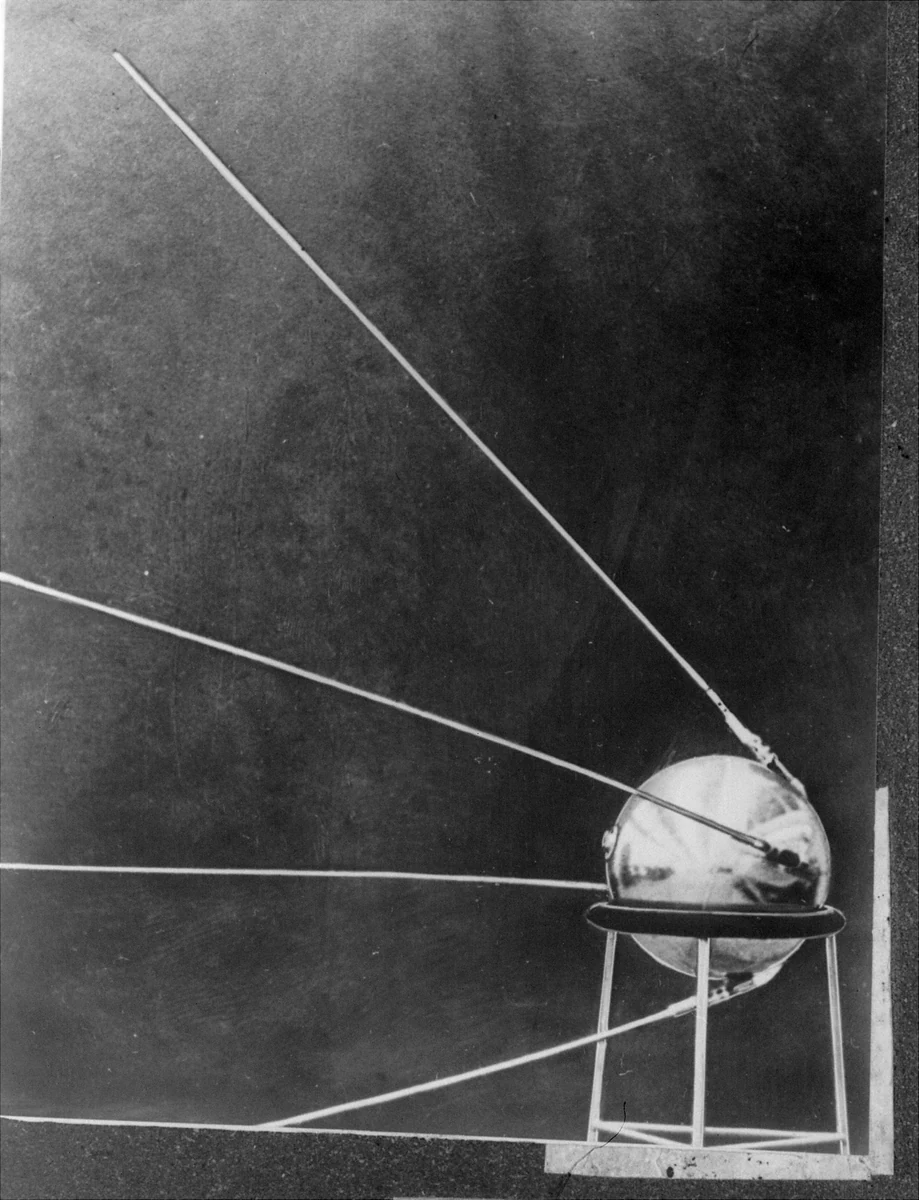
Sputnik was a polished aluminium sphere fifty-eight centimetres across, with four antennae trailing behind it. It carried no astronaut, took no photographs and went nowhere except around the Earth. Its radio transmitted little more than a pulse.
Beep.
Beep.
Beep.
For a seventeen-year-old in Queens, that sound meant that the sky had ceased to be a boundary. Humanity had put one of its own objects into orbit.
Asked decades later why he was willing to spend $20 million to follow it, Tito returned to that October night. “I have always dreamed of going into space since I was 17,” he said in 2000.
No family tradition appears to have prepared the dream. Tito was the eldest child of working-class Italian immigrants in New York, in a household with little formal education and none of the obvious machinery for producing a rocket scientist. He had been earning his own money since he was twelve. When the Los Angeles Times asked where his formidable independence came from, he answered with almost brutal economy:
“My parents never encouraged me. I did everything on my own.”
Sputnik did not awaken an inherited ambition. It supplied one.
NASA did not yet exist. Project Mercury had not produced an American astronaut; Kennedy’s promise of the Moon lay almost four years ahead. The magnificent American mythology that would make a boy’s fascination with space seem naturally American—Mercury, Gemini, Apollo, Armstrong, the Saturn V—came later.
The first object to show Tito that the sky was penetrable was Soviet. That small accident of timing would sit quietly inside an American life for more than four decades.
A customer without a market
Tito followed the signal into mathematics. He studied aeronautics and astronautics at New York University, earned a master’s degree at Rensselaer Polytechnic Institute in 1964 and went west to the Jet Propulsion Laboratory in Pasadena.
He worked on trajectories for the Mariner planetary missions. Before cheap computation, sending a spacecraft from Earth to another planet required celestial mechanics, numerical calculation and an imagination capable of holding the moving geometry together. Tito later described visualising the spacecraft and the planet whose gravity it would encounter. In time, he began to imagine himself aboard the trajectories he calculated.
Mariner 4 flew past Mars. Mariner 5 went to Venus. Dennis Tito stayed in Pasadena.
He was helping machines do the thing he wanted to do himself, but the American space programme had no place for a customer. NASA chose people it considered useful, trained them, assigned them to missions and gave them institutional purposes. A citizen could admire the programme and pay taxes for it. There was no desk in Houston where he could ask:
How much for a seat?
For a short time NASA itself came close to something different.
Ronald Reagan’s administration created the Space Flight Participant Program. From roughly 11,000 applicants, NASA chose Christa McAuliffe, a high-school social-studies teacher from Concord, New Hampshire, for the first flight. She trained with the Challenger crew and prepared two lessons to teach live from orbit. Journalists, poets and artists were expected eventually to follow.
Then Challenger disintegrated seventy-three seconds after launch on 28 January 1986.
McAuliffe died with the crew.
NASA kept the Teacher in Space project active while it reconsidered the programme, then cancelled it in 1990.
By the time Tito seriously went looking for his way into orbit, the American door had swung shut.
Another door, unexpectedly, was opening.
It was Russian.
The Soviet Union’s space programme was desperately short of hard currency, but it still possessed a station, launch vehicles, Soyuz spacecraft, experienced crews and Star City’s training infrastructure.
In December 1990, Japanese television journalist Toyohiro Akiyama flew to Mir on a mission purchased by Tokyo Broadcasting System for at least $11 million. Five months later Helen Sharman followed through Britain’s privately organised and sponsored Project Juno. Their employers and sponsors were buying media, experiments and national narratives rather than personal holidays. For Tito, the decisive fact was simpler.
A seat aboard a state spacecraft had acquired a price.
He approached the Russians in 1991. The Soviet Union dissolved, the attempt went nowhere and the customer returned home. Yet the market’s strange geography was already visible: capitalist America had rockets but no checkout desk; the collapsing socialist state had accidentally invented one.
The mathematics that bought the ticket
Tito could afford to keep asking because he had turned rocket mathematics into money.
He left aerospace, entered finance and founded Wilshire Associates in 1972. The change of industry was less dramatic than it looked. A planetary trajectory asks how an object behaves when velocity, time and gravitational forces interact. A portfolio asks how assets behave when returns, correlations and risks interact. The variables changed; the appetite for systems did not.
Tito became an early practitioner of quantitative investment analysis. Wilshire grew into an influential institutional consultancy, and its Wilshire 5000 became one of the broadest measures of the American equity market. The mathematical habits developed for spacecraft now governed investments.
The loop was unusually clean. Space had led Tito to mathematics; mathematics made him wealthy; wealth gave the old ambition a price he could meet. The fortune and the journey shared a distant origin in Sputnik’s pulse.
“I want to go”
By the late 1990s, the customer was ready and the industry was still trying to imagine him.
In early 2000, Eric Anderson of Space Adventures entered Tito’s Santa Monica office hoping to attract an investor. His company’s proposition sounded improbable: private people—extraordinarily wealthy ones at first—would purchase access to space.
Anderson made the presentation. Tito listened, then explained that the wrong opportunity was being offered. The essence of his answer, as Anderson later remembered it, was:
I don’t want to invest.
I want to go.
A few weeks later he became Space Adventures’ first customer. Entrepreneurs had forecasts for a market that might one day exist; Tito supplied the missing half of the equation. He was demand in a chair.
Another company soon offered a destination. MirCorp had been formed around an audacious attempt to commercialise and preserve Russia’s ageing Mir station, drawing revenue from media, research, entertainment and private visitors. In June 2000 it announced Tito as its first Citizen Explorer. By August he had passed the Russian medical board, signed a contract and placed a multimillion-dollar deposit.
A lifelong desire had become a sequence of practical arrangements: Soyuz, Star City, Mir and a price generally reported as $20 million.
Then Russia chose to deorbit the station. Mir broke apart over the South Pacific on 23 March 2001. Tito changed his arrangements and his destination. Space Adventures returned to the negotiations; Russia could still provide a Soyuz seat, and the new International Space Station could receive it.
The journey was now possible. It was also entangled with NASA.
NASA says no
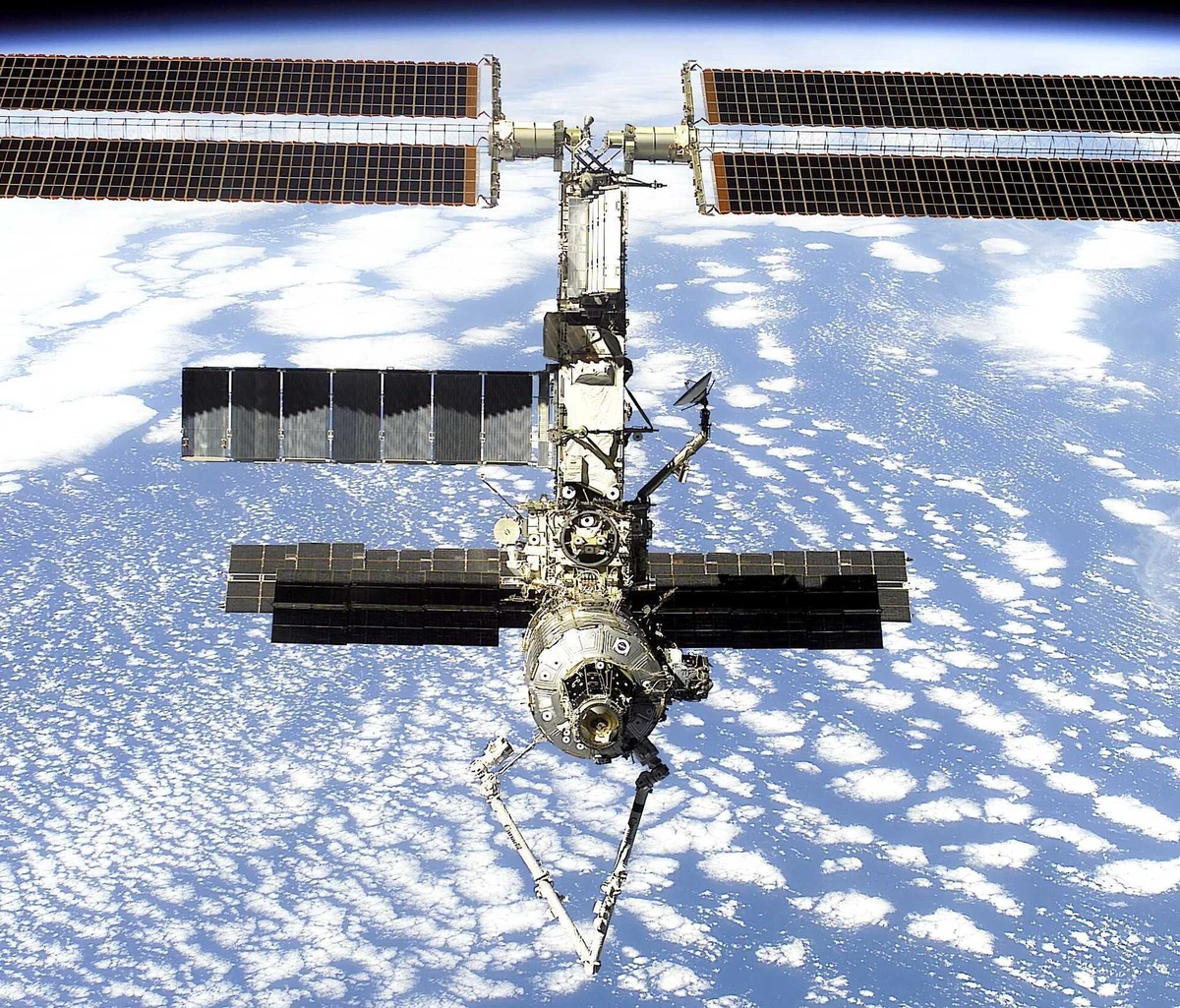
The ISS of early 2001 was not the mature station familiar from later photographs. Assembly had begun only in 1998. Construction was demanding, procedures between international partners were still evolving, and every person aboard represented oxygen, crew time, emergency duties and risk.
NASA’s objections were operational as well as cultural. The agency argued that Tito lacked sufficient training in critical station systems and might burden the resident crew during a difficult assembly period. Tito arrived in Houston with his Russian crewmates for joint training; NASA refused to train him. The Soyuz commander, Talgat Musabayev, withdrew with him in protest.
An old space-race rivalry had acquired a paying American passenger as its latest dispute.
For eight months in Russia, Tito trained without knowing whether he would fly. Support there was not unanimous: Energia and Star City wanted the mission, while parts of the Russian bureaucracy stood closer to NASA. He studied systems, learned procedures in Russian, passed medical examinations and prepared to ride a machine in which failure meant rather more than a cancelled flight.
He was sixty, and he kept going.
The reported price followed him everywhere. In 2001, $20 million made the story easy to caricature as the world’s most expensive amusement. A quarter-century later, the number remains extraordinary: in 2025, Axiom Space put the customer price for its fourth private ISS mission at more than $65 million. Tito’s price now looks less like an isolated extravagance than the opening figure in a market that remains ferociously costly.
Tito’s ticket bought a Soyuz launch, months of cosmonaut training, residence aboard the International Space Station and nearly eight days away from Earth. Orbit had acquired customers without becoming ordinary.
The customer understood the machine carrying him. Tito had calculated planetary trajectories and remained an experienced pilot. In his seventies he competed seriously in soaring, became the worldwide Online Contest champion in 2018 and commissioned Arcus sailplanes fitted with retractable jet engines. Luxury was never the centre of his fascination. He wanted access to the edge of what a machine could do.
His technical seriousness and his identity as a tourist belong together. Tito asserted that personal experience was itself a sufficient reason to accept the training, expense and danger. He could conduct experiments aboard the ISS, and he did, but experiments had not started the ambition in 1957.
He wanted to know what it was like.
28 April
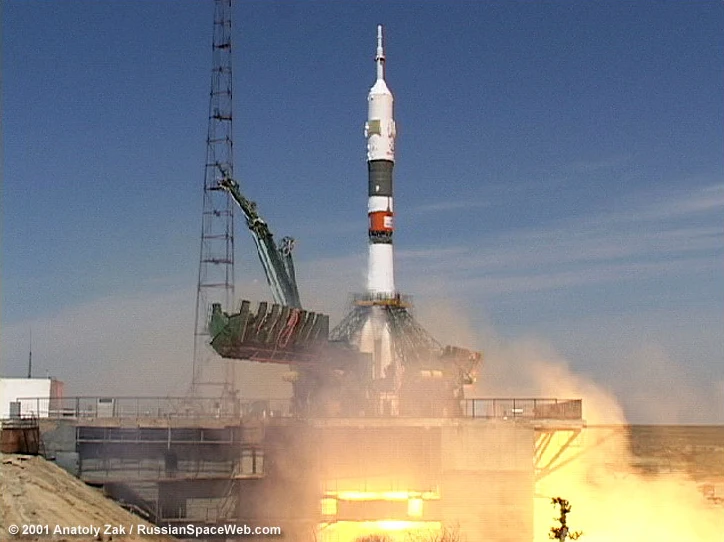
At 11:37 in the morning local time on 28 April 2001, Soyuz TM-32 lifted from Baikonur.
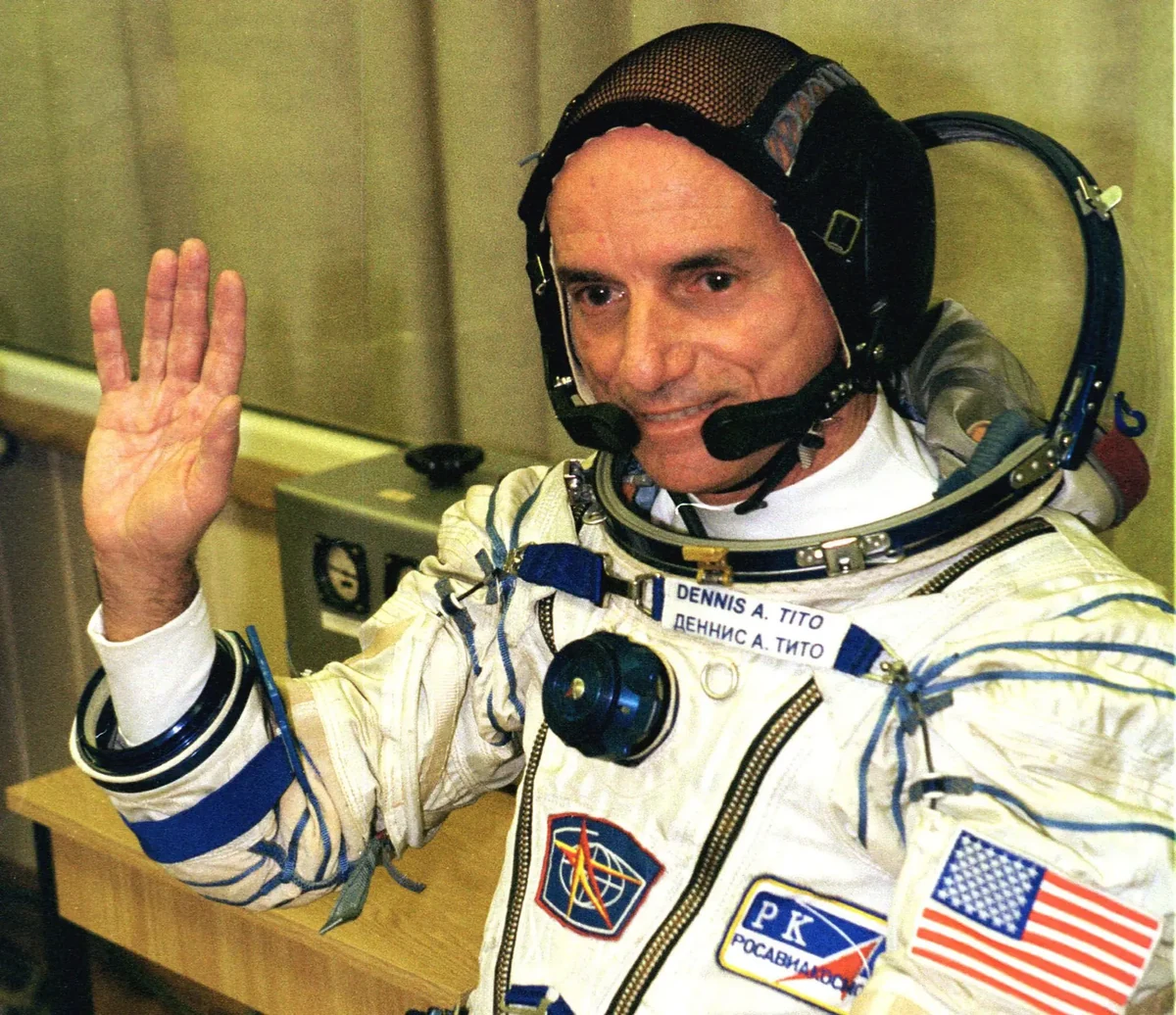
A photograph taken shortly before launch shows Tito in a white-and-blue Sokol pressure suit. Spacecraft erase wealth efficiently. Inside Soyuz there is no penthouse: the customer and the career cosmonauts sit folded into nearly the same amount of space, wear the same suit and depend on the same bolts, valves, computers and parachutes.
Money can purchase the seat. It cannot purchase a gentler version of orbital mechanics.
Two days later the Soyuz docked with the International Space Station. Dennis Tito floated inside.
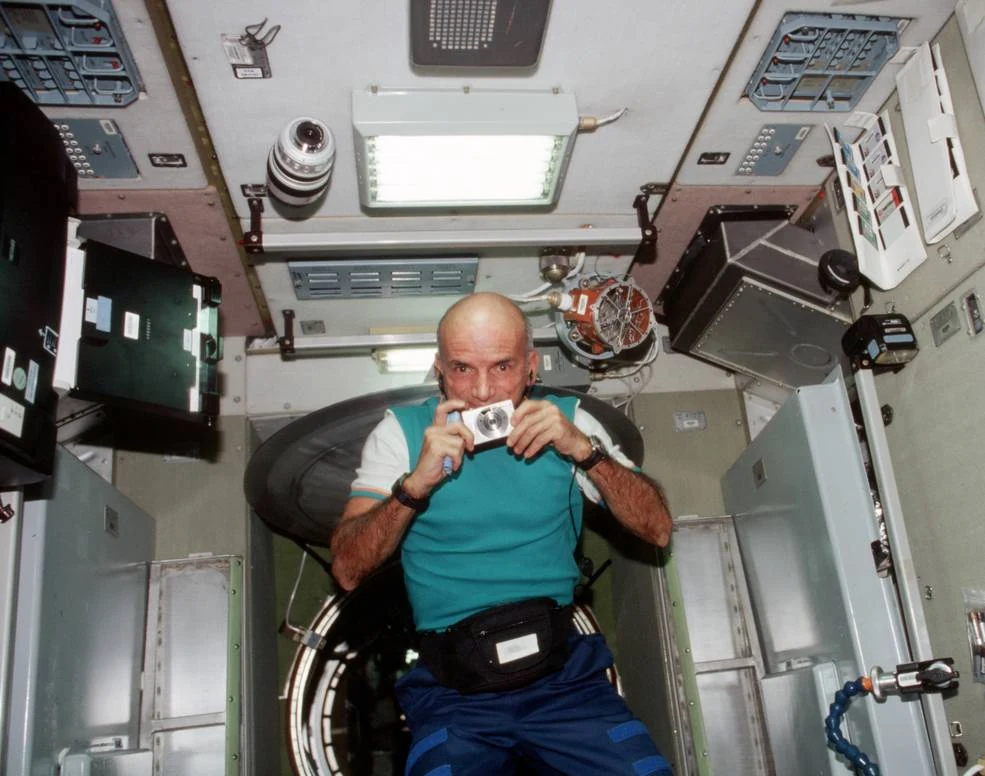
His accommodation belonged to the machinery. NASA’s final safety plan limited his unescorted movement to the Russian modules and assigned the Soyuz—his emergency vehicle—as his bedroom. That is where he slept. Zvezda supplied the domestic essentials: a galley, hygiene facilities and a toilet.
At mealtimes Tito made himself useful as the crew’s unofficial “chef”, choosing the tubes of food. Before launch he had offered to help with routine chores, including cleaning the toilet. The customer had bought access to the station, not service aboard it.
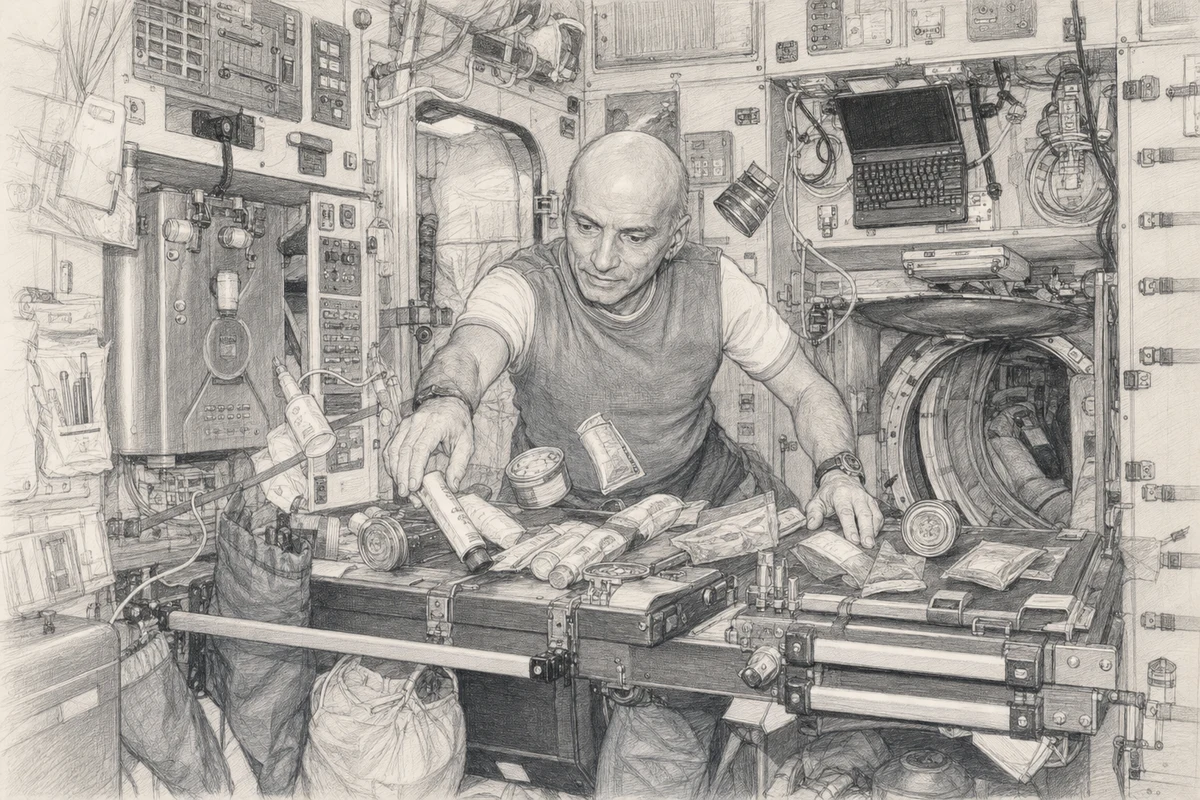
Forty-three and a half years had passed since Sputnik. When reporters spoke to him from orbit, the financier and engineer had difficulty sounding analytical. Zero gravity and the sight of Earth, he said, were beyond what he had dreamed.
For nearly eight days, the trajectory engineer became the object on the trajectory. Soyuz TM-31 returned him to Kazakhstan on 6 May.
The biography could have ended there as a magnificent eccentricity: one determined man, one costly journey, one desire satisfied. The history begins with what survived him.
A reason of one’s own
Tito had established a principle larger than the itinerary: the cosmos could contain destinations.
The idea is easily reduced to an orbital hotel, as if the future must reproduce the industries we already know. A century from now, if human mobility beyond Earth expands, space tourism may sound as broad and unhelpful as planet tourism. Journeys might follow routes chosen for the view, intercept a comet that will not return for three hundred years, visit protected worlds where settlement is forbidden or make pilgrimages to the Apollo sites. The names of some destinations may not yet exist.
Tito’s importance does not depend on any particular forecast coming true. He made personal choice part of the mission architecture.
The model has already moved beyond a spare seat on a government spacecraft. Blue Origin repeatedly recruits, screens, trains, launches and recovers private passengers. Inspiration4 placed four private citizens into orbit in 2021 without a professional government astronaut aboard. Polaris Dawn flew higher in 2024 and performed the first commercial spacewalk. These missions were defined outside a government astronaut corps and carried by commercial spacecraft.
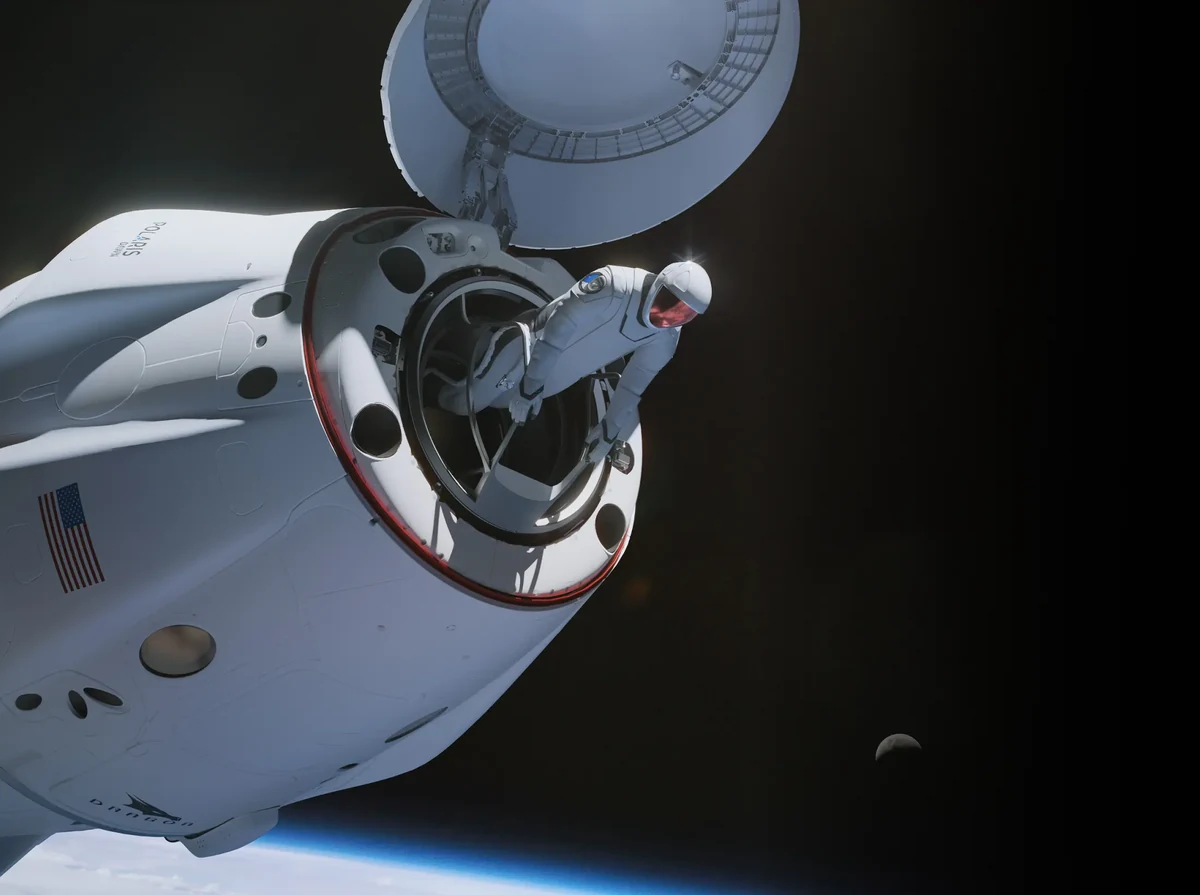
Private access to the ISS has become repeatable enough for NASA to select Axiom Mission 5, targeted for no earlier than January 2027. The important inversion is now familiar: governments once chose a traveller and assigned the mission; a customer or private organisation can increasingly begin with a mission and find the vehicle.
Tito himself kept thinking in destinations. At eighty-two, more than two decades after Soyuz TM-32, he and his wife, Akiko, announced plans to fly aboard SpaceX’s Starship on a journey around the Moon. The flight has not happened, no public date has been set and Starship’s human lunar future remains a work in progress. The continuity is more revealing than the schedule. Orbit had not cured him. The Moon had become somewhere else to go.
We grant dignity to difficult travel most readily when it arrives with an approved purpose. The scientist in Antarctica is serious; the climber on Everest is heroic; the wealthy person fascinated by the place is a tourist. Spaceflight intensifies the prejudice because its costs are immense and its history belongs to national prestige. Apollo had a purpose. Gagarin had a purpose. ISS expeditions have objectives divided carefully among agencies.
Tito’s purpose was personal, and that was the point.
A place enters human geography when someone reaches it. It changes again when someone who does not need to be there chooses to go. Merchants made use of Venice; travellers desired it. Shepherds and geologists had reasons to enter the Alps; other people eventually crossed them for the experience itself. Tito carried that ancient impulse into a realm where governments had long reserved the right to choose both traveller and reason.
The route there ignored ideological neatness. Soviet Sputnik fixed the desire. America’s space age trained the engineer. American finance produced the fortune. The shortage of money in post-Soviet Russia made a Soyuz seat negotiable. An American customer finally rode Russian hardware into an American-led international station.
Tito’s particular agency lay in asking the question that forced those systems to meet: I would like to go there. What will it take?
In 1991 there was barely an answer. In 2001 it meant eight months in Russia, political warfare with NASA, medical examinations, Soyuz training and approximately $20 million. Today there are several answers. Some rise briefly above the atmosphere; others reach orbit; private missions can be built around purposes chosen outside government programmes.
On 4 October 1957, the sky over Queens answered Tito with a pulse. Forty-three years later, it answered with a seat.
Space remains difficult, dangerous and ruinously expensive.
But beside the seat, there is now a price.