
Sometime in the 1580s, Michel de Montaigne complained that the ladies of France were treating his Essays as “a common movable, a book to lay in the parlour window.” He meant it as an insult. Four centuries later, a whole industry would take it as a business plan.
The book that is bought to be seen is older than the coffee table, older than photography and considerably older than the living room. And the travel book, the large and lavish record of somewhere far away, has always been its most natural form. A great city, a desert temple or a mountain range fits badly into a small volume. It needs width. It needs weight. It needs, eventually, a table.
This is the story of how it got there.
Marvels for a duke
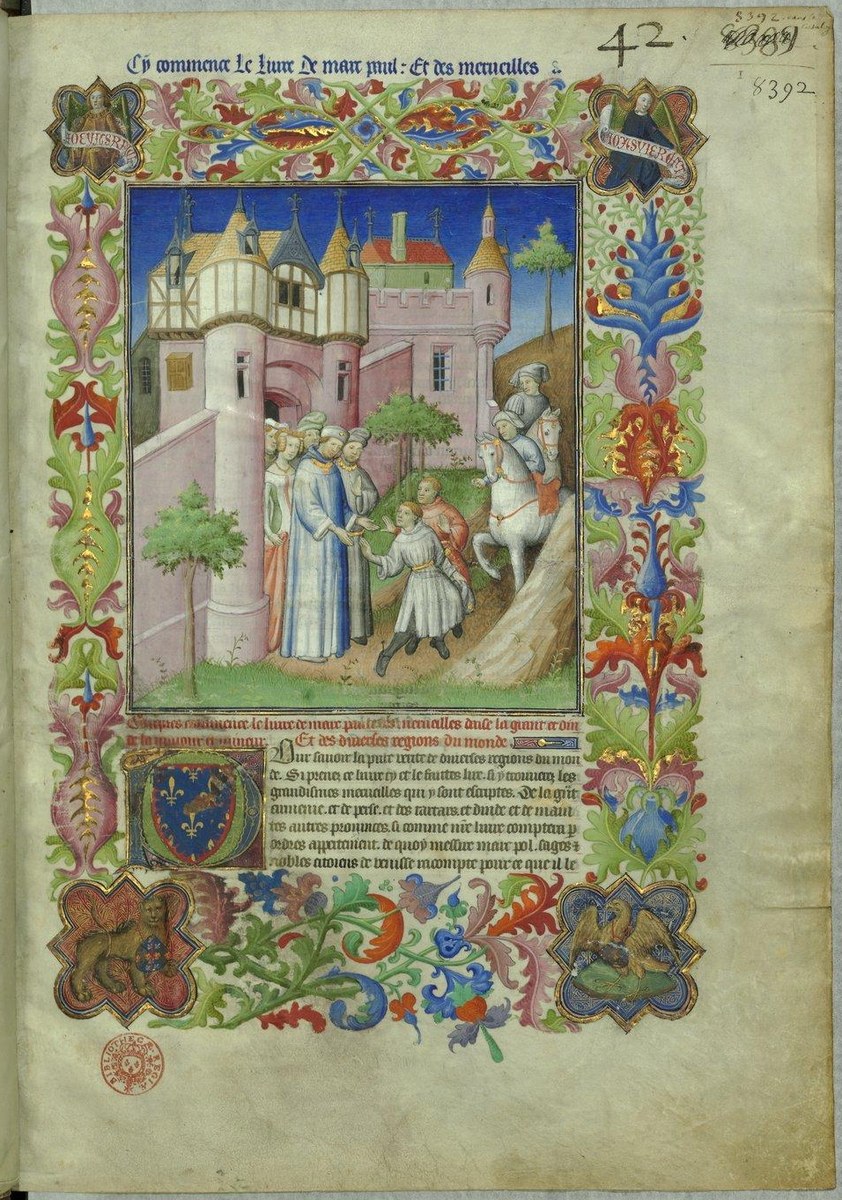
Before printing, a travel book was a singular object, and very few people would ever see one. The finest to survive is probably the Livre des merveilles du monde, now in the Bibliothèque nationale de France. Made in Paris around 1410–1412, it gathers Marco Polo’s account of Asia with the travels of Odoric of Pordenone, John Mandeville and other voyagers to the East: 297 leaves, 265 miniatures, the work of several of the finest workshops in the city.
It was painted for John the Fearless, Duke of Burgundy, whose arms appear throughout. In 1413 he gave it to his uncle, John, Duke of Berry, the most insatiable book collector of his age. That is the first thing to understand about the luxury travel book: from the beginning, it was a gift between powerful men. Few of its owners would ever see Hangzhou. The book let them possess it anyway, in gold leaf and lapis blue.
Printing changed the number of books, but not at once the ambition. In 1493, Nuremberg produced the Liber Chronicarum, better known as the Nuremberg Chronicle, a history of the world with 1,809 woodcut illustrations printed from only 645 blocks. The arithmetic gives the game away. The same woodcut often served for several different towns. The great cities, though, received their own portraits, and Venice is among the finest.
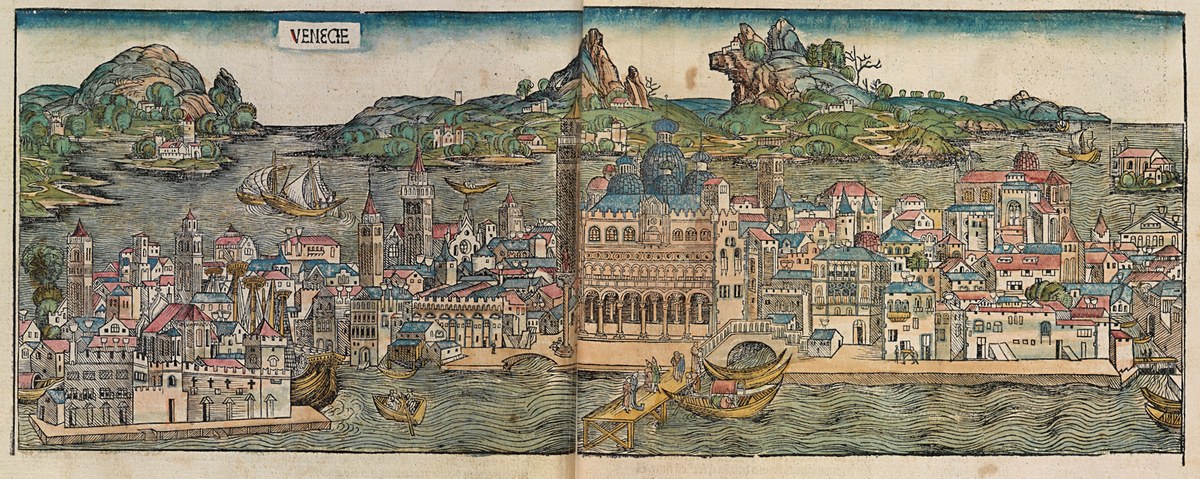
Copies coloured by hand cost more, and single leaves of Venice or Jerusalem are still sold today as framed prints. The idea of the view as a possession, a city you could own on paper, was already there.
The spoils of war
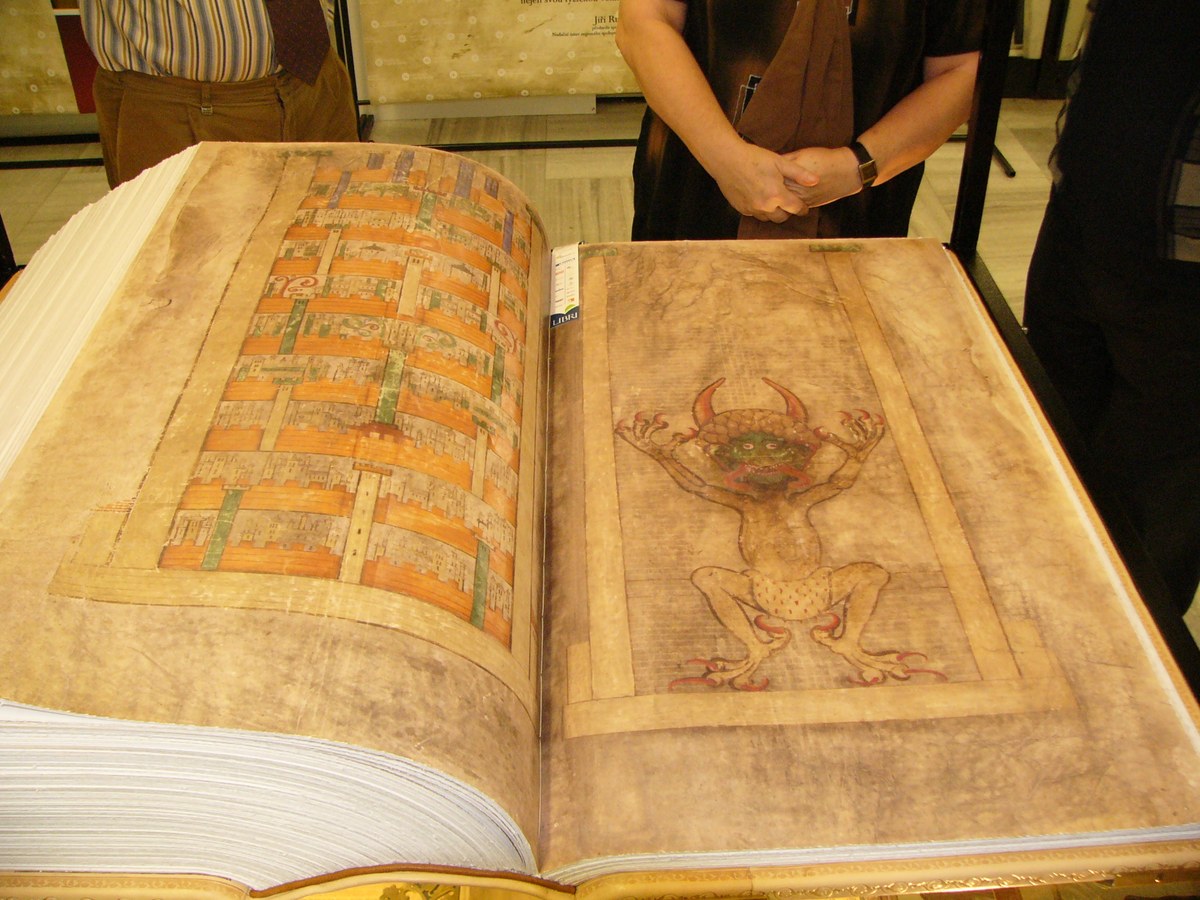
Great books have always travelled in the baggage of armies. In July 1648, in the last months of the Thirty Years’ War, Swedish troops broke into Prague. Among the treasures of the emperor Rudolf II they took the Codex Gigas, the largest surviving medieval manuscript in the world: 92 centimetres tall, roughly 75 kilograms, with a full-page portrait of the Devil that earned it the name of the Devil’s Bible. It went to the library of Queen Christina in Stockholm and has never gone back. The National Library of Sweden still calls it, candidly, spoils of war.
A century and a half later, war produced not only loot but a new kind of book. When Napoleon sailed for Egypt in 1798, he took an army and roughly 160 scholars, engineers and artists, the savants. The campaign failed. The book did not. Between 1809 and 1829 the French state published the Description de l’Égypte: some two dozen volumes of text and plates, prepared by around 2,000 artists and technicians, including 400 engravers. Its largest volumes, the so-called mammoth folios, measure about one metre by 81 centimetres. For a time it was the largest published work in the world.
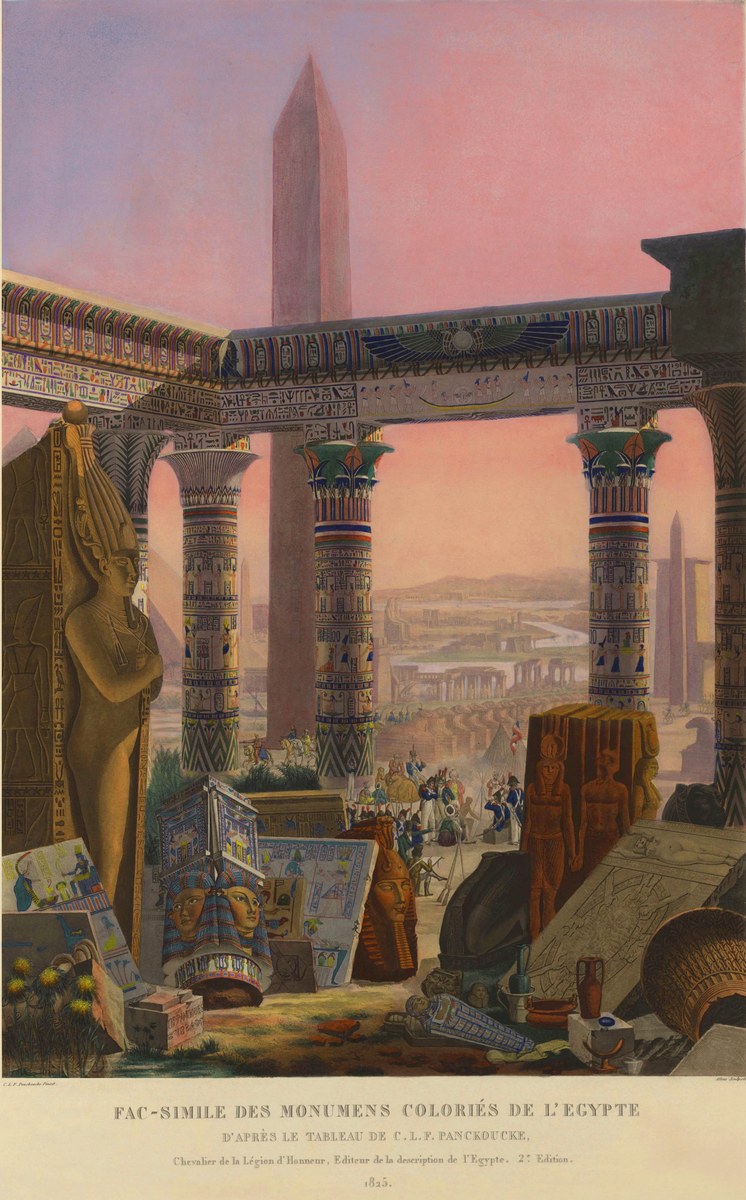
It was science, and it was also possession. Edward Said later called it “that great collective appropriation of one country by another.” France had lost Egypt on the battlefield and kept it on paper. Sets became gifts of state: one splendid copy was presented by King Charles X to his minister of justice, who had it bound in polished morocco. The Parisian cabinetmaker Morel built special cabinets for the work, with rolling shelves on which the great volumes could lie flat; the French Senate still displays volumes in one of them. An object of that size needs its own furniture. The coffee table was still some decades away, but the logic was already fixed.
The subscribers’ Orient
The British answer came from a Scottish painter rather than an emperor. David Roberts travelled through Egypt, Sinai, Petra and the Holy Land in 1838 and 1839. He returned with 272 watercolour sketches, and the publisher F. G. Moon paid him £3,000 for the copyright. Louis Haghe, the finest lithographer of the day, turned them into 250 hand-coloured plates, issued between 1842 and 1849 as The Holy Land, Syria, Idumea, Arabia, Egypt, and Nubia.
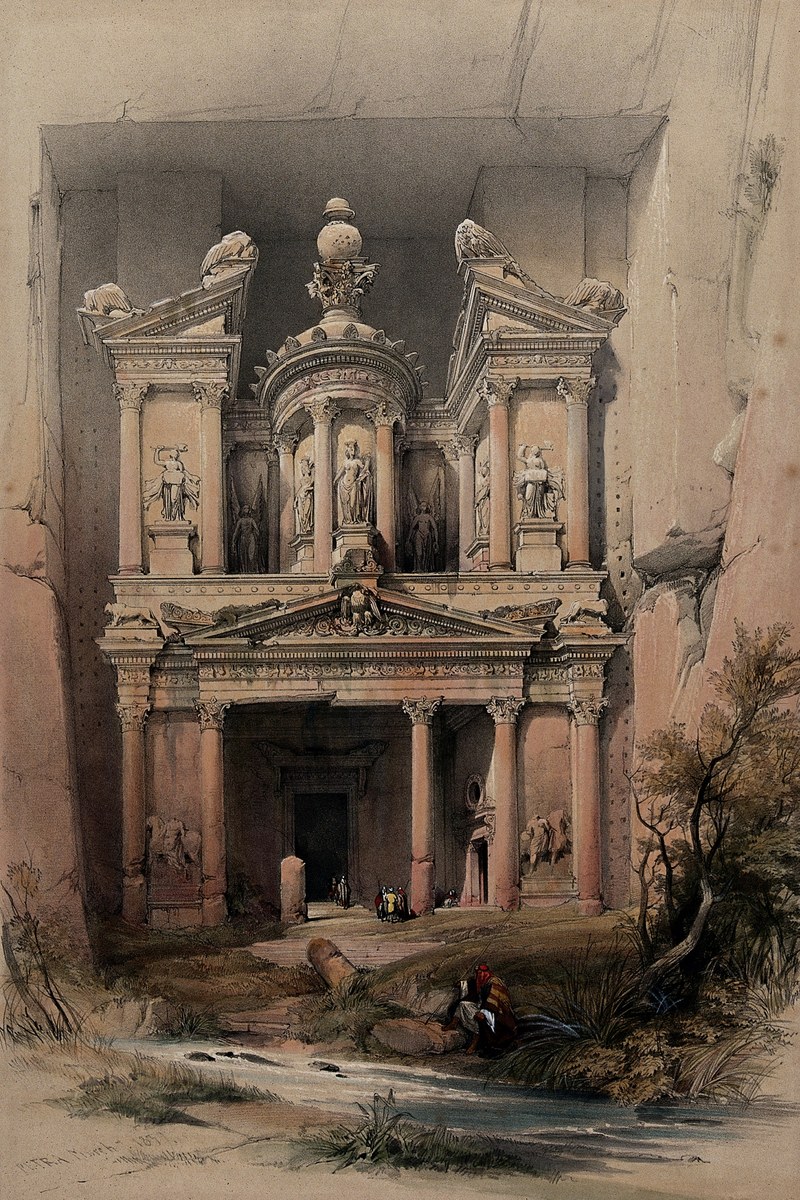
It was financed the way luxury books often were: by subscription. Queen Victoria put her name down first. Charles Dickens and John Ruskin were among the other subscribers. Ruskin, never easily pleased, praised the plates as “faithful and laborious beyond any outlines from nature I have ever seen.” The work became one of the most expensive publications of the nineteenth century and, as critics of Orientalism have since observed, shaped how a whole region was imagined in the West.
What matters here is the transaction. Roberts sold a view to people who would never stand beneath the Treasury at Petra. The Victorian drawing room received the East as a set of great loose plates, to be turned slowly, shown to guests and discussed. That is a coffee table book in everything except its binding.
When the camera arrived
In 1849 a young French writer named Maxime Du Camp set out for Egypt with his friend Gustave Flaubert and a camera. The government had asked him to exploit photography’s supposedly incontestable accuracy. He came home with more than 200 paper negatives. In 1852, 125 of them appeared as salted-paper prints, mounted one to a page, in Égypte, Nubie, Palestine et Syrie. It is regarded as the first French book illustrated with photographs.
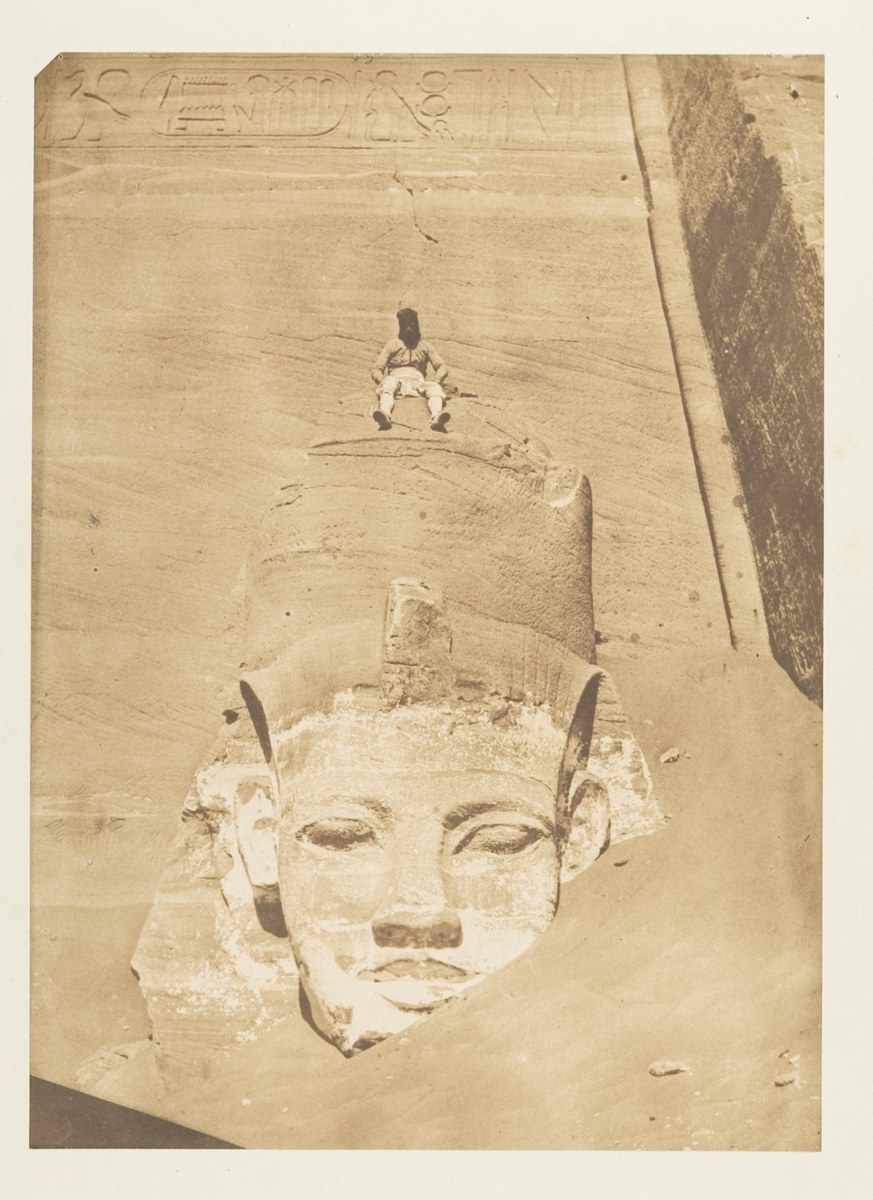
For this photograph at Abu Simbel, Du Camp had the lower part of the face cleared of sand and his assistant climb onto the crown, to show the scale. The small seated figure is doing the work that every guidebook photograph has done since: telling us how large the world is and how small we are within it.
Yet each print still had to be made by hand and pasted in, so the book was nearly as rare as Roberts’s. The real break came with the halftone screen, which let a photograph be printed on the same press as the text. On 4 March 1880 the New York Daily Graphic published “A Scene in Shantytown”, the first halftone news photograph in an American newspaper. Within two generations, the photographs of distant places would become the cheapest thing in print.
A table of its own
The furniture caught up in the meantime. Around 1868 the English architect E. W. Godwin designed a low table that was made in quantity by William Watt, one of the earliest pieces to be called a coffee table. It lowered the book to the level of the sofa, where it could be picked up between one conversation and the next.
The modern coffee table book itself was invented, or at least perfected, after the Second World War. In Geneva, Albert Skira made art books whose colour plates were printed separately and tipped in by hand. In 1949 Harry N. Abrams founded the first American publisher to specialise in them, and Walter and Eva Neurath founded Thames & Hudson in London to build what they called a “museum without walls.”
Travel then found its prophet in David Brower, executive director of the Sierra Club. He wanted books with “a page size big enough to carry a given image’s dynamic,” where “the eye must be required to move about within the boundaries of the image, not encompass it all in one glance.” The first of his Exhibit Format series, This Is the American Earth, with photographs by Ansel Adams and others and text by Nancy Newhall, appeared in 1960. By 1964 the series had brought in more than ten million dollars and helped turn the American public towards wilderness conservation.
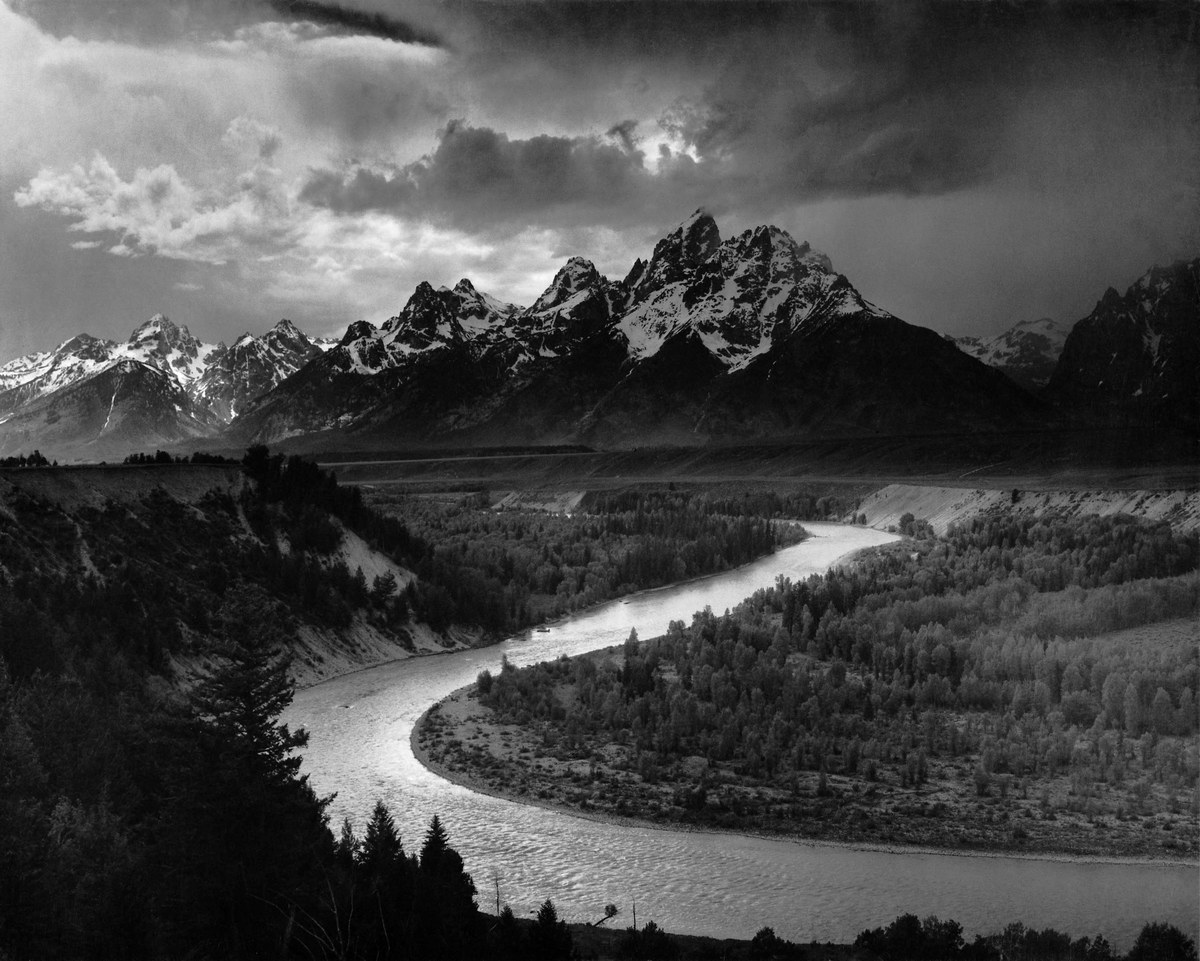
This photograph was later encoded on the Voyager Golden Record, launched into interstellar space in 1977. It is hard to think of a larger coffee table.
The phrase itself followed quickly. “Coffee table book” appeared in Arts Magazine in 1961, and The Coffee Table Book of Astrology was published in 1962. The format had a name, a market and a place in the house.
The ring on the cover
Cheap colour printing, much of it in Italy and later in Hong Kong and mainland China, finished the job. The large illustrated book was no longer an inheritance. It was a present for a new house, a museum-shop souvenir, a thing you bought on the way home from the Louvre.
Its new place carried a small cost. A book that lives beside the cups will, sooner or later, receive a coffee ring, a pale brown moon on a heavy cloth cover. There is rarely a perfect cure; scrubbing usually spreads the tide line. Most owners learn to live with the mark as evidence that the book was actually used.
Seinfeld made the joke permanent in 1993, when Kramer proposed a coffee table book about coffee tables. It would have folding legs, so the book could become a coffee table itself, and “on the cover is a built-in coaster.” The idea was later published as a real, miniature book, legs included.
The disc that was going to replace it
Then, for about fifteen years, it seemed that the whole enterprise would disappear.
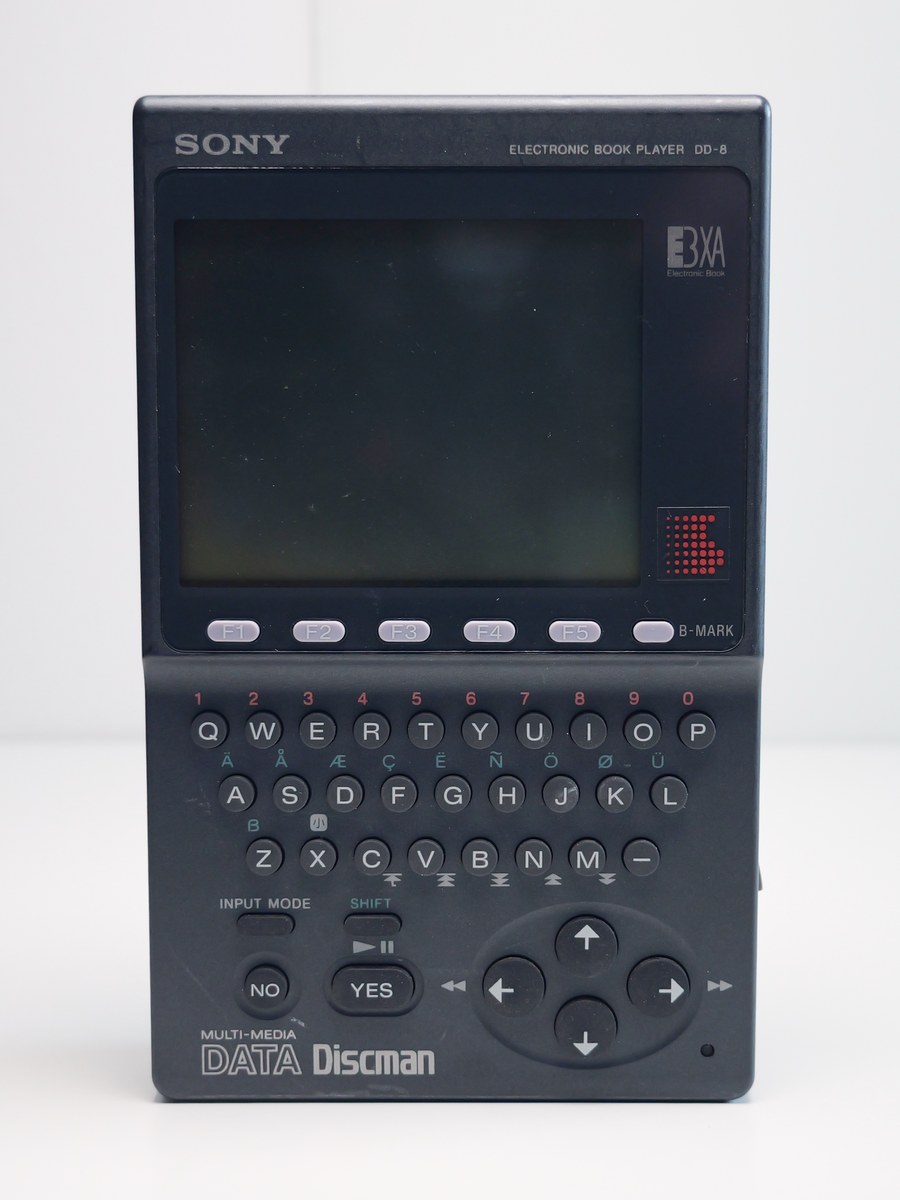
In 1992 the Voyager Company released its Expanded Books for Apple’s PowerBook, beginning with The Hitchhiker’s Guide to the Galaxy, The Annotated Alice and Jurassic Park. Sony sold the Data Discman, which played reference books from small discs; by 1995 one was displayed at the Victoria and Albert Museum in an exhibition called The Book and Beyond. Microsoft launched Encarta on CD-ROM in 1993, and the Encyclopaedia Britannica never recovered its old business. Its last printed edition appeared in 2010.
Publishers rushed to become technology companies, and technology companies bought pictures. In 1995 Bill Gates’s private company, Corbis, acquired the Bettmann Archive, some 16 million historical images, to feed a future of digital screens. Dorling Kindersley, admired for its beautifully illustrated books, built a multimedia division, then sold its CD-ROM backlist in 2000, the same year the weakened company was taken over by Pearson.
Travel publishing had its own fever. BBC Worldwide bought Lonely Planet in 2007 and sold it in 2013 at a loss of almost £80 million. Google bought Frommer’s in 2012, published no guidebooks, and within a year sold the name back to its 83-year-old founder, Arthur Frommer, who intended to print them again. The Bettmann Archive, meanwhile, was moved between 2001 and 2002 to a former limestone mine in Pennsylvania, 220 feet underground, to preserve the originals the digital future had seemed to make unnecessary.
The screen did take the encyclopaedia and much of the guidebook. It never took the object that people wanted to hold, share and leave open on a table.
The weight of paper
The man who best understood this began with comics. Benedikt Taschen opened a comic shop in Cologne in 1980. In 1984 he borrowed money from his family and bought 40,000 remaindered copies of an English-language book on René Magritte, reportedly for a dollar each, then sold them at a handsome profit. The lesson was simple: beautiful pictures, fairly priced, would sell in enormous numbers.
TASCHEN’s Basic Art series followed in 1985. It later reissued the plates of the Description de l’Égypte, bringing Napoleon’s imperial survey within reach of a student’s budget. Then the house went the other way. The Helmut Newton SUMO of 1999, signed, limited to 10,000 copies and sold with a bookstand designed by Philippe Starck, became the most expensive book published in the twentieth century when copy number one reached $304,000 at auction. GOAT, its tribute to Muhammad Ali, measures 50 by 50 centimetres and weighs 34 kilograms. Der Spiegel called it “the biggest, heaviest, most radiant thing ever printed in the history of civilization.” The Codex Gigas, for the record, is still heavier.
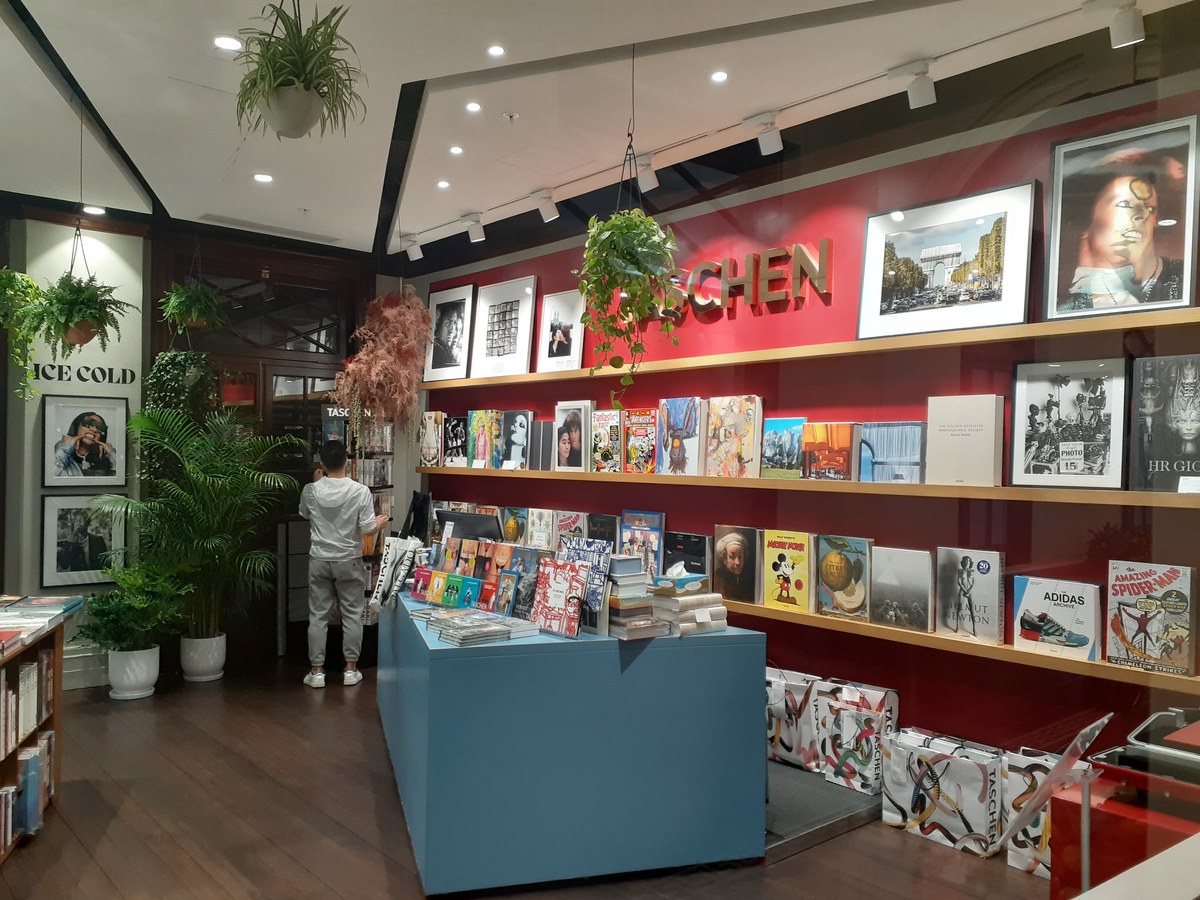
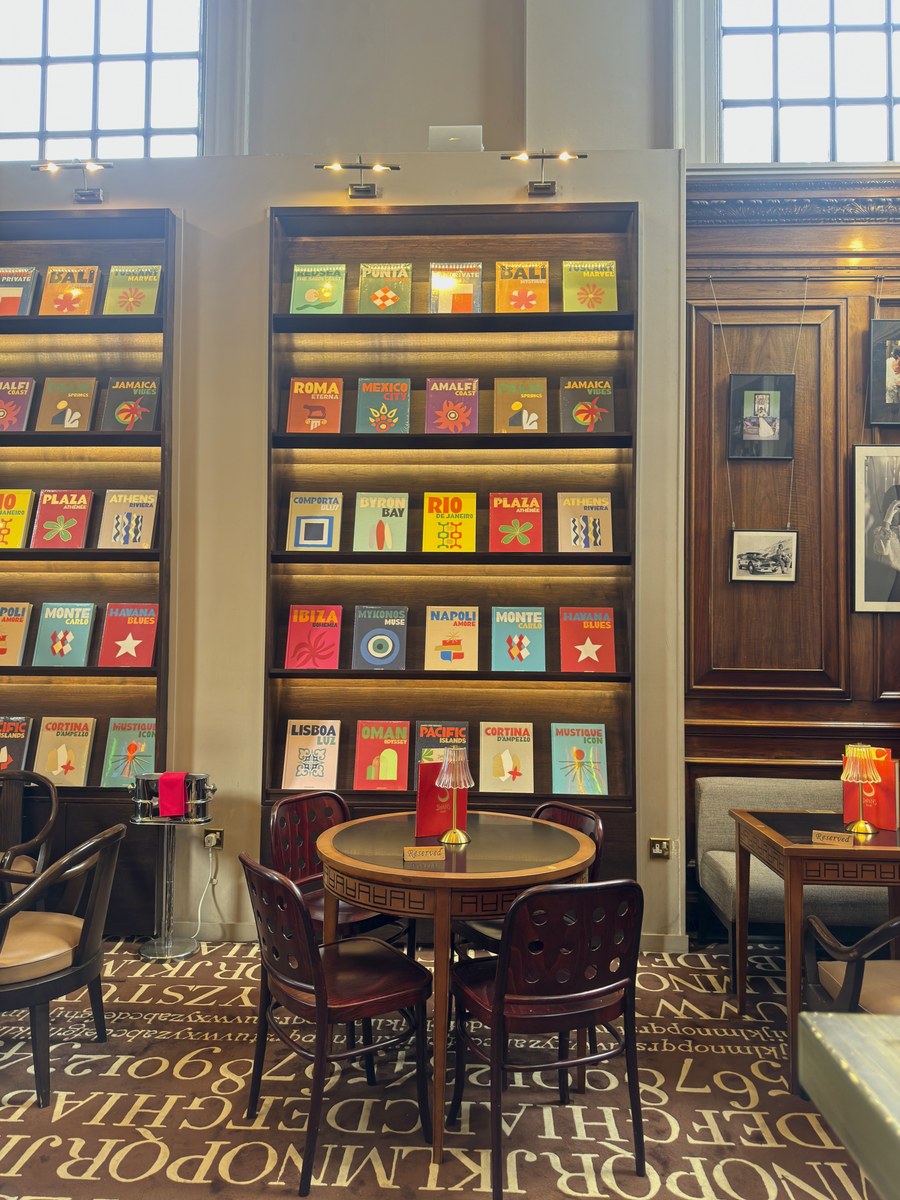
Assouline began, fittingly, with a hotel. In 1994 Prosper and Martine Assouline published their first book from the basement of their Paris apartment: La Colombe d’Or, about their favourite inn in Saint-Paul-de-Vence, with his photographs and her text. The house has since published more than 1,700 titles. Its linen-bound Travel Series turned destinations from St. Barths to Jaipur into a recognisable shelf. LVMH took a minority stake in 2013. Maison Assouline opened on Piccadilly in 2014, with a bar among the books, and the company now designs whole libraries for private houses and hotels.
Luxury houses joined them. Louis Vuitton launched its illustrated Travel Books in 2013, inviting artists to draw a city as a visitor, and returned, in its way, to Roberts and his sketchbooks.
The book in the frame
So the digital future did not kill the printed travel book. It changed what the book was for. Print sales in the United States peaked in 2021 at nearly 840 million copies and have settled since at a level above anything seen before the pandemic. A smaller share of those books is read on a train. More of them are placed.
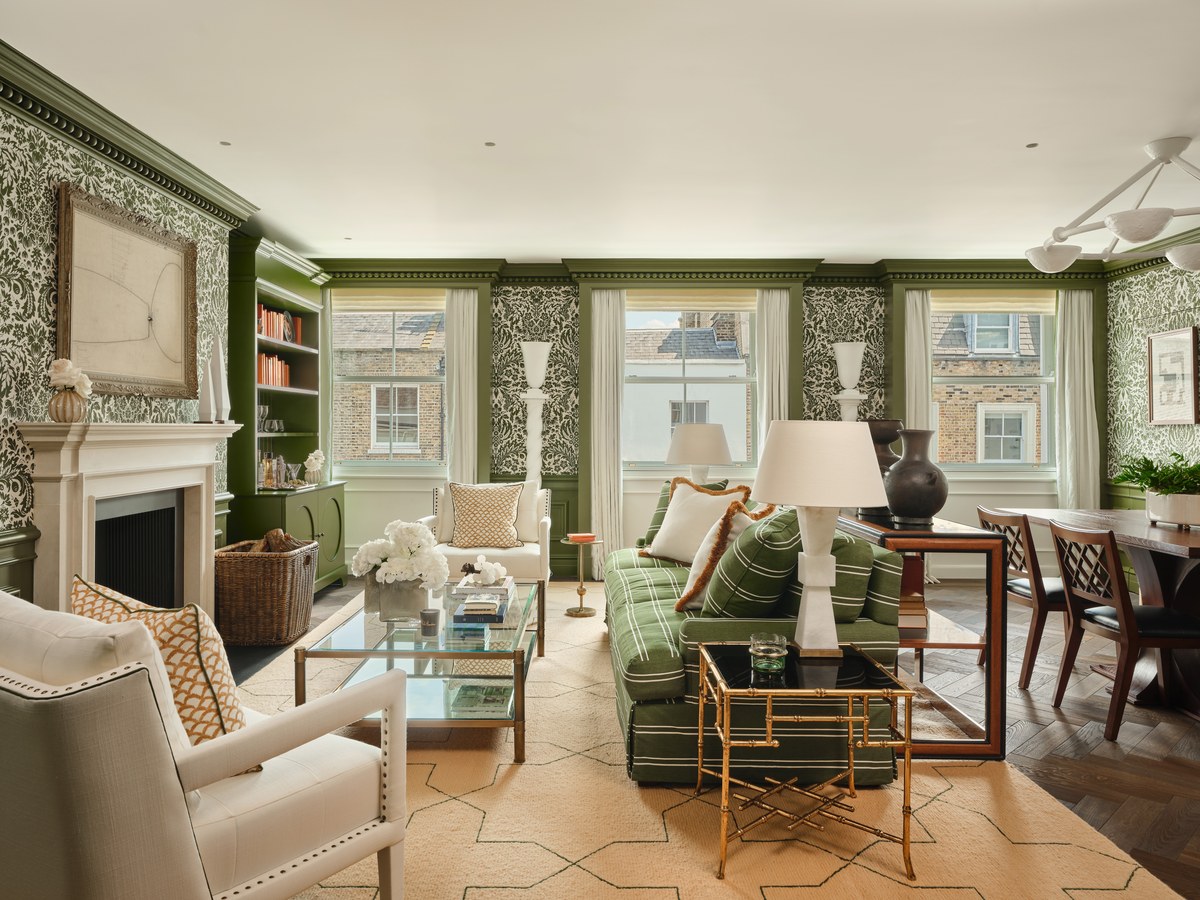
Look at the travel photographs of the past decade and the coffee table book is everywhere: on the ottoman of a hotel suite, beside the breakfast tray, in the corner of a flat lay with a straw hat and a passport. A book on Capri or Marrakech is a quick way to announce where you are, or where you would like to be. Montaigne’s parlour window has become a square on a phone.
It would be easy to be cynical about that, and I am not. The good ones still reward the hand that opens them. A cover can be a prop and an education at once; the object is simply doing what it has always done, from the Duke of Berry’s marvels to Queen Victoria’s Petra. It lets us possess a place we have not yet reached, or keep one we are afraid of forgetting.
That is why each country on blonde.travel now ends with a book of this kind. You can find them across our destinations, most from Assouline, a few from TASCHEN, Rizzoli and other houses. They are there to be picked up. I hope some of them acquire a coffee ring.