

“Jurassic Park”, or an expedition to Komodo
When we had finished exploring Rinca, we set off for the next island of the national park.
Komodo is the largest of all the park’s islands, and the most remote. The captain suggested a few stops along the way to snorkel, at Batu Bolong or Makassar Reef, or to walk on Pink Beach. But we decided to save those for the journey back.
Loh Liang
At Loh Liang, on Komodo, I found the same scene as at Loh Buaya on Rinca: a crowd of dragons lounging grandly near the buildings, some of them even tucked under the steps.


Nobody paid them the slightest attention, and they returned the favour. Yet the moment one giant beast got to its feet and set off at a lazy walk, a ripple of excitement went round.


The first day was drawing to a close, the sun sinking lower and lower, and by the rules all tourist movement on the island stops at sunset.
That would have been the end of our expedition to the dragons, and tomorrow we would have sailed off among the islands, beaches and underwater beauty, had it not been for one wonderful event that changed my mood and my impressions entirely for the better and added the most extraordinary colour to it all. An encounter, to be precise.
As we were about to go down to the boat, I noticed a ranger, a man of great character, exactly as I had probably always imagined rangers to be. Without a second thought I went up to him, hoping at least to get answers to a few of my questions about the Komodo dragons. He asked when we were sailing back to Labuan Bajo and, on hearing that we had one more day, asked: “Are you ready for a walk with adrenaline?”
I almost jumped for joy at the offer. Though why “almost”… Of course we would come back tomorrow, at six in the morning if need be. The joy nearly exploded inside me, and the ranger watched and smiled in surprise. In the end we agreed on eight. And off I went to spend the night on the boat in unbounded delight.
Watching the flying foxes
The flying foxes and a magical sunset became one of the most unforgettable parts of our journey through the Komodo islands.
Back on the boat, we sailed to the island of Kalong and stopped at sea, not far from the shore. Little by little the sky took on the colours of sunset, from orange to pink. It was very quiet. And suddenly hundreds of little dots appeared against the bright horizon and began to come towards us. Bats! It was magical: enormous bats, which people call flying foxes, flew over us in the absolute stillness of the evening, cutting through the air with their great wings. An unforgettable moment. On an evening like that I would take my own Zeiss Terra ED binoculars.
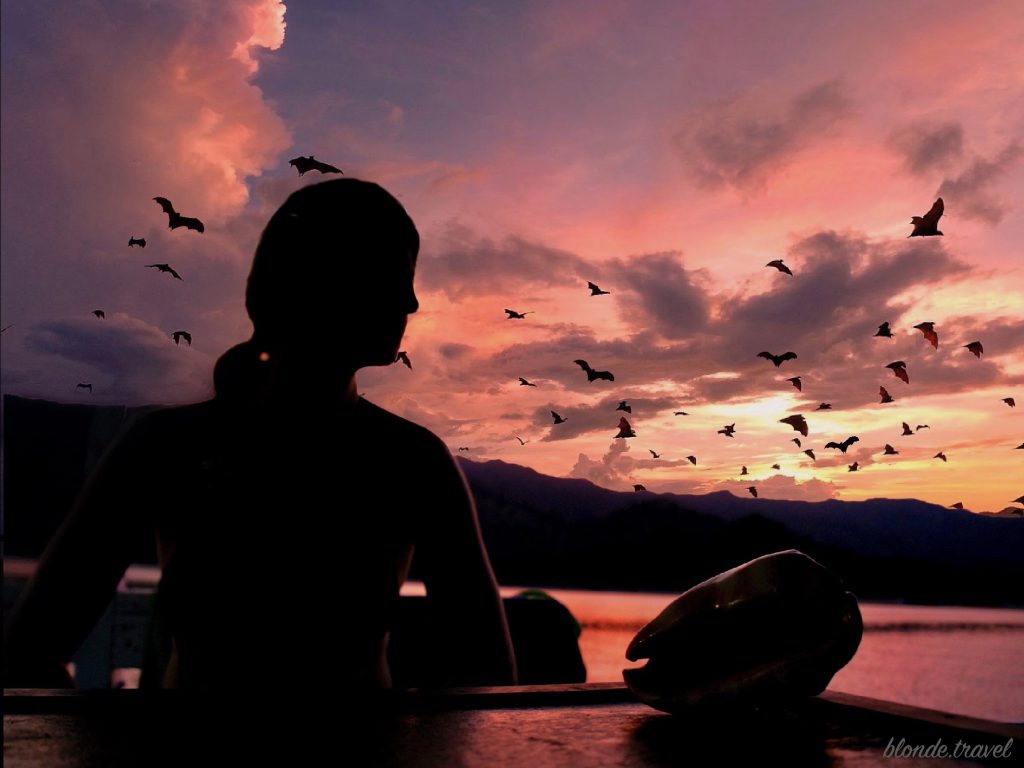
If I were going back today, that evening would be the one I would want again. This three-day sailing trip from Labuan Bajo anchors off Kalong for the flying foxes, walks with a ranger on Komodo and stops at Pink Beach and Manta Point.
It grew dark. The stars came out in their thousands. With no lights for miles around, the sight was unforgettable. We decided to climb out of the cabin and asked to stay on deck, to sleep under the open sky.
The boatswain, mind you, still rigged a roof afterwards and closed in the sides of the boat, for safety, as he explained.
I could only guess why, and think about swimming Komodo dragons, until I drifted off into the arms of Morpheus.

I had wanted to wake at dawn, but the sea rocked me so gently that I woke only when the sun was already up and doing its best to get in through every crack in the awning.

We ate a quick breakfast and set off for the island.
Walking on Komodo
The ranger was already waiting for us on the jetty, and we happily followed him. The gate to the dragons’ kingdom here looks much like the one that greeted us on Rinca.

The system is the same as at our earlier stop on Rinca: several routes, each a different length. But today we had an exclusive trail, from the oldest and most experienced regular on the island.

The ranger impressed me even more than the dragons we had sailed all this way to see. Until then I had only read about people like him in books. His oneness with nature, his way of communing with it, were unreal. He seemed to know every animal on the island personally and could tell one dragon from another. Tell them apart? They most likely spoke some language known only to them; they understood him and did as he said.
How on earth he spotted a tiny lizard on a tree trunk in the thick undergrowth, and how the next instant it was already in his hand, I cannot imagine. I could only marvel.
A little flying dragon, one of the gliding lizards of these islands:

The ranger told us a great deal, and all of it fascinating.
- The largest Komodo dragon ever recorded by researchers weighed 166 kilograms, counting food not yet digested (a dragon can eat up to 80 per cent of its own weight), and measured 3 metres 13 centimetres.
- Komodo dragons are good swimmers and can cross from island to island, but only over short distances. That is why their range is so small.
- A dragon can run at up to 30 kilometres an hour.
Needless to say, today luck was on our side. In a two-hour walk I even lost count of the dragons we met.

It seems to be asleep. But a drowsy dragon is in no way a safe one. Above all, you must understand that this is no open-air zoo.

This Komodo dragon was full and content, having eaten a couple of days before. Still, being behind it, on the opposite side from the ranger, was a little frightening. No, I’m lying: a little doesn’t come into it. When it raised its head, turned it ninety degrees in my direction and rose on its legs, my whole life flashed before my eyes. I had always wondered why the heroes of horror films, on seeing some monster, never run away, but stand and stare at it, or scream at the top of their lungs on top of that. Today I understood. My legs seemed to have grown into the ground and would not move. A couple of seconds later I came to my senses, and the very next instant I was behind the back of our commander-in-chief.
The Komodo dragon’s bite
The many stories about how dangerous a Komodo dragon’s bite can be are no tall tales for tourists. The dragon’s mouth holds so many bacteria that once they reach the blood, infection spreads at catastrophic speed and paralyses the internal organs. On top of that, its venom stops the bleeding from clotting.

Komodo dragons can attack prey larger than themselves: goats, wild horses, buffalo, deer, and other dragons.

They hunt by lying in wait until the prey comes close. Then they attack, trying to knock it off its feet and tear a wound into which the venom and the bacteria pour.
Once it has bitten its prey, the dragon has nothing more to do but watch calmly from the side as the wound festers, the blood is poisoned, and the animal weakens and dies. After that the meal is no trouble at all. A dragon can eat 80 per cent of its own weight at one sitting.


Komodo dragons have a keen sense of smell. In the villages there have been cases of dragons digging up the buried dead. Nor are they squeamish about their own kind. Cannibalism among Komodo dragons is fairly common, especially in hungry times, and it is usually the young and the sick who suffer.

When it needs to, say to reach food in a tree, a dragon can stand upright on its hind legs, using its tail as a prop.
That must be quite a sight. As a rule, this is how they fight, and of course they fight to establish who is in charge, both over food and over the fairer half of the population.
There are four villages on the islands of the reserve, one of them on Komodo and two on Rinca. Very rarely, but it does happen, a dragon wanders into a village and attacks a person.


Komodo’s scenery is enchanting. As far as the eye can see, hills roll away with a few palm trees scattered over them, and on the horizon shines a bright emerald strip of calm sea. True, the withered grass and wild scrub make the landscape look almost like a desert.

Which is better, Rinca or Komodo?
Many travellers who can visit only one island face this question; either can be done in a single day from Labuan Bajo, without spending the night.
Personally, I liked Komodo more. Perhaps that was thanks to our superb guide. Had we found a ranger like him on Rinca, our walk there would have been far more memorable and interesting.
On the main criterion, the number and quality of Komodo dragons seen, Komodo wins.
By the counts of the time, Rinca had more dragons than Komodo; the latest counts give Komodo the larger share. In its nature and the variety of its landscape, Komodo is the more interesting. As for large wild animals, on Rinca we met a buffalo, and on Komodo a deer.
Pink Beach, snorkelling and diving
Komodo National Park is not only about the dragons. They are, without doubt, its most vivid part, but the park holds a great many other natural wonders. One of them is Pink Beach, not far from Loh Liang on Komodo.
Pink beaches are rare on our planet, and one of them lies right off the coast of Komodo.
The unbelievable, even surreal colour comes from fragments of red coral that the waves throw ashore and mix with the sand.
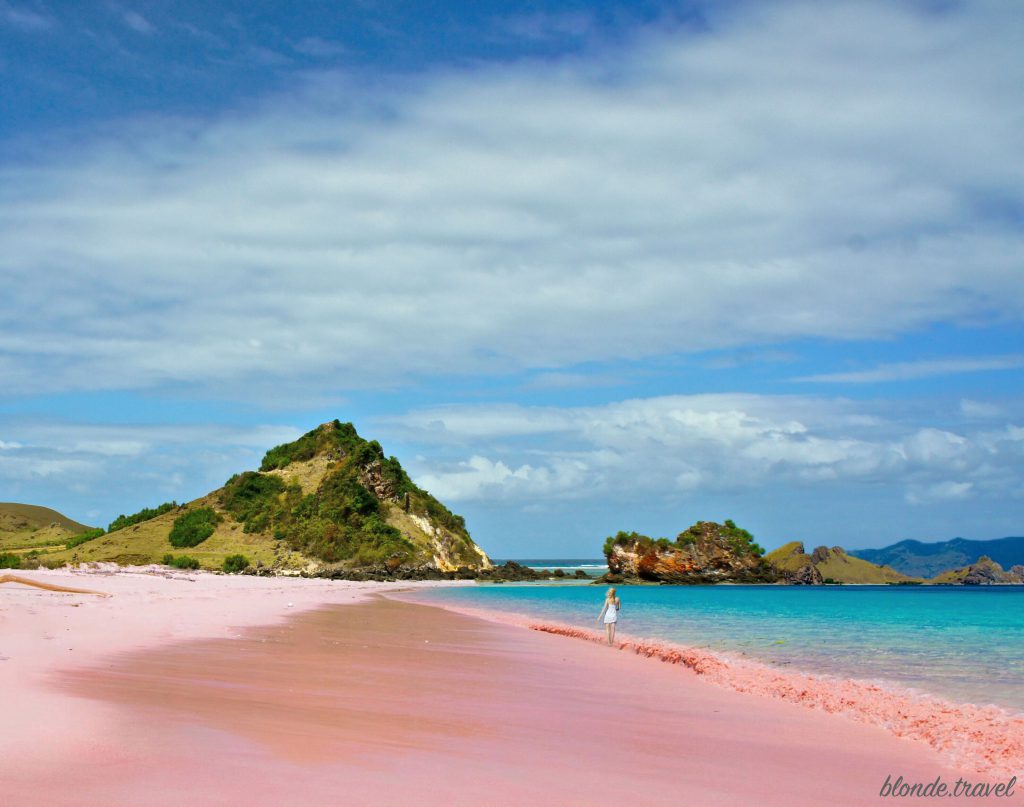
There is another explanation, though: that the pink comes from microscopic animals living in the sand. It is the truer of the two. The colour belongs to foraminifera, tiny single-celled creatures with red shells, whose remains mix with the pale coral sand.
Either way, the beach is very beautiful and not crowded. It is a wonderful place to sunbathe and enjoy the peace and quiet of nature. And if your soul still longs for adventure, you can swim underwater here, dive or snorkel.
The underwater world of Komodo National Park is magnificent.
It is not for nothing that it draws divers from all over the world.
You can swim with manta rays (at the Manta Alley site), see turtles and even reef sharks. You can snorkel for hours, watching the reef fish and the lovely corals.
I could not believe that such a rich underwater world lay so close to the shore.
The journey from Komodo back to Labuan Bajo, with a few stops to swim, took six hours. By five in the afternoon the familiar hills of Labuan Bajo’s bay rose on the horizon.
