
Every November, as soon as the wooden chalets go up across Luxembourg City, the same argument resumes online. Travelers debate Strasbourg versus Colmar, book Vienna months ahead, or queue for tickets into Germany’s most photographed squares, while almost nobody puts Luxembourg on the itinerary. Why does the Grand Duchy keep missing it?
I live here, and I make the rounds of these stalls and squares every year. They opened for the 2026 season on 20 November. Watching the squares light up again sharpened an opinion I’ve held for years now. Luxembourg is the most underrated Christmas market destination in Europe.
Consider the ingredients. The Grand Duchy has deep Catholic foundations, and its holiday season belongs first to local religious and civic life. Saint Nicholas, known locally as Kleeschen, still arrives on 6 December with his own parades and treats, so December retains a rhythm that residents would keep with or without visitors. Luxembourg is also one of the wealthiest countries in the world, and you can detect that in the execution. The wooden chalets look well kept, the illuminations are tasteful rather than chaotic, the streets are spotless, and the city seems genuinely safe even late on a Friday evening. Yet because travelers chase trendier names, you get all that with room to breathe, hold your mug without spilling it on a stranger’s coat, and look around.
One honest caveat concerns snow. I’ll return to it in the weather section, because it explains why I stop short of calling Luxembourg Europe’s #1. Even so, once you smell wood-roasted salmon and Portuguese chestnuts drifting across a cliff-edge square overlooking a lit stone viaduct, it’s difficult to understand why everyone drives on by.
Winterlights 2026 Dates and Hours
Luxembourg City’s Christmas season runs under the name Winterlights, from 20 November 2026 to 3 January 2027. Unlike the German and Alsatian markets that pack up on Christmas Eve, the capital stays open through New Year’s weekend. That long season also makes it an easy post-Christmas escape, when many better-known destinations have already cleared away their stalls.
The timetable repays a little attention, and I’d check the date before setting out. All six market sites are closed on 25 December. On 24 and 31 December, stalls open from 11 a.m. to 6 p.m. On ordinary days, Sunday through Thursday trading begins at 11 a.m. and ends at 9 p.m. Friday and Saturday trading begins at 11 a.m., with stalls closing at 10 p.m. Food and drink chalets often pour for an additional hour, until 10 p.m. on weekdays and 11 p.m. on weekends.
The small Sapin Royal site at Place Émile Hamilius opens at noon Sunday to Thursday. It continues welcoming visitors for one extra day, until 4 January 2027. The municipality keeps its street illuminations switched on until 10 January 2027. Yes, entry to every square is free!
When should you come? For the strongest local atmosphere, choose late November or the opening days of December. The Kleeschen procession on 29 November and Saint Nicholas Day on 6 December bring the city’s seasonal rhythm into sharpest relief. If you’re traveling with children during the school holidays, the free Winterkids Village workshops run from 19 December to 3 January.
Luxembourg Christmas markets at a glance, 2026–2027
All six Luxembourg City Winterlights venues run from 20 November 2026 to 3 January 2027 (Sapin Royal through 4 January), closed only on 25 December. Town and village markets outside the capital keep shorter Advent windows—all reachable on free trains and buses.
Luxembourg City (20 Nov–3 Jan)
| Market venue | Dates & hours | Highlight | Free tram / bus stop |
|---|---|---|---|
| Place d’Armes (Lëtzebuerger Chrëschtmaart) | 20 Nov–3 Jan; 11am–9pm (Fri–Sat 10pm) | Historic market since 1984, 15 m fir, nativity scene, covered tables | Hamilius (tram T1) or F.D. Roosevelt |
| Place de la Constitution (Wantermaart) | 20 Nov–3 Jan; 11am–9pm (Fri–Sat 10pm) | 32 m Ferris wheel, Gëlle Fra views, giant pyramid, valley terrace | Hamilius (tram T1) or F.D. Roosevelt |
| Place Guillaume II (Winterkids) | 20 Nov–3 Jan; workshops 19 Dec–3 Jan (11am–6pm) | Adventskalennerhaus (daily windows 1–24 Dec), giant slide, kids’ village | Hamilius (tram T1) or F.D. Roosevelt |
| Place Émile Hamilius (Sapin Royal) | 20 Nov–4 Jan; 12pm–9pm (Fri–Sat 11am–10pm) | Six chalets beneath a 10 m tree with a circling miniature train | Hamilius (tram T1) |
| Kinnekswiss (Wanterpark) | 20 Nov–3 Jan; 11am–9pm (Fri–Sat 10pm) | Open-air ice rink, 12 m glowing heart, five gourmet chalets, evening DJs | Theater or Faïencerie (tram T1) |
| Place de Paris (Niklosmaart) | 20 Nov–3 Jan; 11am–9pm (Fri–Sat 10pm) | 22 m Niklosbam tree, vintage swing carousel, 80+ concerts, Kleeschen cottage | Paräisser Plaz (tram T1) |
Towns & villages (free train/bus)
| Town or village | 2026 dates | Highlight & free route from Gare Centrale |
|---|---|---|
| Differdange | 27 Nov–20 Dec | Luxembourg’s oldest Christmas market (30+ chalets, open-air ice rink) · direct train (~35 min) |
| Esch-sur-Alzette | 13 Nov–23 Dec | Place de l’Hôtel de Ville (~20 chalets, street canopy, mini-train) · direct train (~25 min) |
| Dudelange | 28 Nov–20 Dec (medieval 11–20 Dec) | Winter market plus traditional and campfire medieval zones · train via Bettembourg (~25–30 min) |
| Echternach | 11–13 Dec | Single festive weekend (~40 chalets) in Luxembourg’s oldest abbey town · direct bus (~45–55 min) |
| Clervaux | 13 Dec (main market, 11am–6pm) | Ardennes castle valley, crafts, municipal band, Advent weekends · direct northern train (~60 min) |
| Vianden | 28 Nov (2pm–7pm) | Cozy single-afternoon village market below the castle · train to Ettelbruck + bus (~65–75 min) |
Six Squares, One Walkable Capital
Rather than cramming every stall into one congested plaza, Luxembourg City spreads its Christmas markets across six distinct squares and parks. Five lie within a compact ten-minute radius in the upper old town (Ville Haute) and the municipal park. The sixth waits across the Pont Adolphe in the Gare district, where you can reach it by a scenic thirteen-minute walk or two quick stops on the free tram.
Can you cover all six in a single afternoon and evening? You can, although the circuit becomes more pleasurable if you leave time to eat rather than treating every square as a checkbox. I’d give them two nights. Begin in late afternoon, while the valley views are still visible, and return after dark, when the lights change the character of the streets.
Place d’Armes: Lëtzebuerger Chrëschtmaart
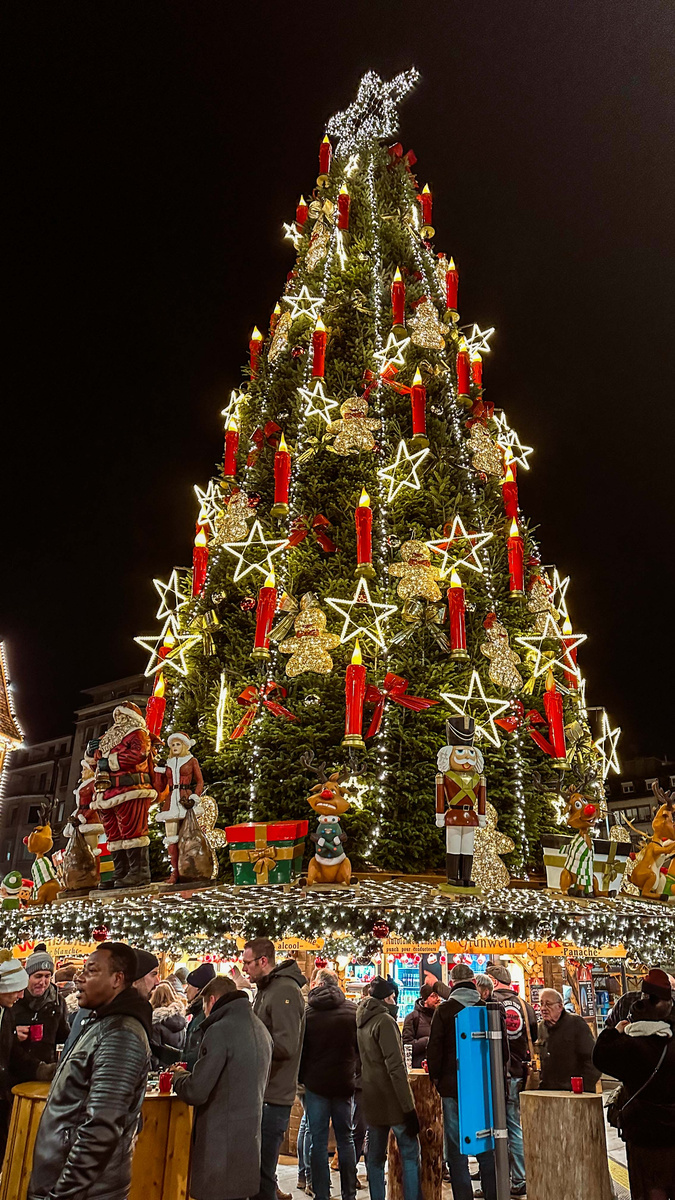
Place d’Armes has welcomed Luxembourg’s historic Christmas market since 1984, and it still feels like the city’s living room in December. Café terraces and the nineteenth-century Cercle Cité enclose the square. At its center, wooden chalets surround a 15-meter Nordmann fir dressed in red baubles and tall red candles, with a large nativity scene set inside the bandstand.
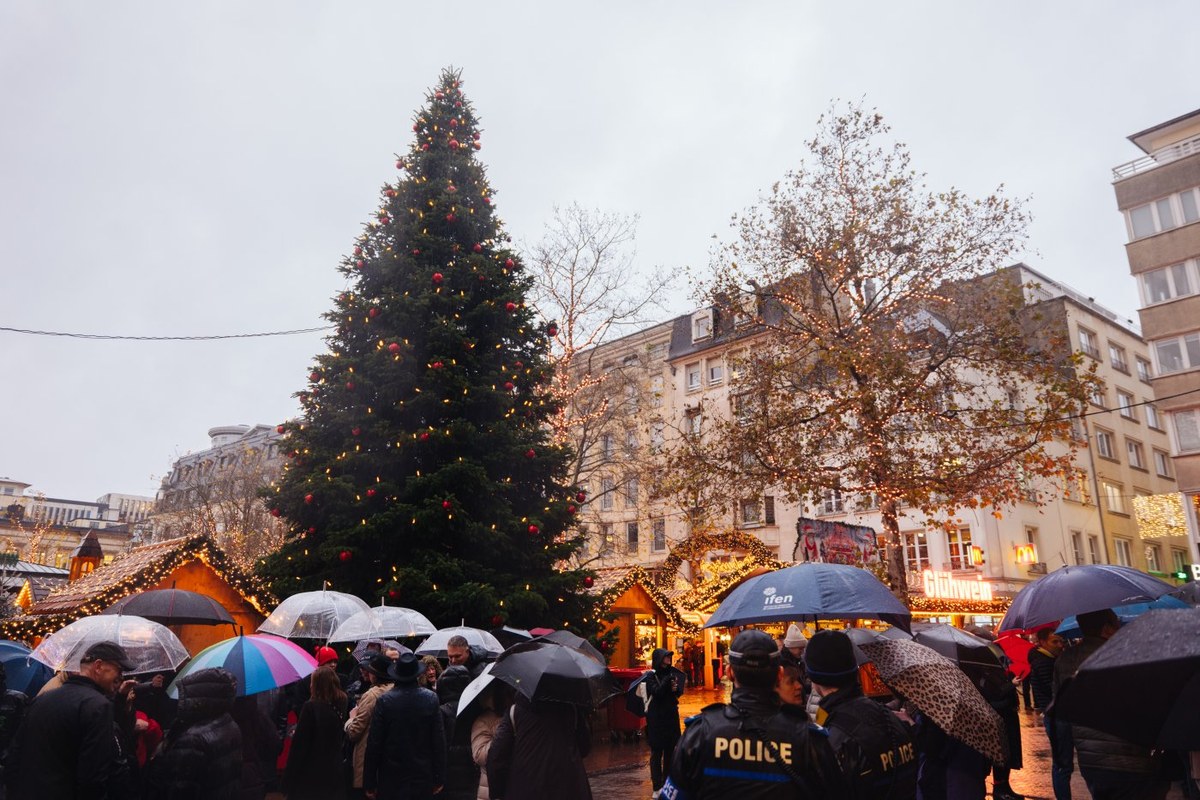
Where should you begin? My own starting point is usually here. Place d’Armes feels enclosed and convivial, while the wider panorama belongs to Place de la Constitution, a few streets away. You can stand at one of the covered wooden tables with a first cup of mulled wine, warm up, and listen to a local brass ensemble before moving on.
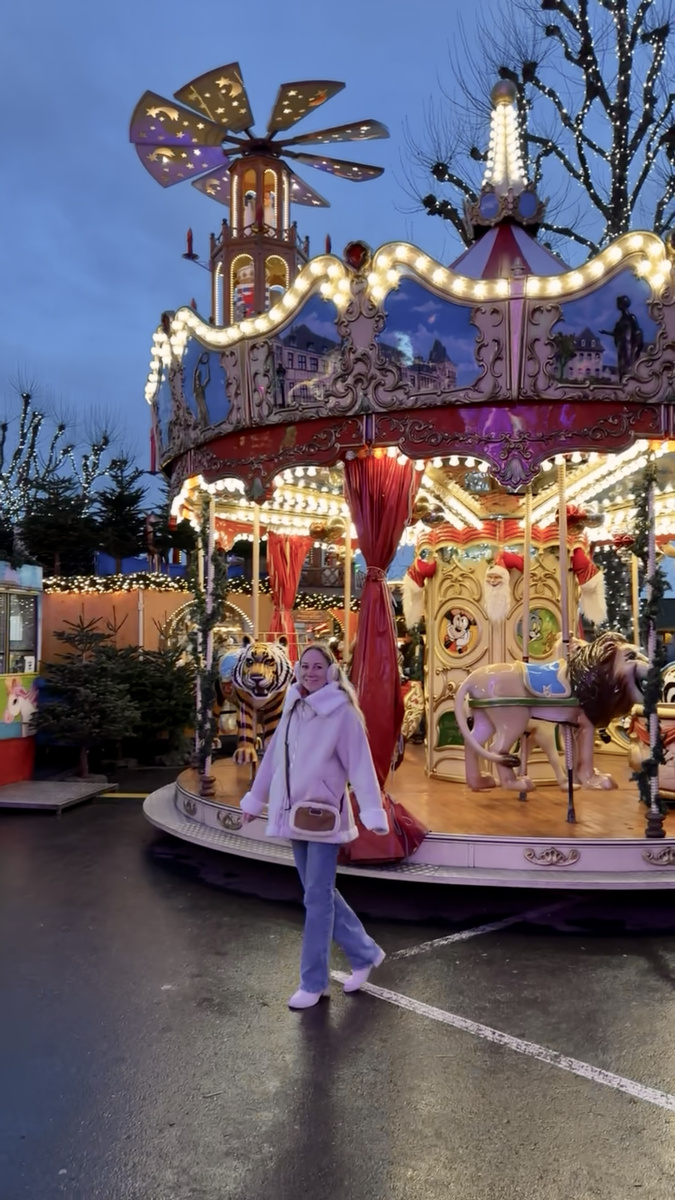
Children drift toward the Chahut des 4 éléments carousel and the Wanterzuch miniature train. The food chalets lean heavily into winter comfort, and a Swiss rösti chalet joins the lineup for 2026.
Place de la Constitution: Wantermaart
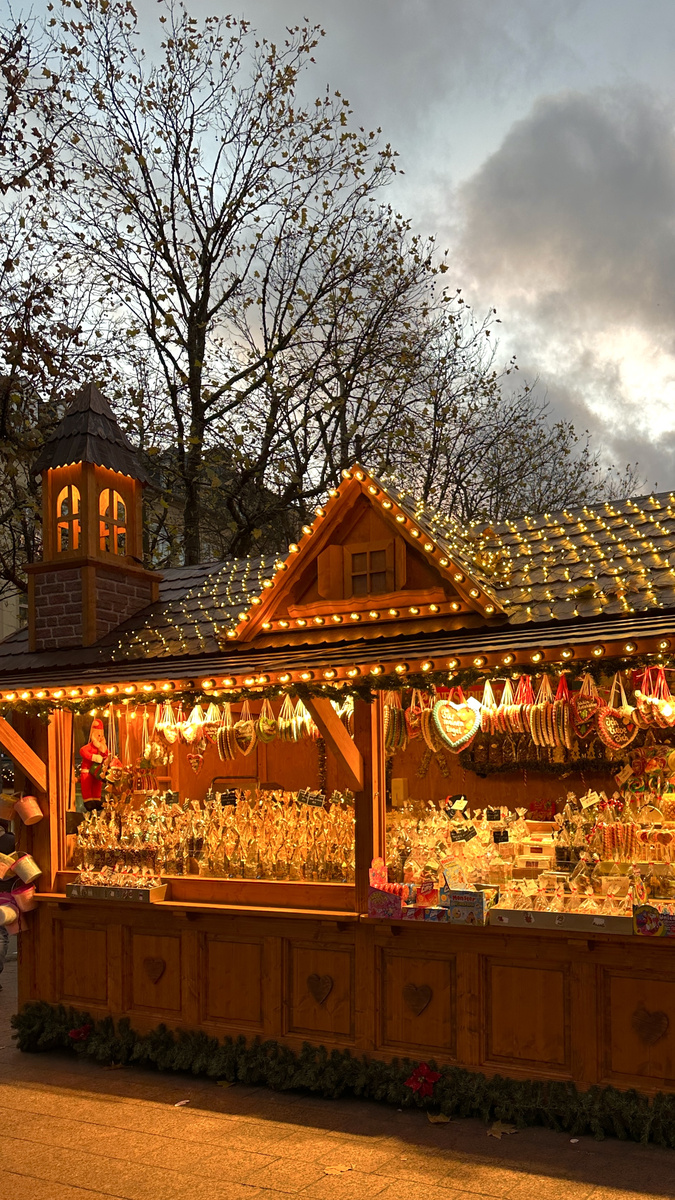
Walk three minutes south from Place d’Armes, and the narrow old-town streets open onto a sheer drop over the Pétrusse Valley. This is Wantermaart, set around the golden Gëlle Fra obelisk. It’s the most dramatic market setting in the city, and it’s my personal favorite—for the food variety, the real wood fire pits, and those valley views. If you only have the time or energy for one square, make it this one.
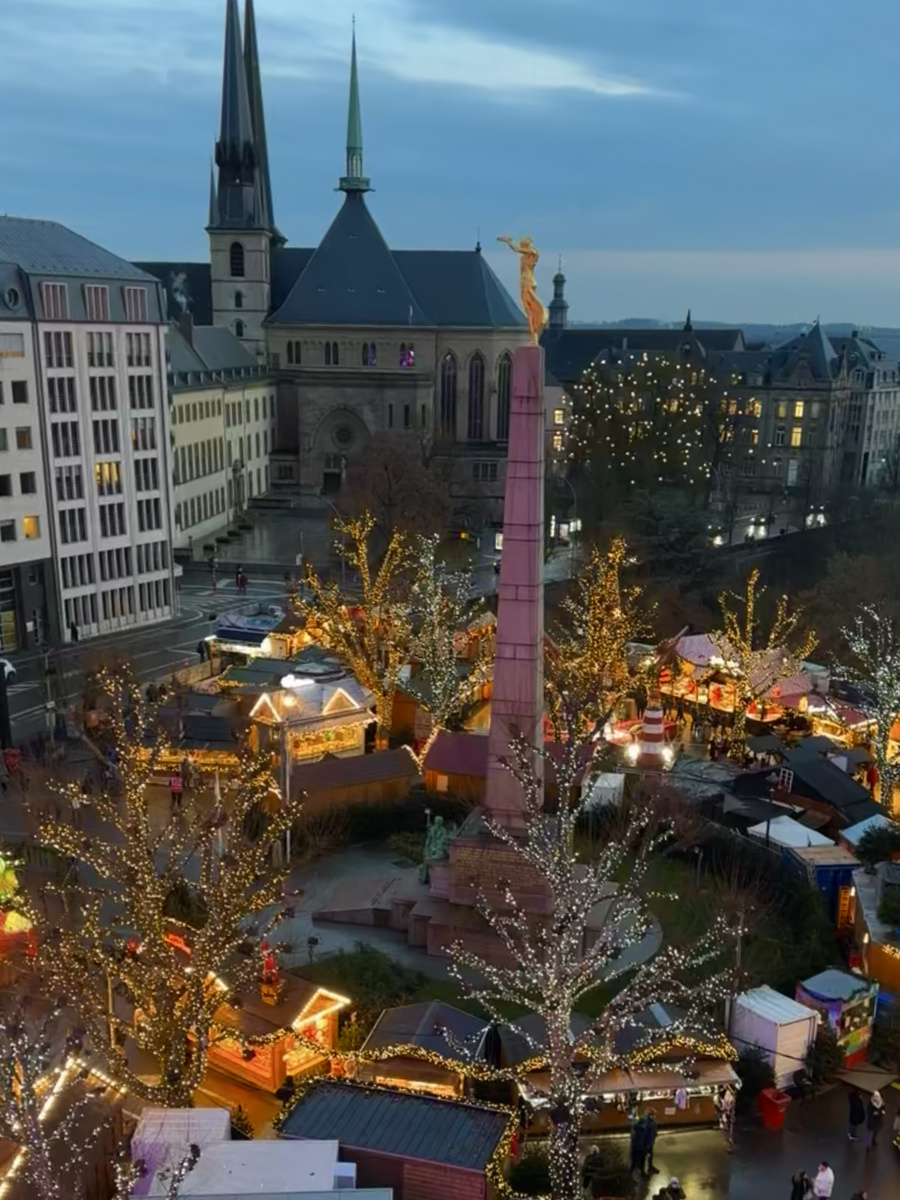
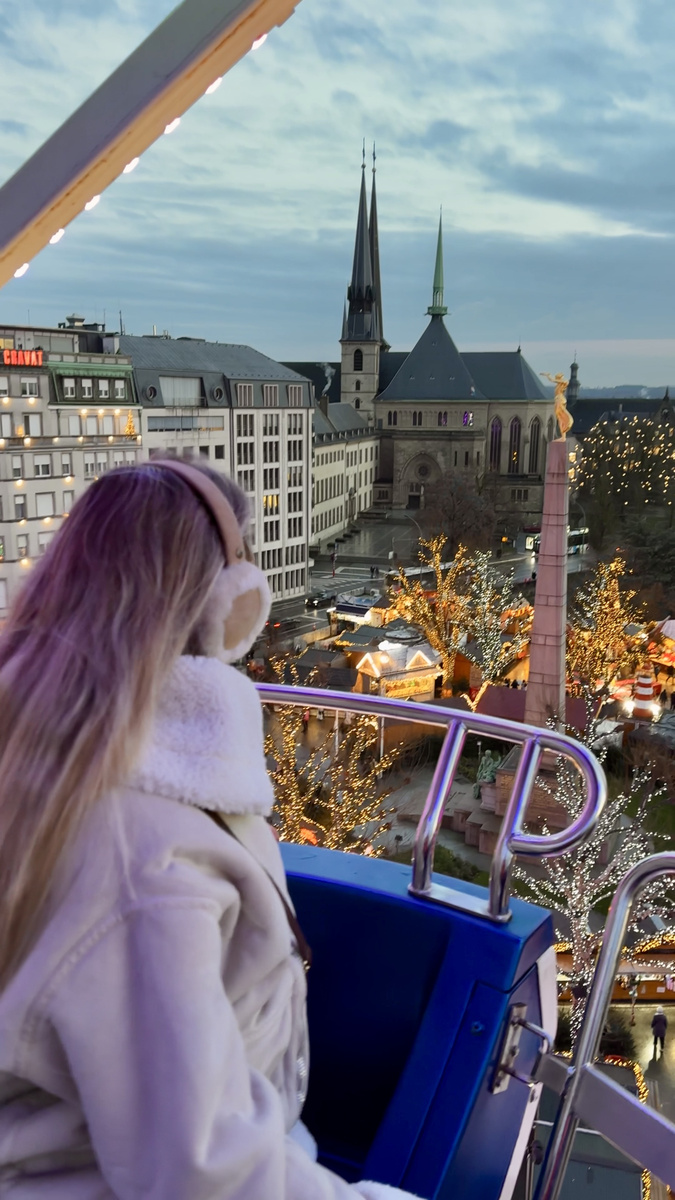
Its centerpiece is the 32-meter Ferris wheel. Is it worthwhile if fairground rides usually leave you cold? Yes, provided you ride at blue hour. Do take one turn! From the top, you look straight down onto the glowing wooden roofs and the golden monument. Notre-Dame Cathedral’s slender spires rise behind them, while the sweeping stone arches of Pont Adolphe cross the gorge.
That cliff-edge square from the opening is this one, which gives you a useful way to time the visit. Arrive while there’s still enough light to read the valley, ride as the roofs begin to glow, and then warm your fingers beside the wood fires below.
The square also holds the 13-meter Sapin Doré, the multi-tiered Luxemburger Pyramide, three children’s rides, and a panoramic dining terrace facing the valley.
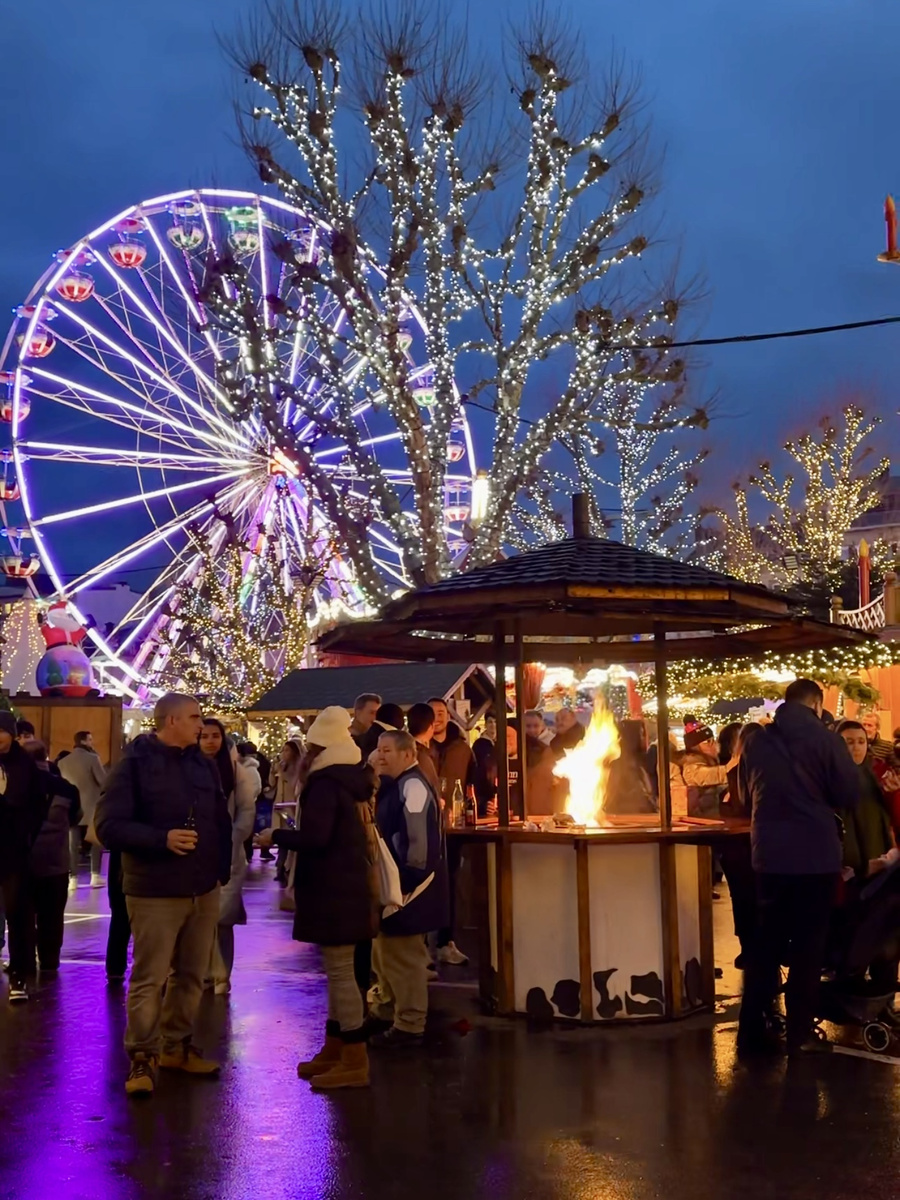
Local producers lead the drinks list. You’ll find Lëtzebuerger Glühwäin in red, white, and rosé, together with craft mulled wines and alcohol-free pours. New food cabins for 2026 serve baqlette and Belgian fries. On a cold night, the open wood-fire pavilions near the Ferris wheel become natural gathering points, where you can set down your cup and thaw your fingers.
Place Guillaume II: Winterkids and the Giant Advent Calendar
Two minutes east of Place d’Armes sits Place Guillaume II, which locals call the Knuedler, facing the neoclassical City Hall. In recent winters, the city has turned this square into Winterkids, a dedicated family space anchored by the Adventskalennerhaus. This full-scale chalet has illuminated windows arranged as an Advent calendar.
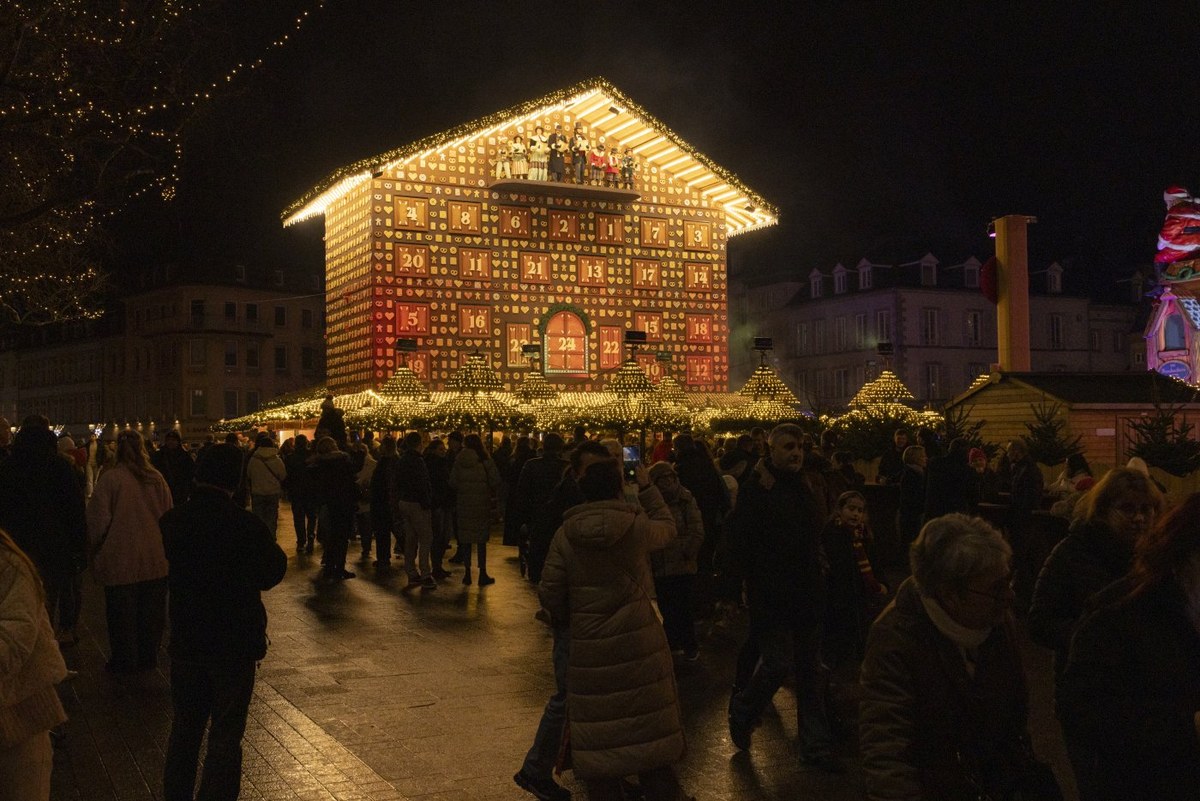
From 1 to 24 December, a new window opens each day to reveal another chapter of a winter story told in Luxembourgish, French, and German. Weekday openings take place at noon, 6 p.m., and 8 p.m. On weekends and during school breaks, additional afternoon openings take place at 2 p.m. and 4 p.m. From 26 December onward, all twenty-four windows remain on view.
What if you’re traveling with children? Around the house, they’ll find trampolines, a flying reindeer sleigh ride, and the Winter Rutsch mat slide. Once school holidays begin on 19 December, the adjacent Winterkids Village adds more than 280 free drop-in workshops. Beeswax candles, baking, crafts, and puppet shows fill a daily program that runs from 11 a.m. to 6 p.m. until 3 January.
Place Émile Hamilius: Sapin Royal
Four minutes west of Place d’Armes, beside the central Hamilius tram stop, Sapin Royal is the smallest of the six stops. Its six tidy chalets cluster around a decorated tree more than ten meters tall. A miniature Christmas train circles the upper branches.
Would I cross town for it alone? I wouldn’t. It works well as a quick mug-refill pause on your route between Place d’Armes and the park. It can also serve as a final stop on 4 January, once the other squares have closed.
Kinnekswiss: Wanterpark Ice Rink
Continue north from Place Émile Hamilius for about eight or nine minutes, and the stone streets yield to the trees of the municipal park. At Kinnekswiss, the city installs Wanterpark, an open-air ice skating rink beneath a clear canopy. Five gourmet chalets frame it, and you reach it past a twelve-meter-wide illuminated heart at Avenue Amélie.
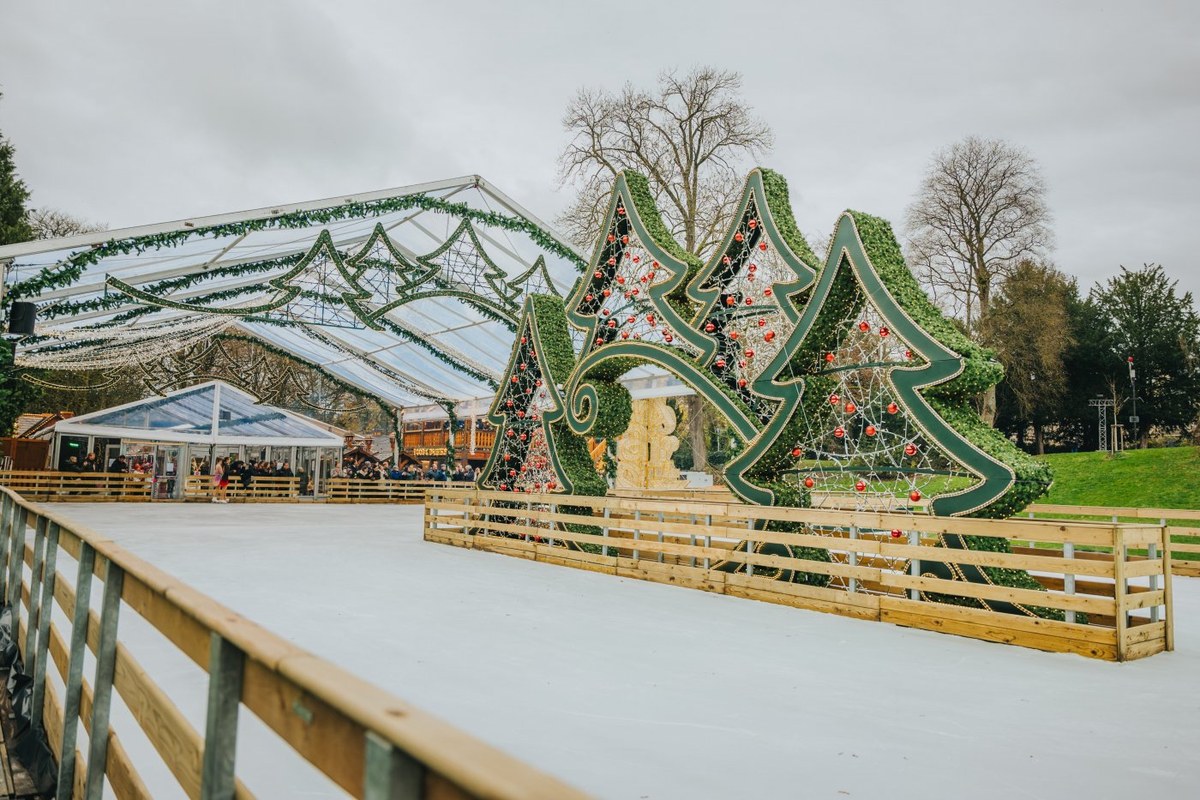
Do you need to skate to enjoy it? No, although the rink carries a livelier, younger mood than the historic squares after 6 p.m., when more than thirty DJ sets take turns across the season from Tuesday through Sunday evening. Even if you never lace up, the walk through the lit park gives your evening a welcome change of tempo. Glowing woodland animal sculptures watch from the lawn, which makes the stroll an attraction in its own right.
Place de Paris: Niklosmaart
To reach the sixth market, walk south from Place de la Constitution across the Pont Adolphe, about thirteen minutes on foot, or ride two stops on the free T1 tram to Paräisser Plaz. Niklosmaart sits in the Gare neighborhood, seven minutes from Luxembourg Central Station. It feels noticeably more neighborhood-driven than the upper town.
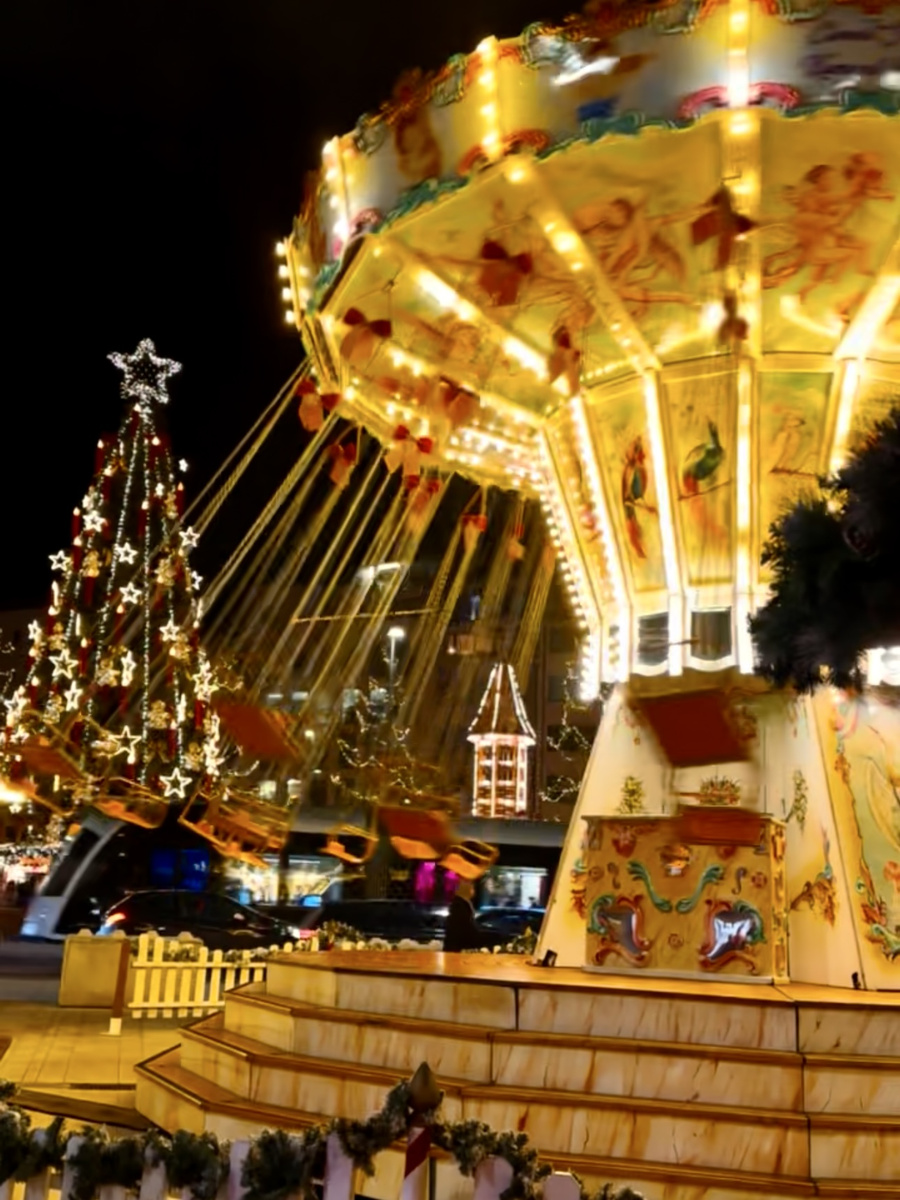
The square centers on the Niklosbam, a 22-meter Christmas tree assembled from 350 firs, 51 giant candles, and 285,000 LEDs. A vintage swing carousel accompanies it and looks especially good spinning against the darkness. More than eighty live concerts run across the season here.
On select late-November afternoons, specifically 21, 22, 24, 26, and 28 November from 3 p.m. to 5 p.m., children can visit Dem Kleesche säin Haus, Saint Nicholas’s fireside cottage. The food chalets mix Luxembourg classics with broadly familiar fare, adding corn dogs and quenelles in 2026.
The Streets Between the Squares
Half the pleasure of Winterlights happens while you walk from one square to the next. More than a million LEDs hang above Ville Haute. Along Grand-Rue, Rue Philippe II, and Rue de la Boucherie, overhanging canopies and starlit arches turn ordinary pedestrian lanes into warm corridors of light.
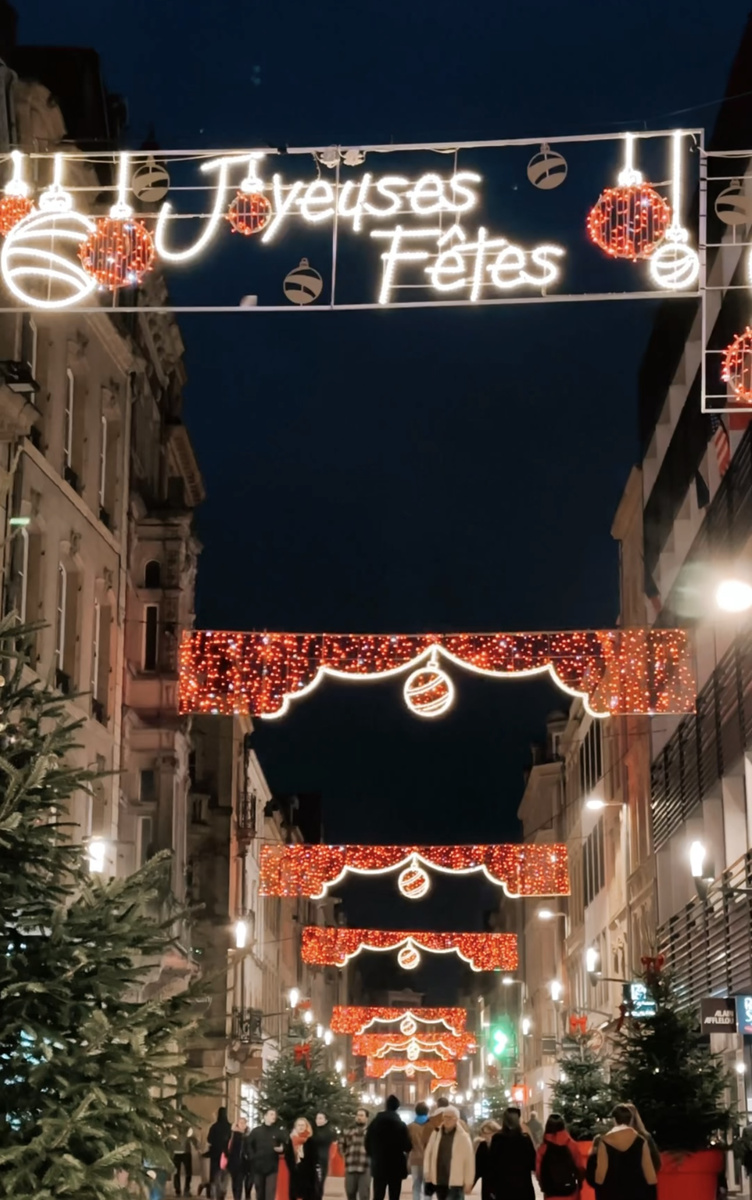
If your legs still have energy after dark, you have two worthwhile detours. The first leads three minutes east from Place Guillaume II to the Chemin de la Corniche, a promenade cut along the cliff above the Grund valley. The second takes you down through a lit canyon installation on the complimentary glass Pfaffenthal Panoramic Elevator. Neither adds a ticket to your evening.
The Ferris wheel has already given you the map; these detours give you the scale. That matters because Luxembourg’s two-level topography can seem like a scenic backdrop until you descend into it and discover how completely it shapes the city.
What to Eat: Europe’s Most International Christmas Market Table
If there’s one reason I keep going back to these markets week after week, even as a resident who has already seen every tree twice, it’s the food. Nearly 70% of Luxembourg City’s residents are foreign nationals representing about 160 nationalities. A substantial Portuguese community lives alongside French, Italian, Belgian, German, and Central European neighbors. On a December evening, you can taste that demographics sheet directly from the stalls. I’ve never seen a wider spread of culinary origins gathered into one European Christmas market circuit. What a table that mix sets!
Those Portuguese chestnuts in the opening now have a demographic explanation. They’re also a reason to look beyond the usual Germanic market menu, because Luxembourg’s most telling dishes often come from the communities that actually live here.
What should you eat first? Start with the Grand Duchy’s own staples, which you’ll smell before you reach the first square.
- Gromperekichelcher. Finely grated raw potato fritters are seasoned with onion and parsley, fried crisp in sizzling oil, and handed over piping hot in a paper cone, often with applesauce.
- Mettwurst and Grillwurscht. Smoky Luxembourg sausages blister over glowing embers on hanging charcoal Schwenkgrills, before being tucked into crusty rolls with mustard.
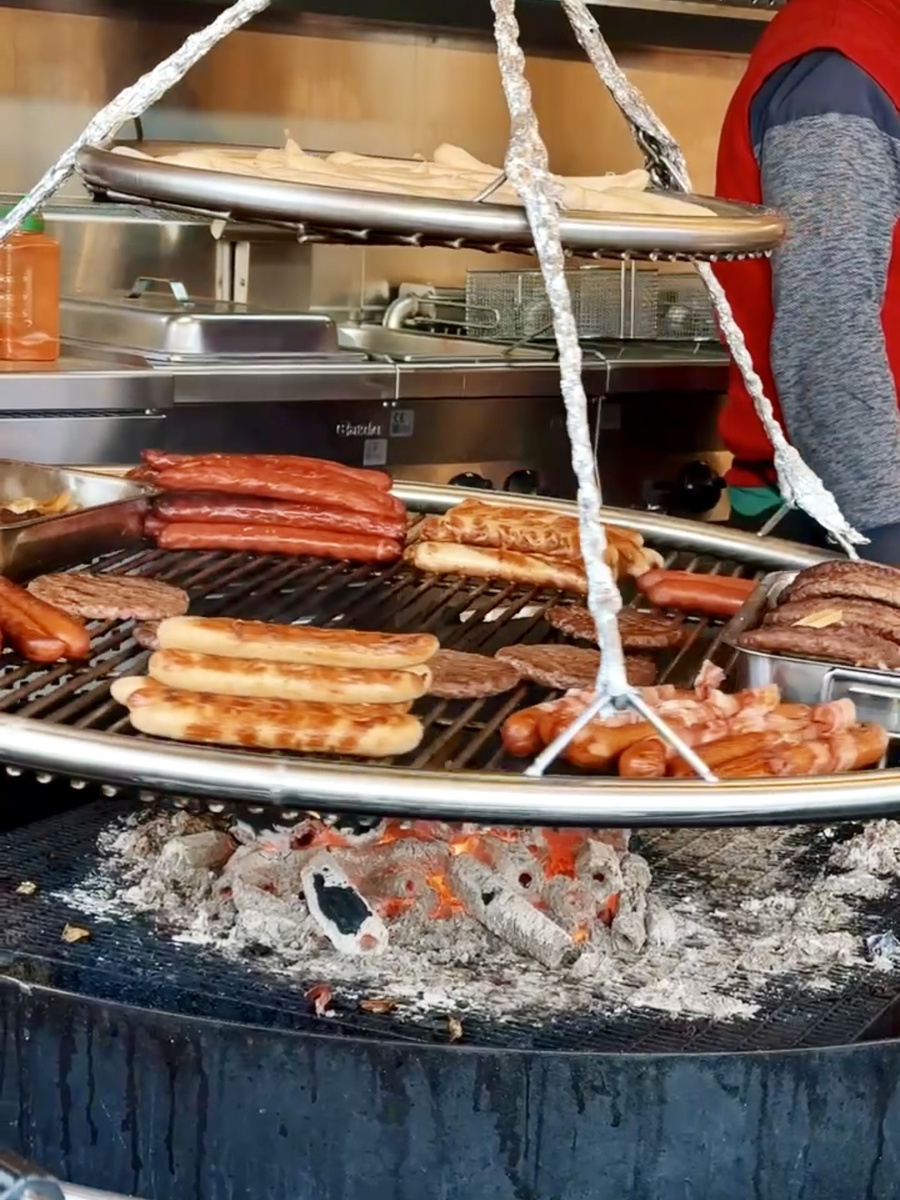
Once you’ve ticked off the Grand Duchy’s comfort food, the rest of Europe opens up stall by stall.
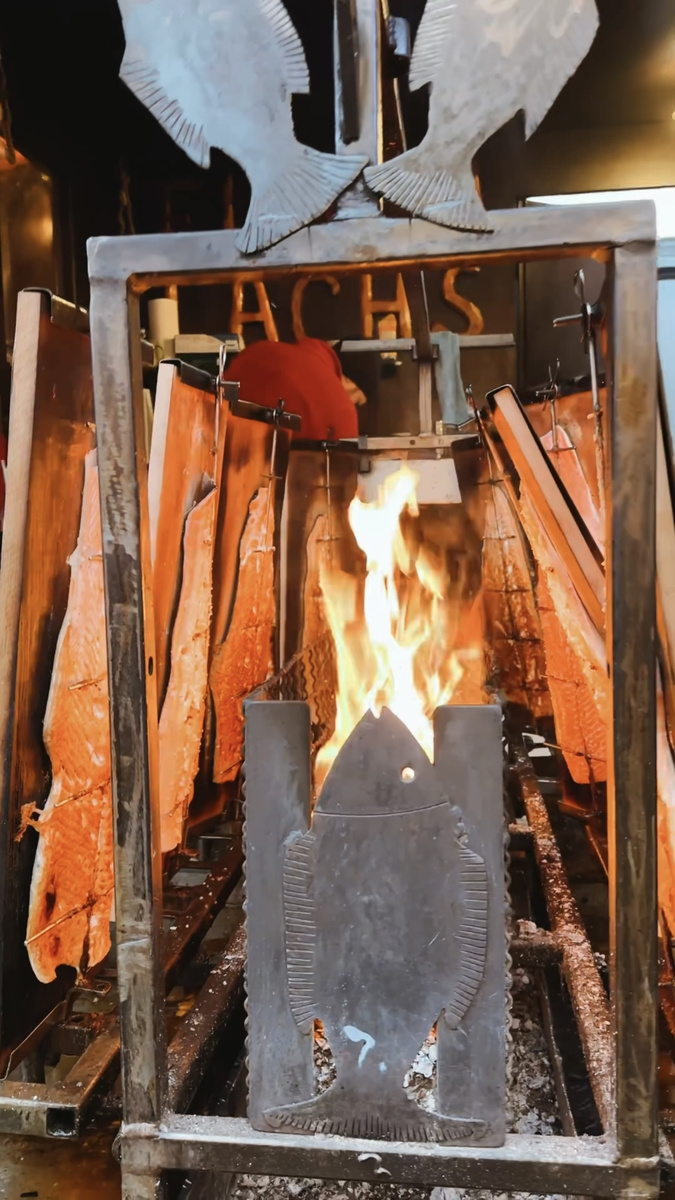
- Flammlachs. Whole sides of salmon are pegged to wooden boards beside open birch-wood flames. They roast slowly in a vertical position until the edges caramelize and the center stays tender. At Wantermaart, this often draws the longest queue, and it merits the wait.
- Portuguese roasted chestnuts and grilled sardines. These form a distinct Luxembourg signature that you almost never encounter at German or Alsatian markets.
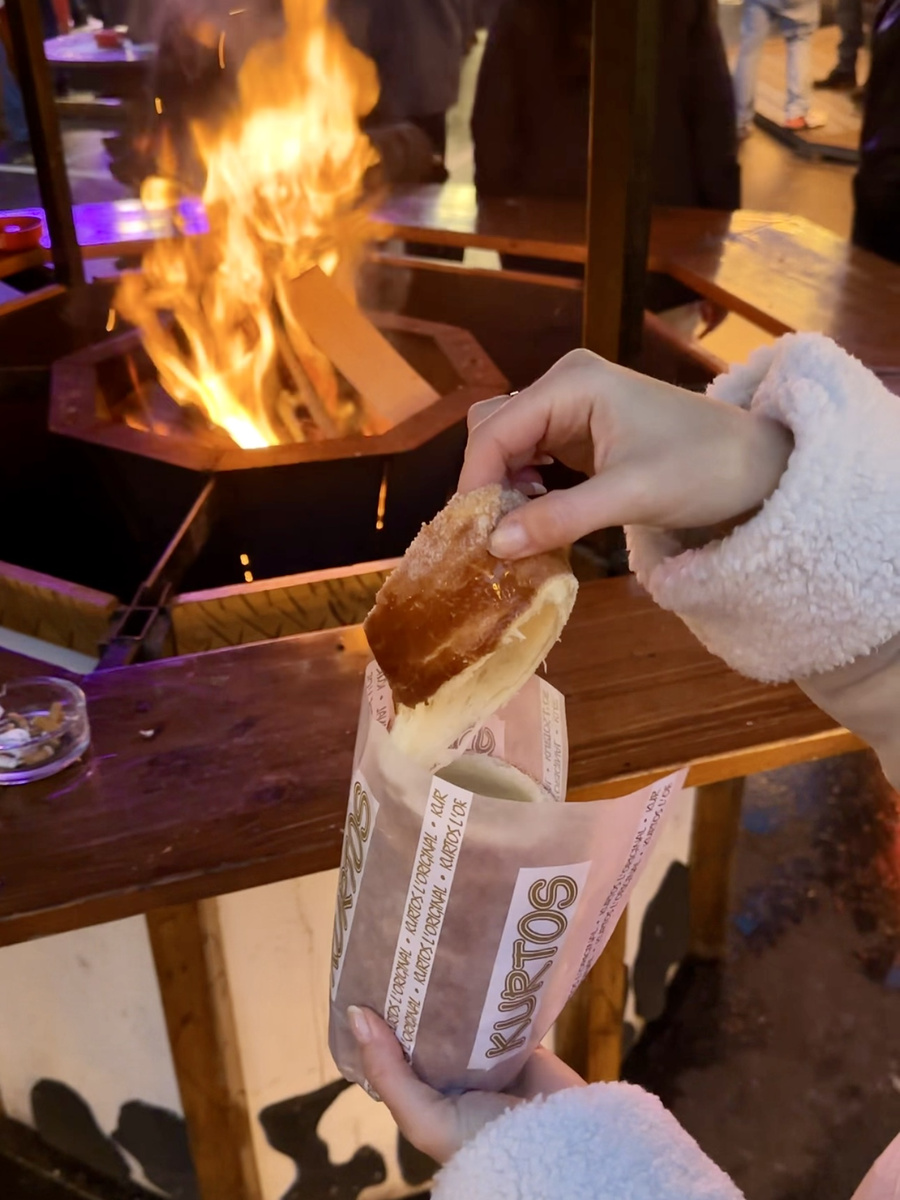
- Hungarian kürtőskalács. Hollow spiral chimney cakes are baked over hot coals and rolled in cinnamon sugar, vanilla, or caramel. Tear one apart while it’s warm beside an open fire pit.
- Swiss fondue and raclette sandwiches. Melted alpine cheese is scraped onto baguette, with hearty alpine soups and rösti served alongside.
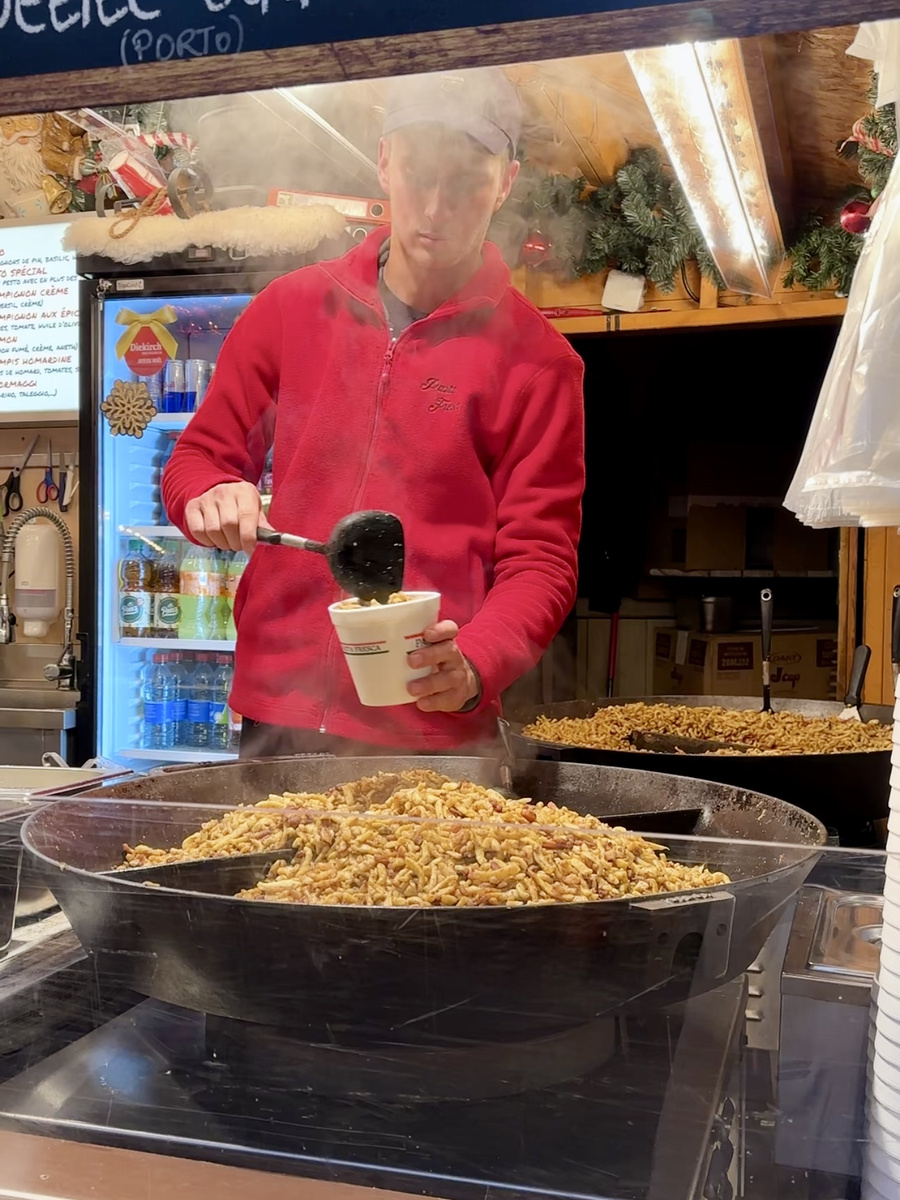
- French crêpes, Belgian specialties, Spanish dishes, and Italian pasta. Belgian stalls cover both waffles and fries, while Spain contributes churros and paella. Fresh Italian pasta is ladled from steaming skillets with pesto, mushroom cream, or four-cheese sauces.
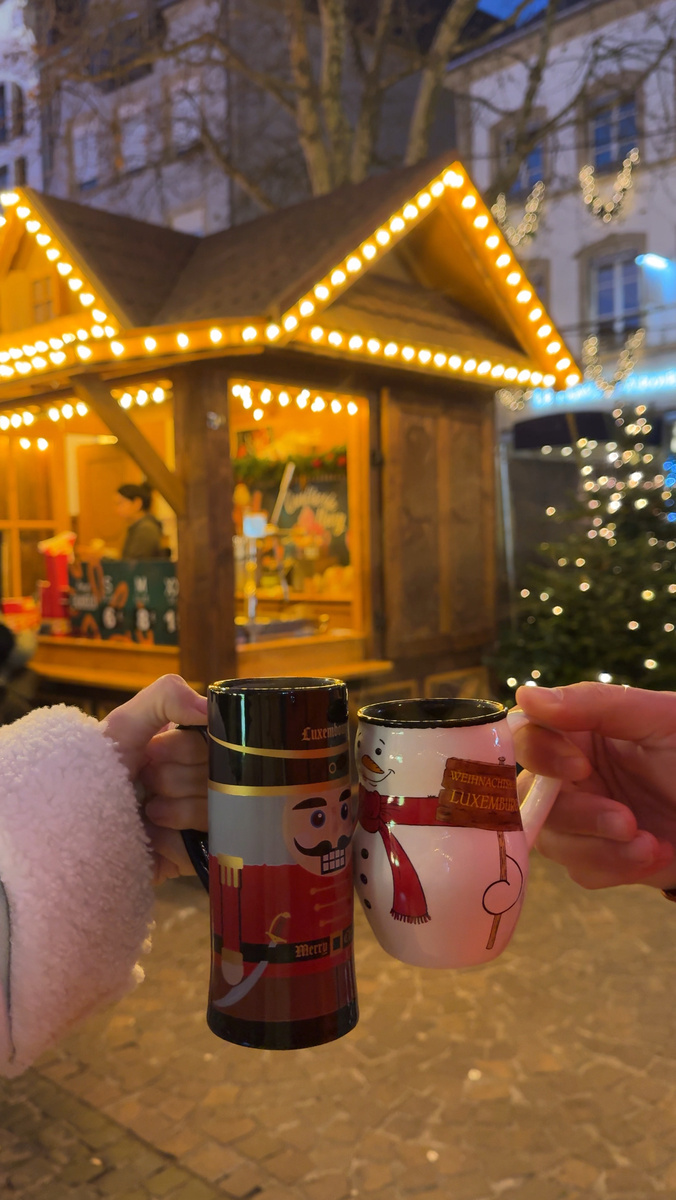
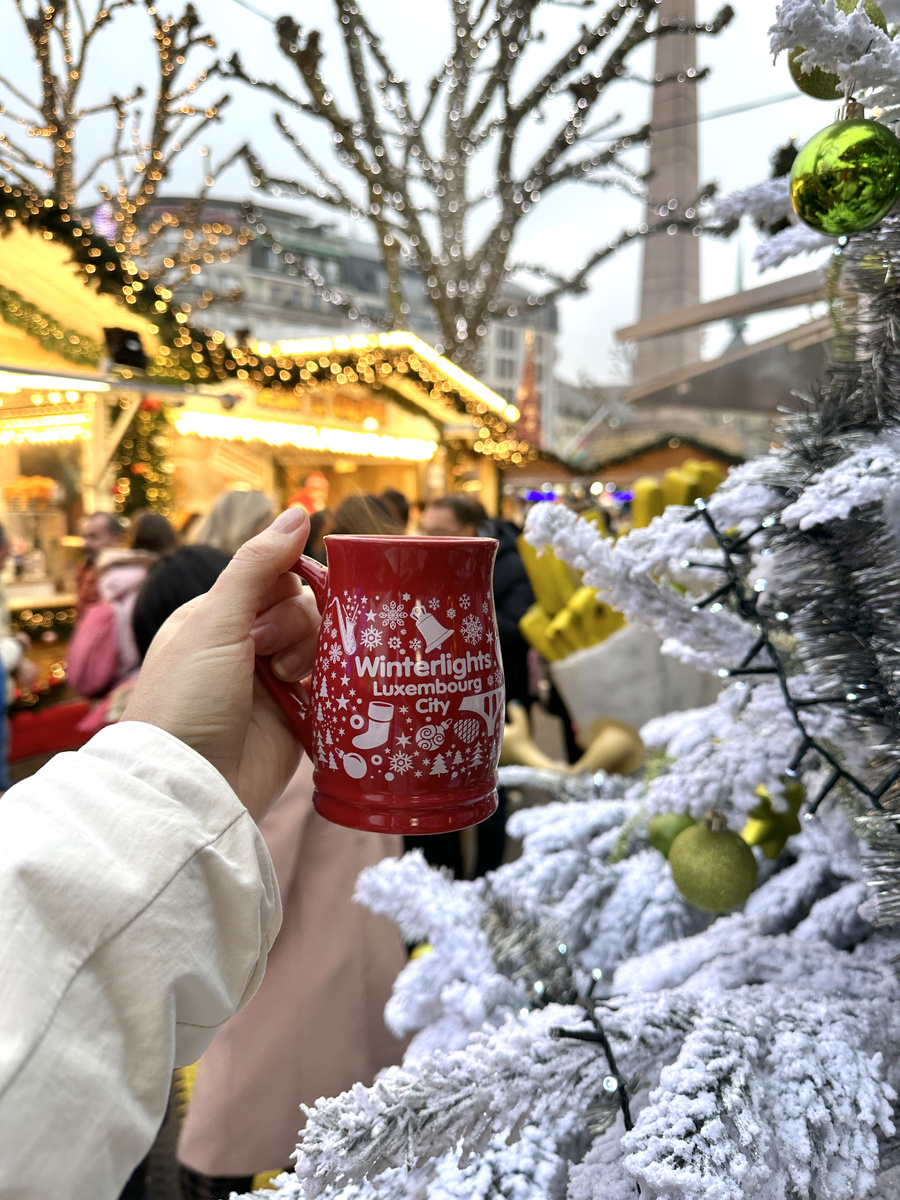
Then there are the mugs. Order Glühwäin, hot spiced apple juice, hot chocolate, or flaming Feuerzangenbowle, in which rum-soaked sugar burns above mulled wine. You pay a refundable deposit of a few euros for the mug.
Return the mug or keep it? Keep it. At most Alsatian markets—and plenty of German ones too—you’re handed cheap, generic plastic cups, which makes Luxembourg’s real ceramic mugs feel all the more special. Because the designs change from square to square and year to year, each one makes an easy, lasting souvenir; I’ve built my own collection at home over the winters. Holding a steaming mug against the arches of Pont Adolphe at sunset has become one of my small December rituals.

Where to Stay in Luxembourg City for the Markets
Luxembourg City is small enough that location can make a winter weekend or compromise it. You’ll want to drop shopping bags, warm up for an hour, and walk back out once the lights switch on. That extra pouring hour at the food and drink chalets makes a nearby room more than a map fetish, since you can stay for another mug without turning the journey home into an expedition.
Four hotels stand out for the market season, depending on whether you’re after valley views, a private château park, or Place d’Armes on your doorstep.
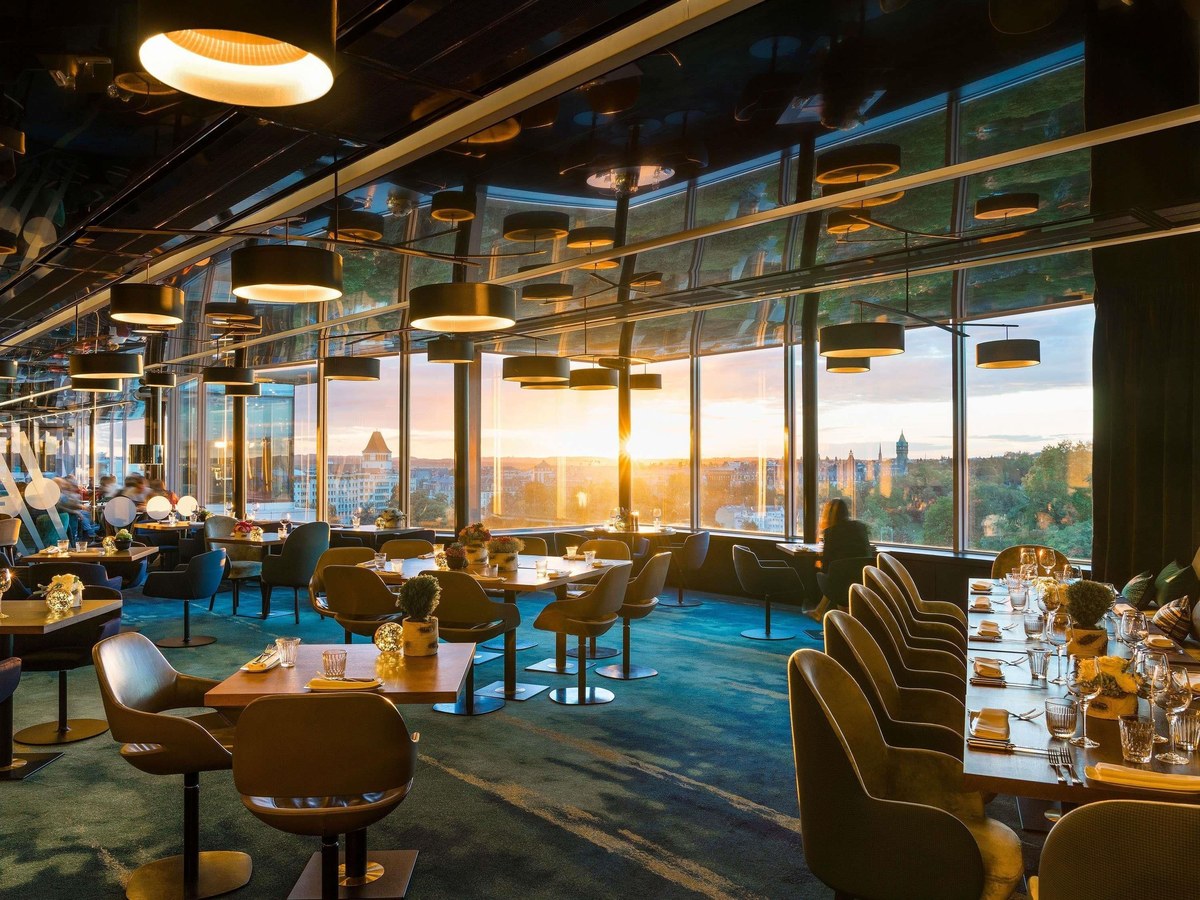
Sofitel Luxembourg Le Grand Ducal sits on the opposite side of the Pétrusse and Alzette valleys, looking directly across the gorge toward the illuminated old town and the markets. That vantage point is its real draw, above all from the top-level Mu restaurant and the eighth-floor L’Observatoire cocktail bar after dark. You’re about a nine-minute walk from Niklosmaart on Place de Paris and a fifteen-minute walk from Place de la Constitution. Alternatively, you can take a quick free tram or bus ride over the viaduct.
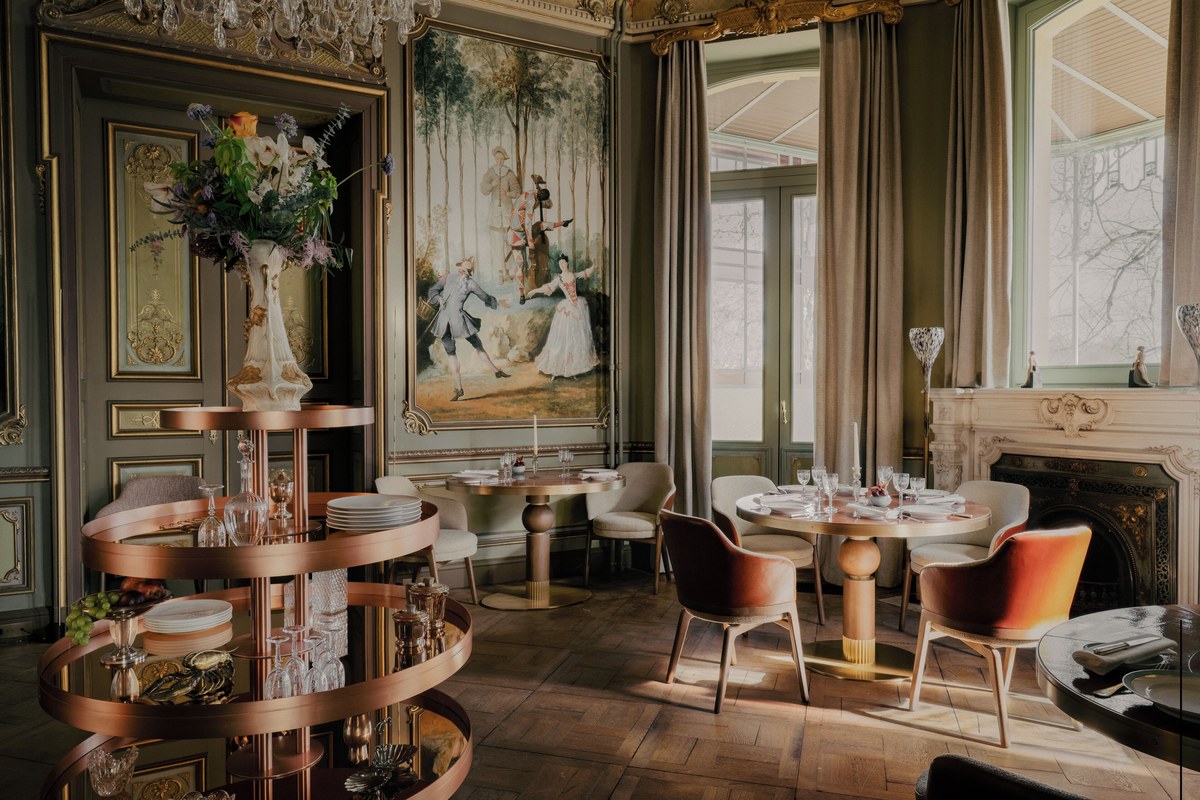
Villa Pétrusse is the city’s most coveted quiet luxury address. This restored 1880 miniature château stands inside a century-old park along the Pétrusse Valley and belongs to Relais & Châteaux. Its 22 rooms, suites, and penthouse give it the seclusion of a country estate. Yet it sits a six-minute walk from the Ferris wheel at Place de la Constitution and eight minutes from Place d’Armes. In 2026 it earned Two MICHELIN Keys, while its restaurant, Le Lys, holds one MICHELIN star under Chef Kim De Dood. It’s an appealing base if you want one memorable dinner to balance market snacks.
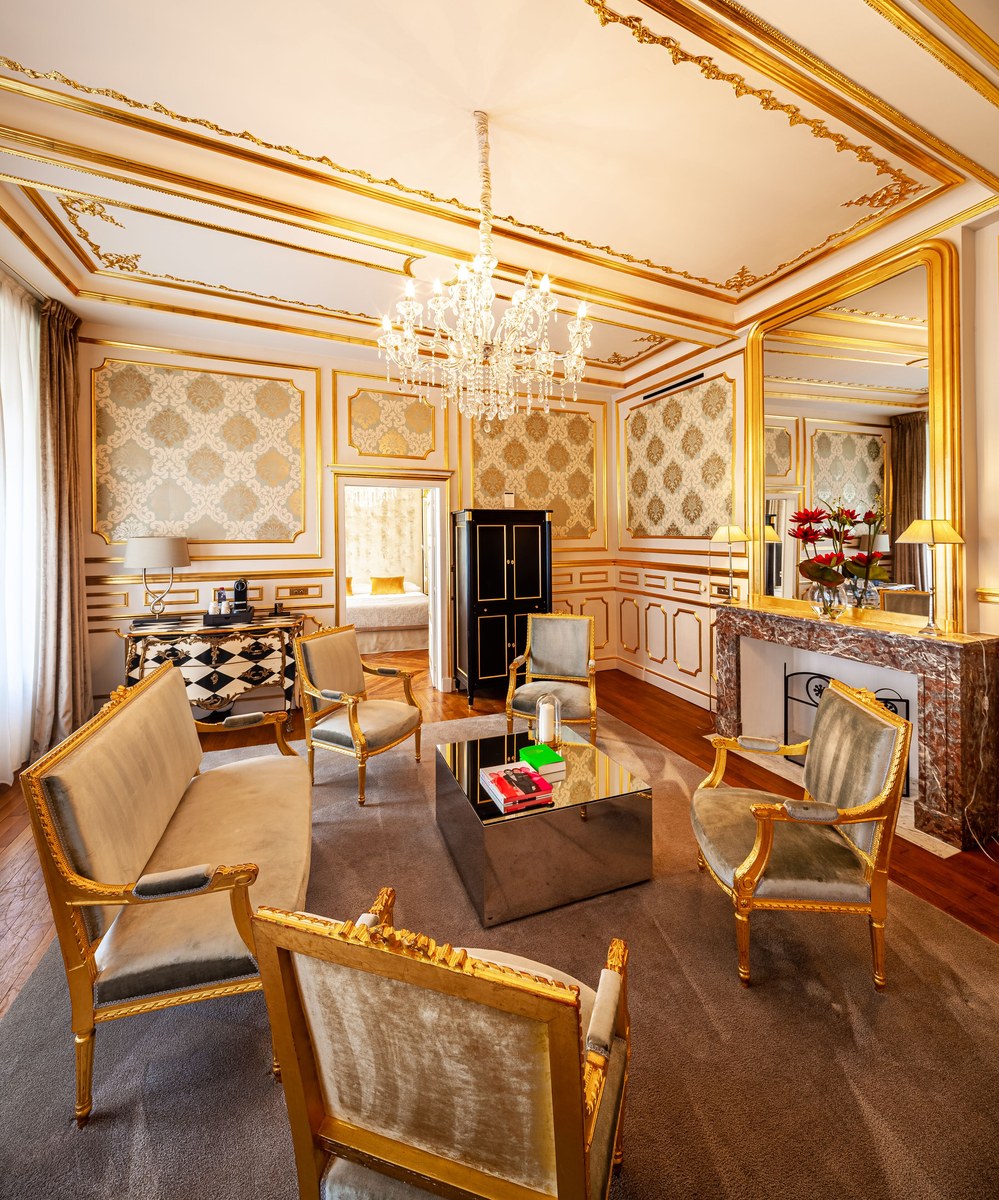
Hôtel Le Place d’Armes is the finest hotel directly on Place d’Armes itself, and it, too, belongs to Relais & Châteaux. Connected eighteenth-century townhouses make up the building. Inside, period beams and antique fireplaces meet Art Nouveau detailing, while its roughly thirty accommodations comprise rooms and suites. You step straight into the glow of the Lëtzebuerger Chrëschtmaart. Place de la Constitution is five minutes away on foot. Downstairs, you’ll find MICHELIN-recommended La Cristallerie, Le Plëss brasserie, and Café de Paris.
Hôtel Français offers that walk-out-the-door Place d’Armes address at a much gentler price point. The Simoncini family has run it for decades. This 22-room three-star sits above Café Français on the square. It’s unpretentious, central, and practical if you expect to spend most of your hours outdoors rather than in the room. Light sleepers may want to request a quieter room off the square on Friday and Saturday nights.
Beyond the Capital: Town and Village Markets by Free Train
Do you need to leave Luxembourg City for a complete trip? No, because the capital comfortably carries a two-night winter break. If you stay three or four days, however, you can take advantage of a practical luxury unique to the Grand Duchy. Since March 2020, every bus, tram, and second-class train across the entire country has been free of charge. You need neither ticket nor app, and there are no zones to decode.
The free T1 ride to Niklosmaart is the city-scale version of that national rule. Its consequence becomes clear at Gare Centrale, where you can walk onto a train and ride out to smaller regional markets without calculating whether each excursion justifies another fare.
- Differdange, Déifferdenger Chrëschtmaart. The Christmas market with Luxembourg’s longest history runs 27 November to 20 December 2026, with more than thirty chalets, daily concerts, and an open-air ice rink.
- Esch-sur-Alzette, Escher Krëschtmoart. An easy direct rail journey south brings you to Place de l’Hôtel de Ville. The market is open 13 November to 23 December 2026, with around twenty chalets and a mini-train along Rue de l’Alzette.
- Dudelange, Noël à Dudelange. Its winter market extends from 28 November to 20 December 2026. From 11 to 20 December, both a traditional market and an atmospheric medieval market with campfires join it on Place Kinnen.
- Echternach, Chrëschtmoart. Luxembourg’s oldest abbey town hosts around forty chalets for a single festive weekend, 11 to 13 December 2026.
- Clervaux and Vianden. These northern castle towns keep their dates intimate and local. Vianden’s one-afternoon Veiner Krësmoort takes place on 28 November 2026, from 2 p.m. to 7 p.m. Clervaux spreads its Advent celebrations across weekends and holds its main traditional market day on 13 December 2026.
If you want an evening indoors during a longer stay—especially with children—Cirque du Lux pitches its big top next to the Stade de Luxembourg for the season. Its international festival weekend runs 28–29 November, followed by the animal-free Christmas Circus Show from 4 December 2026 to 3 January 2027. The free T1 tram runs straight there from the city center, with 24-hour free parking at the adjacent P+R Stade de Luxembourg.
Yes, nationwide public transport really is free! A car, or an easy cross-border rail connection, also puts neighboring markets within easy reach. Trier in Germany is about fifty minutes away by car. Metz in France is under an hour away. The Christmas markets of Alsace begin around two and a half hours south in Strasbourg, while Colmar is about three hours away.
The Weather Question—and Why I Hesitate to Call It Europe’s #1
Late in 2025, a BBC Travel feature named Luxembourg City’s Christmas markets the best in Europe. The feature prompted a lively local debate in Chronicle.lu over whether such a crown brings more pressure than blessing. Living here, I understand both sides. My own hesitation comes down to weather rather than food, setting, or organization.
December snow is uncommon in Luxembourg. Average December temperatures sit between 0 °C and 5 °C, equivalent to 32 °F to 41 °F. Mild Atlantic weather systems shape that range. As a result, rain-slicked cobblestones under a moody gray twilight are far more probable than fresh powder, and you’re more likely to tread across wet stone than through snow. In lucky winters, snow arrives around New Year’s. Through most of Advent, you should pack waterproof boots, a warm coat, and an umbrella.
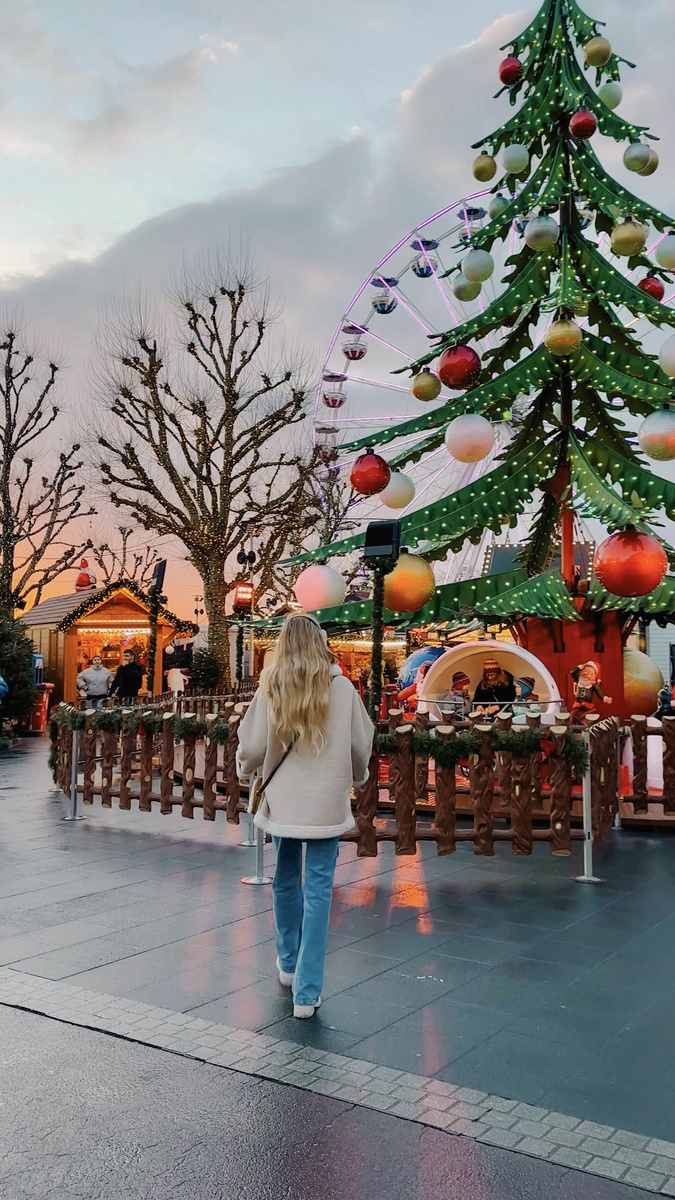
How much should that matter? Alsace is about two and a half hours down the motorway, and December weather in Strasbourg and Colmar is essentially the same. Most of Europe’s famous lowland Christmas markets share that limitation.
If deep, guaranteed snow is nonnegotiable for your holiday trip, skip central Europe altogether and fly north to somewhere like Rovaniemi in Finnish Lapland. If your priorities are warm lights, spotless streets, remarkable food from half the continent, free transport, and space to linger, Luxembourg delivers. You won’t have to fight a wall of tour groups to enjoy them. It offers more than almost anywhere twice its fame.
The snow caveat announced at the beginning therefore changes the superlative, not the recommendation. I’d call Luxembourg the smarter December choice rather than pretending it can supply an Alpine postcard every night.
Getting to Luxembourg City and Parking
How should you arrive? That depends on your starting point, but each route into the city has a straightforward final leg.
By air. Luxembourg Airport at Findel sits about fifteen to twenty minutes outside the center. Free public buses, together with the T1 tram extension, connect it directly into town.
By train. Luxembourg Central Station, Gare Centrale, receives direct TGV services from Paris in a little over two hours, alongside regional links from Brussels, Metz, and Trier. From the station, Niklosmaart at Place de Paris is a seven-minute walk. You can also board the free T1 tram, which runs at frequent intervals and continues straight to Hamilius in the upper town.
By car. Skip hunting for garages inside Ville Haute on December weekends. Instead, leave the car at one of the city’s free 24-hour park-and-ride sites on the outskirts. You can choose P+R Bouillon, P+R Stade de Luxembourg, P+R Luxembourg Sud, or P+R Kockelscheuer. Frequent free trams and buses connect each site directly to the markets. Park once, step onto the tram, and let the rest of the weekend unfold on foot. For once, the easiest driving advice is to stop driving!
Official Winterlights 2026 program and transport guide
Shared on

The post and its conversation
The photographs as they appeared on Instagram, with what readers said there. Likes and replies open on Instagram.



 Join the conversation on Instagram