
On 4 September 1971, a white needle came out of the Atlantic and descended toward Cayenne.
It was not yet an airliner. There were no financiers drinking champagne in narrow leather seats, no film stars timing dinner in Paris and supper in New York, no British Airways captain announcing that the number glowing on the cabin wall had passed Mach 2. This was Concorde 001, the French prototype, on a proving and promotional tour. That day it had crossed the South Atlantic for the first time, from Sal in the Cape Verde islands to French Guiana.
A technician at the nearby Guiana Space Centre later remembered the aircraft making a low pass. Diners came outside to look. The restaurant owner came outside too, but to curse the noise.
It is hard to invent a better little scene for Concorde. Europe’s passenger aircraft of the future roaring over Europe’s spaceport of the future; spectators staring upward; one man already objecting to the sound.
And there was a political detail invisible from the ground. Only a few months earlier, the United States Congress had withdrawn support from America’s own supersonic transport programme. The Soviet Union had already flown the Tupolev Tu-144. The United States—the country that had just put men on the Moon—had decided that a civilian Mach-2 airliner was too expensive, too noisy and too doubtful commercially to continue funding.
Yet the British and the French machine was crossing an ocean.
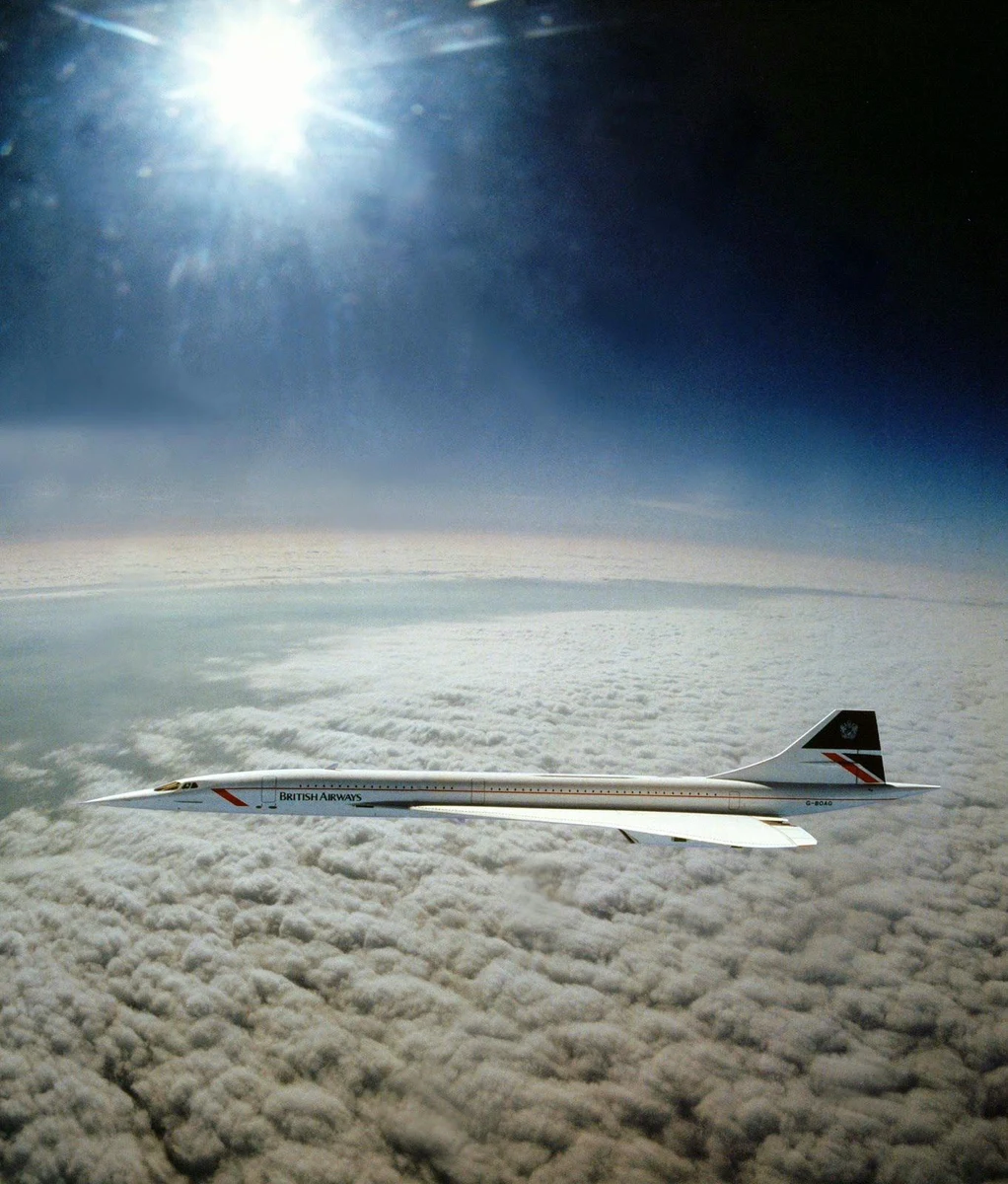
Concorde would need another four years before fare-paying passengers could buy a ticket. When they finally could, in January 1976, they entered one of the strangest products ever offered by the travel industry: a scheduled airliner that cruised at about twice the speed of sound, around 60,000 feet above the Earth, carrying roughly one hundred people in a fuselage narrower than many modern business-class cabins. London to New York could take around three and a half hours. Because of the time difference, a passenger could arrive in Manhattan at a local time earlier than the clock time at which he had left London.
The seat was not the miracle. The clock was.
Concorde eventually became an emblem of luxury travel because the fares became extraordinary, the capacity was tiny and the experience was scarce. But that is to look at the finished product and miss the more improbable story underneath it. Airlines could place options, but they did not carry Concorde’s development risk. No conventional manufacturer could have absorbed it. Twenty aircraft were built in total; only fourteen entered airline service. The development bill belonged overwhelmingly to taxpayers in Britain and France.
Which produces an uncomfortable question.
Why did democratic governments spend enormous public sums creating a machine that would ultimately be used by a minute fraction of unusually wealthy travellers?
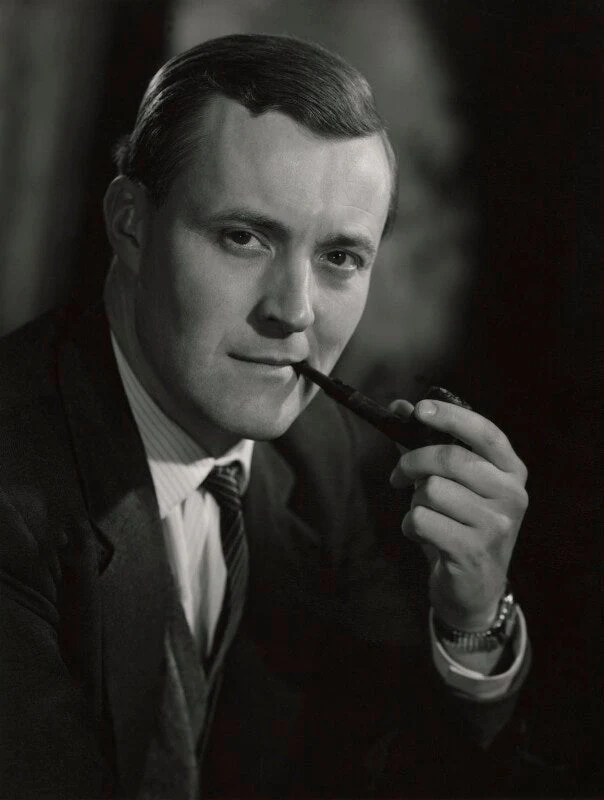
One of the most interesting answers is a British socialist called Tony Benn.
He did not design Concorde. He did not conceive the delta wing. He did not build its Olympus engines. He was not the politician who signed the original Anglo-French treaty in 1962. If we were writing the engineering history, there would be other names before his.
But if the question is how an extravagant experiment survived long enough to become a passenger reality, Benn belongs near the centre of the story.
And the argument he used tells us something important about why Concorde mattered even after Concorde failed.
The war in which machines were arguments
Concorde emerged from a period when machines argued on behalf of states.
Sputnik’s beep had carried the prestige of the Soviet system into orbit. Yuri Gagarin’s flight made one cosmonaut the evidence of a national future. Apollo 11 answered with an American flag on the Moon. The Cold War appeared not only in weapons and proxy wars, but in spectacular demonstrations of scientific and industrial power.
An airliner could make the same claim. Boeing, Douglas and Lockheed were commercial companies, but their command of the jet age also displayed American scale. The Soviet Tu-144 flew before Concorde, on 31 December 1968. The United States was pursuing the larger, faster Boeing 2707.
Britain and France were trying to prove that Europe had not become a technological province between two superpowers.
Tony Benn recognised the argument. In a 1967 parliamentary debate, he described Western Europe as rich in scientific talent but unable to match the speed with which the United States and Soviet Union turned science into industrial technology. He had recently visited the Soviet Union. His subject was larger than aircraft: computers, nuclear engineering, research budgets and the political consequences of technological dependence.
This is the Benn who matters to the Concorde story—not yet the elderly anti-war tribune remembered from protest marches, but Harold Wilson’s Minister of Technology inside a government possessed by the “white heat” of technological change.
Technology, in this worldview, was national power.
A socialist inherits a very expensive bird
Benn had an unusually personal relationship with the British state.
Born Anthony Neil Wedgwood Benn in 1925, he inherited the title Viscount Stansgate when his father died. Under the law then in force, that peerage removed him from the House of Commons despite the fact that voters in Bristol had elected him. Benn fought the system, helped force the creation of a legal right to disclaim hereditary peerages, disclaimed the title in 1963, and returned to the Commons.
That history matters because Benn’s political instinct was persistently about who was allowed to decide. He distrusted closed systems—hereditary privilege, secretive civil-service power, corporate authority without accountability. Later in life this developed into the radical Bennism for which he became famous.
Yet in the 1960s he was also an exuberant technophile. He liked machines, recording equipment, broadcasting technology and industrial projects. In 1966 Wilson made him Minister of Technology. His parliamentary constituency was Bristol South East; at Filton, near Bristol, thousands of people were working on the British Concorde.
Technology, employment, parliamentary power and Bristol met inside his ministry. Concorde engaged all four.
But he inherited a programme that had already frightened one British government.
The original 1962 agreement with France was not an ordinary industrial contract. It was an international treaty, with no simple unilateral break clause. When Labour came to power in 1964 amid a financial crisis, it examined cancelling expensive prestige projects. Concorde was an obvious candidate. The economic case looked poor enough that the government tried to find a way out.
The treaty made retreat politically and legally difficult. Britain had tied itself to France before it knew what the final bill would be.
This is one of the ironies of Concorde: the project survived its first great political threat partly because an earlier Conservative government had made it deliberately difficult for later politicians to escape.
Benn was not naïve about this. He later criticised the secrecy surrounding the treaty and demanded much greater parliamentary scrutiny of Concorde’s finances. He understood cost escalation well enough to joke that the final e in Concorde could stand not only for excellence but for extravagance and escalation.
Yet when senior officials told him the project should be cancelled, his later recollection was memorable for its simplicity: what were they talking about? Of course it was going ahead.
The accountant and the politician were measuring different things.
The little letter that explained the whole project
There was once a surprisingly serious argument over whether Britain should call the aircraft Concord or Concorde.
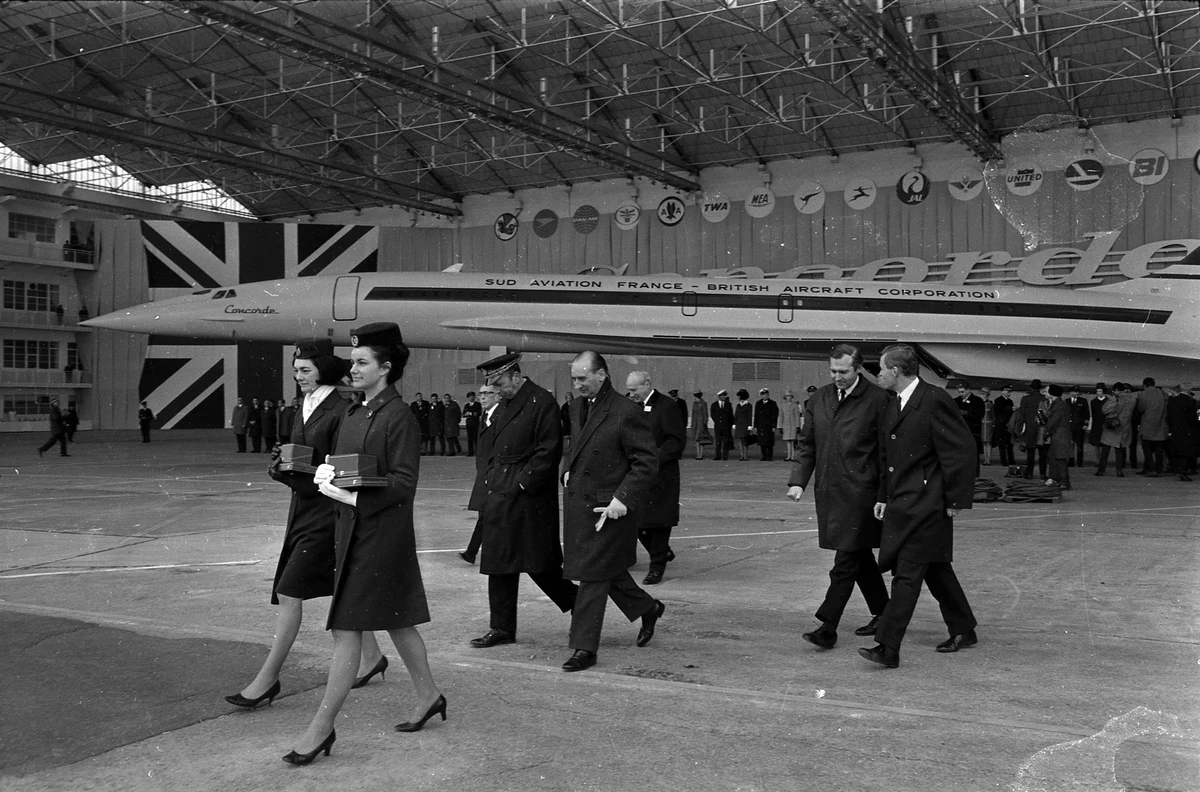
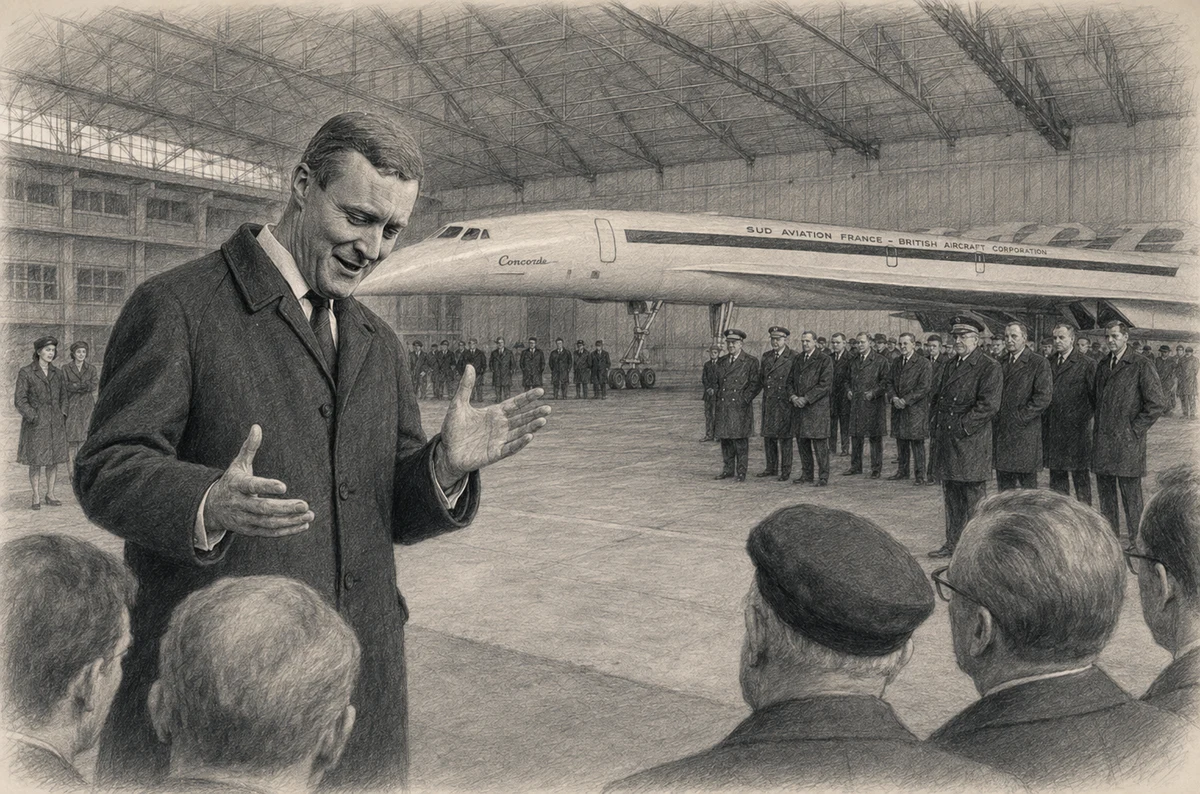
The French spelling had the final e. British ministers had preferred the version without it. At the French prototype’s roll-out in Toulouse in December 1967, Benn simply announced that Britain would use the French spelling too.
He later explained that the e stood for excellence, England, Europe and entente.
A Scottish correspondent complained that an aircraft partly built in Scotland had apparently been forgotten. Benn replied that the e could also stand for Écosse.
It sounds like a charming piece of political wordplay. In fact it contains almost Benn’s entire case for Concorde.
Excellence: Europe should attempt things that were genuinely at the frontier of engineering.
England: advanced industry mattered to the national economy and to skilled workers, including Benn’s constituents around Bristol.
Europe: Britain alone was increasingly too small to compete with American industrial scale; collaboration was not sentimental internationalism but a technological necessity.
Entente: cooperation with France had strategic value beyond this one aeroplane.
Even the jokes he added later—extravagance and escalation—belonged there too. Benn knew the contradiction. He did not need anyone to explain it to him.
That is what makes him a more interesting figure than a simple booster of glamorous technology.
The rich man’s toy
The political objection to Concorde was devastatingly easy to state.
Public money was being used to build a very expensive aircraft for passengers likely to be richer than the people paying the taxes.
Opponents in Parliament called it a “rich man’s toy.” One argued in 1973 that even if Concorde succeeded, it would be a success “which only the rich of the world will enjoy”—expense-account travellers whose fares would ultimately be borne by companies, governments or taxpayers. In 1974 another critic congratulated Benn for publishing uncomfortable financial figures and said every “super first-class passenger” would carry a substantial taxpayer subsidy.
There was no way to make this criticism disappear, because in distributional terms it was substantially true.
Concorde’s supporters sometimes replied that time mattered not merely to playboys but to business executives, professionals, diplomats and officials. This was also true. A transatlantic business trip compressed by several hours had real economic value.
But it still did not explain why a factory worker in Britain should help finance a banker’s lunch in New York.
Benn’s stronger answer was different.
The passenger was not the whole product.
The industrial capability was the product.
The aerospace workforce was the product.
The technologies being forced into existence were the product.
The ability of Britain and France to build something that neither could sensibly build alone was the product.
And in the Cold War, the visible fact that Western Europe could produce the world’s most advanced civil airliner was itself a product.
This was the argument with which Benn helped keep Concorde politically survivable. The state was not supposed to be subsidising champagne. It was investing in a technological base, while a small group of premium passengers would later exploit the machine’s most obvious benefit.
One can disagree with the economics and still understand the logic. Governments routinely fund capabilities whose first users are not representative of the general population. Early computers were not bought by ordinary families. Satellite navigation began as military infrastructure. Jet engines were transformed by war long before low-cost airlines sold €29 tickets around Europe.
The political wager is that some expensive capabilities eventually diffuse.
With Concorde, that wager turned out to be both wrong and right.
4 September 1971
By the time Concorde 001 headed across the Atlantic in September 1971, Benn was no longer Minister of Technology. Labour had lost the 1970 election, and he had moved into opposition.
The timing nevertheless made the flight a strange vindication of the argument he had been making.
America had abandoned its SST programme earlier that year. NASA records the reasons plainly: technical difficulty, economics, environmental concern and political pressure. The Soviet Tu-144 existed, but its development would prove troubled and its passenger career extraordinarily short.
Now the Anglo-French prototype was doing something prototypes have to do before they become transport: leaving the safe orbit of a test field and behaving more like an aeroplane that belonged to the world.
The South American tour was promotional, but it was also operational proving. Concorde crossed the Atlantic, entered real traffic environments, visited unfamiliar airports and demonstrated endurance away from its home engineering base.
On 4 September it was still years away from carrying a fare-paying traveller.
But the argument had shifted.
The question was no longer whether Europeans could build a supersonic passenger aircraft.
They had built one.
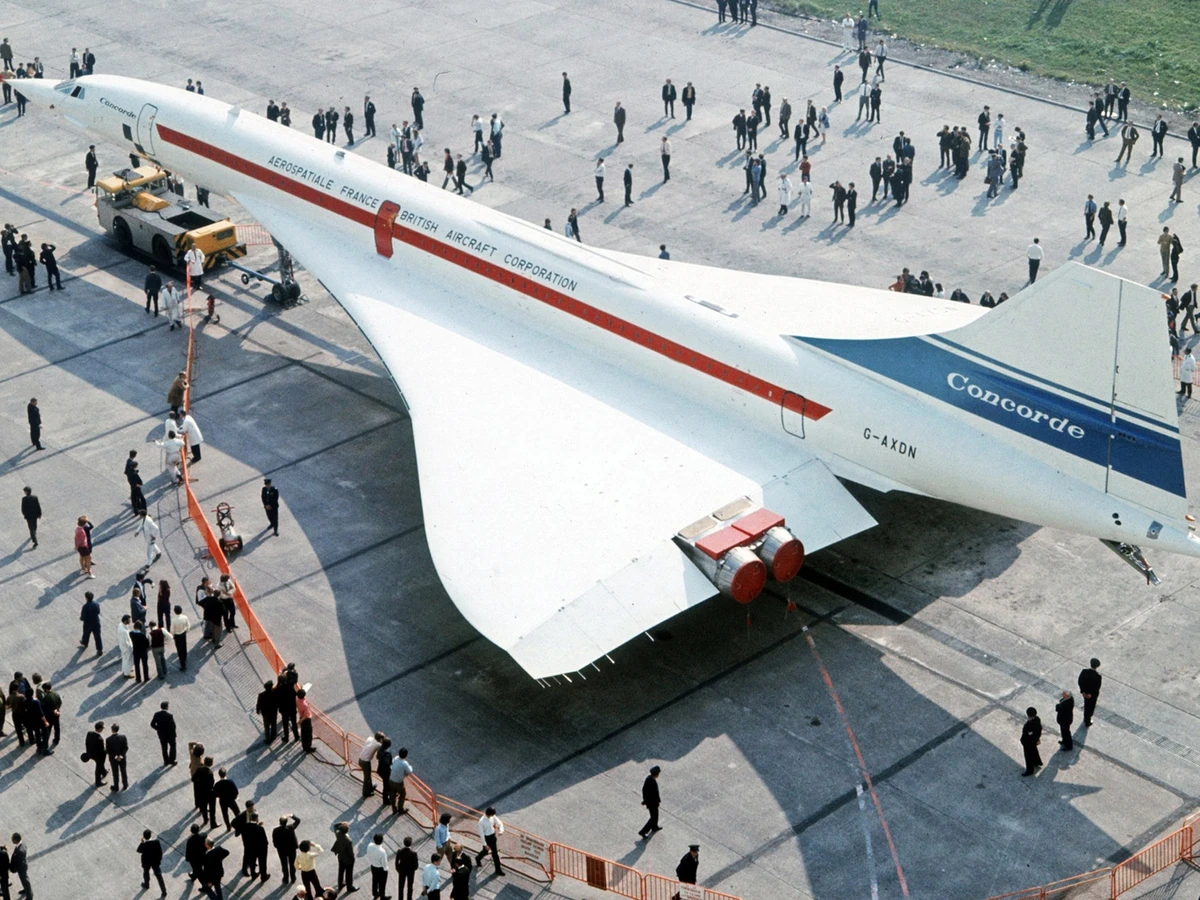
The question was whether they would spend enough money to finish the idea.
The last gap
The cruel part of the Concorde story came after the engineering success became undeniable.
The market disappeared.
At one point, airlines around the world had accumulated dozens of options for Concorde. Pan Am, TWA, American, United, Lufthansa, JAL, Qantas and others had all looked seriously at a supersonic future.
Then the assumptions beneath that future deteriorated. Costs rose. Noise restrictions threatened routes. The environmental movement became politically powerful. Wide-body aircraft such as the Boeing 747 showed another path to the future: not fewer people moving much faster, but many more people moving relatively cheaply. And in 1973 Pan Am and TWA cancelled their options.
Inside Whitehall, the commercial dream was effectively over.
When Labour returned to power in 1974, Benn returned to responsibility for the programme as Secretary of State for Industry. His officials told him that the bureaucracy had already converged on the answer: Concorde should be cancelled.
This is the moment that makes Benn particularly suitable for a travel portrait.
He did not respond by pretending that the original business case was healthy.
He published information about the costs. He acknowledged the collapse of airline orders. He accepted that Parliament had been given too little information in the past. He had already argued that governments should not begin future projects of this kind without much better control.
In other words, Benn had learned the lesson of Concorde.
He simply refused to conclude that the lesson was to destroy Concorde a few months before it could enter service.
In July 1974, answering critics in the Commons, he said he could not accept that after the finest British and French skills had been invested for half a generation in an aircraft now demonstrating its technical ability, “common sense” required cancellation just before entry into service.
Privately, his argument was sharper. A 1974 Cabinet paper records Benn asserting that Concorde was the only British product “supremely better than anything else on offer in the world.”
That is not an accountant’s sentence.
It is a sentence about capability.
The government ultimately authorised completion of the sixteen production aircraft already in the programme, without committing to an endless production line. It was a retreat from the original dream of hundreds of supersonic transports, but it was enough.
British Airways and Air France began scheduled Concorde service in January 1976.
Politics had carried the aircraft over the last gap between prototype and passenger product.
What did the taxpayers actually buy?
If Concorde’s legacy ended with wealthy passengers crossing the Atlantic very quickly, the critics would have the simpler historical case.
The programme was commercially disappointing. Hundreds of aircraft did not sell. Its environmental disadvantages were real. Its route network was constrained by sonic-boom restrictions. The United States had been right about some of the problems that led it to cancel its own SST.
But technological programmes leave descendants that do not appear on their sales sheets.
Concorde’s most important inheritance is easy to miss precisely because it became ordinary.
The pilot’s hands stopped being mechanically connected to the aeroplane
Concorde was the first commercial aircraft to make analogue fly-by-wire its primary flight-control system. Instead of relying only on a pilot moving controls mechanically through cables, rods and pulleys, electrical signals carried commands through the control chain. The aircraft still retained a conventional mechanical backup.
The full digital revolution came later. Modern fly-by-wire was developed through military aircraft and Concorde before it became the defining architecture of the A320.
When the A320 entered service in 1988 with full digital fly-by-wire, computers could interpret pilot commands, apply control laws and help protect the aircraft from exceeding parts of its safe flight envelope. The same broad architecture now sits behind the operation of modern Airbus aircraft and competitors including the Boeing 777 and 787 and Embraer E-Jets.
A technology once justified by the extraordinary control demands of a Mach-2 airliner became normal equipment on aircraft carrying holidaymakers to Málaga.
This is exactly the kind of inheritance that disappears from public memory because success makes it boring.
Concorde helped turn carbon brakes from exotic material into airline hardware
Concorde also imposed a brutal braking problem. It was fast, and every unnecessary kilogram mattered. Traditional steel brakes carried a substantial weight penalty while having to absorb enormous energy.
The demand for weight reduction helped stimulate the development of carbon-carbon aircraft brakes. Engineering work on Concorde reported weight savings of roughly sixty percent for the carbon discs compared with steel. Concorde became one of the pioneering commercial applications of the technology.
Carbon brakes subsequently spread through modern medium and large aircraft. The Science Museum preserves a Dunlop disc made for Concorde; the industry later moved from metallic to carbon-matrix reinforced brakes as the technology matured.
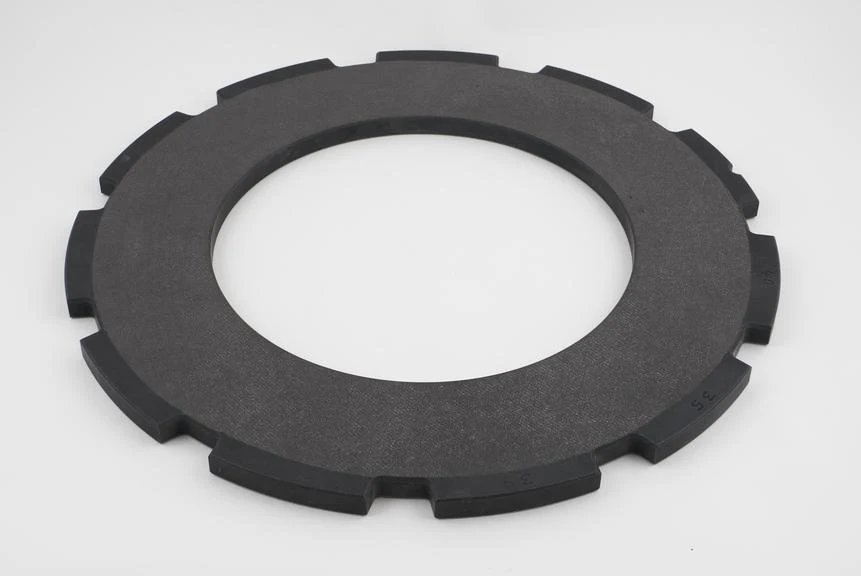
The passenger in 2026 does not see any of this. The aircraft touches down; the brakes become very hot; everyone reaches for a telephone.
That is inheritance too.
Europe learned how to build one aircraft in several countries
The largest legacy may not be a component at all.
Concorde required French and British engineers, factories, governments and suppliers to behave as pieces of one industrial system. The arrangement was often inefficient. Political sensitivity led to duplicated structures—including separate final-assembly lines—and every disagreement could become an international negotiation.
But failure is an expensive teacher, and Europe learned.
Airbus explicitly identifies Concorde as one of the transnational programmes that gave the later A300 project a foundation. The experience helped Airbus avoid some of Concorde’s mistakes, including politically motivated duplication, while preserving the deeper idea: no single European national aircraft industry had to confront Boeing and Douglas alone.
That institutional inheritance is staggering.
Fourteen production Concordes entered airline service.
Airbus went on to make multinational European aircraft production routine and, eventually, to become one of the two dominant builders of large commercial airliners in the world.
The economic return cannot honestly be credited to Concorde as though Airbus were a dividend payment from the SST programme. Airbus had other ancestors, other political bargains and other brilliant founders.
But Concorde was part of the school in which European aerospace learned cooperation under maximum difficulty. Airbus now names Concorde among the transnational programmes that gave the A300 strong foundations.
And that is precisely the kind of asset Tony Benn was afraid of throwing away when officials showed him a spreadsheet saying the aircraft itself did not pay.
The luxury product was not the deepest legacy
There is another reason Concorde belongs in travel history rather than merely aviation history.
It changed the meaning of premium travel.
Ocean-liner luxury had traditionally meant abundance: larger rooms, more servants, more courses, more luggage, more physical space. Even the great subsonic jet age inherited much of that logic. First class meant that the passenger received more of the journey.
Concorde offered something different.
Its cabin was narrow. Its seats would look unimpressive beside a modern enclosed first-class suite. There was no private bedroom, no shower and no bar occupying the upper deck of an A380.
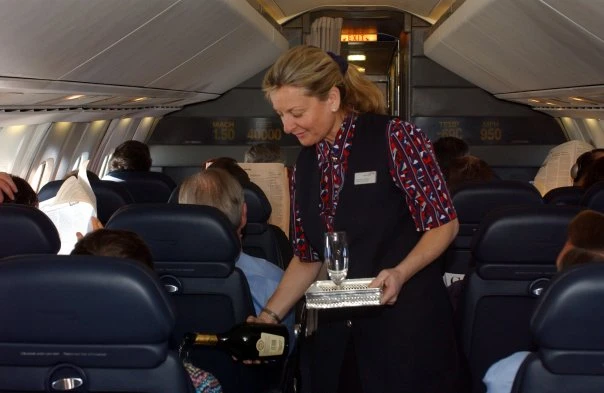
What it sold was less journey.
Less time between London and New York.
Less waiting relative to the value of the traveller’s day.
A capability originally defended in the language of industrial competition became a luxury product whose ultimate commodity was time itself.
That idea has survived Concorde perhaps even more completely than its tableware or champagne rituals. The premium travel industry of 2026 spends enormous amounts removing minutes and friction: dedicated airport entrances, private security channels, chauffeur transfers, direct lounge boarding, biometric formalities, fast-track immigration, cars waiting beside aircraft, baggage that appears before everyone else’s.
Modern first class can give you a bed Concorde never had.
What it still struggles to give you is Concorde’s three saved hours.
Benn’s uncomfortable victory
Tony Benn is an awkward hero for such a machine.
He became one of Britain’s most famous men of the left. Concorde became a global symbol of privilege. He spent much of his later career attacking concentrations of power; Concorde’s passenger list could look like a directory of them.
The contradiction should not be edited away. It is the portrait.
Benn did not fight to preserve Concorde because he believed rich people possessed a moral right to cross the Atlantic before lunch.
He fought for it because he believed a democratic state could value things the market did not know how to price properly: skills, strategic industrial capacity, technological confidence, employment, cooperation between countries and the ability to remain a producer rather than merely a customer of the future.
The belief can produce waste and capabilities whose value appears somewhere else. Concorde proved both.
Benn himself eventually became cautious about grand technological programmes. Historical research has pointed out the paradox: the man who had warned against creating more Concorde-like projects became the politician who preserved the remaining Concorde programme. He could distinguish between saying we should not start another project this way and saying therefore we should destroy the one we have almost finished.
That distinction is more sophisticated than either worshipping Concorde or laughing at its economics.
The E, fifty-five years later
On 4 September 1971, Concorde 001 crossed the Atlantic and arrived in French Guiana.
Fifty-five years later, there is no scheduled Mach-2 passenger service. A normal airliner still crosses the Atlantic at roughly the cruising speed jets used decades ago. In that narrow sense, Concorde has no descendants.
Look closer.
A modern Airbus responds through fly-by-wire architecture whose civil lineage runs through Concorde. Carbon brakes, once driven forward by the desperate need to save weight on an exotic supersonic aircraft, became ordinary aviation technology. The European habit of dividing an aircraft among national centres of excellence—and somehow making the pieces meet at final assembly—became the operating model of an aerospace giant.
Even the political question has returned.
How much should societies spend to preserve technological sovereignty? When should governments support a capability whose first market appears too small? When is a prestige project merely prestige, and when is it tuition for an industry that will matter later?
We ask the same questions now about launch vehicles, artificial intelligence, semiconductors, energy systems and the next generation of supersonic aircraft.
Tony Benn would probably have argued about all of them.
That was his habit.
There is a temptation to remember Concorde as a beautiful dead end: the white delta, the drooping nose, the champagne, the celebrities, the glowing MACH 2.00 display. That makes a good museum object and an incomplete history.
Concorde’s stranger achievement was that some of the extravagance escaped the aircraft.
The rich passengers got the speed.
The rest of aviation inherited parts of the engineering culture that made the speed possible.
And the politician who once restored a single letter to its name accidentally supplied the best epitaph.
The e really did stand for excellence, England, Europe and entente.
It also stood for extravagance and escalation.
Tony Benn knew both versions were true.
That is why he kept the letter.
And, when the moment came, why he kept the aeroplane.