
Living in Luxembourg’s Moselle region, I can reach Trier more easily than any other German Christmas market. From Grevenmacher, the drive across the river takes less than half an hour; from Remich or Luxembourg City, it takes about three-quarters of an hour. I’ve driven over in two different Decembers now, yet convenience remains the least convincing reason to put Trier on your winter map. Well, it may get you across the river, but it can’t explain why you should be glad once you arrive.
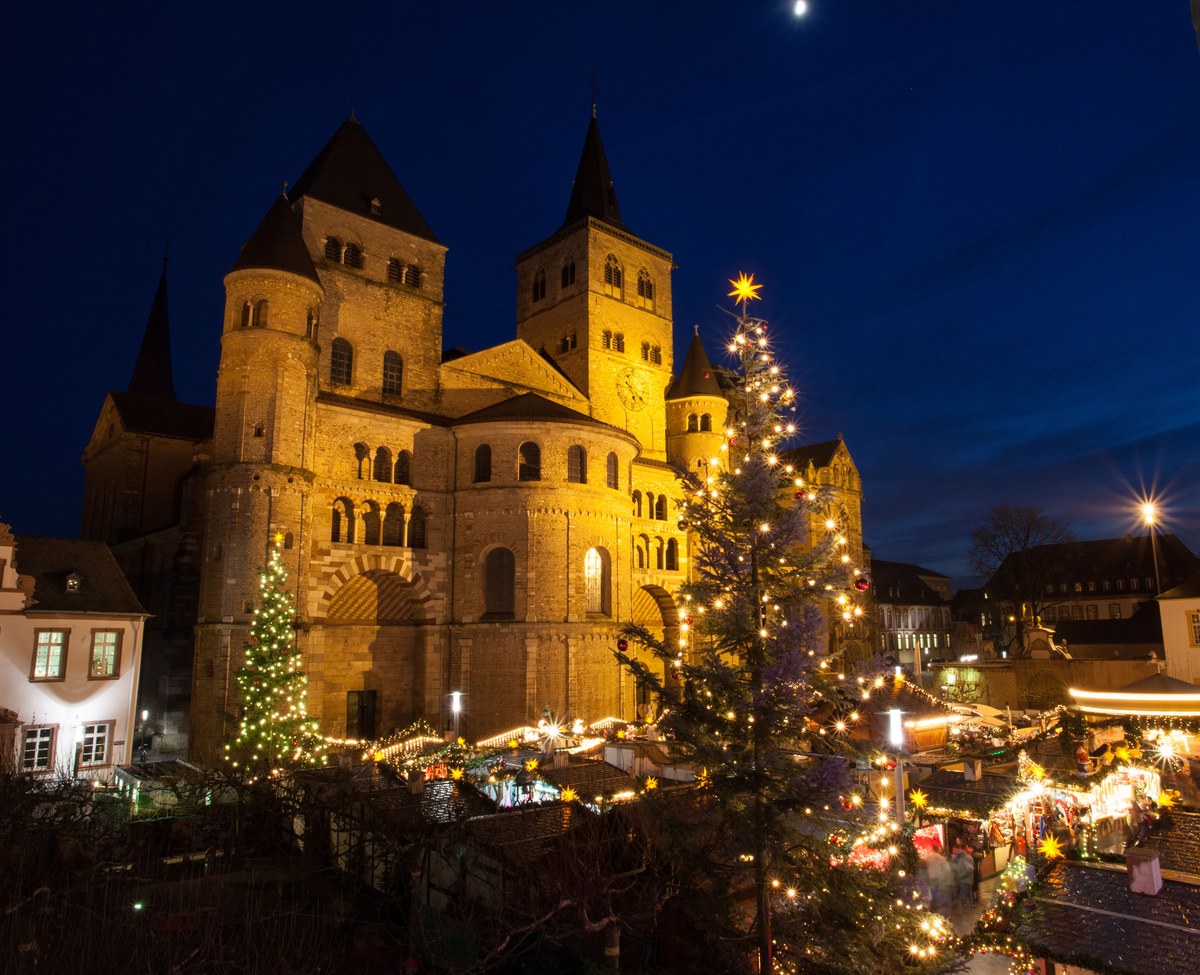
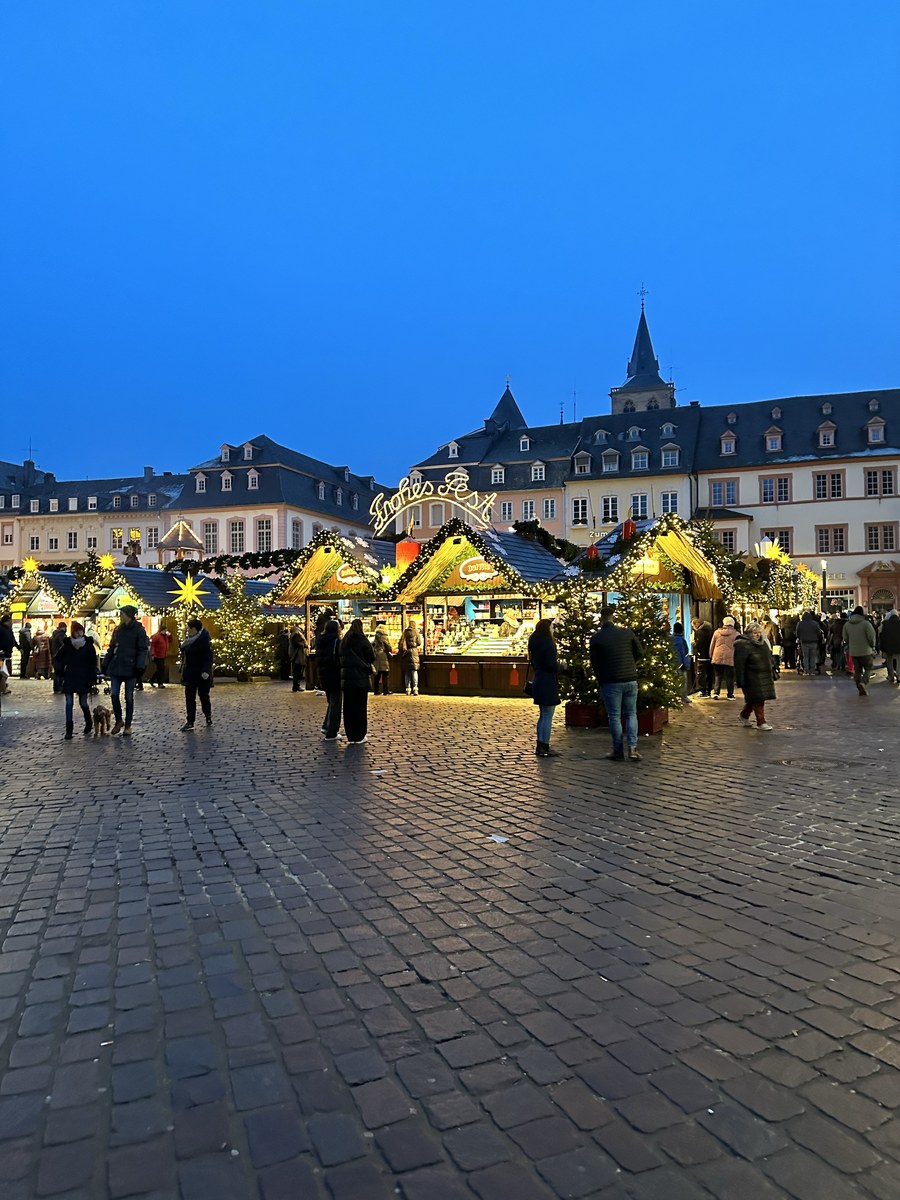
Even if you lived five hours away, Trier would earn the detour on its own terms. This is Germany’s oldest city. The Romans founded it around 16 BCE as Augusta Treverorum, yet an inscription cut into the Red House on the main square still insists that Trier stood 1,300 years before Rome. In late November, about ninety wooden chalets settle into the medieval Hauptmarkt and the forecourt of Trier Cathedral, the Domfreihof. The Cathedral’s twin Romanesque towers, curved stone apse, and massive sandstone flanks rise directly behind them like the curtain wall of a medieval castle.
You step into that stone enclosure after dark. Oak smoke drifts from a real baker’s oven, and you may wonder why travelers fight through shoulder-to-shoulder crowds in Germany’s louder December capitals instead. I’ll return to that smoke in the bakery section, because it leads to one ordering decision that can shape your evening.
Trier largely escapes the crush that wears people down in bigger cities. Even on a December weekend evening, there’s room to pause between stalls, hold a hot mug without guarding your elbows, and talk properly to the people behind the counters. That unhurried scale, paired with serious Moselle winemaking just outside the city gates, gives Trier a culinary polish I seldom encounter even at far more famous German markets.
Trier Christmas Market 2026, Dates, Hours, and How to Time It
The 46th Trierer Weihnachtsmarkt runs from 20 November through 22 December 2026, and entrance is free across both squares. One pause is mandatory near the start of the season. The stalls remain closed on Sunday, 22 November for Totensonntag, Germany’s quiet day of remembrance. The official opening ceremony follows on Tuesday, 24 November at 5 p.m., when the Deutsche Glühweinkönigin and local dialect band Leiendecker Bloas appear on the Domfreihof stage.
Daily hours are generous, but they won’t turn the old town into a late-night street party.
- Monday through Thursday, from 11 a.m. to 8:30 p.m.
- Friday and Saturday, from 11 a.m. to 10 p.m.
- Sunday, from 11 a.m. to 8 p.m.
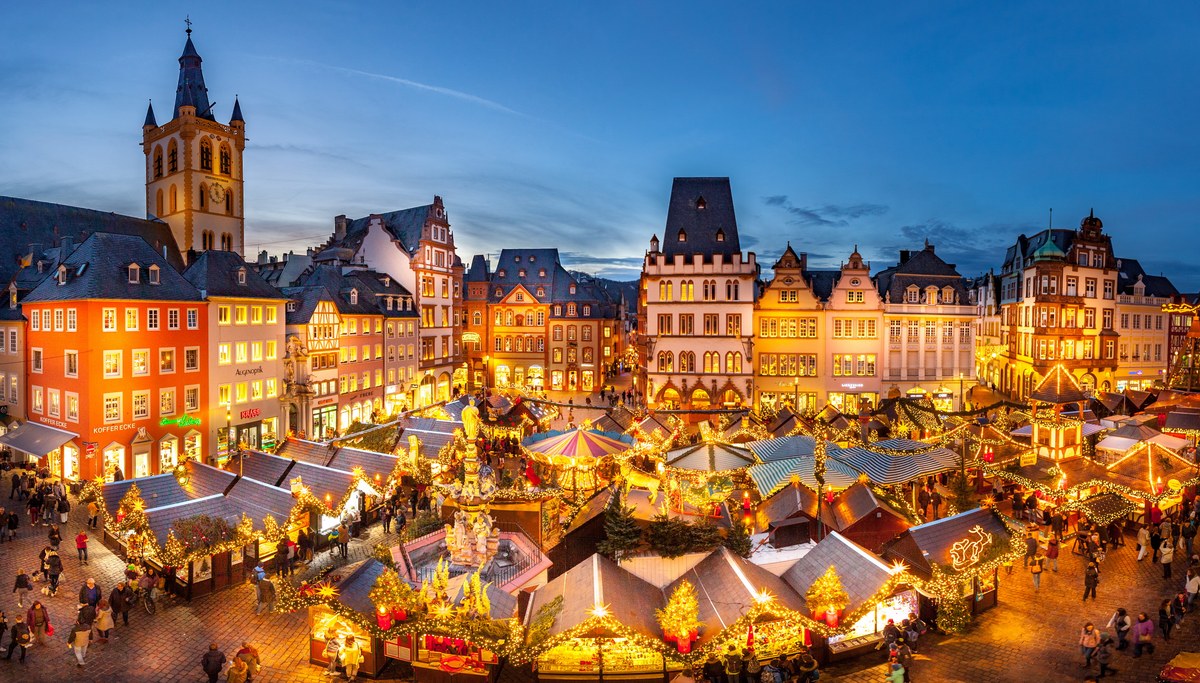
When should you arrive? If you can choose the hour, aim for blue hour, about 4:15 to 4:45 p.m. in late November and December. During that brief window, cobalt dusk still holds behind the spires while the wooden roofs flare warm gold, so Trier photographs at its best and feels especially alive.
Which direction should you walk? On my visits, I’ve found that the route changes the effect. Start on the Cathedral side at Domfreihof, then walk toward Hauptmarkt through short Sternstraße. As you follow it, the architectural reveal tightens and brightens with every step.
Trier & the Moselle–Luxembourg Christmas circuit, 2026–2027
Trier’s 46th Christmas market runs from 20 November to 22 December 2026 (closed 22 November). Four contrasting markets sit within an hour’s drive across Germany and Luxembourg, making an easy multi-day December loop.
Moselle–Luxembourg circuit
| Destination | 2026–2027 dates | Drive from Trier | Why add it |
|---|---|---|---|
| Trier (Hauptmarkt & Domfreihof) | 20 Nov–22 Dec (closed 22 Nov) | Start | Cathedral courtyard setting, Moselle Winzerglühwein, wood-fired bakery, handmade ceramics |
| Saarburg (Christkindlmarkt) | 4–6 & 11–13 Dec (weekends) | 29 min (24 km) | Intimate stalls around the illuminated Leukbach waterfall; Victorian market 12–13 Dec |
| Bernkastel-Kues | 20 Nov–20 Dec (closed 22 Nov) | 43 min (47 km) | Half-timbered old town and the region’s largest Advent calendar on the Adler Pharmacy |
| Luxembourg City (Winterlights) | 20 Nov–3 Jan (closed 25 Dec) | 47 min (48 km) | Six walkable squares, valley Ferris wheel, wide international food; free local transit |
| Traben-Trarbach (Mosel-Wein-Nachts-Markt) | 20 Nov–2 Jan (mainly Fri–Sun) | 56 min (61 km) | Underground wine-cellar market (€5 adult entry); weatherproof on rainy December days |
Trier 2026 hours & highlights
| Schedule & events | When | Details |
|---|---|---|
| Monday–Thursday | 11am–8:30pm | Quietest afternoons; arrive around 4:15 p.m. for cobalt blue hour |
| Friday & Saturday | 11am–10pm | Late-evening Moselle Winzerglühwein pours under the illuminated Cathedral |
| Sunday | 11am–8pm | Closed 22 November (Totensonntag); central Tiefgarage Konstantin caps Sunday parking at €3.60 |
| Official opening ceremony | Tue 24 Nov, 5pm | Domfreihof stage with Deutsche Glühweinkönigin Louisa Kress and local band Leiendecker Bloas |
| St. Nicholas & alphorns | 5–6 Dec & 11 Dec | St. Nicholas visits from 2pm (5–6 Dec); alphorn ensembles before the Cathedral portal (5 & 11 Dec, 3pm) |
| Puppet theater & carols | Tue 1, 8, 15 Dec; Fri 18 Dec | Puppenbühne Rheinland on Tuesdays (3pm & 5pm); Stadttheater children’s choir & tenor Thomas Kiessling on 18 Dec (5pm) |
Domfreihof, A Market Inside a Medieval Stone Keep
Stand in the middle of Domfreihof after nightfall. The impression of being inside a fortified castle courtyard is immediate, because the buildings do more than frame the market. Trier Cathedral, or Trierer Dom, is Germany’s oldest cathedral. It was begun under Constantine in the fourth century, then inscribed on the UNESCO World Heritage list in 1986 alongside the Gothic Liebfrauenkirche beside it and Trier’s Roman monuments. Pale sandstone blocks, heavy recesses with rounded arches, and flanking stair turrets give its sheer Romanesque west front the character of a stronghold from the Middle Ages rather than a delicate Gothic church. What a commanding piece of masonry it is!
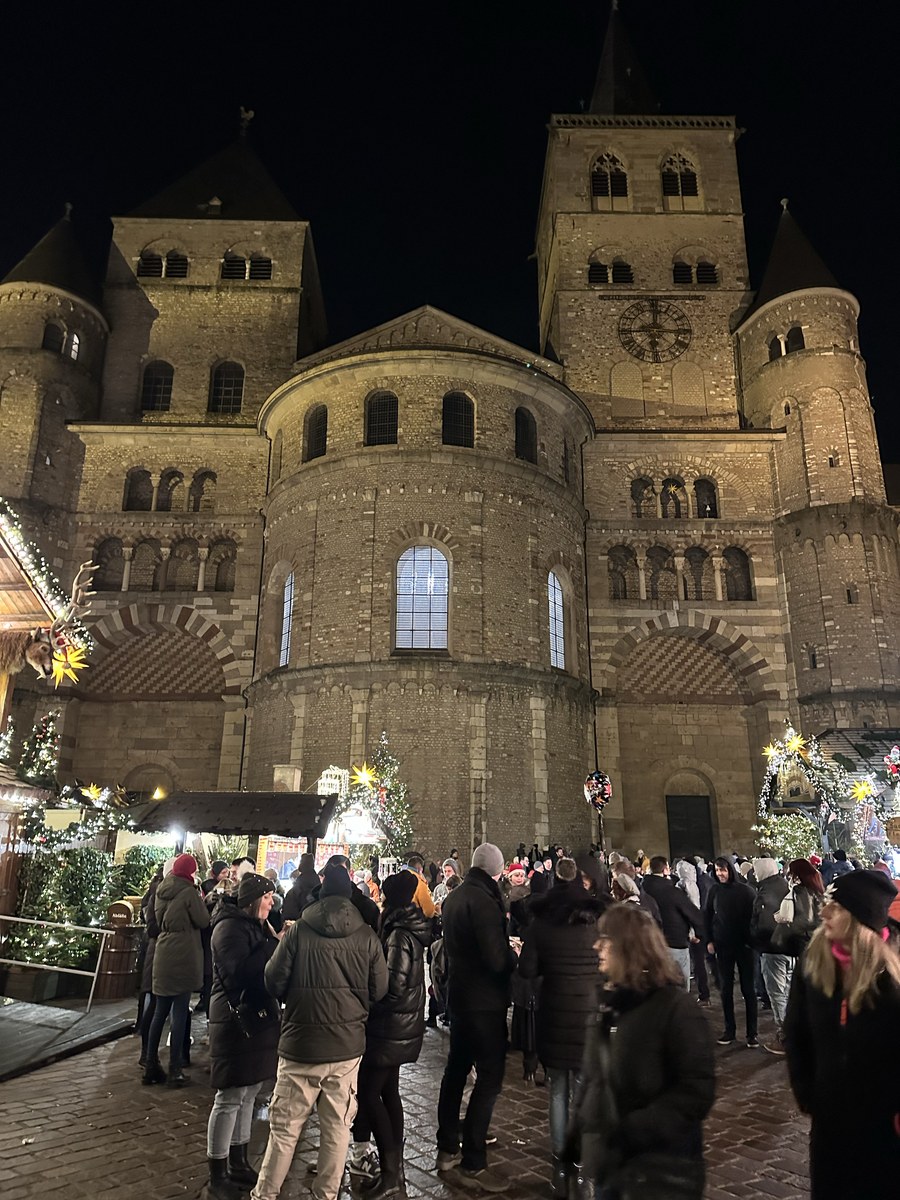
That massive stone backdrop changes both the acoustic and the visual mood. Chalets tuck themselves along the edges of the cobbles, while a tall fir rises beside the apse. Although the Domfreihof stage carries the seasonal calendar, it doesn’t drown out conversation.
The classical carol sing-alongs return on weekday evenings, led by tenors Thomas Kiessling and Thomas Siessegger. On Tuesdays, Puppenbühne Rheinland presents afternoon puppet theater on 1, 8, and 15 December, at 3 and 5 p.m. Alphorn ensembles play in front of the Cathedral portal at 3 p.m. on 5 and 11 December. Saint Nicholas walks both squares on 5 and 6 December from 2 p.m., and the Trier Stadttheater children’s choir joins Thomas Kiessling on Friday, 18 December at 5 p.m.
What if you miss every scheduled performance? You should still linger before moving on. The court stays open enough in the center for you to step back, look straight up at the lit clock tower, and take in the full height of the masonry above the timber roofs. I’d allow a few unscheduled minutes here, not because another spectacle might be coming, but because the square itself rewards your attention.
Hauptmarkt, Gables, the Pyramid, and a Thousand-Year Cross
Two minutes away down Sternstraße, the Cathedral courtyard opens onto the medieval Hauptmarkt, where Trier displays its civic pride in plain view. Painted half-timbered houses and baroque merchant fronts enclose the cobbles.
Look for the fifteenth-century Steipe. Its tall arcades and armored knight figures face the square. Beside it stands the Rotes Haus, which carries that defiant Latin boast, Ante Romam Treveris stetit annis mille trecentis. The inscription is rooted in the medieval legend of Assyrian prince Trebeta, and it gives the building an attitude that no amount of festive greenery can soften.
Near the center stands the stone Marktkreuz. Archbishop Henry raised it in 958 CE as a symbol of market peace and civic authority. More than a millennium later, it still presides over December trade.
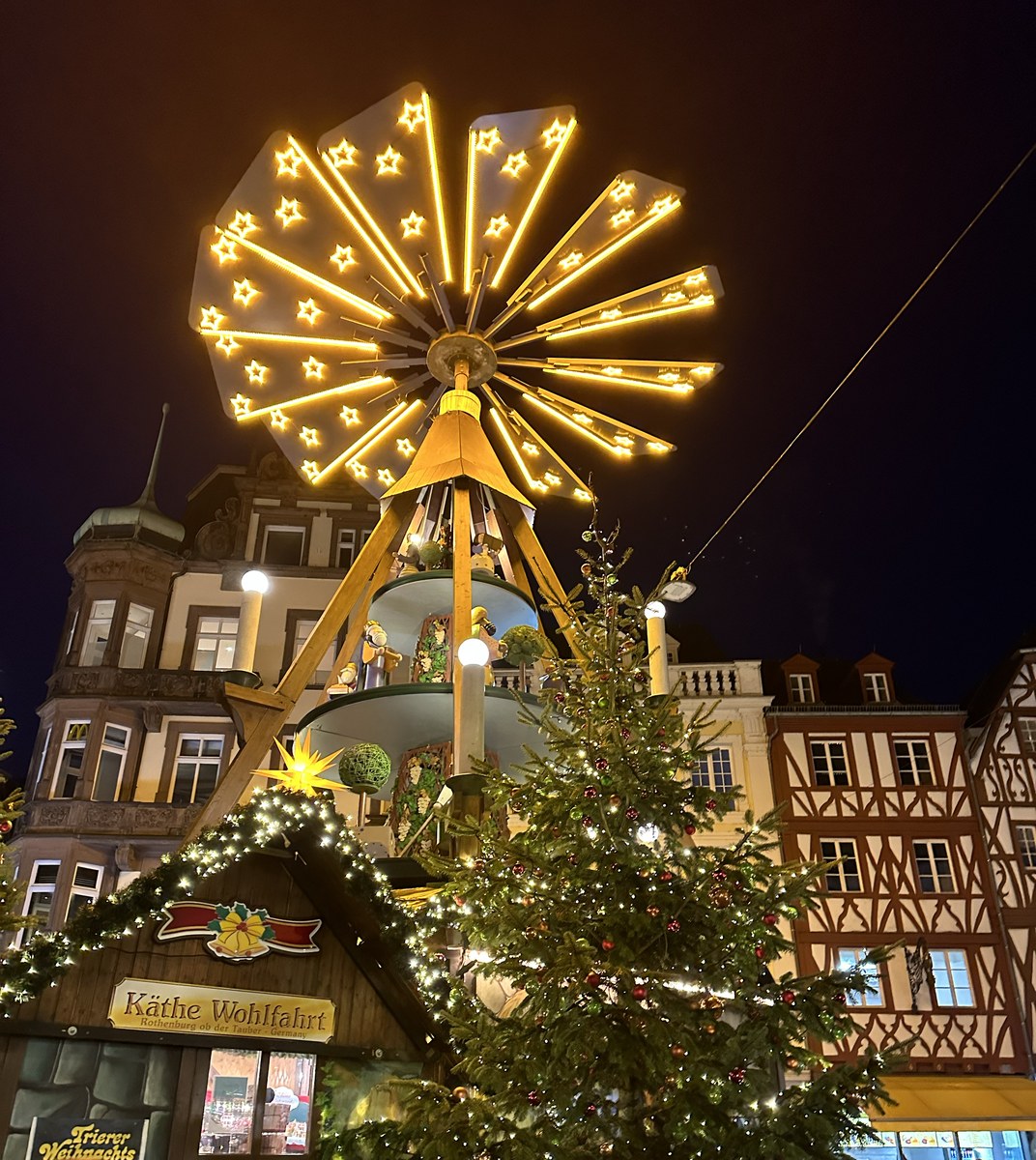
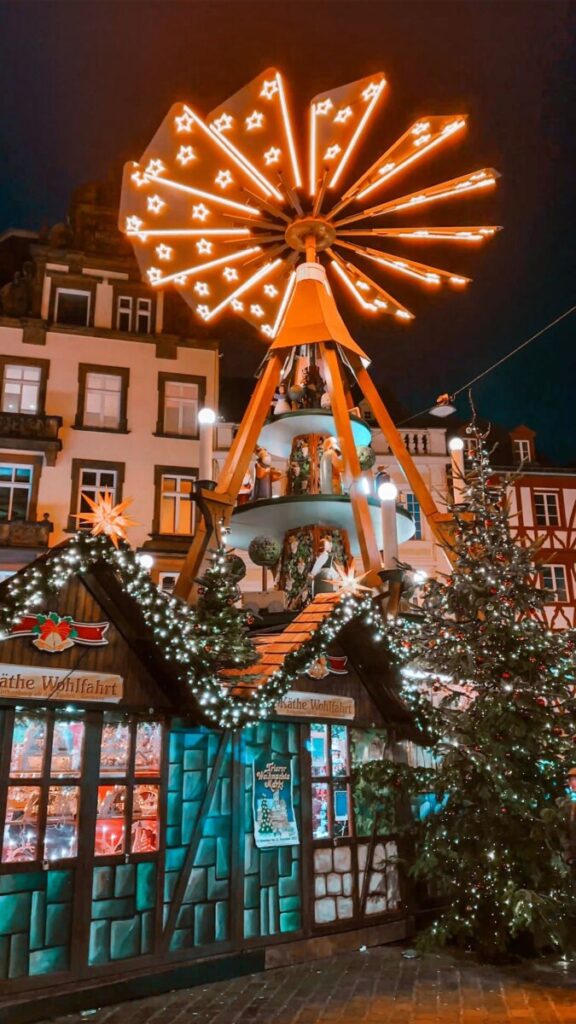
When European Best Destinations named Trier the Best Christmas Market in Germany in 2024, it made a case you can test on Hauptmarkt at twilight. Does the setting explain the award? It does, once you see how the elements hold together. The multi-tiered Christmas pyramid turns its star-cut vanes directly against the half-timbered gables, while a vintage carousel spins nearby. The stalls remain cohesive instead of spilling into plastic carnival sprawl.
The Red House boast introduced at the outset has company here. Read beside the Steipe and the ancient cross, it becomes part of a larger argument about civic continuity, so the square’s beauty comes with an unusually long memory. Because the space is broad and cleanly framed, you can walk from one side to the other at dusk without shuffling in a single-file queue. How liberating that feels in December!
Moselle Wine Culture, Winzerglühwein, and Germany’s Glühwein Queen
Most Christmas markets pour anonymous mulled wine from bulk drums that taste mainly of cinnamon syrup and regret. Trier sits squarely on the Moselle, where steep slate vineyards surround the city, and that working wine culture changes what ends up in your mug.
Local wineries produce their own regional Winzerglühwein, an estate-based specialty made by mulling Moselle vintages. They offer it in red and in a fragrant white Riesling style whose acidity gives it lift. Red or white? If your default is red, you should order the white at least once. Yes, order the white at least once! Its Moselle acidity keeps the spice bright rather than syrupy, which makes it a useful corrective for anyone who expects mulled wine to be sweet and heavy.
You’ll also spot hot Viez, the region’s dry apple-and-pear cider, poured steaming for anyone who wants a sharper local alternative to sweet punch. The serious winemaking outside the city gates now has a practical consequence. Instead of choosing between colors of anonymous punch, you can choose among drinks that express something specific about the region.
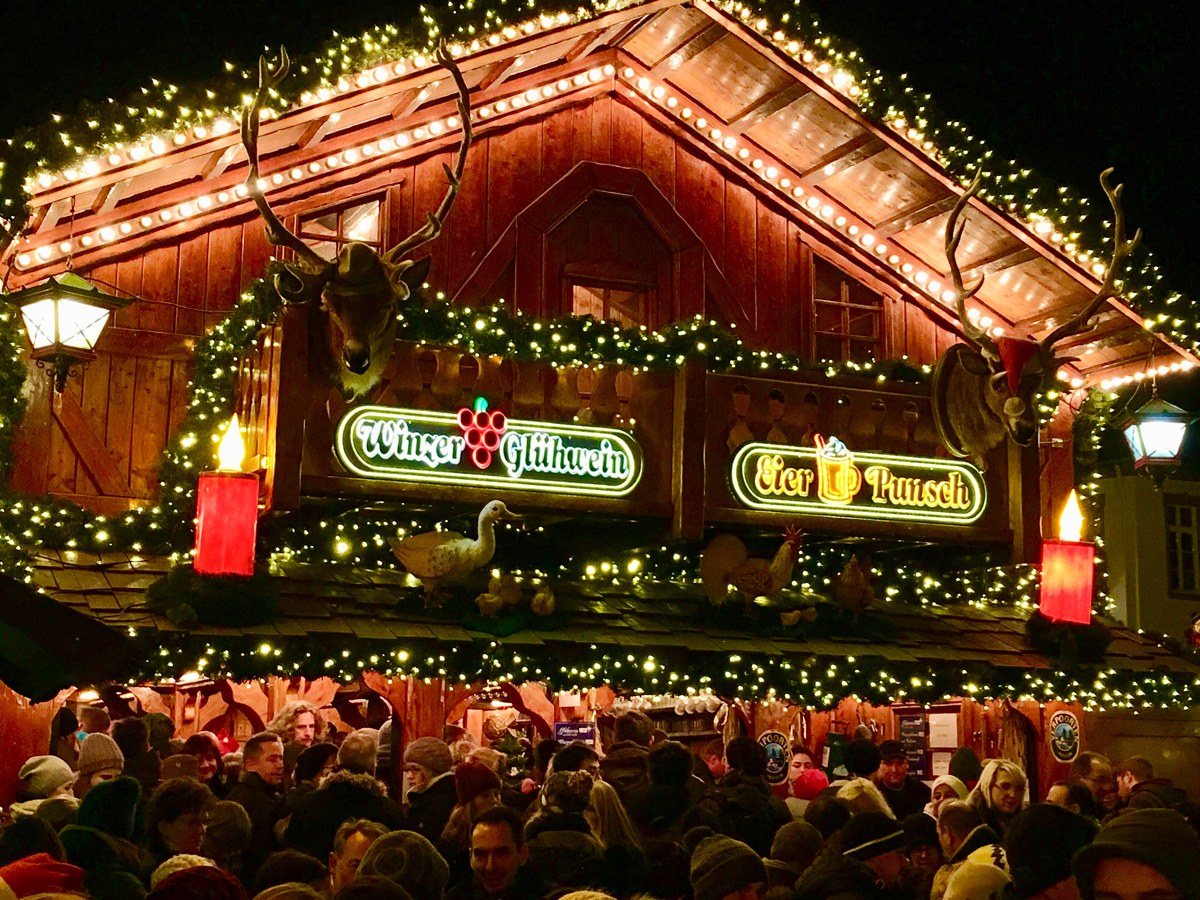
Trier’s commitment to winter wine also has an official expression. The market holds the registered German trademark for the Deutsche Glühweinkönigin, Germany’s sole official Mulled Wine Queen. Louisa Kress continues in the role for the 46th edition in 2026, serving as ambassador for Moselle Winzerglühwein at the opening ceremony and throughout the season.
It could sound like a tourism gimmick until you take a single swallow beside the Cathedral and realize that the wine behind the sash actually justifies the title.
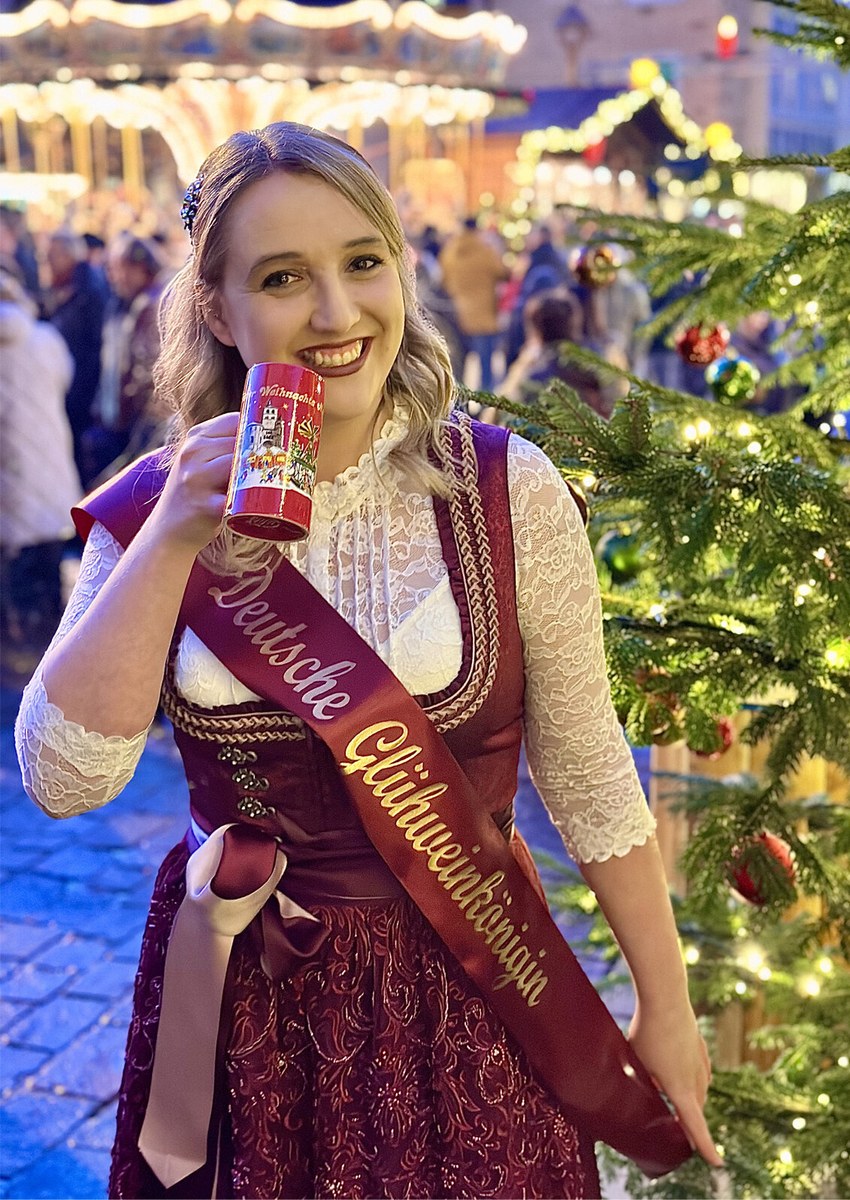
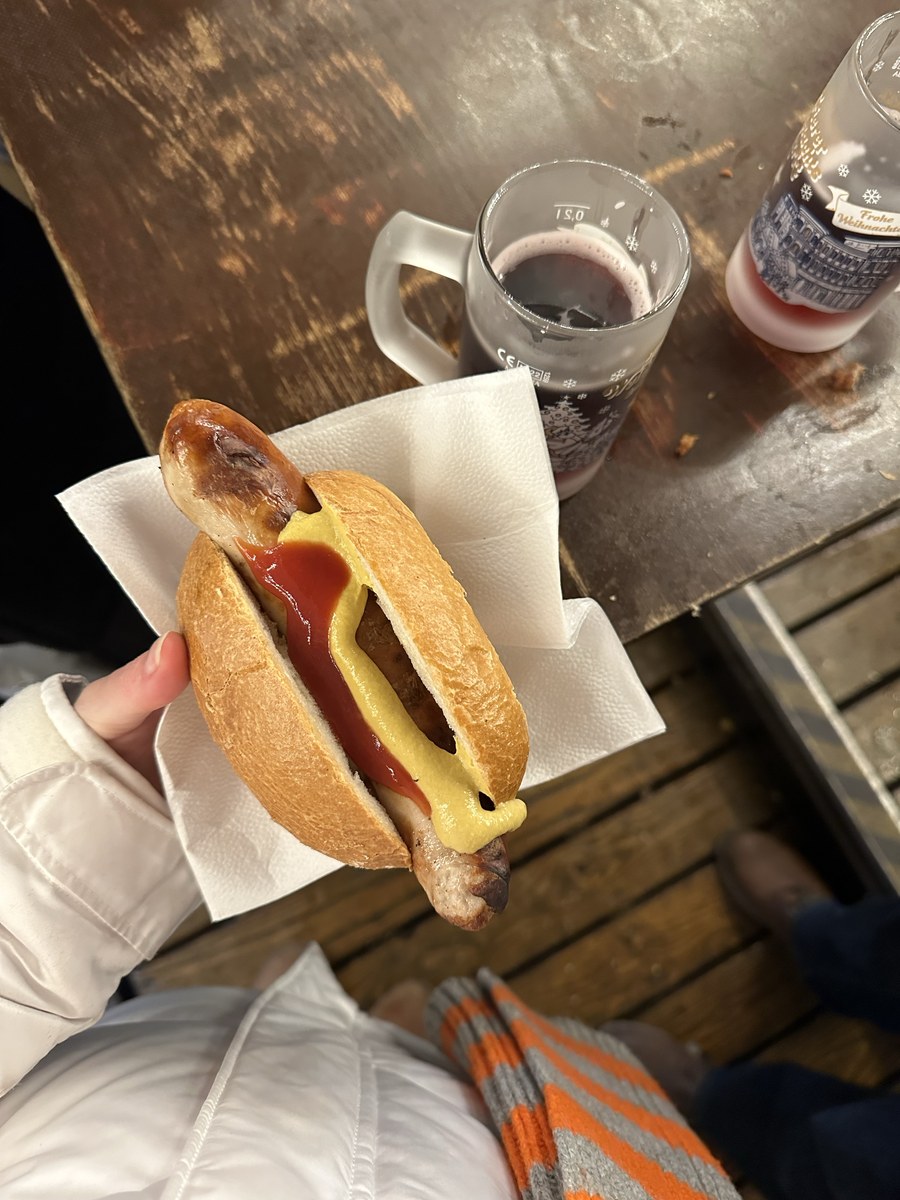
Should you keep your mug? You can, provided you’re willing to forgo the deposit. The vessels are worth considering, too. Depending on the stall and the year, Trier serves its drinks in frosted glass mugs printed with local landmarks or in tall red ceramic collector mugs illustrated with the Cathedral and market scenes.
A cup of Winzerglühwein runs about €4 to €4.50, plus a €3 to €4 deposit, or Pfand. Hand the mug back for your coins, or slip it into your coat pocket as a proper keepsake that costs less than a souvenir-shop purchase farther along the road. That small financial choice lets you decide whether your last drink of the evening should also become your luggage problem.
The Wood-Fired Bread Bakery and What to Eat
Which single stall do I head for whenever I return to Trier? The answer is the wood-fired bread bakery. Höfer Backhäusle trades under its rustic wooden S’ Backhaus sign near the Cathedral, and it deserves more than a passing glance.
A genuine four-tier whitewashed stone oven stoked with split hardwood logs remains rare at European Christmas markets. This one stands right in the open air. Ah, you’ll smell it half a square before you see the woodpile!
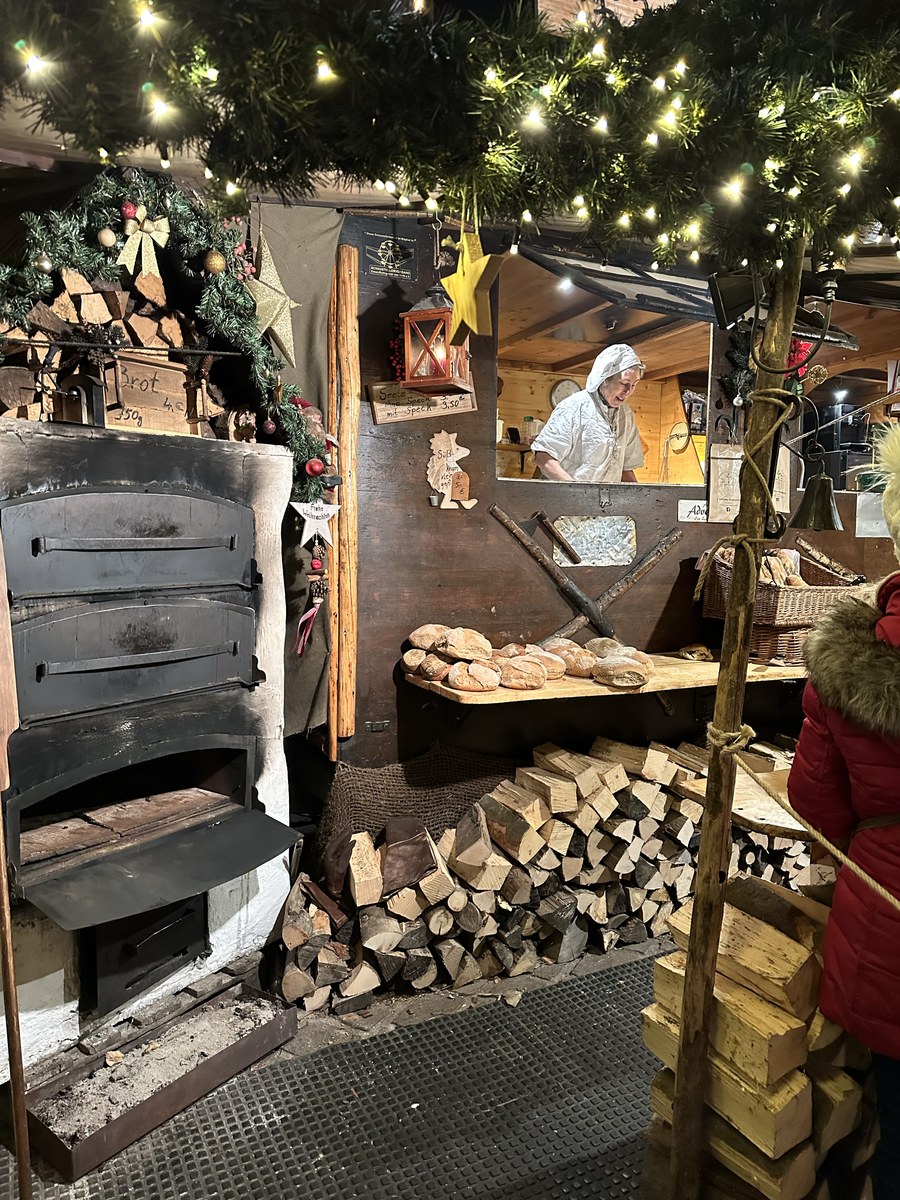
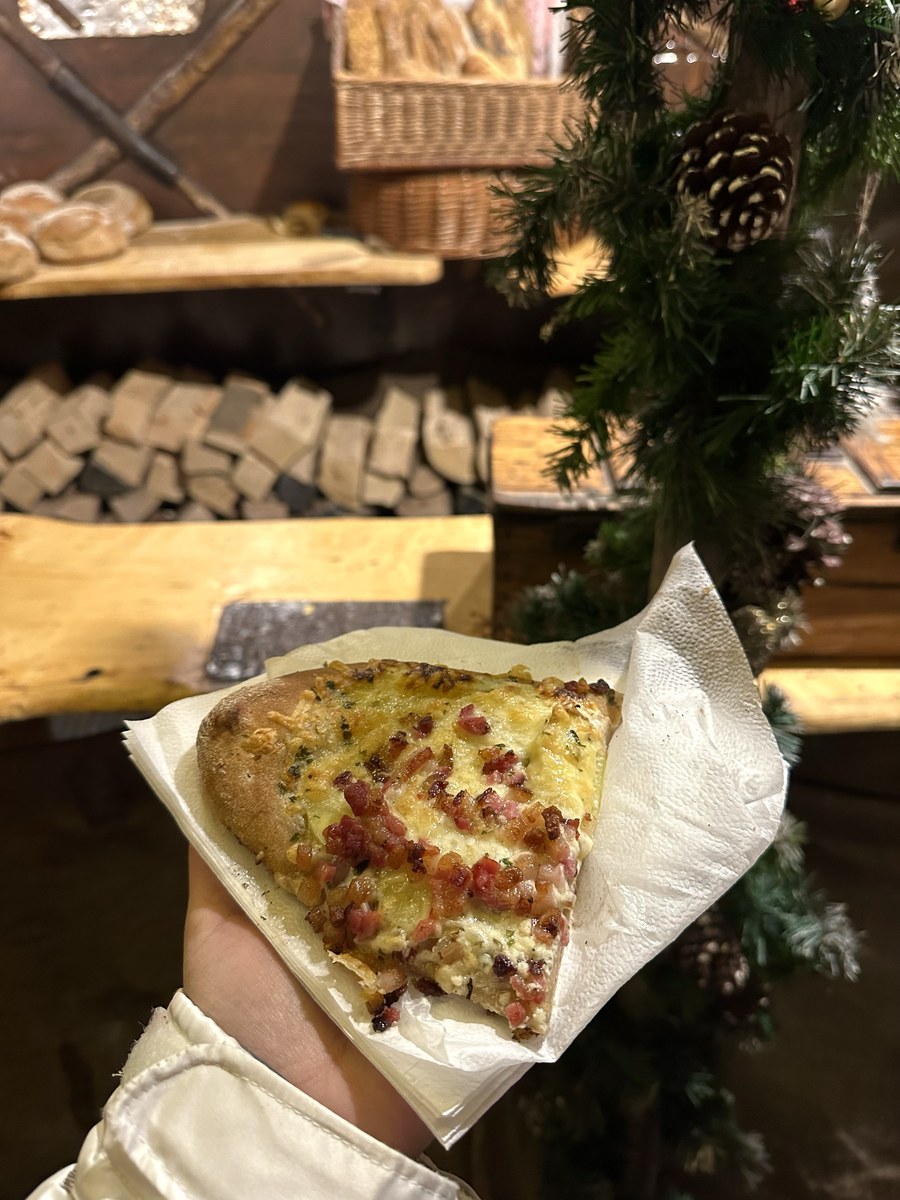
Stop for two minutes so that you can watch the bakers work. When the iron doors drop open, a thick plume of oven steam rolls up into the cold air. The bakers then slide out long boards of crusty country loaves, crisp-outside Seelen, and blistered Dünnele. The last of these is Swabian-style Flammkuchen, baked to order in the wood oven.
On my December 2024 visit, Dünnele cost €7, while the vegan option cost €8. You could choose classic speck with onion, potato with cheese, or roasted vegetables. The dough comes off the hot stone crisp at the edges and smoky underneath. For me, the result is the best savory thing on the entire market.
What should you eat first, and what should wait until later? Save appetite for the rest of the square, because Trier’s food lineup punches well above its size, but give some thought to the order as well as the dishes.
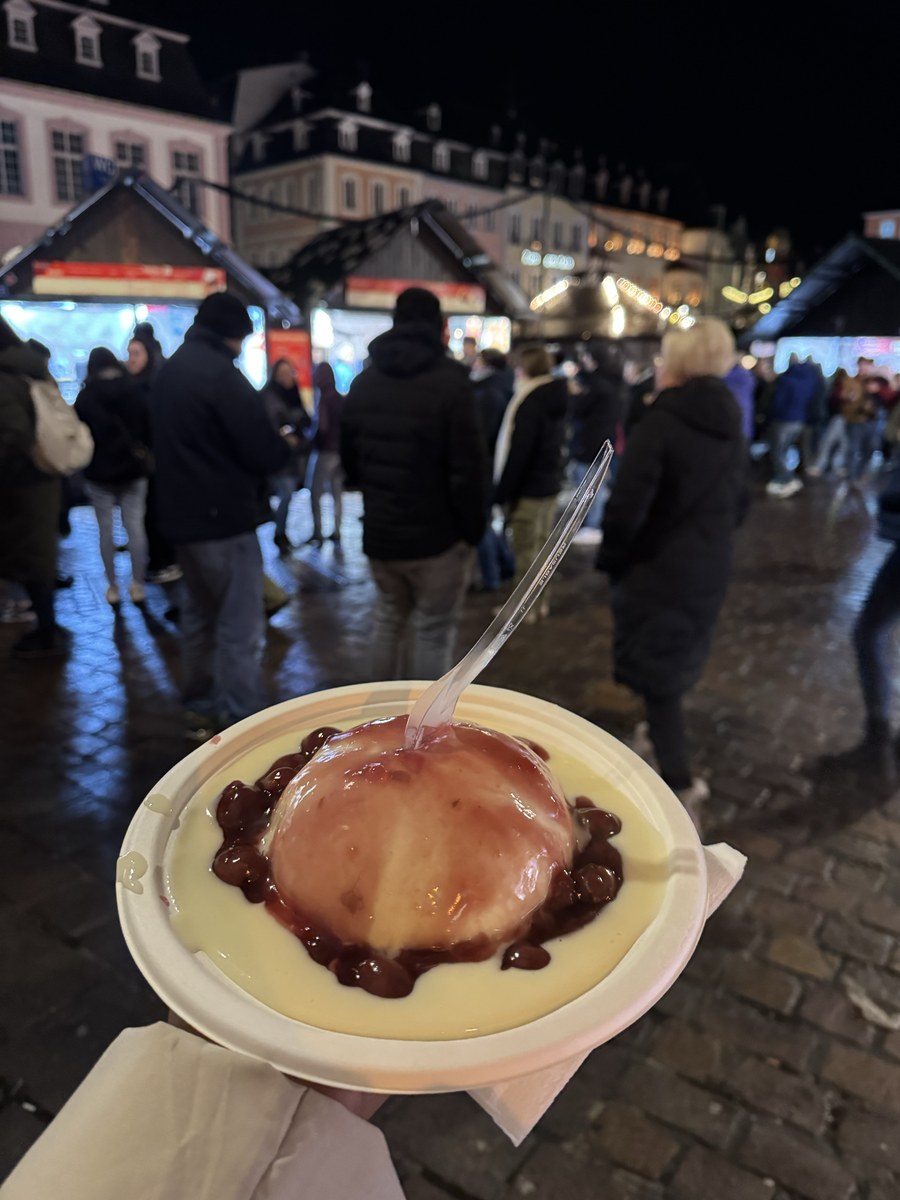
- Dampfnudel with vanilla sauce and warm cherries. This is a pillowy steamed yeast dumpling drowned in hot custard and tart dark cherries. One hard-won tip from my visits is to eat your Dampfnudel before you start on Glühwein. If you reverse them, the spiced wine makes the vanilla sauce taste far too sweet.
- Schupfnudeln with sauerkraut. Rolled potato noodles are browned in wide skillets made of cast iron until their edges turn golden.
- Raclette scraped straight off the wheel. The wheel of mountain cheese is heated, and its bubbling surface is scraped onto crusty bread.
- Bratwurst or spicy Feuerwurst. Either sausage is grilled over charcoal and tucked into a crisp roll, which gives you a simple, fast companion for your first mug at a standing timber table.
- Reibekuchen and Feuerzangenbowle. Crisp grated potato pancakes come with applesauce, while rum-flamed spiced wine offers reinforcement when the Moselle damp settles in after sunset.
The oak smoke from the opening walk now becomes a timing decision, as promised. Order your Dünnele before the evening rush, and you can eat it while the oven, rather than the queue, commands your attention.
Handmade Ceramic Artisans and Crafts Worth Packing Home
A good half of Europe’s December markets now recycle the same factory-made scarves and plastic snow globes. Trier still gives prominent space to working craftspeople, and my other nonnegotiable stop, immediately after the wood-fired bakery, is the handmade ceramic artisans’ stall.
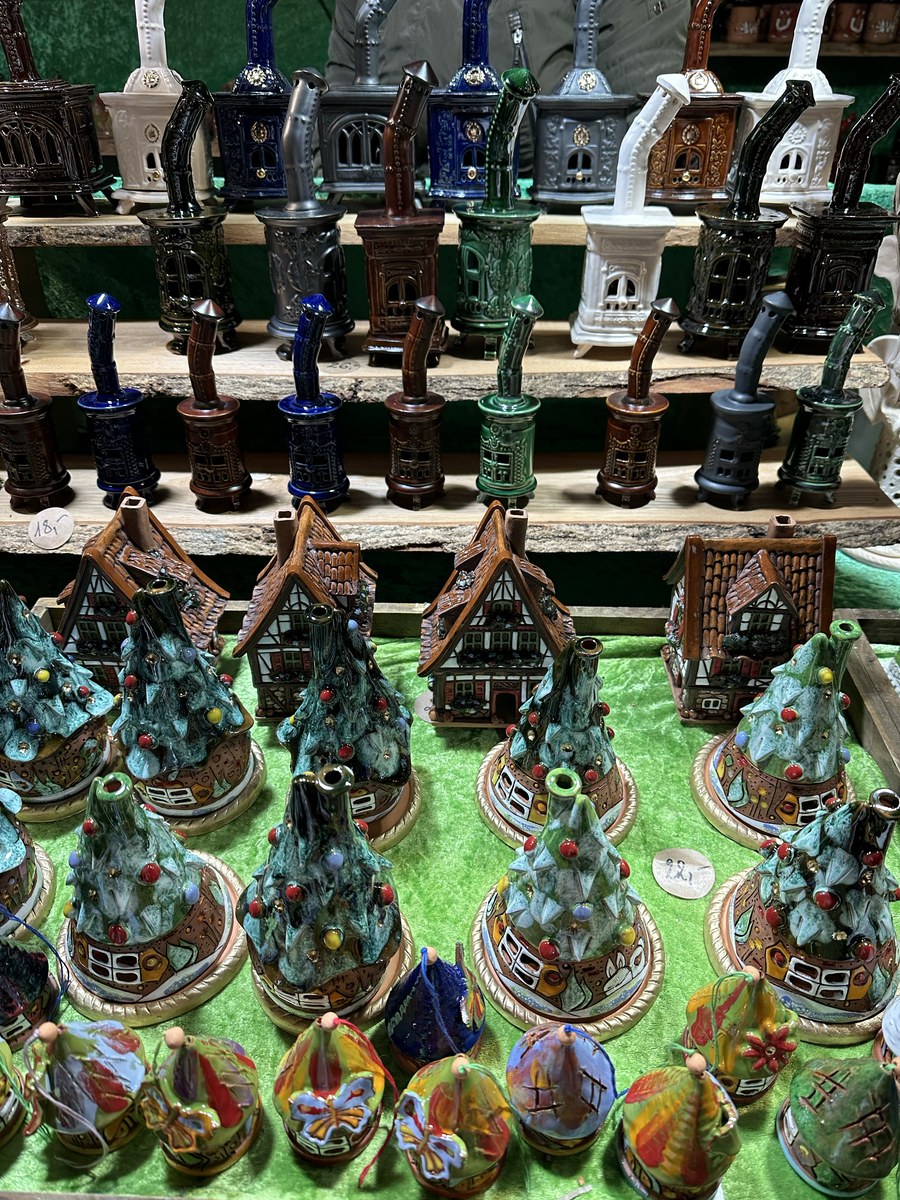
Rather than generic trinkets, the shelves hold ranks of hand-glazed ceramic incense stoves, or Räucheröfen, with curved chimneys. Beside them stand miniature half-timbered houses built to hold a tealight or an incense cone. Painted ceramic Christmas trees, studded with colored glazes, complete the display.
Because the makers mold and glaze each piece individually, every roof and tree differs slightly from the next. Wrap one in newspaper and carry it home beside your red Glühwein mug. Years later, it still looks like Trier rather than an airport gift shop.
If classic wooden German tree ornaments, nutcrackers, or carved pyramids are on your packing list, the Käthe Wohlfahrt chalet sits precisely beneath the Hauptmarkt pyramid. Smaller independent ornament booths stand alongside it, so you can compare their work before you commit your remaining suitcase space.
Germany’s Oldest City Beyond the Stalls
One reason Trier works so well as a winter stop of several hours or a full overnight is that its two thousand years of history are concentrated around the squares where the chalets gather. Do you need a bus or a strict museum timetable? No, you don’t. Everything worth seeing sits within a five-to-twelve-minute walk of Hauptmarkt.
Five minutes north down Simeonstraße stands the Porta Nigra. Built around 180 CE from darkened sandstone blocks laid without mortar, it remains the largest surviving Roman gateway north of the Alps. It lasted through the Middle Ages chiefly because a Greek hermit moved inside and turned it into a church.
Along the way, look up at the Dreikönigenhaus, the House of the Three Magi, dating from 1230. This fortified medieval tower-house originally had its doorway one level above the ground. Residents climbed up by wooden ladder, then pulled it inside behind them at night.
On the other side of Hauptmarkt, six minutes brings you to the expansive brick Konstantinsbasilika, Emperor Constantine’s fourth-century throne hall, and the pink rococo façade of the Electoral Palace, or Kurfürstliches Palais. The Karl-Marx-Haus museum lies seven minutes west, while the ruined vaults of the Roman Kaiserthermen, the Imperial Baths, sit twelve minutes south.
The Cathedral’s fortress-like west front now becomes more than an atmospheric backdrop. It gives your walking route a fixed endpoint, which means you can visit two or three of those stops in crisp afternoon daylight and return to Domfreihof as blue hour begins. That sequence grows a market visit into a complete day without requiring you to pack it with appointments.
Combining Trier with Luxembourg and the Moselle Circuit
Because Trier sits where Germany, Luxembourg, and France converge, it fits naturally into a two-to-four-day winter circuit rather than standing alone.
The easiest pairing is with Luxembourg’s Christmas markets, forty-seven minutes west by car or an effortless cross-border hop by train or bus. Their calendars complement each other. Trier closes on 22 December, whereas Luxembourg City’s six Winterlights squares stay open through 3 January 2027.
Start in Trier before Christmas for Roman stone, estate Winzerglühwein, and the wood-fired bakery, then shift to Luxembourg for valley views over the Pétrusse and its international food counters. The 22 December closing date in the diary above now determines the order. Putting Trier first preserves everything you want there while leaving Luxembourg available for the days after Christmas.
If you have a car and want to stay along the river, three smaller Moselle and Saar markets sit within an hour of Trier.
- Saarburg, 29 minutes south. An intimate Christkindlmarkt gathers around the illuminated Leukbach waterfall on the second and third Advent weekends, 4 to 6 and 11 to 13 December 2026. A Victorian Dickens-themed market joins it in the KulturGießerei on 12 to 13 December.
- Bernkastel-Kues, 43 minutes northeast. Its half-timbered medieval market square runs from 20 November through 20 December 2026, with a closure on 22 November. The historic Adler Pharmacy façade becomes the region’s largest Advent calendar.
- Traben-Trarbach, 56 minutes northeast. The Mosel-Wein-Nachts-Markt runs from 20 November 2026 through 2 January 2027, mainly from Friday to Sunday, plus select holiday dates. Adult cellar entry costs €5. The market takes place underground inside heated historic wine vaults. What if December rain rolls down the valley? This is the smartest fallback in the region, because you can move your evening below ground without abandoning the wine theme.
If you’re building a longer European Christmas drive, you can also push south into France. Colmar’s six old-town markets and the villages in my Alsace Christmas markets guide give you a natural continuation. Alternatively, you can cross south toward the Alps for Lake Constance’s three-country Christmas circuit.
Where to Stay If You Break the Journey Here
Should you stay overnight? Well, that depends on your route. A winter visit to Trier can fit comfortably into a single day, so an overnight is a routing choice rather than a requirement. Most travelers can walk the Roman landmarks in afternoon daylight, spend blue hour and evening across Domfreihof and Hauptmarkt, and move on comfortably.
An overnight makes sense when Trier sits on a longer German or tri-border route. If you do stay, two sharply different properties stand out.
- Romantik Hotel Zur Glocke, a short walk from the market. Central Trier has no international five-star hotel. That absence leaves this historic townhouse, dating from 1567 and standing in the pedestrian old town, as the standout old-world address. Hauptmarkt is two minutes away on foot. Rooms are individually styled, with some looking toward the Cathedral, and the vaulted cellar tavern downstairs serves regional dishes and pours Moselle wines.
- Schloss Lieser, Autograph Collection, 40 minutes along the Moselle. If you want genuine five-star luxury outside the city, drive forty minutes northeast down the river to Lieser, right beside Bernkastel-Kues. The castle was built between 1884 and 1887 in neo-Renaissance style beneath steep Riesling slopes. Today, the restored Schloss pairs stately river-view suites with an indoor pool and wellness spa. It also offers fine dining at Puricelli Restaurant and full December menus for the holidays. For a slow winter weekend on the Moselle, it can make a far better base than a standard city hotel.
Getting to Trier and Parking
Trier can work either as a quick hop from Luxembourg or as a western stopover on a wider German Christmas market itinerary.
By car from Germany and France. From Koblenz, where the Moselle meets the Rhine, the drive requires about an hour and a half. Mainz sits about two hours east, while Cologne and Heidelberg are both about two hours and fifteen minutes away. Plan on about two and a half hours from Frankfurt Airport or central Frankfurt, two hours and forty minutes coming north from Strasbourg, and an hour and twenty minutes from Metz.
From Luxembourg and nearby airports. Luxembourg Airport (LUX) is the closest international gateway, about forty minutes from central Trier. Luxembourg City lies roughly forty-seven minutes west. The Luxembourg Moselle towns of Grevenmacher and Remich are twenty-five to forty-three minutes away across the river.
By train. Every service comes into Trier Hauptbahnhof. From there, Hauptmarkt is a flat fourteen-minute walk.
- From Koblenz. Direct regional trains RE1 and RE11 follow the Moselle valley hourly, taking about an hour and a half.
- From Frankfurt. Expect around two hours and forty-five minutes to three hours and fifteen minutes with one transfer, most often at Koblenz or Mainz.
- From Cologne. Direct regional trains RE22 and RB22 run through the volcanic Eifel along the restored Eifelbahn, taking about three hours and ten minutes.
- From Luxembourg. Direct RE11 trains take about fifty minutes. Second-class public transport is free across Luxembourg up to the border at Wasserbillig. You pay for the short German segment, about €3.40 to €5.90 one way, unless a Deutschlandticket covers it. Cross-border RGTR buses such as line 303 use RegioZone fares, €3 for two hours or €5 for a day.
Where should you park? When I drove into central Trier, I parked at Tiefgarage Konstantin, Konstantinstraße 7. It is a 24-hour municipal underground garage within a short walk of the market. Clearance is 1.90 meters. Rates run €1.20 per 30 minutes up to €18 from Monday to Saturday, while Sunday charges are capped at a flat €3.60. If it fills on a peak Saturday afternoon, Parkhaus Hauptmarkt and Tiefgarage Basilika sit on the same central parking guidance loop, so you won’t need to improvise your way through the old town.
Pack waterproof boots for damp cobbles and one extra warm layer for standing in the open paved squares after dark. Arrive before sunset. Begin beneath the fortress-like façade of the Cathedral, then order a hot wood-fired Dünnele before the evening rush.
When you return to the Cathedral side, the stone enclosure that framed your first steps also gives your last hour an easy shape. You can stay within the two squares, finish a glass of white Moselle Winzerglühwein, and let the towers supply the finale. What a calm way to end a December day!
Shared on

The post and its conversation
The photographs as they appeared on Instagram, with what readers said there. Likes and replies open on Instagram.



 Join the conversation on Instagram